A Psychogeographical Christmas. Photo & text: David Secombe.
Posted: December 20, 2012 Filed under: Architectural, Crime and Punishment, Food, Health and welfare, Hospitals, Housing, Literary London, London Labour, Monumental | Tags: Billy Butlins, BT Tower, charles dickens, Christmas Day in the Workhouse, Cleveland Street Workhouse, Cold War, Noel Edmonds, Post Office Tower, White Heat of Technology Comments Off on A Psychogeographical Christmas. Photo & text: David Secombe. The Cleveland Street Workhouse and the BT Tower. Photo © David Secombe 2011.
The Cleveland Street Workhouse was built in 1775 as a workhouse infirmary and ended up as part of the Middlesex Hospital until that institution closed in 2005. According to The Cleveland Street Workhouse it ‘has survived largely unchanged since the Georgian era. Its austere appearance is a rare testimony to the bleak and utilitarian institution it was designed to be. Its back yard was a graveyard for the poor, full of dead to a depth of at least 20 feet. Recent research has revealed that the building was the likely inspiration for Charles Dickens’ Oliver Twist, since the famous author lived a few doors away, on the same side of the road, for nearly five years of his young life, before he became famous as ‘Boz’’.
As it is Dickens’s bicentennial year, I offer here a glimpse of the grim edifice that loomed over the infant Dickens’s early years in the city. He was only two years old when his parents, fresh from Portsmouth, found lodgings in Norfolk Street – now Cleveland Street – in 1814. At that time the area still had a semi-rural character, with fields and farms lying just east of Tottenham Court Road – although the grand houses of Fitzroy Square were under construction and the churning awfulness of Oxford Street was only a few yards away. Dickens’s friend John Forster said that the novelist was able to recall vivid details of his early childhood, so it is an attractive proposition to believe that the workhouse in the picture above marked itself indelibly upon young Charles’s imagination during the three years (not five) in which he and his family lodged in the district. By 1817, Charles’s father had got a job in Chatham, and it was another five years before Dickens returned to the city, leaving his idyllic years in the Kent countryside for a more permanent engagement with ‘the great wilderness of London’.
The traditional Christmas is in many ways Dickens’s own creation, marked in particular by his characteristic juxtaposition of seasonal conviviality against the bleakness outside: ‘exaggerating the darkness beyond the small circle of light’ as Peter Ackroyd puts it. Dickens described composing A Christmas Carol whilst walking ‘the black streets of London, fifteen and twenty miles, many a night when all the sober folks had gone to bed’ and, for all its fairy-tale sentiment, it succeeded in rousing the conscience of his contemporary audience. The following year he produced The Chimes, another seasonal polemic. According to Ackroyd, The Chimes was partially inspired by a complacent review of A Christmas Carol and also by a story in The Times concerning a young woman, terrified of the workhouse, who had thrown herself and her baby into the Thames – the baby drowned, but the mother was rescued and condemned to death for murder of her child. The Cleveland Street Workhouse was Grade II listed in 2011 and, given Dickens’s agitating for reform of the Poor Law and his disdain for old buildings in general, he would probably have been appalled that this symbol of misery had been preserved for the nation – but there’s no question that the building retains its cruel power, an emblem of the darkness and suffering against which Dickens created some of his most brilliant effects..
Further north on Cleveland Street is the BT Tower, built as The Post Office Tower in 1961, the tallest building in London for nearly 300 years (it was taller than St Paul’s), its construction flattening a block of Workhouse-era buildings on the corner of Howland Street, including the one where Paul Verlaine and Arthur Rimbaud had lived during their stay in the city. The cylindrical form of the Tower was intended to lend stability in high winds – especially, it was darkly muttered, those from a nuclear blast. The Tower is also Grade II listed, and it too is an emblem of its time, redolent of the Cold War and the avowed technological modernity of the MacMillian/Wilson ‘White Heat of Technology’ era. When it opened in 1965, it boasted a revolving restaurant at its top, a concession operated by Billy Butlin; but if a nuclear exchange had taken place, the Tower would have been essential in maintaining contact between whatever was left of Britain and whatever was left of everywhere else. Today, advances in communication technology and the end of the Cold War have left the Tower almost as obsolete as its neighbour the Workhouse. The revolving restaurant was closed after an IRA bomb incident in 1971, and plans to re-open the venue for the 2012 Olympics were quietly shelved – which is a pity, as it would have made a suitably elevated position for the ego of some superchef or other. But, as this is a Christmas post, it is pleasing to report that on Christmas Day 1984, Noel Edmonds’s Live Live Christmas Breakfast Show was broadcast from the top of the Tower, an event described by its coiffed and beaming host as ‘one of the greatest communications projects ever put forward’. Noel went on to present several such Christmas Day TV events from the Tower throughout the 1980s, thus associating an icon of post-war modernity with the traditional late-20th Century Christmas: bored, over-fed and in front of the telly.
(NB: My friend and colleague Chris Brand has just pointed out that I have overlooked the Post Office Tower’s finest moment, in The Goodies’s Kitten Kong episode. Was this a Christmas special? Who cares.)
And on that tenuous and tortuously established link, we would like to wish all our readers a very Happy Christmas.
… for The London Column.
See also: The London Nobody Knows – revisited, Christmas on Greek Street
Drop-in centre. Photos & text Manuel Capurso (5/5)
Posted: February 17, 2012 Filed under: Health and welfare, London Types | Tags: Camden drop-in centre, Manuel Capurso Comments Off on Drop-in centre. Photos & text Manuel Capurso (5/5)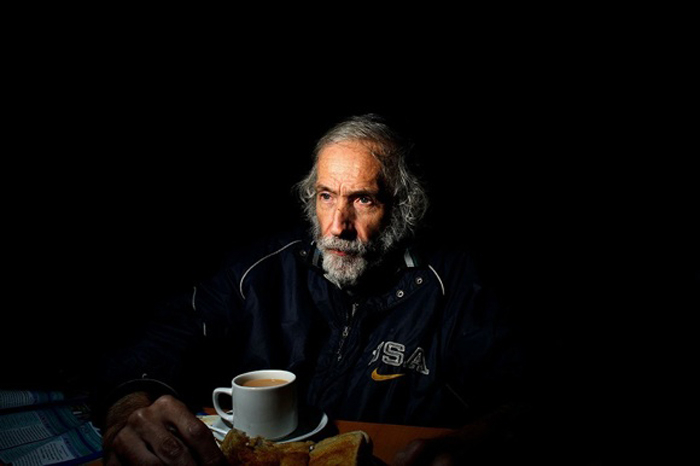
© Manuel Capurso.
Manuel Capurso writes:
In a metropolis like London, people tend to exist in their own world: their existence as social creatures rapidly diminishes. The result is a sort of public culture that promotes detachment over engagement and where the basis of social solidarity loses significance.
In this contest the drop in centre in Church Street represents a sort of unique experience, where old people can create and maintain “personal communities”. For most of the users the centre is their main form of social contact. Some of them are poor, in poor health or without family support. By contrast, others have friends outside the centre, from whom they bring stories for those who are more isolated, and they represent a sort of virtual bridge to the outside world.
I spent one week there, the first couple of days trying to engage with them, introducing myself, talking to them, as I was aware that I was breaking their routine. Only after few days, when the novelty effect was over, I started taking pictures, getting varied reaction but being generally accepted as a silent presence. I tried to represent their dignity in the face of the social marginalisation they suffer in the outside world.
… for The London Column. © Manuel Capurso.
Drop-in centre. Photos Manuel Capurso, text Roisin Tierney (4/5)
Posted: February 16, 2012 Filed under: Health and welfare, London Types Comments Off on Drop-in centre. Photos Manuel Capurso, text Roisin Tierney (4/5)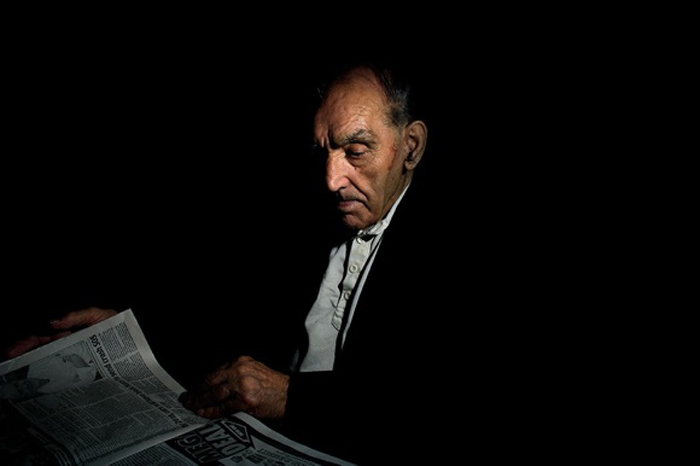
© Manuel Capurso.
Diogenes Syndrome by Roisin Tierney
Old man, we can barely enter for the stench,
the ever-ripening fetor that swarms your flat,
that creeps beneath the door. Your carpet dappled
with piles of your own manure. Your bath piled high
with ‘stuff’. The toilet blocked, a floating Vesuvius at its brim.
It’s been some time. We interview you elsewhere.
The doctor notes your gentleness and filth,
Your gummy smile, lank hair and jovial good humour.
You swear you eat, mention cans of beer.
(You even lie, and say you exercise,
which makes us laugh, oh how we laugh at that!)
You only cry once, when you mention ‘rent’.
You fear perhaps the landlord wants you out.
You don’t know why.
My dear, its not too late, we’ll scrub you up,
allocate you your own social worker.
It’ll not happen again, not to you,
And we’re sorry that it even happened once.
Not that you even know what we’re on about –
nor we enough to force aside
that thing, that whatever-it-is, that blocks your light.
© Roisin Tierney.
All the poems in this series are from Dream Endings, by Roísin Tierney, Rack Press 2011, and used by permission.
N.B.: Editor’s note: the subject of Roisin’s poem is not the gentleman in Manuel’s photo.
Drop-in centre. Photos Manuel Capurso, text Roisin Tierney (3/5)
Posted: February 15, 2012 Filed under: Health and welfare, London Types Comments Off on Drop-in centre. Photos Manuel Capurso, text Roisin Tierney (3/5)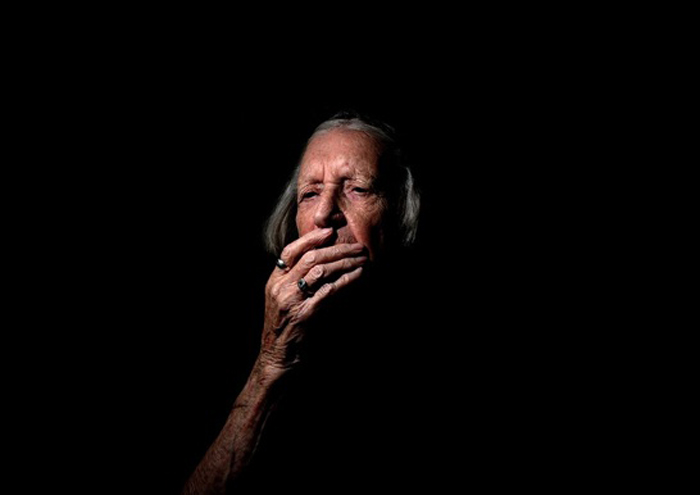
© Manuel Capurso.
Vera by Roisin Tierney
Vera, eighty-something, sprightly yet,
lives with her daughter in her council flat.
She keeps it spick and span – immaculate.
Her short term memory’s gone, or going fast,
her grandchildren a blur. She loves them all,
but cannot place a face. Her keys are not
where she last laid them, the front door
flies open in the middle of the night.
She knows her husband’s dead these twenty years,
that they were happy, but can’t say what he did,
still manages to shop and use the stairs,
takes all her meds and likes to watch TV,
has only one perceptual delusion;
each night she sees a soldier in her room,
standing in the corner, leaning on
his rifle, looking towards her.
She thinks he’s real. This does not disturb her.
© Roisin Tierney
All the poems in this series are from Dream Endings, by Roísin Tierney, Rack Press 2011, and used by permission.
N.B.: Editor’s note – the lady in Manuel’s photo is emphatically not the Vera of Roisin’s poem.


 The London Column