London Perceived. Text V.S. Pritchett, photos Evelyn Hofer (4/5).
Posted: July 28, 2011 Filed under: London Labour, London Types | Tags: Evelyn Hofer, London Perceived, V.S. Pritchett Comments Off on London Perceived. Text V.S. Pritchett, photos Evelyn Hofer (4/5).
Warehousemen, Southwark, 1962. Photo © Estate of Evelyn Hofer.
V.S. Pritchett writing in London Perceived *, 1962:
One goes up-river now enclosed in noise and caught up in work. This is a working river. Hour after hour the radio-telephone is cackling on the tugs. “Calling Sun 17, take the Florian and go in with her. Calling Sun 16, has that little Spaniard moved yet? What’s the matter with her?” Language, old river hands complain, has become politer on the river. Education, they say, is the curse of everything, and the bad-language joke, refined to a high polish of London irony by the characters of W.W. Jacobs (“The langwidge ‘e see fit to use was a’most as much as I could answer”), has lost its anchorage. The Florian is one of the ships lying under the tall sky in the sweep of Gravesend water. It bears down like an hotel upon the tug, and the tug’s cabin boy brings up the eternal mug of strong tea on which working London lives. If you were to go with him to the dock gate, you would see the beauty of the skipper’s job. You would understand why there is all that clever waltzing and pulling this way and that, all that threshing at the stern of the tug as it gently but decisively takes 15,000 tons round a series of sharp right-angle turns into the lock and the alleyways of a dock basin, without touching a quay or any other craft by so much as a graze. These skippers are artists: they bolt down a mutton chop between crise, ruin their digestions, grouse because fog in the estuary has kept them on duty for forty-eith hours without a wink of sleep; but they play their game with the wind, the strong Thames tide, the current and the heavy traffic.
The Thames is a main road. It is our Grand Canal, and if you half close your eyes at the Pool, the brown warehouses look like palaces in a smoky Venice. The river men have always quarrelled with the City, and nowadays the quarrel is with the roads, for road transport is killing the coastwise traffic. Some say that in fifty years half the area will revert to what it once was: a pleasure ground, and, heaven knows, the warehousemen and wharfingers of London have up to now killed the waterside as a place of pleasure and amusement. Tug skippers growl when they pass the wharves of the Ford plant at Dagenham, where the iron ore is being grabbed out of lighters, swung high, and sent by conveyors to the furnaces, where it turns into red liquid and where the liquid turns into cars and trucks. “It comes in by water and goes out on wheels”, they say. They hate wheels, for wheels are the enemy of water. But, in London, in England generally, nothing is ever given up if it has a point of law attached to it. The docks were built because the mass of shipping in the Pool became impenetrable; but the lightermen and wharfingers fought for their rights, as hard as Defoe fought for the Dissenters, as the City fought against the King, as Wilkes fought for the press, as the early trade unionists fought. The lighters can be loaded on the water side of the ship, free of dock duties. There is usually money at the bottom of London liberties: there has been nothing abstract in the London view of the desirable life.
* © 1962 and renewed 1990 by V.S. Pritchett. Used by permission of David R. Godine, Publisher, Inc.
[Special thanks in assembling this week’s feature are due to: Jim McKinniss at The Photo Exchange; Mark Giorgione of the Rose Gallery in Santa Monica, California; Andreas Pauly at the Hofer Estate; and Carl Scarbrough at David Godine. D.S.]
London Perceived. Text V.S. Pritchett, photos Evelyn Hofer (3/5)
Posted: July 27, 2011 Filed under: London Labour, The Thames | Tags: Evelyn Hofer, London Perceived, Pool of London, V.S. Pritchett Comments Off on London Perceived. Text V.S. Pritchett, photos Evelyn Hofer (3/5)
The Thames: Upper Pool, 1962. Photo © Estate of Evelyn Hofer.
V.S. Pritchett writing in London Perceived*, 1962:
Twenty-three miles of industrial racket, twenty-three miles of cement works, paper-mills, power stations, dock basins, cranes and conveyors shattering to the ear. From now on, no silence. In the bar at thre Royal Clarence at Gravesend, once a house built for a duke’s mistress, it is all talk of up-anchoring, and everyone has an eye on the ships going down as the ebb begins, at the rate of two a minute. The tugs blaspheme. One lives in an orchestra of chuggings, whinings, the clanking and croaking of anchors, the spinning of winches, the fizz of steam, and all kinds of shovellings, rattlings, and whistlings, broken once in a while by a loud human voice shouting an unprintable word. Opposite are the liners like hotels, waiting to go to Africa, India, the Far East; down come all the traders of Europe and all the flags from Finland to Japan. You take in lungfuls of coal smoke and diesel fume; the docks and wharves send out stenches in clouds across the water: gusts of raw timber, coal gas, camphor, and the gluey, sickly reek of bulk sugar. The Thames smells of goods: of hides, the muttonish reek of wool, the heady odours of hops, the sharp smell of packing cases, of fish, frozen meat, bananas from Tenerife, bacon from Scandanavia,
Before us are ugly places with ancient names where the streets are packed with clownish Cockneys and West Indian immigrants, the traffic heavy. Some of them on the north side between Tilbury and Bethnal Green are slums, dismal, derelict, bombed; some of them so transformed since 1940 by fine building that places with bad names – Ratcliff Highway and Limehouse Causeway and Wapping – are now respectable and even elegant. The old East End has a good deal been replaced by a welfare city since 1946. We pass Poplar, Stepney, Shadwell, Deptford, Woolwich, the Isle of Dogs – where Charles II kept his spaniels – and now mostly dock, with the ships’ bows sticking over the black dock walls and over the streets. We pass Cuckold’s Point, where one of the kings of England gratified a loyal innkeeper by seducing his wife. Until the sixteenth century – according to the delightful Stow, who said he “knew not the fancy for it” – a pair of horns stood on a pole there, a coarse Thames-side warning, perhaps, of the hazards that lie between wind and water.
The Thames, we realize, was for centuries London’s only East to West road or, at any rate, the safest, quickest, and most convenient way that joined the two cities, one swelling out from the Tower and the other from Westminster. And there is another important matter. It is hard now to believe as we go past these miles of wharves and the low-built areas of dockland where one place now runs into another in a string of bus routes, but this mess was once royal. The superb Naval College at Greenwich is the only reminder. It is built on the site of the Palace of Placentia, where Henry VIII, the great Elizabeth and Mary were born. Here was the scene of the luxurious Tudor pageants, the banquetings that went on for weeks, the great wrestling bouts, the tournaments, the displays of archery. It is from “the manor of East Greenwich” and not from Westminster that the charters to Virginia and New Jersey were given in the seventeenth century. It is odd that London began as a collection of manors and that the word “manor” is still thieves’ slang for “London”. At Deptford, nearby, was the Royal Naval Dockyard where all the Tudor ships were built – Drake’s Golden Hind was laid down here. One can see the reason. It is not simply that the Tudors liked building palaces, just as the aristocracy liked building mansions that vied with those of the kings. It is not simply that English monarchs have been a restless lot, although that is true too. The plain reality is that a monarch who has been churched at Westminster needs money; he has to get it from the City; the City gets it from ships and trade, and that trade and its ports must be defended by navies. Deptford and Greenwich were close to London’s fortune, where the goods came in, whence the adventurers sailed, and where the attackers attacked.
* © 1962 and renewed 1990 by V.S. Pritchett. Used by permission of David R. Godine, Publisher, Inc.
[Special thanks in assembling this week’s feature are due to: Jim McKinniss; Mark Giorgione of the Rose Gallery in Santa Monica, California; Andreas Pauly at the Hofer Estate; and Carl Scarbrough at David Godine. D.S.]
Point of Interest. Photos Peter Marlow (1/3)
Posted: June 1, 2011 Filed under: Interiors, London Labour Comments Off on Point of Interest. Photos Peter Marlow (1/3)
Empty Office, Clerkenwell, 2002. Photo © Peter Marlow (from Point of Interest, courtesy of the photographer and The Wapping Project Bankside*).
Katy Evans-Bush writes:
The Future Tense
The office as its redundant workers move out is spotted with relics of human degradation: that is, of the letdown from future perfect to mere life.
The screw stuck in the wall, reminder of that award for the old campaign that no one still here now remembers – although it was great work and targets were exceeded – surrounded by nails that hold their heads proud, knowing they held up the proofs of its successes.
Comfortable tea stains, paper clips wedged where the desk didn’t quite meet the wall, a blotched photo of Sarah who worked here half a decade ago, with a small child; she’d be wanting that back, if anyone knew where to find her now. Bits of phone chargers. A chocolate egg in foil. A bit of silk ribbon, some one-legged scissors, a dusty old bottle of Bristol Cream: why is it blue? Are they really that colour? A sad pile of paperbacks no one will ever read: Windows for Dummies and guides to blogging for businesses. Blu-Tack smears where no one thought they’d matter. Sticker-marks on the phones, where someone put the new supplier’s number. Dirt on the sills from the plants the receptionist had to water, because optimism always wins out. Optimism and sheer daily labour.
The pure pristine will deepen even out the window, with a screaming green that seems to creep from the trees and into the souls of the workers. Like algae. The natural world takes over, and things get done because they can’t be prevented, like dental decay or ambition.
Things can’t stay clean forever. People are people and every negotiation will be tarnished. Its spreading spots will eat at your blind belief in silver and grey and the functional streamline that bypasses doubt and loops back to the bank, via mobile phones, and suits with reinforced shoulders, and platinum cardholders.
Forget your cheap tiles screaming masculine thrust from the Carpetland down on the roundabout. This office was made for pink fluffy sweaters, cake crumbs, to-do lists, pictures of cats, the darkening water in a vase, nail files and overstuffed folders.
… for The London Column. © Katy Evans-Bush 2011.
* Point of Interest is showing at The Wapping Project Bankside, London SE1, until 2 July 2011.
Old and New Soho. Photo & text by Mark Granier (4/5)
Posted: May 26, 2011 Filed under: Amusements, Bohemian London, Interiors, Lettering, London Labour Comments Off on Old and New Soho. Photo & text by Mark Granier (4/5)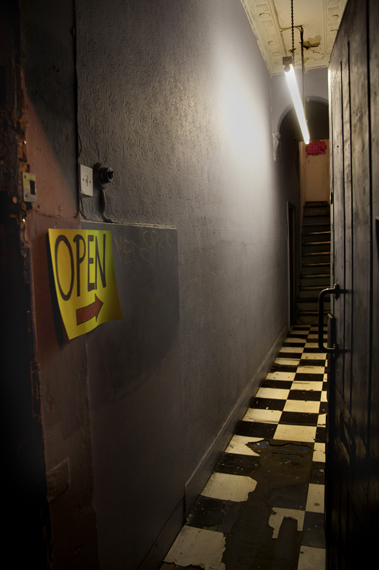
Soho, 2010. Photo © Mark Granier.
Mark Granier writes:
My cousin was working in London for a few months, so when I came over from Dublin we met up a couple of times. One evening we went to the ‘Exposed’ exhibition of photography at Tate Modern, concerned with ‘Voyeurism, Surveillance and the Camera.’ They had stretched the theme a little, so that it practically became a history of the art, taking in all kinds of street/reportage/war photography, from the 1930s (or possibly earlier) – Brassaï, Cartier-Bresson, Robert Frank, etc. – right up to contemporaries such as Nan Goldin. Afterwards, we found a little restaurant in her favourite part of the city, Soho. My cousin is a smoker, so we sat at a table on the sidewalk, talking and watching the variegated street-life. When the place closed we ambled through the surrounding streets.
I love the blurring of boundaries in Soho – music, art, food, sex – the city in microcosm. Just before hailing a taxi, we noticed this doorway, with its eloquent one-word sign, and it was like encountering an annex to the exhibition, an intimate little theatre/Tardis that opened a corridor between centuries. The photograph took itself before I clicked the shutter. The poem, such as it is, took a little longer:
OPEN
said the handmade sign
(underscored by a red arrow)
inside a doorway one step
from a Soho street. We stopped
just a tick, then longer, as if
we had some business here
other than letting our eyes
travel the strip-lit grey
narrowing walls, torn lino,
lines draining like a sink
to a high arch, behind which
steel-edged stairs further the lesson
in perspectives: the whoosh of
compressed centuries, a lost
hunting cry, razzmatazz, brass
rubbings of jazz, appetite’s
arrows, harnesses, taxies
and here’s one now –
… for The London Column. © Mark Granier 2011


 The London Column