Street traders. Photo & text: David Secombe. (2/3)
Posted: March 29, 2012 Filed under: London Types, Markets | Tags: Brixton Market, Christopher Columbus, Oswald Denniston 1 Comment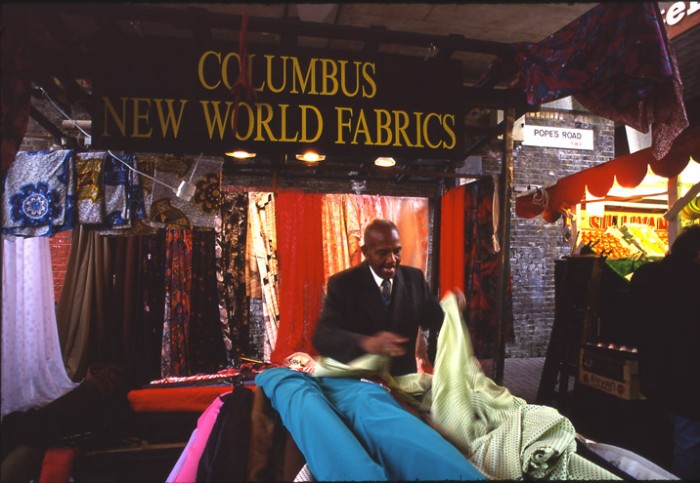
Oswald ‘Columbus’ Denniston, Brixton Market, SW9. Photo © David Secombe, 1990.
From Of the street-sellers of textile fabrics: London Labour and the London Poor, Volume 1, Henry Mayhew, 1851:
These street-folk present perhaps as great a diversity of character as any of which I have been called upon to treat.Among them are the strong persevering men, who carry rolls of linen or cotton manufacture in packs on their backs, and trudge along holding a yard-wand by the middle, which – it is a not uncommon joke against them – is always worn down an inch or two, by being used as a walking-stick in their long pedestrian journeys. Some of these men love to tell of the many hundreds of miles they have walked in their time, and in the three kingdoms.
From The Daily Express, 23 June 1948:
Oswald M. Dennison – the first of 430 job-seeking Jamaicans to land at Tilbury yesterday morning from the trooper Empire Windrush – started a £4-a-week job last night. Wrapped in two warm blankets to keep warm, he settled in as a night watchman of the meals marquee in Clapham Common, SW where 240 of the Jamaicans are staying in deep wartime shelters. All of them sat down there to their first meal on English soil: roast beef, potatoes, vegetables, Yorkshire pudding suet pudding with currants and custard. A bed and three hot meals will cost them 6s.6d (32.5p) a day. Most of the Jamaicans have about £5 to last them until they find work. Oswald Dennison, 35-year-old sign painter, got his job after making a speech of thanks to government officials. He called for three cheers for the Ministry of Labour and raised his Anthony Eden hat. Others clapped. Panamas, blue, pink, and biscuit trilbys and one bowler were waved.
David Secombe:
When this picture was taken, Oswald ‘Columbus’ Denniston was a sprightly 76, and had been selling fabrics in Brixton for nearly thirty years – the first Afro-Caribbean trader in Brixton market. The photo was commissioned for a Sunday Times Magazine article on London street traders (which never appeared as the ‘London’ section of the magazine folded before the feature was published). By this time in his life, Oswald Denniston had become a potent symbol for the black community in London, his manifest virtues of charm, capability and decency commanding widespread fondness and admiration. The quote from Mayhew seems appropriate here, for surely no-one has ever travelled so far to sell fabrics as Columbus Denniston.
In 1998, he was interviewed by the BBC to mark the 40th anniversary of the Windrush sailing: the interview may be read here. He died in 2000; his Guardian obituary was written by Mike Phillips.
Street traders. Photo & text: David Secombe (1/3)
Posted: March 27, 2012 Filed under: Amusements, Fictional London, London on film, London Types, Markets, Street Portraits | Tags: Del Boy and Rodney, east street market, John Sullivan, Johnny Wallington, only fools and horses 3 Comments Johnny Wallington, East Street Market. Photo © David Secombe 1990.
Although only officially designated a market in the 1880s, East Street Market continues a tradition of street trading in Walworth that goes back to Tudor times. Perhaps more germane to the purposes of the current post is the identification of the market with the 1980s & 90s situation comedy Only Fools and Horses, which is set in Peckham and uses photographs of East Street Market in its opening titles.
The popularity of John Sullivan‘s TV series has given this stretch of south London its own place in modern popular culture. Sullivan himself was from Balham, and he knew the milieu very well. He was working as a scene shifter at the BBC when he approached producer Dennis Main Wilson with an idea for a comedy. Main Wilson was a genuine enthusiast for comedy, a quality not always found in producers of ‘light entertainment’, and had an impeccable gift for searching out the genuine article. The idea was commissioned and became Citizen Smith.
Sullivan’s south London is a fabled place: Del and Rodney live in the mythical Nelson Mandela House (although there is a Nelson Mandela Way not too far away), the local boozer is a haunt of cartoon geezers and Peckham the bucolic playground for an assortment of genial chancers, through whom Sullivan has contributed several phrases to colloquial English. Television writers such as Sullivan and Galton & Simpson (Hancock’s Half Hour, Steptoe and Son) have created Dickensian characters for modern times, refashioning London in the image of their creations. Peckham has become Del Boy’s manor, just as any mention of Cheam conjures up the ghost of Anthony Aloysius St John Hancock – and Surbiton still bears the scars of The Good Life.
Drop-in centre. Photos & text Manuel Capurso (5/5)
Posted: February 17, 2012 Filed under: Health and welfare, London Types | Tags: Camden drop-in centre, Manuel Capurso Comments Off on Drop-in centre. Photos & text Manuel Capurso (5/5)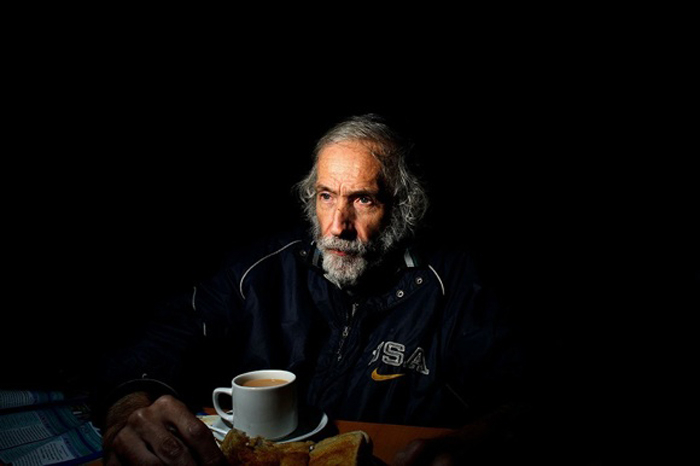
© Manuel Capurso.
Manuel Capurso writes:
In a metropolis like London, people tend to exist in their own world: their existence as social creatures rapidly diminishes. The result is a sort of public culture that promotes detachment over engagement and where the basis of social solidarity loses significance.
In this contest the drop in centre in Church Street represents a sort of unique experience, where old people can create and maintain “personal communities”. For most of the users the centre is their main form of social contact. Some of them are poor, in poor health or without family support. By contrast, others have friends outside the centre, from whom they bring stories for those who are more isolated, and they represent a sort of virtual bridge to the outside world.
I spent one week there, the first couple of days trying to engage with them, introducing myself, talking to them, as I was aware that I was breaking their routine. Only after few days, when the novelty effect was over, I started taking pictures, getting varied reaction but being generally accepted as a silent presence. I tried to represent their dignity in the face of the social marginalisation they suffer in the outside world.
… for The London Column. © Manuel Capurso.
Drop-in centre. Photos Manuel Capurso, text Roisin Tierney (4/5)
Posted: February 16, 2012 Filed under: Health and welfare, London Types Comments Off on Drop-in centre. Photos Manuel Capurso, text Roisin Tierney (4/5)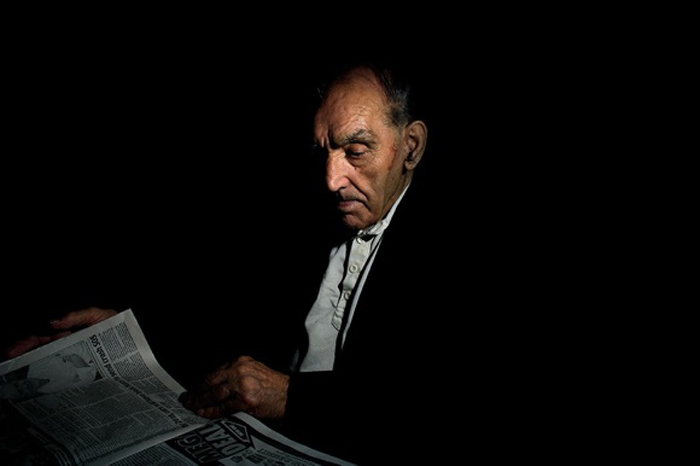
© Manuel Capurso.
Diogenes Syndrome by Roisin Tierney
Old man, we can barely enter for the stench,
the ever-ripening fetor that swarms your flat,
that creeps beneath the door. Your carpet dappled
with piles of your own manure. Your bath piled high
with ‘stuff’. The toilet blocked, a floating Vesuvius at its brim.
It’s been some time. We interview you elsewhere.
The doctor notes your gentleness and filth,
Your gummy smile, lank hair and jovial good humour.
You swear you eat, mention cans of beer.
(You even lie, and say you exercise,
which makes us laugh, oh how we laugh at that!)
You only cry once, when you mention ‘rent’.
You fear perhaps the landlord wants you out.
You don’t know why.
My dear, its not too late, we’ll scrub you up,
allocate you your own social worker.
It’ll not happen again, not to you,
And we’re sorry that it even happened once.
Not that you even know what we’re on about –
nor we enough to force aside
that thing, that whatever-it-is, that blocks your light.
© Roisin Tierney.
All the poems in this series are from Dream Endings, by Roísin Tierney, Rack Press 2011, and used by permission.
N.B.: Editor’s note: the subject of Roisin’s poem is not the gentleman in Manuel’s photo.


 The London Column