Deep South London. Photos & text: David Secombe (4/5)
Posted: June 17, 2011 Filed under: London Types, Street Portraits | Tags: Brenton Pink, Lewisham Way, painted house Comments Off on Deep South London. Photos & text: David Secombe (4/5)
Brenton Pink on the steps of his house, Lewisham. Photo © David Secombe 1999.
Brenton Pink’s house sits on Lewisham Way, a busy artery into London from the south-east. It is a large Victorian house – described elsewhere as a ‘mansion’, which might be an exaggeration – which its owner has decorated in an extremely vivid colour scheme evoking his native Jamaica, from whence he emigrated to London in the 1950s. By virtue of its prominent location, the house has become a well-known south London landmark. The photograph above is over ten years old; at time of writing, I believe that Mr. Pink is still in residence, although he is not seen outside the property as often as before.
V.S. Pritchett once described London’s brick buildings as having hues “as delicate as plumage”* and their muted tones lend the older suburbs much of their drab character. Painted in primary colours, a Victorian house becomes different altogether: the candy-bright paintwork commonly seen in well-to-do suburbs of London transforms small terraced houses into would-be Italian villas. But Brenton Pink’s decoration of his home is something else: it is a memoir of Jamaica, a fragment of the Caribbean recreated in Lewisham – hardly the brightest of suburbs then or now. He is London’s own Douanier Rousseau.
* London Perceived, 1965.
… for The London Column. © David Secombe 2011.
Deep South London. Photos & text: David Secombe (3/5)
Posted: June 16, 2011 Filed under: London Types | Tags: brockley, Wickham Road 1 Comment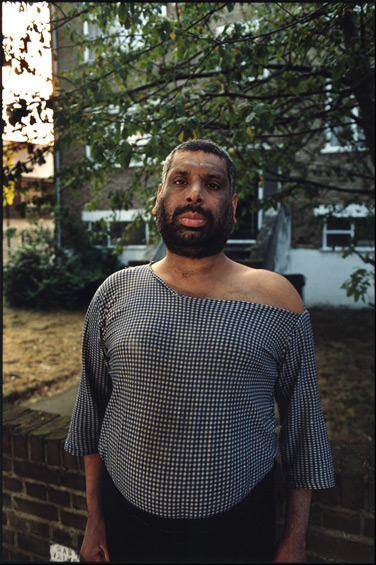
Photo © David Secombe 1999.
Walking up to strangers and asking them if you can take a photograph can be a ticklish business, but more often than not people are charming and accommodating. They will often pose for you with the kind of co-operation which one would expect of a professional model; but one has to get it done with fast.
The gentleman in today’s photo was a fixture on Brockley’s Wickham Road for years. I lived nearby and saw him almost daily: seen at a distance, he appeared to carry on vehement conversations with himself, gesticulating forcefully and waving his customary tin of Tennant’s Super. (Someone told me that this mind-numbingly strong lager is known colloquially as ‘Purple Herple’, but I’m not sure whether to believe them.)
I never found out his name, but he possessed a wonderful profile, like a teardrop wearing trousers: it was as if he’d been poured into his habitual outfit of elasticated, calf-length pants and off-the shoulder vest. Out walking one Saturday morning, I turned a corner and encountered him at close quarters. He was calmer than usual and I steeled myself to ask him if I could take his picture. He instantly snapped to attention, and very formally and politely complied with my request. I think he must have had a military background, as his pose was very erect, and as I tried to edge round for a profile shot he swivelled with my camera, so I was obliged to photograph him straight on, as he wished. This is entirely fitting, and he emerges in the photo as he appeared to me in person: as a distinguished gentleman who might have encountered some difficulties but who was yet to jettison his dignity.
… for The London Column. © David Secombe 2011.
Deep South London. Photos & text: David Secombe (2/5)
Posted: June 15, 2011 Filed under: London Types | Tags: Charlton, mystic Comments Off on Deep South London. Photos & text: David Secombe (2/5)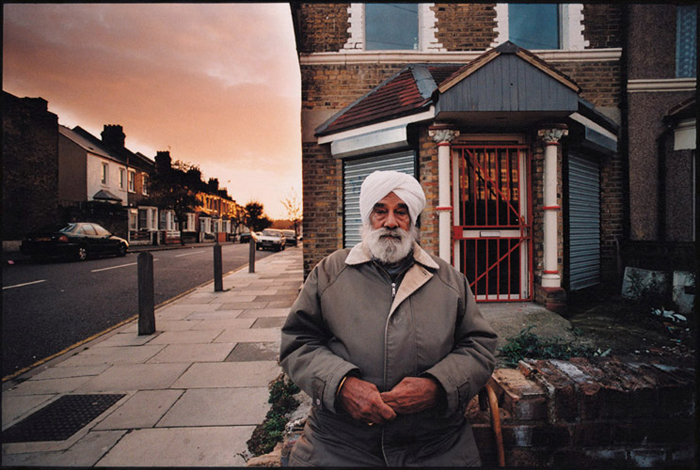
Victoria Way, Charlton, SE7. Photo © David Secombe 1998.
Despite London’s world city status, there are districts that can seem as remote, cloistered or exotic as Samarkand or Tibet – particularly those areas where the tube penetrates not at all or merely feebly. Charlton, SE7, remains one of the most overlooked and permanently unfashionable of all London localities. Its backwater ambience is very appealing to a certain type of person, and equally incomprehensible to those who crave easy access to a tube line or who see districts east and south of a given marker as dragon-infested territory. I lived there for seven years and grew rather fond of the place. (We moved out when they built the Millennium Dome in ‘north Greenwich’ a mile or so to the north-west, a development which has added little charm to the district.)
This gentleman lived a few doors away from where he is pictured, sitting at the junction of Victoria Way and Eastcombe Avenue, a daily routine which enshrined him as a local landmark. I photographed him twice, this being the most successful attempt. He indicated that he was deaf, so conversation was impossible, but he posed and co-operated with beguiling charm. He had a sort of stoic nobility and his presence on this nondescript south-east London street lent it a mysterious, romantic quality which it otherwise had no right to possess.
… for The London Column. © David Secombe 2011
Deep South London. Photos & text: David Secombe (1/5)
Posted: June 14, 2011 Filed under: London Types | Tags: cowboy, Laurel and Hardy, Way Out West Comments Off on Deep South London. Photos & text: David Secombe (1/5)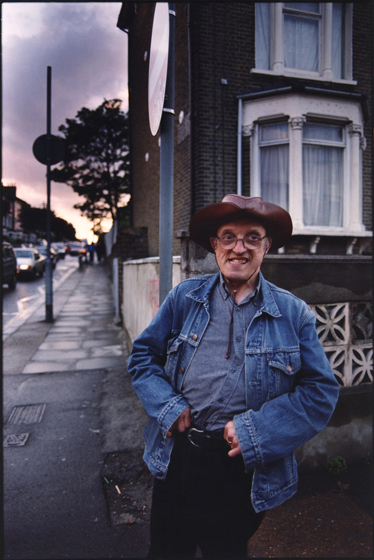
Brockley. Photo © David Secombe 1999.
STAN: I’m from the South too.
OLLIE: The south of what, sir?
STAN: The south of London.
– Laurel and Hardy in Way Out West, 1936.
The Brockley Cowboy – I can’t tell you his name – has been a familiar figure on the streets of SE4 for many years. During all this time, his outfit has remained broadly the same: a ‘life on the range’ denim jacket, usually teamed with matching jeans – although not in this photo; a plastic cowboy hat and the occasional idiosyncratic accessories (a small tartan wheelie case was a featured item for a time).
Occasionally, I would see him in the company of someone who appeared to be his carer, but more often than not I saw him alone, almost always smiling, restricting himself to just a few streets at the western end of the SE4 postcode. In this picture he is standing at the junction of Drakefell and Endwell Roads. I happened to be passing – I lived on Endwell Road – and asked him if I could take his photograph: he gestured his assent with an endearing largesse. It was as if these streets were his prairie, the evening flow of commuters and traffic as familiar and natural to him as cattle moving across the plains.
… for The London Column. © David Secombe 2011


 The London Column