The Heath. Photo: Andy Sewell, text: Katy Evans-Bush (1/5)
Posted: August 23, 2011 Filed under: Parks | Tags: Andy Sewell, hampstead heath, Katy Evans-Bush, London wolves Comments Off on The Heath. Photo: Andy Sewell, text: Katy Evans-Bush (1/5) Photo © Andy Sewell
Time was when Hampstead was a happy hunting-ground for lurking footpads and half-masked highwaymen. Coaches were stopped and rifled on the roads that crossed or skirted the famous Heath, while hapless pedestrians were not infrequently stripped of money and jewels and left dead or well nigh strangled under the bushes. The daring outlaws guilty of such crimes were, after capture and trial at the Old Bailey, strung up to prominent trees on the Heath and kept dangling there till their skins were “crackling in the sun.”
There was an earlier time, fully seven centuries ago, when all Hampstead was so infested with wolves that the pioneer settlers on its wild heights dare not venture out across the Heath after dark; and geologists tell us that farther back still far back in prehistoric ages the whole Thames valley was a vast arm of the sea, and the higher ridges of Hampstead, that are to this day thickly coated with a soft, silvery sea-sand, may have formed part of an ancient beach that was foam-whitened and deserted daily by the incoming and the outgoing tides.
…
Out of these mists of conjecture and tradition Hampstead materialises, clothes itself with history, and grows in size and definite importance as a very popular and fashionable health and pleasure resort; an importance that, with certain modifications, it retains to this day. By the year 1698 its chalybeate springs had become so famous for their medicinal qualities that the waters were sold by the flask at apothecaries’ shops and at Coffee Houses in Fleet Street and Charing Cross, while physicians sent their patients out to lodgings in the village of Hampstead that they might drink at the Wells daily and enjoy the benefit of the purer air of the locality. It presently came to pass, therefore, that a Pump Room and Assembly Rooms were established in Well Walk, and Hampstead competed successfully with Bath and Tunbridge as a health resort for wealthy and fashionable invalids and idlers.from Some Hampstead Memories, by Mary Adams
Priory Press 1909
To this day, Hampstead Heath exists out of time. Certain times lie very heavy on it; we feel the 18th and 19th centuries all over it, but that is because of the houses, the personalities who still help to define London for us – Leigh Hunt, Keats, Dr Johnson – and because we simply know more about the more recent times. In some way, though, the other times all still co-exist up there on those hills over London. On some days you can even feel the wolves. Maybe, “up where the air is clear” (as they said in Mary Poppins) you can not only see further across, but feel further back. In fact, it is like the way time stands utterly still to a person lying suspended in water, alone, surrounded by nothing but trees and sky, on a summer day. All heaviness vanishes: the world stops its ceaseless dragging, and only the water, the sky, the summer day – and Hampstead Heath – remain.
… for the London Column. © Katy Evans Bush 2011
Andy Sewell’s book The Heath may be purchased here.
Summertime Blues. Text assembled by Charles Jennings, photo: Tim Marshall.
Posted: August 19, 2011 Filed under: Crime and Punishment, Street of Shame | Tags: Anarchy in the UK, feral youth, Hoodies, JD Sports, journalistic cliche, London riots, urban rampage Comments Off on Summertime Blues. Text assembled by Charles Jennings, photo: Tim Marshall.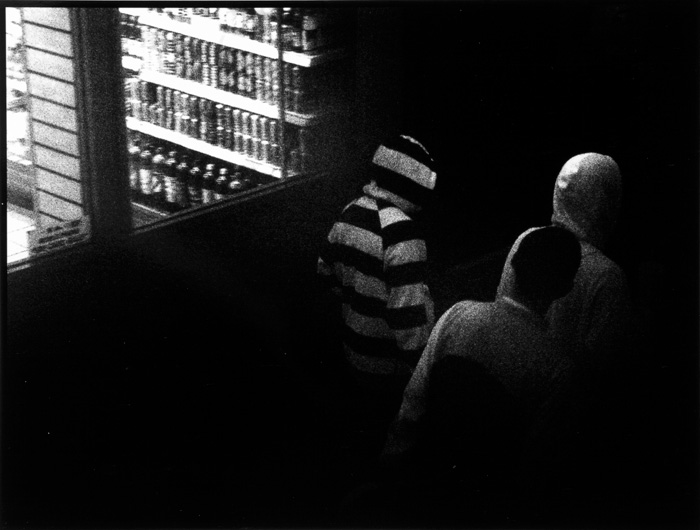
Essex Road. Photo © Tim Marshall.*
Newspaper quotes from August 2011:
She knows what she has done.
In order to get people’s respect and get noticed, this mother brazenly walks out of the back door of an Argos store. As a Glaswegian I was relieved of course.
There was more. After being yanked away by a hooded looter, the son of an evangelist minister ‘stole from supermarket’, admitted burglary by looting a £7.49 bottle of wine, and left stupid messages on Facebook.
Trying to gouge out a policeman’s eyes, the teenager then blamed the police for his crimes, adding that everything he had worked for is destroyed.
But victims will be given the chance to speak out, clean up in an orange jumpsuit, sweep scum off our streets, and be rightly alarmed.
Modern-day Fagins, on the other hand, cannot have people being frightened in their beds, or running into their basement flat with electrical items. It is deplorable behaviour, leading to instant ‘no-go’ areas to tackle mob violence.
At last, though, there is a smell of fresh paint, as well as vicious infighting between politicians and senior policemen. The public is finally seeing proper medicine handed out. Residents cheered police as they carried out the operation!
Some would argue that this all smacks of headline grabbing; others, that the dehumanising epithets flew like bricks through a JD Sports window.
But what matters is that this kind of anarchy is never allowed to happen again.
Nurse accused of sending saucy underwear pics to schizophrenic patient.
(Taken from The Sun, Daily Mail, Daily Telegraph, Guardian, Daily Express, Daily Mirror.)
* Disclaimer: in the interests of full disclosure, I must point out that the photo above was not taken during this month’s disturbances, but some years ago (the date is uncertain) and forms part of Tim Marshall’s 38 Special project, which we have already featured on The London Column. Whilst the young men in Tim’s photo were not looting anything, we have posted some contemporary riot photos on our Facebook page. D.S.
Nights at the Opera. Photo & text: David Secombe. (5/5)
Posted: August 5, 2011 Filed under: Artistic London, Performers, Theatrical London | Tags: curtain call, Macmillan's Romeo and Juliet, Royal Ballet, Viviana Durante Comments Off on Nights at the Opera. Photo & text: David Secombe. (5/5)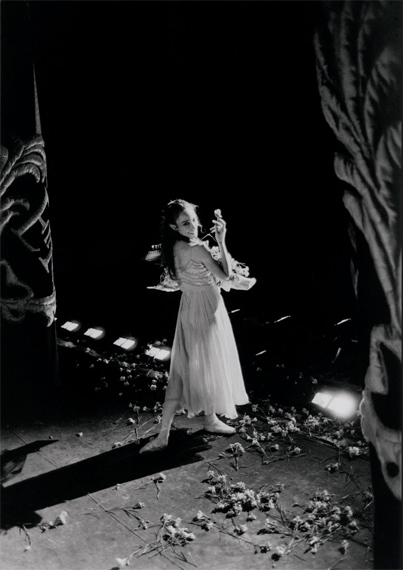
Viviana Durante taking her curtain call. Photo © David Secombe 1994.
To a Dancer by Arthur Symons:
Intoxicatingly,
Her eyes across the footlights gleam,
(The wine of love, the wine of dream)
Her eyes that gleam for me!
The eyes of all that see
Draw to her glances stealing fire
From her desire that leaps to my desire
Her eyes that gleam for me!
(There are two more verses of this awful poem, but I think we’ve heard enough.)
Viviana Durante is seen here taking a final bow at the end of Kenneth MacMillan’s acclaimed staging of Prokofiev’s Romeo and Juliet. This was the last concert of the season, a hot June night, and dance fans in the gods indulged in the agreeably cheesey custom of throwing flowers on to the stage as the principals took their calls. Ms Durante appears to be looking into the lens in this picture – this is likely, as the next frame shows her getting a fit of giggles as she looks at someone standing on my right. So you get it both ways: a poised ballerina straight from Symons’ coy imaginings, who sends up the entire form with a lethally witty gesture. Only someone seriously good can get away with that.
The London Column takes its own break for a week or so; material will be amassing in the mean time, so join us again later in the month.
David Secombe
Nights at the Opera. Photo & text: David Secombe (4/5)
Posted: August 4, 2011 Filed under: Theatrical London | Tags: Darcey Bussell, Royal Ballet, Tchaikovsky's Sleeping Beauty Comments Off on Nights at the Opera. Photo & text: David Secombe (4/5)
Darcey Bussell, Royal Ballet Company, Royal Opera House, Covent Garden. Dress rehearsal of Tchaikovsky’s Sleeping Beauty. Photo © David Secombe, 1994.
From London: a book of Aspects by Arthur Symons, 1912
The most magical glimpse I ever caught of a ballet was from the road in front, from the other side of the road, one night when two doors were suddenly thrown open as I was passing. In the moment’s interval before the doors closed again, I saw, in that odd, unexpected way, over the heads of the audience, far off in a sort of blue mist, the whole stage, its brilliant crowd drawn up in the last pose, just as the curtain was beginning to go down.
Ballet is one of those art forms – like poetry and jazz – which may be cheerfully disparaged in polite conversation. Such discussions offer opportunities for the uninterested to dress up their prejudices at the expense of a form which is seen as a minority interest, the province of the uncool or the far too radical. I confess I shared a similar ignorance, even hostility, to dance until I started photographing it. I had been looking forward to seeing opera in the raw and regarded the ballet as a rather irritating add-on to my obligations on the Royal Opera House project. You see something on television and arrogantly assume you know enough to hold an opinion. As it turned out, I found the ballet thrilling and opera a comparative let-down (as theatre, anyway); but the dance was a real discovery. The staggering physicality of dancers at their physical and artistic peak: the noise of the corps de ballet thudding onstage is a shock in itself. Standing off-stage, or just in the wings – as I was when I took the picture above – gives you a glimpse of what it costs to defy gravity; the strain of the job showing just outside the frame of the proscenium arch. I went from total skeptic to convinced enthusiast: a faintly humbling position for a sedentary, overweight photographer to assume.
Some doubts remain. The Royal Ballet’s version of Daphnis and Chloe was a disappointment. Ravel’s rapturous score concludes with one of the great orgiastic frenzies in all art, but the action on stage was something akin to Morris Dancing, with the fabulous Viviana Durante and company poncing about with over-sized handkerchiefs. Even Bernard Haitink’s conducting couldn’t compensate for the absurdity of that.
© David Secombe 2011


 The London Column