London Monumental. Photos & text: David Secombe (2/5)
Posted: September 6, 2011 Filed under: Churches, Fictional London, Funereal | Tags: Bluegate Fields, Picture of Dorian Gray, St.George in the East Comments Off on London Monumental. Photos & text: David Secombe (2/5)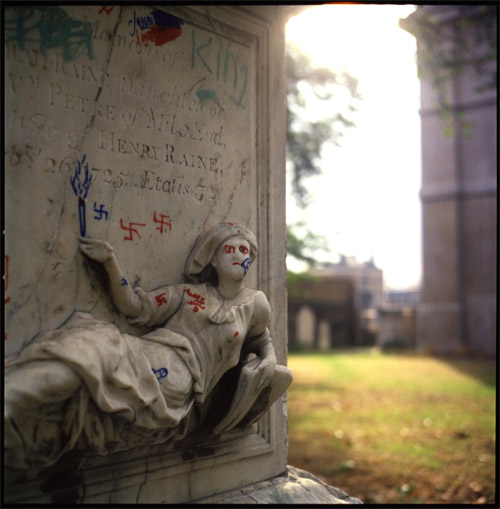
Raine Monument, churchyard of St. George in the East, Wapping. Photo © David Secombe, 1988.
From The Hole in the Wall, Arthur Morrison, 1888:
The Blue Gate is gone now – it went with many places of a history only less black when Ratcliff Highway was put to rout. As you left High Street, Shadwell, for the Highway – they made one thoroughfare – the Blue Gate was on your right, almost opposite an evil lane that led downhill to the New Dock. Blue Gate Fields, it was more fully called, though there was as little of a field or a gate, blue or other, about the place, which was a street, narrow, foul and forbidding, leading up to Back Lane. It was a bad and a dangerous place, the worst in all that neighbourhood. The sailor once brought to anchor in Blue Gate was lucky to get out with clothes to cover him – lucky if he saved no more than his life. Yet sailors were there in plenty, hilarious, shouting, drunk and drugged. Horrible draggled women pawed them over for whatever their pockets might yield, and murderous ruffians were ready at hand whenever a knock on the head could solve a difficulty.
Bluegate Fields, a.k.a. Blue Gate Fields, was a Victorian slum north of the Wapping docks. Two streets were once named Bluegate Fields, the ones now known as Dellow Street and Cable Street, streets which border St. George’s in the East churchyard on the east and northern sides respectively (St. George in the East is one of Nicholas Hawksmoor’s six great London churches). Bluegate Fields is name-checked in The Picture of Dorian Gray as the den of vice where Dorian goes to corrupt his soul. Unlike Arthur Morrison, however, Oscar Wilde never visited Bluegate Fields. The area features in Peter Ackroyd’s 1985 novel Hawksmoor which fictionalises the real Hawksmoor (in the novel he is called Dyer, whilst a 1980s detective is called Hawksmoor) as a shamanic figure and draws on the dark history of the East End, presenting the wilder side of the city as a place that is permanently wrong.
I took the above photograph in 1988, during a rather aimless wander across the East End with a newly-acquired Hasselblad. Last year I revisited the churchyard for the first time in twenty years and was dismayed by the state of the Raine monument. They have at least put iron railings around it now, but persistent vandalism and successively desperate attempts at cleaning have rendered it as white and featureless as a corpse pulled from the river. As I lamented the damage, youths who might well be the sons of the vandals responsible for the decoration seen above cheerfully urinated against the church wall. Peter Ackroyd’s theories of Psychogeography are much mocked, but I confess that on this visit I wondered whether he might be on to something. The persistence of sadness, decay and deprivation in this bleak spot are hard to ignore: the spirit of Bluegate Fields lingers on, albeit in a different register.
© David Secombe 2011.
London Monumental. Photos & text David Secombe (1/5)
Posted: September 5, 2011 Filed under: Catastrophes, Churches | Tags: caryatids, Elgin Marbles, Erectheum Comments Off on London Monumental. Photos & text David Secombe (1/5)
Caryatids, St. Pancras New Church, Euston. Photo © David Secombe, 2010.
From Georgian London, John Summerson, 1945/69:
St. Pancras is the queen of early nineteenth century churches; its architecture earns it the title, as much as its size and cost. Inwood’s flair for recapturing that nervous intensity of Greek architecture of the fifth century is very remarkable, and he seems to have had no difficulty in applying it to the commonplace objects of English practice.
The church stands on the corner of the Euston Road and Upper Woburn Place . It was consecrated in 1822, and was the most expensive church of its time – it was, in fact, the most expensive church in London since St. Paul’s. The father and son team of William and Henry Inwood won the competition to design the building and produced a church in the Greek revival manner, complete with a pair of pavilions modelled on the Acropolis’ Temple of the Erectheum. (Henry Inwood had travelled much in Greece and is generally considered to have been the dominant force in the design of the building.) The terracotta caryatids that guard the crypt are a clear echo of their ancient Greek forbears – one of which resides at the British Museum, part of that long-contested group known collectively as the Elgin Marbles. On July 7 2005, a suicide bomber detonated a bomb on board a number 30 bus which had just passed the church, proceeding down Upper Woburn Place before its destruction in Tavistock Square. The steps of St. Pancras were one of the sites for floral memorials to mark the tragedy.
© David Secombe 2011.


 The London Column