Licensed Victuallers’ Asylum. Photo & text: David Secombe.
Posted: December 7, 2012 Filed under: Architectural, Artistic London | Tags: Asylum, Old Kent Road, The New Hoxton, YBAs Comments Off on Licensed Victuallers’ Asylum. Photo & text: David Secombe.
Victuallers’ almshouses, Caroline Gardens, Peckham. Photo © David Secombe, 2002.
From Georgian London, John Summerson, 1945/1969:
There were plenty of other institutions, some educational, some charitable, some newly-born, some perhaps half a century old, which housed themselves with some grandeur. Almost all were Greek, with good, simple fenestration, and a portico – Doric or Ionic – to mark the status of the institution. Some of these buildings still stand. There is the pleasant, spacious courtyard and porticoed chapel of the Licensed Victuallers’ Asylum at Peckham, built about 1831. Others were damaged in the war and have disappeared since.
As Sir John pointed out, the Licensed Victuallers’ Asylum at Caroline Gardens – almshouses built for retirees from the brewing trade – is a rare survival in the unsentimental city. The Asylum is pretty enough to make one wonder at how it has managed to avoid the wrecking ball, as its very elegance must have been a goad to generations of developers and civic engineers. It is an oasis of Grecian calm just a few steps away from the bleak, business end of the Old Kent Road, and in its present context its charm seems positively defiant, even heroic: an assertion of a charitable ideal in architecture that is both grand and humane – and a welcome corrective to the lurid, day-glo Toys ‘R’ Us shed across the road.
The Old Kent Road remains one of the strangest of all London roads, as well as one of the oldest; it incorporates part of Watling Street, the Romans’ highway from Dover to London and far beyond, to the wild Welsh Marches. A walk along The Old Kent Road today – between New Cross and the Bricklayers’ Arms roundabout – is impressive by virtue of the vast contrasts in tone and scale. On the one hand you have the massive gas works, the acrid colours of the new retail sheds, the abandoned or decommissioned pubs, the unwelcoming wasteland of Burgess Park, the brutalist road scheme and the endless stream of traffic thereon … yet on the other you can see repurposed evangelical churches in former office units or light engineering premises, occasional glimpses of Georgiana subsumed into offices for tyre warehouses, and little runs of genteel villas and terraces which form tributaries off the churning thoroughfare. (The Victuallers’ Asylum is on Asylum Road, one of the most architecturally interesting streets in south London.) On a summer evening, the Old Kent Road has a strangely foreign quality; one could be in a dodgy suburb of Miami or Los Angeles. This may have something to do with its untended nature; even the Holloway Road doesn’t look this abandoned by civic authority. Perhaps any road in any city, left to its own devices, ends up looking slightly American.
With the repurposing come the artists, and it is no surprise that the ragged districts which line the Old Kent Road are increasingly hip areas for ambitious young artists to set out their wares. I have heard both Peckham and New Cross being described, with varying degrees of conviction, as ‘The New Hoxton’ – a statement which ignores the fact that Goldsmiths’ College has been churning out YBAs for decades, so one might say that New Cross was the ‘old Hoxton’. The Victuallers’ chapel was disused for many years but it has recently been adopted as an arts space by a group that calls itself ‘Asylum‘. Tomorrow, Saturday 8th December, it will be hosting a performance of ‘Christmas Mysteries’, a ‘musical adaptation of the nativity from the traditional Medieval Mystery Plays’. An atmospheric venue for it… photos of the interior of the chapel may be found here.
The Haunted House. Photo: David Secombe, text: Andrew Martin.
Posted: November 1, 2012 Filed under: Architectural, Funereal, Housing, Tall Tales | Tags: Alexander Woolcott, Andrew Martin, Bleak House, charles dickens, Edith Nesbitt, Haunted House, Inigo Jones, Lincolns inn Fields, Tulkinghorn Comments Off on The Haunted House. Photo: David Secombe, text: Andrew Martin.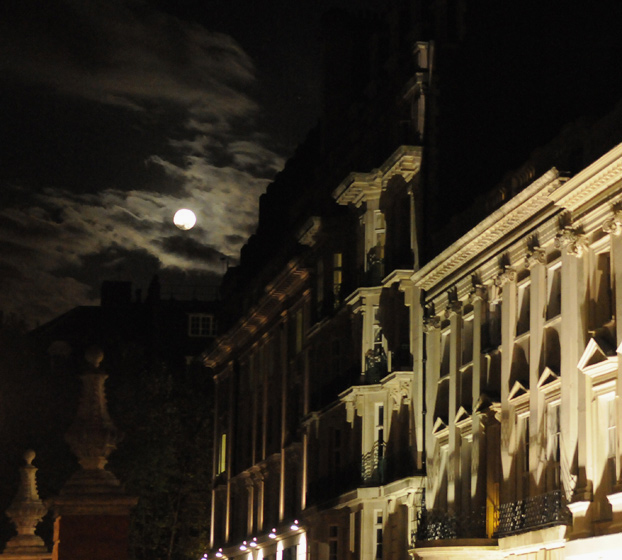
Lincoln’s Inn Fields, west side. Photo © David Secombe 2010.
The Haunted House
If ghost stories arise from the Gothic tradition, which was as much architectural as literary, it is also the case that persistent ghosts need a persistent location in which to manifest. So no wonder houses are haunted.
Haunted houses tend to be old and big. Such properties appeal to the romantic idea of faded grandeur, and also a baser snobbery. Every account of Borley Rectory, ‘the most haunted house in England’, describes it as hideous, but when I look at the pictures I wonder how much it would cost today if it were still standing, and whether the seller would take a low offer in view of its poltergeist infestation. Reading ghost stories we are torn: yes, a malevolent spirit stalks the east wing, but at least there’s am east wing for it to stalk. Ghost stories, both real and fictional, sometimes come with floor plans of the haunted area – literally, property particulars – and very mouth-watering they usually are.
Haunted houses also come with libraries, and with servants. The protagonist in a ghost story is quite alone in his huge house … except for his fifteen servants. The reader might not know about the servants until one of them hesitantly knocks and enters the master’s study on the final page and finds him slumped in his chair ‘With a look on his face, the like of which I’ve never seen …’
The author denigrates the house, but also slyly boosts it to engage our snobbery. In Walter de la Mare’s story, Out of the Deep (1923) the protagonist, Jimmie, inherits his uncle’s ‘horrible old London mansion’. But how horrible and old can a London mansion be? In Moonlight Sonata (1931) by Alexander Woolcott, one of the two principals inhabits ‘the collapsing family manor house to which he had indignantly fallen heir.’ The owner is down to his last gardener, who tends the ‘once sumptuous’ grounds, but the place doesn’t sound too bad to me. The Mystery of the Semi-Detached by Edith Nesbitt (1893) seems, from its title, to be bucking the trend, but the house is ‘commodious’, with several sitting rooms.
I myself grew up in a semi-detached of a more modest sort. We were its first occupants, and I was proud of inhabiting a new house. Those of my contemporaries who lived in old houses seemed to me to be taking a considerable risk. They were living in houses in which people had died, and people they didn’t know at that – people that nobody currently alive knew. It must be like living in a tomb. There would have to be certain echoes. In grappling with the subject, in his collection of sightings, Apparitions and Haunted Houses, Sir Ernest Bennett plaintively wonders, ‘Can it conceivably be the case that in some inscrutable fashion the woodwork and masonry of a house may exert some physical or mental influences which cause certain individuals to see the phantasmal figure of a former resident?’
… from Ghoul Britannia, published by Short Books. © Andrew Martin 2009.
David Secombe:
Elsewhere in his fine book (an overview of the British ghost story tradition), Andrew examines Charles Dickens’s fascination with ghosts and how they impacted on his fiction. The above photograph shows the Inigo Jones mansion – on the right – believed to have been the model for the chambers of Tulkinghorn, the sinister lawyer in Bleak House. Although Bleak House is not ostensibly a novel about ghosts, it deals with the dead hand of the past weighing upon the present; and Dickens’s treatment of Lincoln’s Inn is appropriately atmospheric, menacing and grotesque. Here is the opening of chapter 32:
‘It is night in Lincoln’s Inn — perplexed and troublous valley of the shadow of the law, where suitors generally find but little day — and fat candles are snuffed out in offices, and clerks have rattled down the crazy wooden stairs, and dispersed. The bell that rings at nine o’clock, has ceased its doleful clangour about nothing; the gates are shut; and the night-porter, a solemn warder with a mighty power of sleep, keeps guard in his lodge. [. . . ] It is a close night, though the damp cold is searching too; and there is a laggard mist a little way up in the air. It is a fine steaming night to turn the slaughter-houses, the unwholesome trades, the sewerage, bad water, and burial grounds to account, and give the Registrar of Deaths some extra business’.
See also: The Avoided House, Halloween.
London Gothic. Photo: David Secombe, text: Charles Jennings & David Secombe (5/5)
Posted: July 6, 2012 Filed under: Architectural, London on film, London Places, Monumental | Tags: Charlton House, Iain Sinclair, Ian Nairn, John Evelyn, walled-up corpse Comments Off on London Gothic. Photo: David Secombe, text: Charles Jennings & David Secombe (5/5)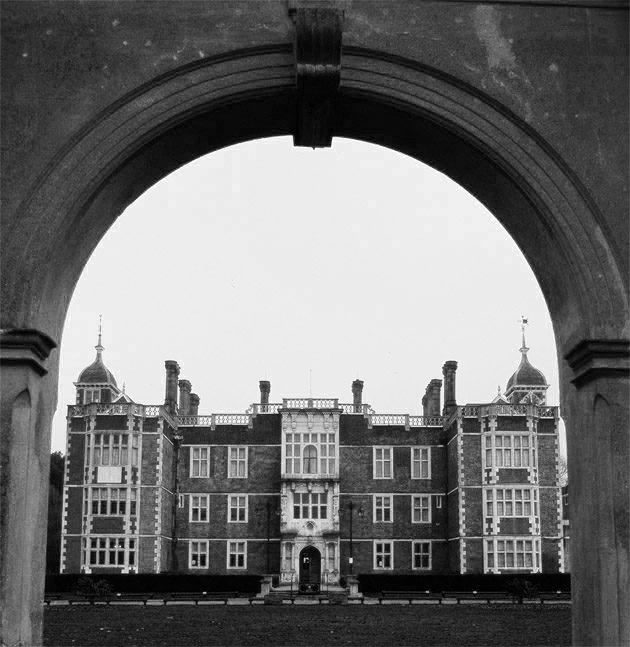
Charlton House. Photo © David Secombe 2010.
Charles Jennings writes:
Nowadays just another stop on the railway line, a part of the sprawl of outer London, Charlton has, to its great and inexplicable glory, one of the most stunning pieces of Jacobean architecture in the whole country. This is Charlton House, dating from 1607 and built for Adam Newton, tutor to Prince Henry, James I’s eldest son and heir to the throne. It is the most wonderful building, made all more wonderful by the drabness of its surroundings.
To get to it from Charlton railway station requires an uninspiring five-minute slog south on Charlton Church Lane before you reach the brow of the hill: a redbrick church – St. Luke’s – on the left, ranks of flats on the right and in the centre, hemmed in by a car park and a stretch of lawn, a fabulous dark red brick Jacobean mansion, decorated with white stone quoins and dressings, and with a great wedding cake frontispiece, involving a huge bay window and the main entrance porch. Sir Niklaus Pevsner claimed that Charlton House contained ‘the most exuberant and undisciplined ornament in all England’; while Ian Nairn drew a metaphor – aptly enough – from Jacobean melodrama, seeing the building as ‘Sinister poetry: the Duchess of Malfi in SE7′. John Evelyn, writing fifty years after the house was built, described the view from the house as ‘one of the most noble in the world, for city, river, ships, meadows, hill, woods and all other amenities’.
David Secombe:
At the end of Lights Out for the Territory, Iain Sinclair’s epic psychogeographical trek across London, the author visits Charlton House and ruminates upon its brooding presence and desirability as a residence for an aristocratic version of himself. Psychogeography is a much-derided concept, and it has been derided in these pages more than once (most recently by Andrew Martin earlier this week), but Charlton House is the kind of place which makes one wonder whether there might be something in it. It just seems monumentally wrong. In the midst of the anonymous south London sprawl it is spectacularly incongruous, but it isn’t just that (in fact, Charlton is the only London village where all the traditional elements remain visibly intact: the big house, the green, the church, the village). There is something else going on.
I once made a short film in which Charlton House featured as the main location. The film was a sort of parody of the English ghost story tradition, three men holding a night-time vigil in the Long Gallery of the House in the hope of seeing ‘something’. When being shown round the building during a recce, we ascended to the Long Gallery in a conspicuously modern elevator. I expressed my surprise at such an unexpected convenience, and was told that when the lift was being installed workmen discovered the body of an adolescent boy walled up behind one of the fireplaces. How long it had been there, no-one could say.
London Gothic. Photo: David Secombe, text: Andrew Martin (3/5)
Posted: July 4, 2012 Filed under: Architectural, Dereliction, Housing | Tags: Andrew Martin, Avoided House, Bates Motel, Camberwell, haunted London Comments Off on London Gothic. Photo: David Secombe, text: Andrew Martin (3/5)
Camberwell. © David Secombe 1988.
From Ghoul Britannia (2010) by Andrew Martin:
THE AVOIDED HOUSE
In a street of any length, there’s one of these: a vacant house, or one that changes hands too often, or not often enough; a house in shadow or being taken over by its own garden. There were a couple of these on my paper round when I was a boy. One had cracked windows, and a decaying Transit van parked immediately in front of the front door. Another had the curtains permanently closed and a front garden filled with rubble. I was encouraged by this rubble. I thought: ‘One day soon they’re going to use it to construct something marvellous like a pond with a fountain.’ But the rubble just remained. I never saw the occupants of either house and I didn’t want to. I found it hard to imagine them going into Ellis’s newsagents and paying for the papers I delivered to them. That would require a degree of normality incompatible with the state of their homes.
It didn’t take much for me to condemn a property; it didn’t have to be semi-derelict. For example, I wasn’t very keen on any of the house facing our own because they didn’t have the sun on them in the morning; and some of my friends’ houses just felt wrong inside. I am not going to broach the subject of psycho-geography because I find myself dying with exhaustion at the typing of the word, but it has been argued that houses with a reputation for being haunted occupy sites where ley lines intersect. Also blamed – and I like this – is carbon monoxide poisoning. This occurs where carbon combustion occurs with too little ventilation, and there’s quite a neat fit with ghostliness in that the symptoms can include anxiety and hallucinations. People burning wood or coal, or using coal-gas lighting in a shuttered room might be at risk, which connects the condition with Victorian winters – a fertile time for ghost stories.
When I first came to London I was amazed at the number of avoided houses. They constitued about fifteen percent of the total stock.
© Andrew Martin. Ghoul Britannia is published by Short Books.
See also: Halloween, The Haunted House.


 The London Column