The Haunted House. Photo: David Secombe, text: Andrew Martin.
Posted: November 1, 2012 Filed under: Architectural, Funereal, Housing, Tall Tales | Tags: Alexander Woolcott, Andrew Martin, Bleak House, charles dickens, Edith Nesbitt, Haunted House, Inigo Jones, Lincolns inn Fields, Tulkinghorn Comments Off on The Haunted House. Photo: David Secombe, text: Andrew Martin.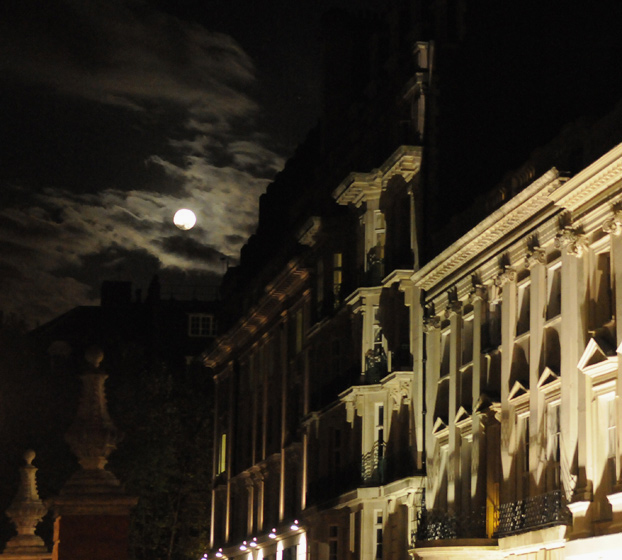
Lincoln’s Inn Fields, west side. Photo © David Secombe 2010.
The Haunted House
If ghost stories arise from the Gothic tradition, which was as much architectural as literary, it is also the case that persistent ghosts need a persistent location in which to manifest. So no wonder houses are haunted.
Haunted houses tend to be old and big. Such properties appeal to the romantic idea of faded grandeur, and also a baser snobbery. Every account of Borley Rectory, ‘the most haunted house in England’, describes it as hideous, but when I look at the pictures I wonder how much it would cost today if it were still standing, and whether the seller would take a low offer in view of its poltergeist infestation. Reading ghost stories we are torn: yes, a malevolent spirit stalks the east wing, but at least there’s am east wing for it to stalk. Ghost stories, both real and fictional, sometimes come with floor plans of the haunted area – literally, property particulars – and very mouth-watering they usually are.
Haunted houses also come with libraries, and with servants. The protagonist in a ghost story is quite alone in his huge house … except for his fifteen servants. The reader might not know about the servants until one of them hesitantly knocks and enters the master’s study on the final page and finds him slumped in his chair ‘With a look on his face, the like of which I’ve never seen …’
The author denigrates the house, but also slyly boosts it to engage our snobbery. In Walter de la Mare’s story, Out of the Deep (1923) the protagonist, Jimmie, inherits his uncle’s ‘horrible old London mansion’. But how horrible and old can a London mansion be? In Moonlight Sonata (1931) by Alexander Woolcott, one of the two principals inhabits ‘the collapsing family manor house to which he had indignantly fallen heir.’ The owner is down to his last gardener, who tends the ‘once sumptuous’ grounds, but the place doesn’t sound too bad to me. The Mystery of the Semi-Detached by Edith Nesbitt (1893) seems, from its title, to be bucking the trend, but the house is ‘commodious’, with several sitting rooms.
I myself grew up in a semi-detached of a more modest sort. We were its first occupants, and I was proud of inhabiting a new house. Those of my contemporaries who lived in old houses seemed to me to be taking a considerable risk. They were living in houses in which people had died, and people they didn’t know at that – people that nobody currently alive knew. It must be like living in a tomb. There would have to be certain echoes. In grappling with the subject, in his collection of sightings, Apparitions and Haunted Houses, Sir Ernest Bennett plaintively wonders, ‘Can it conceivably be the case that in some inscrutable fashion the woodwork and masonry of a house may exert some physical or mental influences which cause certain individuals to see the phantasmal figure of a former resident?’
… from Ghoul Britannia, published by Short Books. © Andrew Martin 2009.
David Secombe:
Elsewhere in his fine book (an overview of the British ghost story tradition), Andrew examines Charles Dickens’s fascination with ghosts and how they impacted on his fiction. The above photograph shows the Inigo Jones mansion – on the right – believed to have been the model for the chambers of Tulkinghorn, the sinister lawyer in Bleak House. Although Bleak House is not ostensibly a novel about ghosts, it deals with the dead hand of the past weighing upon the present; and Dickens’s treatment of Lincoln’s Inn is appropriately atmospheric, menacing and grotesque. Here is the opening of chapter 32:
‘It is night in Lincoln’s Inn — perplexed and troublous valley of the shadow of the law, where suitors generally find but little day — and fat candles are snuffed out in offices, and clerks have rattled down the crazy wooden stairs, and dispersed. The bell that rings at nine o’clock, has ceased its doleful clangour about nothing; the gates are shut; and the night-porter, a solemn warder with a mighty power of sleep, keeps guard in his lodge. [. . . ] It is a close night, though the damp cold is searching too; and there is a laggard mist a little way up in the air. It is a fine steaming night to turn the slaughter-houses, the unwholesome trades, the sewerage, bad water, and burial grounds to account, and give the Registrar of Deaths some extra business’.
See also: The Avoided House, Halloween.
London Gothic. Photo: David Secombe, text: Andrew Martin (3/5)
Posted: July 4, 2012 Filed under: Architectural, Dereliction, Housing | Tags: Andrew Martin, Avoided House, Bates Motel, Camberwell, haunted London Comments Off on London Gothic. Photo: David Secombe, text: Andrew Martin (3/5)
Camberwell. © David Secombe 1988.
From Ghoul Britannia (2010) by Andrew Martin:
THE AVOIDED HOUSE
In a street of any length, there’s one of these: a vacant house, or one that changes hands too often, or not often enough; a house in shadow or being taken over by its own garden. There were a couple of these on my paper round when I was a boy. One had cracked windows, and a decaying Transit van parked immediately in front of the front door. Another had the curtains permanently closed and a front garden filled with rubble. I was encouraged by this rubble. I thought: ‘One day soon they’re going to use it to construct something marvellous like a pond with a fountain.’ But the rubble just remained. I never saw the occupants of either house and I didn’t want to. I found it hard to imagine them going into Ellis’s newsagents and paying for the papers I delivered to them. That would require a degree of normality incompatible with the state of their homes.
It didn’t take much for me to condemn a property; it didn’t have to be semi-derelict. For example, I wasn’t very keen on any of the house facing our own because they didn’t have the sun on them in the morning; and some of my friends’ houses just felt wrong inside. I am not going to broach the subject of psycho-geography because I find myself dying with exhaustion at the typing of the word, but it has been argued that houses with a reputation for being haunted occupy sites where ley lines intersect. Also blamed – and I like this – is carbon monoxide poisoning. This occurs where carbon combustion occurs with too little ventilation, and there’s quite a neat fit with ghostliness in that the symptoms can include anxiety and hallucinations. People burning wood or coal, or using coal-gas lighting in a shuttered room might be at risk, which connects the condition with Victorian winters – a fertile time for ghost stories.
When I first came to London I was amazed at the number of avoided houses. They constitued about fifteen percent of the total stock.
© Andrew Martin. Ghoul Britannia is published by Short Books.
See also: Halloween, The Haunted House.
Flotsam and jetsam. Photo & text: David Secombe. (1/5)
Posted: April 16, 2012 Filed under: Housing, The Thames | Tags: Canary Wharf, corporate London, Isle of Dogs, Piers Gough, River Thames Comments Off on Flotsam and jetsam. Photo & text: David Secombe. (1/5)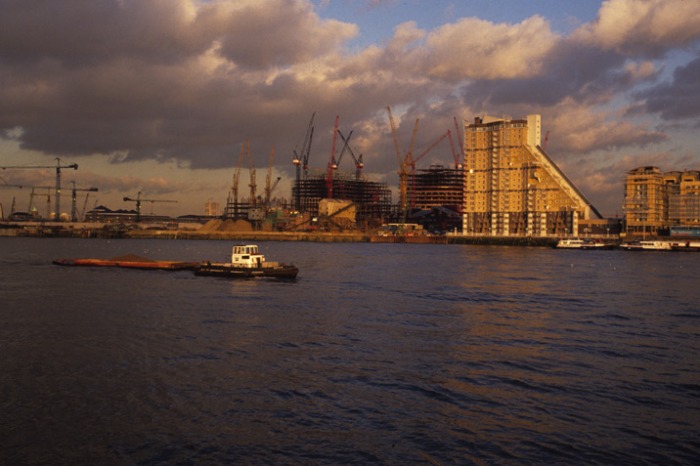
Isle of Dogs, 1988. Photo © David Secombe.
From Without the City Wall, Hector Bolitho and Derek Peel, 1952:
No part of London endured more bombing during the Second World War than the Isle of Dogs. Anyone who has flown over the Thames at night will recall how the river makes a splendid curve here, and how the moonlight shining on the slow oily waters turns the peninsula into a perfect target. The German bombers came to know it well, and the dock and warehouses suffered night after night. The rebuilding has covered many of the scars, but also many of the old romantic streets …”
David Secombe writes:
The photo above – taken for a magazine assignment to illustrate the growth of London’s Docklands – gives a small indication of the speculative building frenzy which characterised the mid-1980s. The building on the right in the photo above, newly constructed when this picture was taken, is Cascades, designed by Piers Gough for CZWG architects. Cascades was the first private apartment block to be built on the Isle of Dogs – a trailblazer for all the other developments of ‘executive homes’ (marginalising the ‘indigenous’ population, naturally) which – despite the occasional market wobble – have followed in its wake. Elsewhere on the Isle of Dogs at the time of this image, the massive foundations of Olympia and York’s Canary Wharf were being laid; gradually, the ethereal, silver profile of 1 Canada Square (the “tallest habitable building in Britain” according to Wikipedia) rose into the sky, elegantly dominating the landscape for miles around – until it was crowded by a cluster of far more vulgar towers belonging to big, bad corporations like Barclays and HSBC. If anyone wants to look for physical manifestations of the arrogance of capitalism, the Isle of Dogs has to be London’s most conspicuous example.
… for The London Column.
London Monumental. Photo & text: David Secombe (4/5)
Posted: September 8, 2011 Filed under: Housing, Parks | Tags: John Nash, Regent's Park, Sir John Summerson Comments Off on London Monumental. Photo & text: David Secombe (4/5)
Cumberland Terrace, NW1. Photo © David Secombe, 1988.
From The Magus by John Fowles, 1966:
Beyond her stretched the grass, a quarter mile of turf to the edge of the park. Beyond that rose the Regency facade, bestatued, many and elegantly windowed, of Cumberland Terrace.
A wall of windows, a row of statues of classical gods. They surveyed the park as if from a dress circle.
[…] The afternoon sun made them [the houses of Cumberland Terrace] gleam with light, that Olympian elixir of serene, remote, benign light one sometimes sees in summer clouds.
Although John Fowles’ epic and impossibly romantic novel about the power of myth and storytelling is mostly set on an isolated Greek island, he chooses to end his story in NW1. In the final chapter of the novel, Fowles’ rattled ‘hero’ and his girlfriend have an angsty scene in Regent’s Park, where Nicholas wonders whether they are being spied upon from the windows of John Nash’s Cumberland Terrace. This is a brilliant example of a novelist employing a real location to enhance the themes of his narrative: Fowles exploits the theatricality of Nash’s park-side architecture to suggest that his punch-drunk protagonist continues to be an unwilling player in a drama staged for an unseen audience.
It is a fitting conceit, as the glimpses of Nash’s terraces from the park bely the (relatively) prosaic houses behind the grandeur of the facades. This louche and rather endearing architectural trick led Sir John Summerson, the celebrated eminence grise on all matters Georgian, to stick the boot in thus:
It is magnificent. And behind it all – behind it are rows and rows of identical houses, identical in their narrowness, their thin pretentiousness, their poverty of design. Where the eye apprehends a mansion of great distinction, supported by lesser mansions and service quarters, the mind must interpret it as a block of thin houses, with other blocks of thin houses carrying less ornament or none at all. The sham is flagrant and absurd. The terraces are architectural whims; and though Nash was serious enough in his intention, the effect is an odd combination of fantasy and bathos which only the retrospect of a century can forgive*.
Summerson’s aristocratic disdain is a bit hard to stomach here, and I think we are entitled to give Sir John the bird on this one. Fowles seems to have a better idea of what Nash was up to, and what he succeeded in doing. Nash’s terraces are there to enhance the public space, they exist to ennoble the walkers in the park, they lend drama to the business of taking the air. It is also at least possible, if not likely, that if they had been ‘dream palaces’ in a more concrete sense they would have gone the way of so many of the grand, inconvenient mansions of Piccadilly and Mayfair, swept away by ruthless economic imperatives well into the post-WW2 era. We can be grateful that the modest ambitions of the houses behind Nash’s palatial frontages have proved adaptable to changing circumstances, and so ensured their survival.
Unforgivably, Summerson also neglects to mention that Patrick Troughton’s Doctor Who had to contend with an invasion of Cybermen outside Cumberland Terrace in 1968: although one could say that it fell slightly outside his brief.
… for The London Column. © David Secombe 2011.
(*Georgian London, Sir John Summerson, 1945/1969.)


 The London Column