Bvsh Hovse.
Posted: December 11, 2013 Filed under: Architectural, Corridors of Power, Fictional London, Interiors, Lettering, Literary London, Monumental, Wartime London | Tags: Aldwych, Bogdan Frymorgen, Bush House, Claire Grove, George Orwell BBC, London architecture, Ministry of Truth, Wych Street Comments Off on Bvsh Hovse.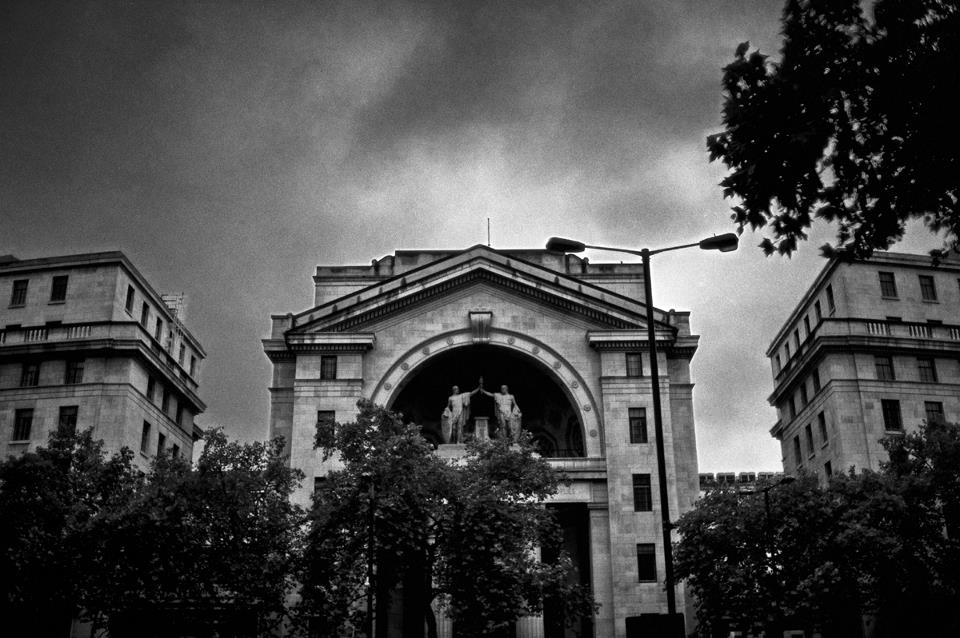
Bush House from Kingsway. © Bogdan Frymorgen 2012.
Bush House, the imposing 1920s edifice which dominates the Aldwych and looms over Kingsway, was once declared to be “the most expensive [building] in the world”: by 1929 its construction had cost its American backers £2,000,000. It was built on the site of Wych Street, an ancient survivor of the Great Fire that was ruthlessly destroyed by London County Council circa 1901.
Built of Portland stone, with extravagant use of marble for its cavernous halls, and fronted by forbidding columns surmounted by statues symbolising ‘Anglo-American friendship’, Bush House embodies its era just as much as the Deco Telegraph Building on Fleet Street, or Collcutt and Hemp’s monolithic Adelphi. (The chunk of old London flattened for the Adelphi was the Adam brothers’ graceful riverside development of 1768.) Like the ‘new’ Adelphi, the sheer bombast of Bush House trails unfortunate traces of Fascist architecture; but where Colcutt and Hemp’s stridently moderne behemoth might look at home in Mussolini’s Rome, Bush House’s gigantic faux-classical styling prefigures the more stolid brand of ‘Totalitarian Retro’ that came to be favoured by Hitler and Stalin.

Main entrance. © Bogdan Frymorgen 2012.

© Bogdan Frymorgen 2012.
The BBC established offices in the building in 1941, and for over 70 years Bush House was home to the BBC World Service, originally known as the BBC Overseas Service. George Orwell was a BBC staff member during the war, and the interiors of the building – in particular its canteen – informed his conception of The Ministry of Truth in Nineteen Eighty Four. (It’s clear that the exterior of Orwell’s Ministry was modelled on Senate House in Bloomsbury, and Room 101 was said to be located somewhere in Broadcasting House, but the echoing, labyrinthine interior of Bush House invites us to imagine Winston Smith lost within it.) It might be easy to resent Bush House – for what was sacrificed for its creation, for its monumental scale, and for the sheer absurdity of that portico (which echoes, in the Latin script above its main entrance, the opening titles of a certain famous 1970s TV series: I CLAVDIVS). You could even say that the payoff for the loss of ancient Aldwych is nothing more than a faceless autostrada with a giant conceited lump at its southern end.

© Bogdan Frymorgen 2012.

© Bogdan Frymorgen 2012.
But London is a restless, shape-shifting city, and Bush House has come to stand for more than the pretensions of its sponsors and designers. With the good fortune to house an institution that infused its overblown rhetoric with genuine purpose, it has become a great London building by default. Orwell’s ironic attitude to the BBC aside, during WW2 it acted as a hub for displaced European intellectuals, who broadcast to their besieged home countries from its offices; coded messages aimed at resistance fighters and SOE agents were transmitted to occupied Europe from its studios. It became a symbol of the War Effort. (It was damaged by a V1 flying bomb that hit the Aldwych in 1944; the V1 landed on the Air Ministry directly opposite, leading to worries over the eerie accuracy of those early cruise missiles.)
Even its grandiose classicism may be said to have a claim to authenticity: workmen laying Bush House’s foundations unearthed Roman statuary beneath the dust of Wych Street. A bust of a Roman noble was duly and reverently put on display in the new building’s lobby (even if there are doubts as to its provenance …).

© Bogdan Frymorgen 2012.
These photographs by Bogdan Frymorgen – a studio manager for the World Service – were taken just hours before the BBC finally left Bush House in July 2012, when the humming bustling halls and studios were already silent. Even as a series of absences, they capture a real sense of the urgency and activity that had so recently been going on. They’re full of love for a building and an institution that came to occupy an important place in British cultural history. It’s too easy to forget the esteem in which the BBC World Service is held by its distant listeners; it’s not television – therefore not sexy – but that is what gives it its reach, as radio waves can go anywhere and radios can be found everywhere. The World Service is a unique and magnificent public service; it’s Reithian; and, as such, it’s permanently under threat.

© Bogdan Frymorgen 2012.
But the BBC’s activities at Bush House weren’t confined to the World Service. Amongst other things, a great deal of radio drama was produced there, and in the past weeks I’ve been thinking of this again. A few years ago, I was fortunate enough to spend a few days working on a radio play at Bush House under the aegis of Claire Grove, one of the most innovative and successful radio drama producers of our time. Her funeral was last week. Her Guardian obituary gives a rough idea of her professional brilliance, but it is hard to sum up such a vital person within the confines of an ‘Other Lives’ entry. Lemn Sissay’s appreciation gives some hints of the energy and life that occupied Claire, and indeed Bush House.

Studio 8, cleared out. © Bogdan Frymorgen 2012.
Amidst current refurbishment, Bush House is now occupied by a law firm and HM Customs and Excise. The love really has left the building. D.S. (with K.E-B.)
… for The London Column. Copies of Bogdan Frymorgen’s photographic tribute to Bush House may be ordered from him at frymorgen@googlemail.com or via his Facebook page.
At Home with Mrs John Profumo.
Posted: March 25, 2013 Filed under: Architectural, Class, Corridors of Power, Events, Housing, Interiors, London scandals | Tags: Chester Terrace, Christine Keeler, Evening Standard Homes and Property, House and Garden, John Profumo, London property market, Profumo Affair, Scandal, Stephen Ward, Toynbee Hall, Valerie Hobson Comments Off on At Home with Mrs John Profumo.
‘Mrs Profumo in the drawing-room with her white French faience hound.’ Uncredited photo from House and Garden, Conde Nast Publications, 1962.
From The House and Garden Book of Interiors, 1962:
Mr. and Mrs. Profumo (she is Valerie Hobson, the actress) live in a typical-looking Regent’s Park stuccoed villa, which has certain highly individual touches, the most covetable being a large garden and a magnificent drawing room.
An improbably large area of the house is given over to the drawing room, which must be one of the largest rooms in London to be found in a house of comparatively modest size. With its double-cube proportions, three fine windows, opening on to the garden, and gaily disciplined Nash decorations, this is a perfect room for a couple who must, perforce, engage in a great deal of entertaining.
A quick glance into Mr. Profumo’s own study provokes the wish that more masculine, magisterial ministerial rooms were half so attractive! Needless to say, the desk is large and if you look carefully you will see a highly decorative as well as highly confidential red ministerial despatch box on it, doubtless often impelling the owner of this charming house away from the family circle to the chores inseparable from high office.
From John Profumo’s statement in the House of Commons, 22nd March, 1963:
“My wife and I first met Miss Keeler at a house party in July 1961 at Cliveden. … Between July and December 1961, I met Miss Keeler on about half-a-dozen occasions at Dr Ward’s flat, when I called to see him and his friends. Miss Keeler and I were on friendly terms. There was no impropriety whatsoever in my acquaintanceship with Miss Keeler. … I shall not hesitate to issue writs for libel and slander if scandalous allegations are made or repeated outside the House.”
From Confessions of Christine, Christine Keeler, News of the World, June 1963:
Our meetings were very discreet. Jack [Profumo] drove a little red mini car. … If we were not in the flat, then we would just drive and drive for hours. Of course, it was impossible that our discretion would be absolutely complete. There was that amazing evening when Jack was round, and an army colonel showed up suddenly looking for Stephen [Ward]. The colonel couldn’t believe it. Jack nearly died. The funny thing is I never used to think of Jack as a Minister. I can not bow down to a man who has just got money or a position. And I liked Jack as a MAN.
David Secombe:
The passage of time has rendered the uncredited House and Garden text as poignant as it is comic. The gushing prose is at odds with the attitude of Valerie Hobson in the picture, lost amidst the chilly perfection of her vast drawing-room. Her husband, despite his vivid presence in the editorial copy, fails to appear in any of the pictures of the interior of their Regency villa, presumably due to the demands of the business of state – or, as implied by Christine Keeler’s racy memoir, some other kind of business.
This issue of House and Garden appeared in 1962, not long before Profumo’s mendacious statement to Parliament, which left a host of hostages to fortune, eventually leading – as everyone knows – to his resignation as Secretary of State for War. Today, politicians have ample opportunities to reinvent themselves after a career-ending debacle: Neil Hamilton, Jonathan Aitken and even Jeffrey Archer have achieved a degree of rehabilitation and it seems likely that Chris Huhne and Vicky Pryce will eventually re-enter ‘public life’ in some form or other. As the pioneer of modern political scandal, John Profumo had no such option: instead, he chose a practically Roman form of self-abasement, cleaning the toilets at Toynbee Hall in Whitechapel (a task he continued to do until the management suggested that there might be better ways of using his skills). He did, eventually, gain a limited re-admittance into high society but even that took him decades.

Former home of Mr. and Mrs. John Profumo, Chester Terrace. Photo © David Secombe 2011.
From Evening Standard Homes and Property, 14 Feb 2012:
This Grade I-listed property at prestigious Chester Terrace overlooking Regent’s Park, was once the home of shamed politician John Profumo, who lived in the splendid stucco townhouse during his much-publicised affair with model Christine Keeler in the Sixties. The scandal forced his resignation as secretary of state for war and damaged the reputation of Harold Macmillan’s government. Designed by John Nash, the architect responsible for much of Regency London, the elegant, four-bedroom house now has a cinema room, wine cellar and enchanting garden. If only walls could talk… Call [estate agent] if you have £10.95 million.
Halloween. Photo: David Secombe, text: Andrew Martin.
Posted: October 31, 2012 Filed under: Anniversaries, Churches, Funereal, Gargoyles, Interiors, Monumental, Out Of Town, Public Art | Tags: Chaldon Church, demon, ladder of salvation, Purgatory and Hell, Trick or Treat 2 Comments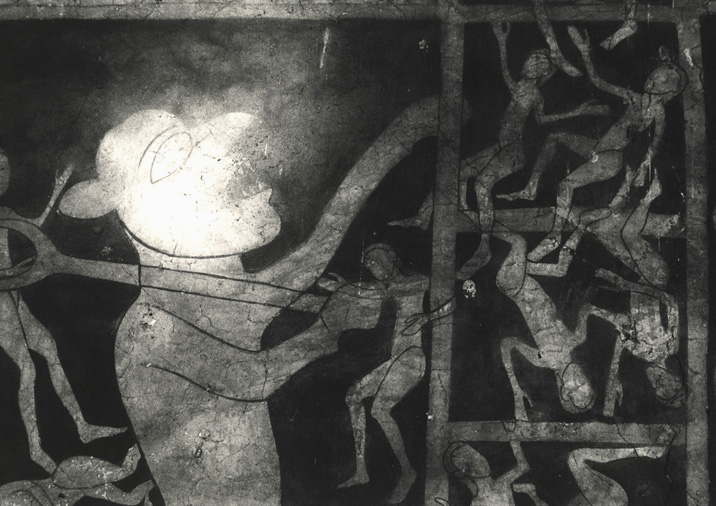
Mural, Chaldon Church, Surrey. Photo © David Secombe, 1989.
Halloween
When I was a boy, Halloween was a shadowy, elusive affair; the occasional carved pumpkin glowing in a window; the occasional fleeting glimpse of a reveller skipping away in a witch’s hat – usually some person you didn’t know and had never seen before. As a festival, it was upstaged by Bonfire Night, and I was frustrated by Halloween in those days. There was nothing you could buy, or be given in connection with it. Today, there is a great deal you can buy, as a result of the promotion of Trick or Treat, by which Halloween has eclipsed Bonfire Night and ghostliness has given way to mock horror. In the weeks before Halloween, Asda stores offer, amid a landslide of plastic tat; the Asda Squeezy Eyeball, the Asda Rat, the Asda Inflatable Coffin, the Child Grim Reaper Outfit (‘one size fits all’), the Adult Grim Reaper Outfit, the Inflatable Pumpkin Cooler (not for cooling pumpkins, you understand), the Skull Martini Shaker.
Asda is American-owned, and Trick or Treat came to us from America. The British folklorist Doc Rowe, believes that the Trick or Treat contagion began with a programme broadcast on BBC2 in the early ’70s as part of a documentary strand called Look Stranger. It depicted life on the American airbase in Woodbridge, Suffolk, and showed the children trick-or-treating. ‘Within two years,’ Doc Rowe told me, ‘all the tabloids were running features on how to dress up for the occasion.’ But his point is that this was merely the re-introduction into this country of a tradition rooted in psychology.
It helps to think of both Halloween and Bonfire Night as outgrowths of the Celtic celebration called Samhain, which marked the turning of their year and the beginning of winter. Samhain was associated with the lighting of fires to honour the dead, and defy malevolent spirits. The medieval church both denounced the festivals as diabolic and sought to appropriate aspects of them in the shape of All Saints Day on November 1st (on which the sanctified are honoured), and All Souls Day on November 2nd (a more democratic honouring of all Christian souls). According to Doc Rowe, ‘By tarring Halloween with an occult brush, by caricaturing it that way, the church made it an occult event.’ But while the original Halloween might not have been thoroughgoingly sinister, it did incorporate games and rituals of licensed naughtiness. All Souls Day, for example, was associated with Soul Caking, wherein poor Christians would say prayers for the departed relations of wealthier ones in return for food – and you can see how there might have been trouble if the rich didn’t play along.
It is likely that these traditions, these precursors of Trick or Treat, were taken to America by Scottish and Irish emigrants of the mid-nineteenth century … so the Asda Inflatable Coffin is actually our fault. But Doc Rowe believes these customs are ineradicable in any case. ‘The more you suppress these things, the greater they become.’ Apart from the Church, he identifies the main suppressors as ‘the health and safety camp’. I know what he means, and I wonder how long it will be before the words ‘high visibility vest’ come up in a ghost story.
… from Ghoul Britannia, published by Short Books. © Andrew Martin 2009.
David Secombe:
Chaldon Church is a tiny and ancient (11th Century) church tucked away in an unnervingly isolated hillside location about a mile north of the junction of the M23 and the ‘Magic Roundabout’ (a.k.a. the M25, London’s present-day Roman Wall). The church is famous for its terrifying medieval wall painting, described by Exploring Surrey’s Past thus: ‘The mural on the west wall of Chaldon church is one of the earliest known English wall paintings – it dates from about 1200 and is without equal in any other part of Europe. It is thought to have been painted by a travelling artist-monk. The picture depicts the ‘Ladder of Salvation of the Human Soul’ together with ‘Purgatory and Hell’. Wall paintings of this kind were intended as a visual aid to religious teaching. The whole picture is in the form of a cross, formed by the Ladder and the horizontal division between Heaven and Hell.’ No photo can adequately convey the power of this mural, or the sense of unease I experienced whilst photographing it on a bleak, windswept afternoon 20+ years ago.The medieval imagination retains its capacity to disturb; and the thrum of traffic from the nearby motorways seemed very distant indeed.
See also: The Avoided House.
Up My Street. Photo: Dylan Collard. (1/5)
Posted: September 24, 2012 Filed under: Interiors, Lettering, Public Announcements, Shops | Tags: Born and Bred, Dylan Collard, Holloway Road, Rowan Arts, Up My Street Comments Off on Up My Street. Photo: Dylan Collard. (1/5)
Elizabeth Sullivan, Beautiful, Holloway Road. © Dylan Collard.
From Born and Bred – Stories of Holloway Road:
Elizabeth Sullivan was born in Hackney in 1991. She moved to Liverpool Road until she was 6 and then moved to Penn Road just off Holloway Road where she has lived since 1997. She has worked as a Beauty Therapist at Beautiful at 639 Holloway Road since 2010.
“I’m always over in Holloway shopping. Even now I’m like ‘I’m just gonna pop over to Holloway’ and I’m over there for hours. I do love it as a little shopping place, you can get a right bargain and if I don’t get my nails done in here there are always the little nail bars. I’ll always meet up with a friend over there and we’ll go for a bit of lunch and have a little shop around.”
“I do waxing, tanning, nails, tinting, facials, massages, a bit of everything really. I really like it here, it’s lovely. The people that come in are lovely. I get on with the staff here hence why I’ve been here two and a half years already and I haven’t planned to move on. I get regular clients who come in and come back to me. With this kind of profession you do build up a clientele just because either they like the way you do certain things or they like coming to see you. You do get a lot of requests. I do think the salon is really good for the area. Everyone that comes in says it’s so nice to have a salon like this locally.”
The above interview is taken from Born and Bred, an oral history project by Rowan Arts documenting the life of the Holloway Road. You can hear more at www.storiesofhollowayroad.com. Up My Street is Dylan Collard‘s own project documenting shops between Kentish Town and Archway. His exhibition The Twelfth Man is currently showing at Exposure Gallery, 22-23 Little Portland Street, London W1. Dylan is represented by the Vue agency.


 The London Column


