Dannie Abse.
Posted: September 30, 2014 Filed under: Literary London, Vanishings | Tags: Dannie Abse, Forward Prize for Poetry, Helen Mort, Jeremy Paxman Comments Off on Dannie Abse.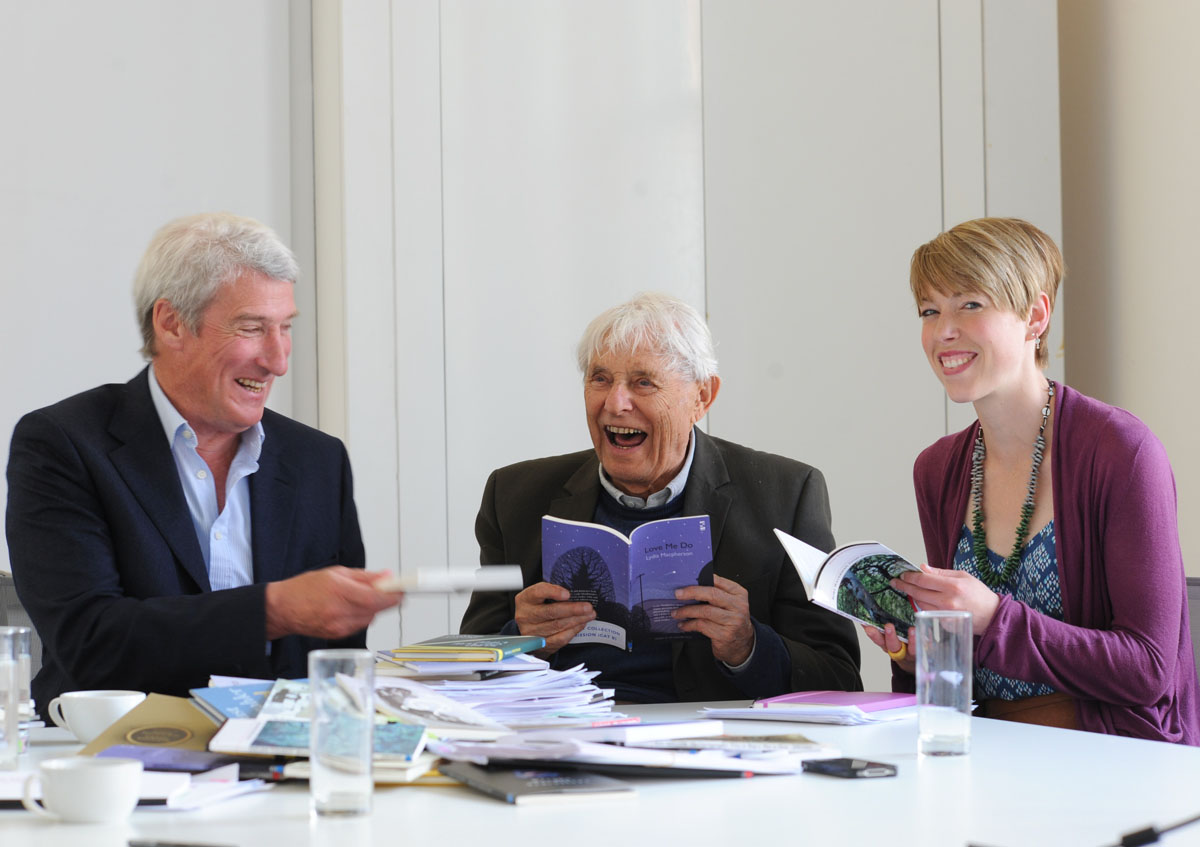
Jeremy Paxman, Dannie Abse, Helen Mort, Forward Poetry Prize jurors 2014. © David Secombe 2014.
Perspectives – five paragraphs for Frank O’Hara by Dannie Abse:
I sit in L’Artista, our local Italian restaurant.
Outside, a rain-thrashed queue waits for their bus.
At an adjacent table, a man with liquorice hair
is shouting to himself; but soon I discover
he’s phoning someone. At 1.50pm I order
Fusilli all’ Ortolana and their house-red poison.
A waitress bending forward to pick up a spoon
bothers me in more ways than two.
She moves with such grace and femininity
the very earth is richer where she stands
It surely makes all the clientele forget
their ‘nostalgia for the infinite’ and to understand,
perhaps for the first time, ‘the nostalgia of the infinite’.
Umbrellas pass by the window as I eat my pasta.
Some of it spills onto my trousers, dammit.
Why does this make me think of how those poets
who write enigmatic nonsense become famously
the darlings of the professors they most despise?
At 2.23 p.m. I drink my cappuccino and glance
at the TV that’s flitting behind the counter.
The 2012 dogs of war are pissing on the dead, Frank.
It could by Syria. Could be Afghanistan.
At 2.40 p.m. the Renoir beautiful one
brings me the bill (£15.10p). She squawks. Pity
her voice like a very active yak makes me shiver.
Outside the rain’s gone North. A 2.41 droplet
of pure silver falls from a high tin roof.
Dannie Abse, 1923 – 2014. Thanks to Baroque in Hackney. The results of the 2014 Forward Prize for Poetry will be announced tonight at the Royal Festival Hall.
The Riverine Strand.
Posted: May 12, 2014 Filed under: Architectural, Bohemian London, Churches, Housing, Literary London, Vanishings | Tags: Adelphi Terrace, Bob Dylan, Gordon's Wine Bar, John and Robert Adam, oscar wilde trial, Peter Ackroyd, Samuel Pepys, Savoy Chapel, Savoy Hotel, Subterranean Homesick Blues 2 Comments
 Royal Society of Arts, Robert St., Adelphi. © David Secombe 2010.
David Secombe: Thirty years ago, I accepted an assignment to illustrate a book of ‘London Walks’; I might have approached this task with more enthusiasm if I hadn’t known that I was offered the brief because the publisher didn’t have the money to pay the author’s preferred photographer. I lost my own copy of the finished item long ago, but recently came across one whilst helping my girlfriend clear an elderly aunt’s house. Looking at it now, it’s obvious that it was a formative experience for me, and that my photos were terrible. In an attempt to expiate former sins, this is the first of two posts revisiting the territory in a bid to see if a grizzled hack can improve upon a callow youth.
On a wet evening last week, I traced the steps of the ‘Riverine Strand’ walk in the company of TLC contributor and bad wine specialist CJ of the Sediment blog. We met outside Gordon’s Wine bar at the bottom of Villiers Street, both of us soaked through and longing for a glass of anything a notch above foul. Gordon’s advertises itself as ‘London’s oldest wine bar’, and it remains an atmospheric place to drink, although it has become more of a corporate playground in recent years. On this occasion our way to the bar was barred by thronging suits, which is why this piece lacks a picture of the vaulted cellar which is Gordon’s USP. We moved on …
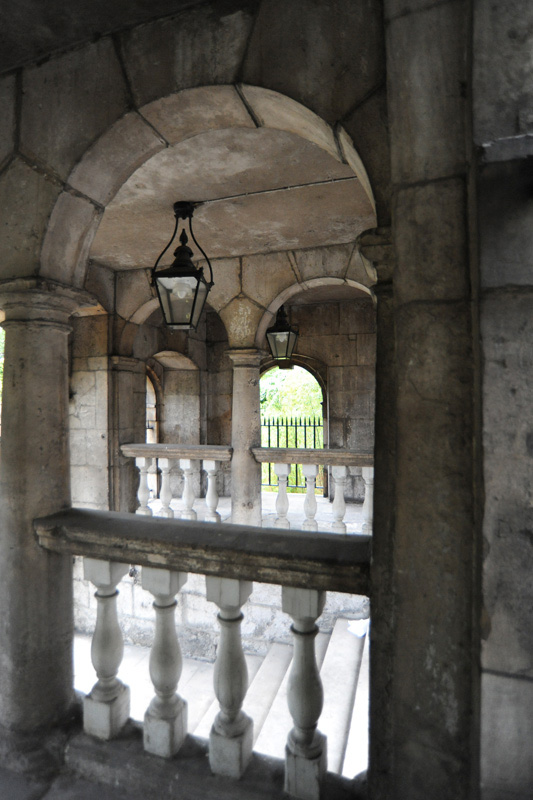
York Watergate. © David Secombe 2014
Opposite Gordon’s is a surviving fragment of the lost, pre-Embankment riverside landscape that once constituted this area: York Watergate, landing for York House, a palazzo which bordered the river for over 500 years. York House’s final, broke, owner, George Villiers, 2nd Duke of Buckingham, flogged it to developers for thirty grand. As Wikipedia gelidly states: ‘He made it a condition of the sale that his name and full title should be commemorated by George Street, Villiers Street, Duke Street, Of Alley, and Buckingham Street. Some of these streets are extant …’. For CJ’s benefit I pointed out that Samuel Pepys lived in a couple of houses on Buckingham Street, and that he also lived in the building where Gordon’s is now. CJ observed that it was still raining.
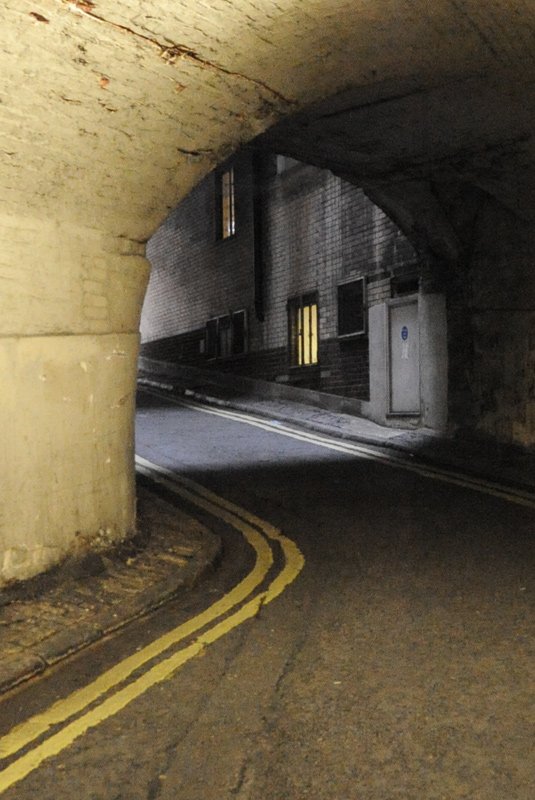
Lower Robert Street, Adelphi. © David Secombe 2014.
Lower Robert Street is an odd, subterranean thoroughfare that runs through what was once the undercroft of Adelphi Terrace, the centrepiece of the Adam Brothers’ Adelphi development. From The Encyclopedia of London:
In 1867 the Adelphi vaults were ‘in part occupied as wine cellars and coal wharves, their grim vastness, a reminder of the Etruscan Cloaca of old Rome’. Here, according to Tombs, ‘the most abandoned characters have often passed the night, nestling upon foul straw; and many a street thief escaped from his pursuers in these dismal haunts before the introduction of gaslight and a vigilant police’.
Dickens has David Copperfield wandering through this vanished maze, ‘a mysterious place with those dark arches’, which we can assume was an autobiographical reference. When I visited Lower Robert Street in the ’80s, for the purpose of illustrating the guidebook, it was still possible to see a dark courtyard beyond an iron gate: the basement of an Adam townhouse, seen from the POV of Victorian low-life … but that gate is bricked up now. (I dilated upon this factoid to an increasingly glazed CJ as drops of rainwater fell from his rimless spectacles.)
Above, the Adam houses reportedly were – as the houses that remain still are – a toy-town vision of elegance and grace. Of the Adelphi Terrace, E.V.Lucas wrote in 1916: ‘The Adelphi is still a favourite abode of men of letters, for it is central yet retired, and the brothers Adam planned rooms of peculiar comfort’. David Garrick, Richard D’Oyly Carte, Bernard Shaw, Thomas Hardy, all lived there, making it a sort of riverside version of The Albany.
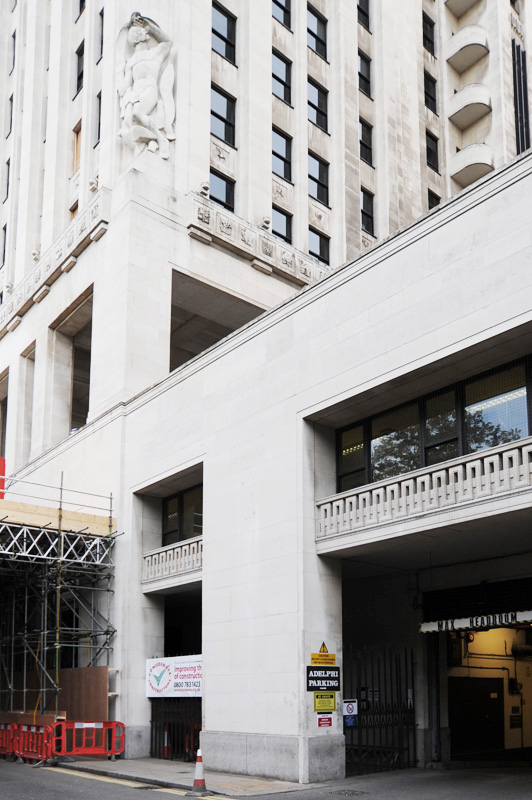 Collcutt & Hemp Adelphi, riverside frontage. © David Secombe 2014.
Adelphi Terrace was demolished by London County Council in 1936 and replaced by Collcutt and Hemp’s vast Deco block. The Adams’ Adelphi was the first neoclassical building in London, whereas Collcutt and Hemp’s edifice – grotesquely named ‘Adelphi’ – has been described by Ed Glinert (in The London Compendium) as ‘London’s most authentic example of totalitarian 1930s architecture’. Like Bush House at the other end of the Strand, it is a permanent reminder of loss, of a wrong inflicted upon the city. (NB: we are currently working on a survey of Boris Johnson’s skyscraper-nurturing programme.) In 1951, London County Council installed a plaque on one of the pillars of the ‘new’ Adelphi to commemorate the one they had connived to destroy. (The photo at the top of this post is of the Adam house which remains on Robert Street, facing Collcutt and Hemp, home to the Royal Society of Arts.)

Savoy Way. © David Secombe 2014
At this point, CJ wanly suggested going for a drink at the Savoy; but I reminded him that the last time we did that was five years ago, when both of us had money. Instead, we contented ourselves with a cursory inspection of the hotel’s rear quarters, a paragon of rationality, clad in the glazed tiles the Victorians reserved for only the filthiest urban environments.
At Oscar Wilde’s first trial, the following exchange took place between prosecution witness Charles Parker and prosecutor Charles Gill:
PARKER: Subsequently Wilde said to me. ‘This is the boy for me! Will you go to the Savoy Hotel with me?’ I consented, and Wilde drove me in a cab to the hotel. Only he and I went, leaving my brother and Taylor behind. At the Savoy we went first to Wilde’s sitting room on the second floor.
GILL: More drink was offered you there?
PARKER: Yes, we had liqueurs. Wilde then asked me to go into his bedroom with him.
(In an early draft of The Importance of Being Earnest, a solicitor arrives to remove Algernon to Holloway Prison for non-payment of restaurant bills at the Savoy, whereupon Algie retorts: ‘I am not going to be imprisoned in the suburbs for dining in the West End. It is ridiculous.’ Prior to his first trial, Wilde found himself held on remand at Holloway.)
It is tempting to imagine Oscar and Bosie hustling rent boys past the laundry bins and crates of vegetables on Savoy Way. CJ wondered whose laundry the gent in the photo might be carrying.
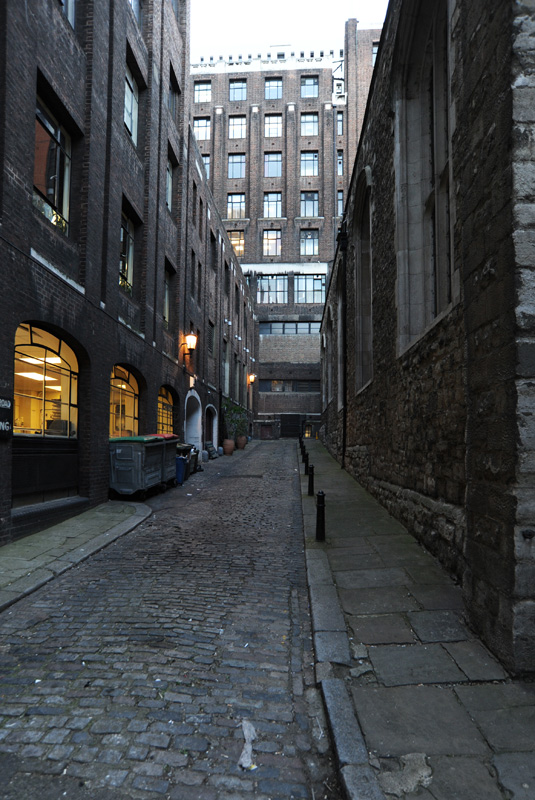
Savoy Chapel, Savoy Lane. © David Secombe 2014.
Adjacent to the Savoy stands one of those anomalous bits of medieval London marooned amongst anonymous offices. Savoy Palace, a vast 13th Century manor, once sprawled across the foreshore here; the Palace was entirely destroyed during the Peasants’ Revolt but the chapel was later rebuilt as part of Henry VII’s Savoy Hospital, of which it is now the only survivor. I don’t know whether Oscar and Bosie ever came here to ‘cool [their] hands in the grey twilight of Gothic things’, but this happens to be the spot where another Savoy resident, the newly-electric Bob Dylan, telegraphed Subterranean Homesick Blues for D.A. Pennebaker’s camera, as Allen Ginsberg and Tom Wilson loitered meaningfully in the background.
CJ and I emerged from Savoy Lane onto the Strand whereupon it started raining again, so we redoubled our efforts to find a sane place to drink. Dodging umbrellas and puddles by the corner of Waterloo Bridge, we chanced to see Peter Ackroyd alight elegantly from a cab and dive into a Tesco Express. We thought of waiting to see what the biographer of London would do when he emerged, entertaining the wistful hope that he might pop into Maplin’s for some fuses or a remote-controlled helicopter … but my boot was leaking, so we went to the Lamb and Flag, where we stood outside and drank our beers in the rain.
© David Secombe … for The London Column.
See also: A short walk down the Old Kent Road, Four streets off Hockley Hole.
Bvsh Hovse.
Posted: December 11, 2013 Filed under: Architectural, Corridors of Power, Fictional London, Interiors, Lettering, Literary London, Monumental, Wartime London | Tags: Aldwych, Bogdan Frymorgen, Bush House, Claire Grove, George Orwell BBC, London architecture, Ministry of Truth, Wych Street Comments Off on Bvsh Hovse.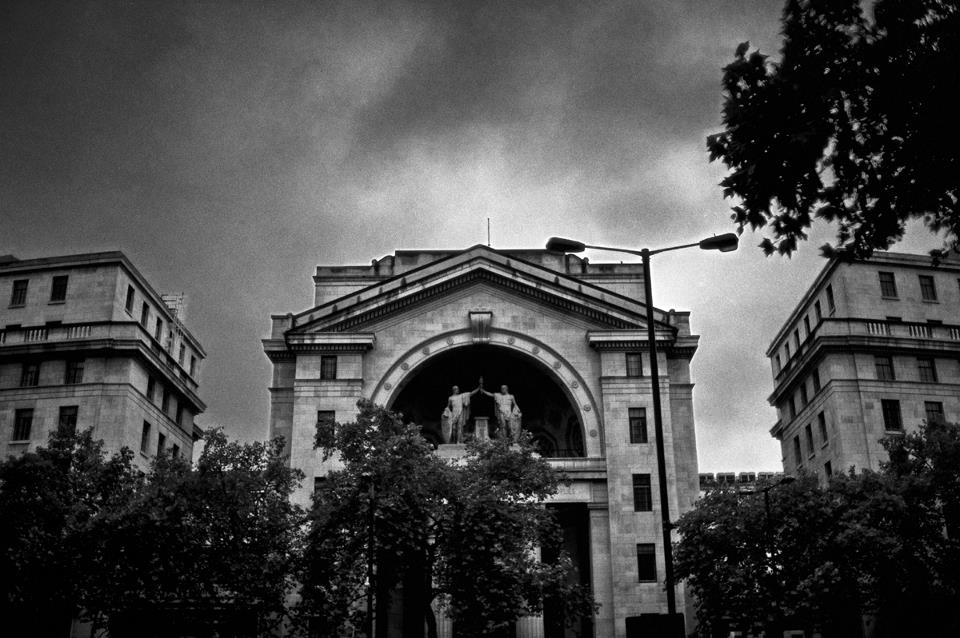
Bush House from Kingsway. © Bogdan Frymorgen 2012.
Bush House, the imposing 1920s edifice which dominates the Aldwych and looms over Kingsway, was once declared to be “the most expensive [building] in the world”: by 1929 its construction had cost its American backers £2,000,000. It was built on the site of Wych Street, an ancient survivor of the Great Fire that was ruthlessly destroyed by London County Council circa 1901.
Built of Portland stone, with extravagant use of marble for its cavernous halls, and fronted by forbidding columns surmounted by statues symbolising ‘Anglo-American friendship’, Bush House embodies its era just as much as the Deco Telegraph Building on Fleet Street, or Collcutt and Hemp’s monolithic Adelphi. (The chunk of old London flattened for the Adelphi was the Adam brothers’ graceful riverside development of 1768.) Like the ‘new’ Adelphi, the sheer bombast of Bush House trails unfortunate traces of Fascist architecture; but where Colcutt and Hemp’s stridently moderne behemoth might look at home in Mussolini’s Rome, Bush House’s gigantic faux-classical styling prefigures the more stolid brand of ‘Totalitarian Retro’ that came to be favoured by Hitler and Stalin.

Main entrance. © Bogdan Frymorgen 2012.

© Bogdan Frymorgen 2012.
The BBC established offices in the building in 1941, and for over 70 years Bush House was home to the BBC World Service, originally known as the BBC Overseas Service. George Orwell was a BBC staff member during the war, and the interiors of the building – in particular its canteen – informed his conception of The Ministry of Truth in Nineteen Eighty Four. (It’s clear that the exterior of Orwell’s Ministry was modelled on Senate House in Bloomsbury, and Room 101 was said to be located somewhere in Broadcasting House, but the echoing, labyrinthine interior of Bush House invites us to imagine Winston Smith lost within it.) It might be easy to resent Bush House – for what was sacrificed for its creation, for its monumental scale, and for the sheer absurdity of that portico (which echoes, in the Latin script above its main entrance, the opening titles of a certain famous 1970s TV series: I CLAVDIVS). You could even say that the payoff for the loss of ancient Aldwych is nothing more than a faceless autostrada with a giant conceited lump at its southern end.

© Bogdan Frymorgen 2012.

© Bogdan Frymorgen 2012.
But London is a restless, shape-shifting city, and Bush House has come to stand for more than the pretensions of its sponsors and designers. With the good fortune to house an institution that infused its overblown rhetoric with genuine purpose, it has become a great London building by default. Orwell’s ironic attitude to the BBC aside, during WW2 it acted as a hub for displaced European intellectuals, who broadcast to their besieged home countries from its offices; coded messages aimed at resistance fighters and SOE agents were transmitted to occupied Europe from its studios. It became a symbol of the War Effort. (It was damaged by a V1 flying bomb that hit the Aldwych in 1944; the V1 landed on the Air Ministry directly opposite, leading to worries over the eerie accuracy of those early cruise missiles.)
Even its grandiose classicism may be said to have a claim to authenticity: workmen laying Bush House’s foundations unearthed Roman statuary beneath the dust of Wych Street. A bust of a Roman noble was duly and reverently put on display in the new building’s lobby (even if there are doubts as to its provenance …).

© Bogdan Frymorgen 2012.
These photographs by Bogdan Frymorgen – a studio manager for the World Service – were taken just hours before the BBC finally left Bush House in July 2012, when the humming bustling halls and studios were already silent. Even as a series of absences, they capture a real sense of the urgency and activity that had so recently been going on. They’re full of love for a building and an institution that came to occupy an important place in British cultural history. It’s too easy to forget the esteem in which the BBC World Service is held by its distant listeners; it’s not television – therefore not sexy – but that is what gives it its reach, as radio waves can go anywhere and radios can be found everywhere. The World Service is a unique and magnificent public service; it’s Reithian; and, as such, it’s permanently under threat.

© Bogdan Frymorgen 2012.
But the BBC’s activities at Bush House weren’t confined to the World Service. Amongst other things, a great deal of radio drama was produced there, and in the past weeks I’ve been thinking of this again. A few years ago, I was fortunate enough to spend a few days working on a radio play at Bush House under the aegis of Claire Grove, one of the most innovative and successful radio drama producers of our time. Her funeral was last week. Her Guardian obituary gives a rough idea of her professional brilliance, but it is hard to sum up such a vital person within the confines of an ‘Other Lives’ entry. Lemn Sissay’s appreciation gives some hints of the energy and life that occupied Claire, and indeed Bush House.

Studio 8, cleared out. © Bogdan Frymorgen 2012.
Amidst current refurbishment, Bush House is now occupied by a law firm and HM Customs and Excise. The love really has left the building. D.S. (with K.E-B.)
… for The London Column. Copies of Bogdan Frymorgen’s photographic tribute to Bush House may be ordered from him at frymorgen@googlemail.com or via his Facebook page.
Two buildings on Fleet Street.
Posted: September 27, 2013 Filed under: Architectural, Fictional London, Literary London, Street of Shame | Tags: Art Deco in London, Daily Express Building, Evelyn Waugh, old Fleet Street, Owen Williams, Scoop, Telegraph Building Comments Off on Two buildings on Fleet Street.
Telegraph Building, Fleet Street. Photo © David Secombe 2010.
From Scoop by Evelyn Waugh:
The bells of St.Bride’s chimed unheard in the customary afternoon din of the Megalopolitan Building. The country edition had gone to bed; below traffic level, in grotto-blue light, leagues of paper ran noisily through the machines; overhead, where floor upon floor rose from the dusk of the streets to the clear air of day, ground-glass doors opened and shut; on a hundred lines reporters talked at cross purposes; sub-editors busied themselves with their humdrum task of reducing to blank nonsense the sheaves of misinformation which whistling urchins piled before them; beside a hundred typewriters soggy biscuits lay in a hundred tepid saucers. At the hub and still centre of all this animation, Lord Copper sat alone in splendid tranquility. His massive head, empty of thought, rested in sculptural fashion upon his left fist. He began to draw a little cow on his writing pad.
David Secombe: Scoop was published in 1938 and is, of course, a literary monument to the glory days of inter-war Fleet Street, drawing on Waugh’s brief 1935 stint as a Daily Mail war correspondent in Abyssinia. The novel’s monstrous Lord Copper is usually described as being an admixture of the proprietor of the Daily Express, Lord Beaverbrook, and The Times’s Lord Northcliffe, with the Mail‘s Lord Rothermere somewhere in the mix as well. The immense power of these men reflected the vast circulations and influence of the titles at their disposal; and, for all its comic genius, the paragraph from Waugh’s novel speaks of the glamour and excitement of old Fleet Street.
The Telegraph Building, designed by Elcock & Sutcliffe and finished in 1928, is a fine example of serious-minded Deco, with sculptural detailing typical of the era’s public buildings (e.g. London Underground’s 55 Broadway, BBC’s Broadcasting House), whilst the clock and detailing of the facade speaks of the 1920s’ infatuation with all things Egyptian. Alfred Oakley’s dynamic frieze above the main entrance depicts a brace of Mercuries flying from Britain to despatch news to her dominions and beyond; whilst, at the very top of the facade, two gravely portentous sculptural masks by Samuel Rabinovitch – ‘Past’ and ‘Future’ – offer further proof of the self-importance of the parties who commissioned the building. (However, Oakley and Rabinovitch were not as celebrated as Gill or Epstein, and their work on the Telegraph building was the high-water mark for both of them.) Together the elements add up to a rich, imposing and endearingly absurd edifice, entirely suitable for a sober, venerable newspaper keen to project an engagement with the hectic modern ‘scene’.
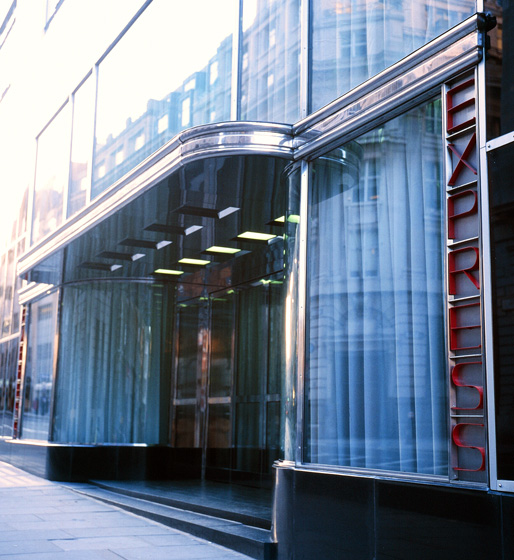
Daily Express Building, Fleet Street. Photo © David Secombe 2010.
A few years later, in 1932, and just four doors away, the new Daily Express Building opened for business and immediately made Elcock & Sutcliffe’s Telegraph design look like something by Augustus Pugin. A self-proclaimed icon of modernity streamlining down inky old Fleet Street, this sleek edifice is as characteristic of the 1930s as the suddenly obsolete Telegraph Building was of the 1920s. Significantly, the building was to a large extent the design of a structural engineer, Owen Williams, who had also advised on the Telegraph Building, and who went on to design Express offices in Manchester and Glasgow in the same fashion as their London prototype. The stark finish common to all three Express buildings – an aggressively moderne melange of black Vitrolite, glass and chrome – may be seen as an expression of the thrusting personality of Beaverbrook: the self-parodic press baron whose considerable political influence derived from the conspicuous popularity of his titles (during its post war zenith, The Daily Express was the biggest-selling newspaper in the world). Reading Scoop, it seems clear that Lord Copper’s Daily Beast is based in a building more like the Express than the Telegraph; quite apart from the architectural stylings, St Bride’s church stands directly opposite the Express Building, its spire reflecting darkly in the inscrutable facade of its upstart neighbour (however much Evelyn Waugh deplored the architecture of his time, he relished its capacity for inadvertent comedy).
Both the Telegraph and Express buildings are now owned by Goldman Sachs, their fabled Deco interiors available for inspection only on rare open days. And ‘The Street of Shame’ remains a street of ghosts, its pristine sense of purpose departing with the newspapers that gave it its unique identity. But for anyone seeking echoes of the giddy aspirations of the 1920s and 30s, these buildings remain evocative and potent, each epitomising the preoccupations of its decade. They are relics of a lost and dizzying world of inter-continental airships, Howard Carter and Tutankhamun, racing at Brooklands, the talkies, the Mitfords, the Blackshirts, Hollywood stars on the Queen Mary, Noel Coward’s Design for Living and Evelyn Waugh in his pomp … factories and temples dedicated to the latest news, expressed in architectural forms as up-to-the-minute as a Clarice Cliff tea-set.

Entrance frieze, Telegraph building, Fleet Street, EC1. Photo © David Secombe 2010.
Fleet Street Portrait – Charles Jennings:


 The London Column


