Arthur Machen’s Hill of Dreams.
Posted: July 4, 2013 Filed under: Architectural, Bohemian London, Fictional London, Literary London | Tags: Arthur Machen, Battersea, Hill of Dreams, pipe smoker Comments Off on Arthur Machen’s Hill of Dreams.
Tennyson Street, Battersea. Photo © David Secombe 1982.
From Hill of Dreams, Arthur Machen, 1907:
It was not till the winter was well advanced that he began at all to explore the region in which he lived. Soon after his arrival in the grey street he had taken one or two vague walks, hardly noticing where he went or what he saw; but for all the summer he had shut himself in his room, beholding nothing but the form and colour of words. [. . .]
Now, however, when the new year was beginning its dull days, he began to diverge occasionally to right and left, sometimes eating his luncheon in odd corners, in the bulging parlours of eighteenth-century taverns, that still fronted the surging sea of modern streets, or perhaps in brand new “publics” on the broken borders of the brickfields, smelling of the clay from which they had swollen. He found waste by-places behind railway embankments where he could smoke his pipe sheltered from the wind; sometimes there was a wooden fence by an old pear-orchard where he sat and gazed at the wet desolation of the market-gardens, munching a few currant biscuits by way of dinner. As he went farther afield a sense of immensity slowly grew upon him; it was as if, from the little island of his room, that one friendly place, he pushed out into the grey unknown, into a city that for him was uninhabited as the desert.
At 11.30 a.m. (UK) today, Thursday 4 July, Radio 4 is broadcasting a documentary about Arthur Machen and his ‘disturbing’ visions of a world beyond our own.
The British Museum Reading Room
Posted: July 1, 2013 Filed under: Architectural, Literary London | Tags: British Museum Reading Room, Louis MacNeice Comments Off on The British Museum Reading Room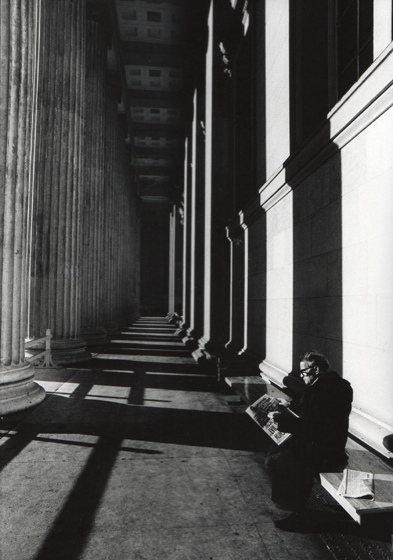
Photo © David Secombe 1988.
The British Museum Reading Room by Louis MacNeice, 1939:
Under the hive-like dome the stooping haunted readers
Go up and down the alleys, tap the cells of knowledge –
Honey and wax, the accumulation of years …
Some on commission, some for the love of learning,
Some because they have nothing better to do
Or because they hope these walls of books will deaden
The drumming of the demon in their ears.
Cranks, hacks, poverty-stricken scholars,
In prince-nez, period hats or romantic beards
And cherishing their hobby or their doom,
Some are too much alive and some are asleep
Hanging like bats in a world of inverted values,
Folded up in themselves in a world which is safe and silent:
This is the British Museum Reading Room.
Out on the steps in the sun the pigeons are courting,
Puffing their ruffs and sweeping their tails or taking
A sun-bath at their ease
And under the totem poles – the ancient terror –
Between the enormous fluted ionic columns
There seeps from heavily jowled or hawk-like foreign faces
The guttural sorrow of the refugees.
[The Reading Room is now merely an exhibit, the centre piece of Foster and Partners’ Great Court. The scholars now have to go up the Euston Road to the British Library.]
Tom Sharpe.
Posted: June 6, 2013 Filed under: Literary London, Out Of Town | Tags: Porterhouse Blue, Riotous Assembly, The Throwback, Tom Sharpe, Wilt Comments Off on Tom Sharpe.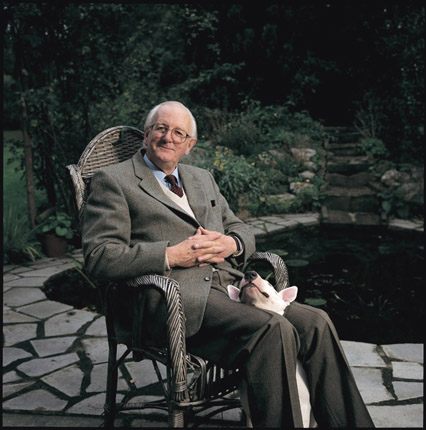
Tom Sharpe, Cambridge, 1992. Photo © David Secombe
Farewell Tom Sharpe … the author of Wilt, Porterhouse Blue, The Throwback, Riotous Assembly, etc. has died at the age of 85.
As an adolescent, I loved Tom Sharpe’s books. In his 1970s pomp, his fierce, majestic and paralysingly funny satires were a cause for great joy, and even made one proud to be British. But it can be a tricky thing to meet your heroes; and driving to Cambridge in the company of a nervous Spanish journalist (on his first ever visit to the UK) to interview the great man, I was fighting off my own attack of nerves. The interview started a bit awkwardly, as my colleague tried a line of questioning about the power of literature, during which he asserted: ‘Madame Bovary changed my life’ – to which Tom replied, ‘Well, you can’t have met that many doctors’ wives’. Things settled down after that, and we ended up going to a local pub – driven there at high speed along wild Fen roads by the author himself – where I finally got my chance to tell him that I thought Chapter 4 of The Throwback was the funniest thing I had ever read.
We discussed contemporary comedy and literature (he wasn’t much impressed), film version of his books (he hated the Smith/Jones version of Wilt but loved Channel 4’s Porterhouse Blue adaptation) and indeed photography, as he had once been a professional photographer and had pleasingly trenchant views on the subject. (When we came to do the photos, he insisted that I use his own tripod for the purpose of making the above picture, as he wasn’t convinced that mine was up to the task.)
The interview was for the Spanish edition of Elle magazine, as Tom had a strong following in Spain, and he eventually went to live there. He ascribed his popularity in Spain to the surrealism Spanish readers found in his books; but his own offering of an example of ‘typically English humour’, as requested on a Spanish TV interview, did not go down too well. He told the story of a troop of Tommies marching to the front line on the Western Front, and an exchange between a young soldier and a sergeant at a posting on the way. ”Ere, Sarge, when do we get to have a rest, been marching all day!’ ‘Don’t worry son, you’ll be dead in half an hour’.
My recollection of the day has a kind of glowing quality: it’s not often you an encounter someone whose work you love and in whom you discover someone who feels like a friend. He struck me much as he appears in the photo above: elegant, droll, mischievous, and as English as a Tudor manor house. We have lost another great one.
… for The London Column.
Calling at the Albany to see Graham Greene.
Posted: May 21, 2013 Filed under: Fictional London, Literary London | Tags: Albany, Dmitri Kasterine, Graham Greene, The Comedians 1 Comment
Graham Greene, Antibes. © Dmitri Kasterine 1983.
Expedition to Greeneland by Susan Grindley
There was a problem with the spellings
of Yeastrol, or Yeastrel, and Tontons Macoutes.
I was the office junior, despatched
with marked-up galley proofs to Albany.
I washed and ironed my hair the night before,
wore my shift dress from Peter Robinson’s
new Top Shop with white stockings and white
patent shoes from Elliott’s of Bond Street.
I’d cracked the secret code to all his books –
women who thought that they were loved were not.
He kept them parked and waiting in the margins,
all that religious stuff – just an excuse.
I didn’t see him. I just left the envelope
with the top-hatted porter at the lodge.
I told them casually back at Production,
‘GG is lunching at his club today.’
© Susan Grindley. The poem is from Susan’s collection New Reader, published by Rack Press; also available from Waterstones, and The London Review Bookshop, 14 Bury Place, London, WC1A.


 The London Column