Up My Street. Photo: Dylan Collard, text: Charles Jennings. (5/5)
Posted: September 28, 2012 Filed under: London Types, Shops | Tags: Dylan Collard, Nisa Food and Wine, Paris-Match, Sediment blog, Up My Street Comments Off on Up My Street. Photo: Dylan Collard, text: Charles Jennings. (5/5)
Mrs Darsham Patel, Nisa Food and Wine, Archway. © Dylan Collard.
Charles Jennings writes:
Booze
Booze in quantity: voluptuous and magical. There’s even a wistfulness in the expression on the face of the proprietess as she stands guard over (in all probability) a few grand’s worth of drink, as if it’s enough just to be close.
It’s a bit like an fabulous picture I once found in a Paris Match from 1952: a French family of four, posing with their entire annual food and drink consumption – Ce Qu’une Famille Française A Mangé Cette Année.
As you might expect, it shows two small parents and their two small children surrounded by everything they nominally consume in a twelve-month period: a double-page spread of scarcely credible eventfulness, containing entire sides of beef, whole pigs, several metric tonnes of bread and potatoes, some game, a lot of charcuterie, and, of course, alcohol.
Three hundred litres of wine; one hundred and sixty-eight litres of beer; fifty-eight litres of cider. The bottles are set out at the feet of the little quartet like a stockade, behind which they sit with understandable complacency. It is described as une ménagère économe, which nonetheless enables the mother and father to absorb well over a litre of booze a day between them (the kids are plainly too young), to say nothing of the apéritifs and digestifs (about four litres’ worth) which also grace the photo. As an advertisement of French priorities, it is hard to beat; and even now, has a cave-of-wonders feel which combines with a nostalgia for something one has never actually experienced, in a deeply affecting whole.
But it’s only the drink which makes one feel truly sentimental. The fascination of the stuff, bottled or poured, is really an inheritance from childhood – when it was not just dazzlingly jewelled in appearance, full of complex and occult signifiers, but also forbidden – and as such contains longings which are deep, unresolved, inadmissible. Just look at all that booze, glowing with the same coral intensity as the proprietress’s stretch top! How can she stand there so calmly?
… for The London Column.
Charles Jennings blogs on wine and other forms of drink at Sediment (‘I’ve bought it so I’ll drink it’). Up My Street is Dylan Collard‘s project documenting shops between Kentish Town and Archway. His exhibition The Twelfth Man is currently showing at Exposure Gallery, 22-23 Little Portland Street, London W1. Dylan is represented by the Vue agency.
Up My Street. Photo: Dylan Collard (2/5)
Posted: September 25, 2012 Filed under: London Types, Shops, Street Portraits | Tags: Archway Roundabout, charity shops, Dylan Collard, Rowan Arts, Stories of the Holloway Road Comments Off on Up My Street. Photo: Dylan Collard (2/5)
Laurence Evans, Second Chance, Archway Roundabout. © Dylan Collard.
From Born and Bred – Stories of Holloway Road:
Laurence Evans was born in Whittington Hospital in 1952. He lived first in Poynings Road and then moved to Caledonian Road where he has lived since 1962. He has volunteered at Second Chance charity shop at 7-9 St John’s Way, in the middle of Archway roundabout, since 2008.
“We’ve got a couple of customers, like a lady called Jenny who comes in and has a cup of tea or coffee and a couple of biscuits, she comes maybe three times a week and there’s a couple of other people who just come in for a cup of tea and they just like the atmosphere and the service.”
“Barry [the manager] and one of our volunteers Basil, they do all of the window displays and a lot of people have commented that the windows are very nice, and ask ‘do you have a professional come in?’ and no it’s just done by volunteers who have a knack for doing window displays. I don’t think I could do that. After Christmas we just did a purely black and white window and people commented that it was a very nice difference. A lot of people say ‘Oh I like that in the window, is it for sale? We don’t want to disturb your window display’ and I say ‘No, everything in the window is for sale’. So you have to take it out of the window and sell it to the customer and then try and find something to replace it.”
The above interview is taken from Born and Bred, an oral history project by Rowan Arts documenting the life of the Holloway Road. You can hear more at www.storiesofhollowayroad.com. Up My Street is Dylan Collard‘s own project documenting shops between Kentish Town and Archway. His exhibition The Twelfth Man is currently showing at Exposure Gallery, 22-23 Little Portland Street, London W1. Dylan is represented by the Vue agency.
Rotherhithe. Photo Geoff Howard, text Charles Jennings (5/5)
Posted: September 7, 2012 Filed under: London Types | Tags: Charles Jennings, Geoff Howard, Rotherhithe Comments Off on Rotherhithe. Photo Geoff Howard, text Charles Jennings (5/5)
Brunel Road, Rotherhithe, London, July 1979. © Geoff Howard.
The rest is silence by Charles Jennings:
This car is following me. No, either it’s following me – dark blue Golf – or it’s as lost as I am and just happens to emerge and re-emerge round corners and at the ends of roads and roll silently past me, the driver painstakingly not looking my way but screwing up his brow as he lunges off up another sidetrack which I know will bring him out twenty yards ahead of me. This is paranoia all right, and I’ve only been here 15 minutes.
Another thing: after a lot of ducking and weaving, I shake the car get onto the street that runs down by the river, two apes start following me, cropheads, bomber jackets, you know the sort, bouncers. Didn’t say anything, mark you, just kept their distance 30 feet behind. Nice sunny day, but I still felt that unease. So I jinked behind a litter bin, doubled back round a newbuild block of flats, nipped out on Salter Road, turned round a couple of times, lost them. Close though.
I don’t normally act this way, but Rotherhithe is not on the level. It was a perfect day, breeze blowing, sun shining, operatic clouds billowing up from the south-west, and yet such is its emptiness, the untenantedness, the shortage of humanity around Rotherhithe a lot of the time, that I can’t remember the last occasion I felt so alone in the big city except when I was last down the wrong stretch of Wapping, the sister city across the Thames. Here they were, of course, Wapping and Canary Wharf, I could see them standing golden in the sun on the north side, while kids combed the shingle beach for pounds.
Alone and lost. Just me and ranks of newbuild properties – little three-bedders with oak-effect doors, new wave flatlets topped off with pointless metal triangles and overturned D’s; refashioned warehouses on the river; fake Georgian tenements – once in a while interrupted by a canal or dead creek with tide heights marked in Roman numerals up the side, all doubling back on themselves, leading in and out of nowhere.
Not even any shops to get some sort of bearing, apart from a pair of bolted and shuttered takeaways next to a Stop ‘n’ Shop and the The Compasses pub. I clung to this last for a bit, going round in circles, afraid to lose it and myself again – before I realised that I had to be somewhere else in an hour and a half and that if I didn’t start looking for a way out, I’d never leave in time.
So it was off to the Dan Dare tube station where I thought I’d arrived a lifetime earlier, and back over the scrap of wasteland – where I finally saw a couple of people, trudging into the distance, carrying bags. And then a terrific racking cough, like a bomb going off, and this wrecky old geezer lurches out from a bush and makes for a bench. I was going to hail him, winkle out the secret of Rotherhithe, the two worlds. V-reg cars penned in behind security fences (“Specialist Dogs and Tactics” it said on a notice on one) versus the tough old estates left behind, but then another of those blokes appeared – no. 1 crop, Crombie, pit bull on a string. I thought “Hallo,” like you do, and bunked off quick.
© Charles Jennings.
[Charles’s copy was originally written for The Guardian‘s ‘Space’ supplement and was published in April 2000. As such, it is almost as much of a period piece as Geoff’s photos. D.S.]
Rotherhithe Photographs: 1971-1980 by Geoff Howard is available direct from the photographer at £25.
Rotherhithe. Photo: Geoff Howard, text: Charles Jennings. (2/5)
Posted: September 4, 2012 Filed under: London Types, Pavements, Shops, Street Portraits | Tags: Charles Jennings, corner shops, gentrification, Geoff Howard, London docklands, Rotherhithe, SE16 Comments Off on Rotherhithe. Photo: Geoff Howard, text: Charles Jennings. (2/5)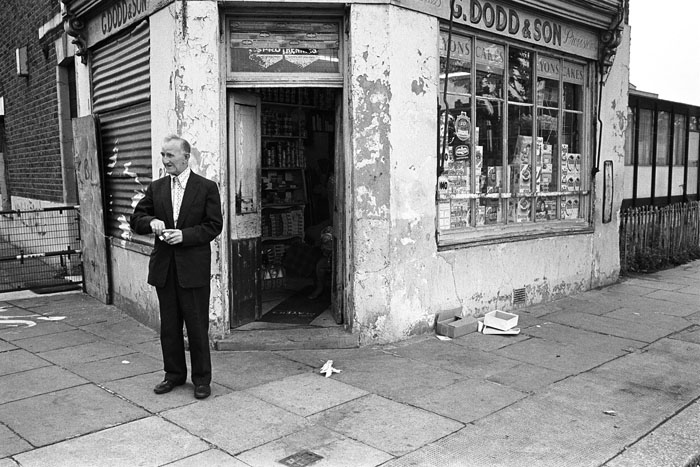
Corner shop, Brunel Road, Rotherhithe, London, July 1974. © Geoff Howard.
Gentrification by Charles Jennings:
Two geezers in overalls flicking litter into a truck (‘Could’ve bleeding stayed in bed, didn’t know it was only this one’). Keeping their ends up against the taggers and bomb artists on the main road. ‘That shouldn’t be allowed ’cause they laid out a lot of money’. You’ve got your haggard local shops, giving out, giving in, ‘Houses & Flats Cleared, Apply Within’, a stupidly optimistic fingerpost. The coughing of the birds, the single, muted noise of a car driving along in first a block away. ‘Big Reductions on Room Size’, with a tiny old lady picking at some cream-vinyl dining chairs stuck out on the pavement as if they were poisonous, a dysfunctional boy pulling at the hair of a girl in a newsagent’s doorway, the sullen rumble of a train. Who’s going to be passing through? Dead cars, living cars, stuff you do to your car, garages. Those jaded avenues of small houses, nervy pre-dereliction, the effort to keep up. The midget shops, the kebabs, the roaming crazies (woman in a tank top scouring the bins: ‘Fucking said to him, “Fucking listen”‘). This tomb of obscurity: drowning in toxins, grimed-up, catching screams from the estate on the west side, the traffic barrelling to hell on the roundabout. Sort myself out a nice K-reg Astra. It’s shy of life, but only because it’s keeling over.
… for The London Column. © Charles Jennings 2012.
Rotherhithe Photographs: 1971-1980 by Geoff Howard is available direct from the photographer at £25.


 The London Column