On the South Bank. (2)
Posted: August 7, 2013 Filed under: Amusements, London Places, Monumental | Tags: BMX Southbank, peadar o'donoghue, southbank poem, southbank skate park, Southbank Undercroft 4 Comments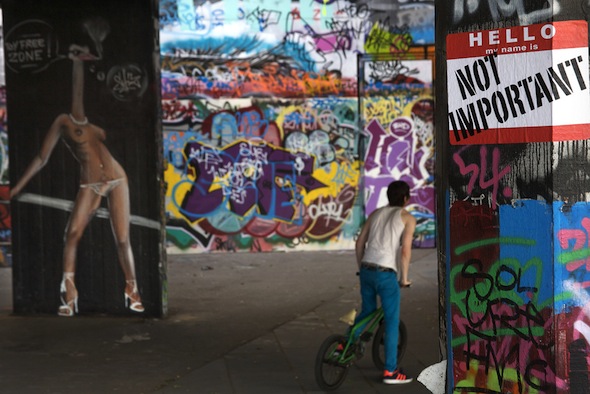
BMX Bike, Southbank Photo: © Mark Granier
Southbank
Everything is neither synonym nor like-
We bruise easy, for example;
Peach. Mottled. Punch.
A fib to say more Lyre than Lear,
The juice of the word ‘apophysis’
The bathos of bone, splintered,
Bowdlerized, a coda of this melancholy,
This street theatre, this effervescent
Promenade, this cultural quarter
This street-beat named desire,
This sliding scale on the spinning,
This leave us be moment,
This warmth from the city.
© Peadar O’Donoghue
Peadar O’Donoghue’s first collection, Jewel, is published by Salmon Poetry, and he edits The Poetry Bus magazine.
On the South Bank. (1)
Posted: August 6, 2013 Filed under: Architectural, Artistic London, Monumental | Tags: london civic space, southbank skate park, The Southbank Centre Comments Off on On the South Bank. (1)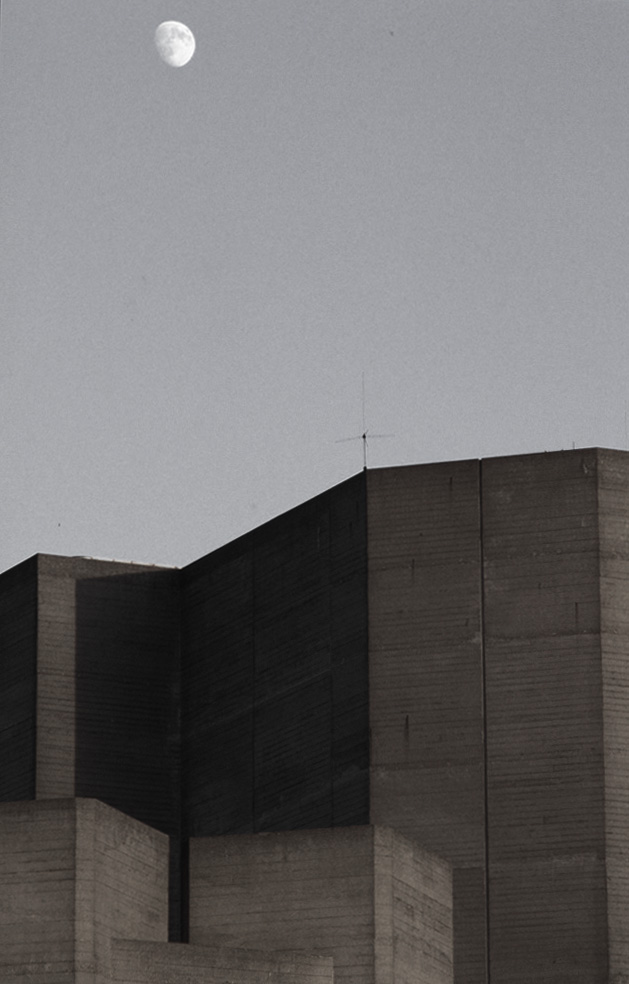
National Theatre. © David Secombe 2010.
Brutalist architecture has never been popular in Britain. The garden, the milk float, the net curtain, all work to alienate the British sensibility from the modernist, and especially the Brutalist, vision. We don’t care how pure its aesthetic is. We like things Nice.
Maybe the one exception is the good old South Bank. For some reason, despite decades of controversy, two murders, and several refits and remodellings, this complex of buildings is that genuine thing, beloved of the people. Unpromising as one may think it looks (though it is now dotted all over with bright structures, a giant yellow stairway, a turquoise Mexican place in shipping containers, pink things, green bits; they do certainly brighten it up). This is by accident as much as design. Maybe familiarity. Maybe proximity to Tate Modern. Maybe the development of Gabriel’s Wharf and that whole stretch of the river into something a little more friendly. Partly the skateboarders, who just seem to exist alongside everything else, whose thwack thwacks have followed us along that path by the river since the seventies. Certainly the restaurants: people always want something to eat, and the current proposed redevelopment is essentially an opportunity to expand on this.
At just that point, it stops being accident and becomes something more sinister. The space, rejuvenated as it is, has felt increasingly managed (that is, filled with things to be bought) for the past span of years. This is in keeping with a trend, as civic space becomes more and more tied to retail; we are forgetting how to occupy a city without buying, without being told what to look at. If this plan goes ahead, the stretch of river we love most will end up like the renovated Brunswick Centre, with added Thames.
But the Brunswick doesn’t incorporate two of Britain’s most important cultural venues – or the Thames. There is a debate that Londoners (particularly; but also the whole country) need to have about what kind of shared space this complex is supposed to be – who is it for? what is it for? what do we value about it? what do we want it to be like? And, if nothing else, we appear now to be beginning to have that debate (this link is the most informative article we’ve seen on the subject).
The South Bank is important on a personal level. Many of us – most of us, in London – have played out our lives with it as a backdrop. Much as it pains us to admit it, Richard Curtis got that much right; every new relationship seems to have a South Bank moment, and serendipity multiplies there. You meet people, you see things, you get some space to contemplate the sky, you feel the proximity of the physical river, suddenly London feels open and mysterious. But serendipity only happens if you’re left alone to find it. The existing Southbank Centre has more than enough cafés, about 2000% more than ten years ago, and we liked it even then. (Very fond memories of the unassuming old canteen, going back further.) It has been that rare thing: a public space where one can feel private.
These shop-heavy proposals – necessitated by the desperate need for funding to maintain ever-growing levels of activity – will transform the area into yet another crowdfuelled, corporatised zone (art needs people; corporations need crowds). They will gut the Festival Hall embankment in the way that the Royal Opera House extension (also paid for by shiny shops) eviscerated Russell Street. No one can argue that the Royal Opera extension didn’t effectively kill the life (as distinguished from the shopping and eating) of the eastern end of Covent Garden Piazza; and you only have to look at what has been done to Spitalfields and Borough markets in the past few years to be afraid for the South Bank.
Aside from which, everyone seems to have forgotten a principle that was voiced by the influential architect Cedric Price (who designed a radical overhaul for the South Bank in 1983, complete with giant ferris wheel). He said that cities and buildings should never be empty, but nor should they ever be full. For all the recently-added ‘lifestyle opportunities’, this stretch of embankment has been one of the few areas left in London that retains some of this balance; and it’s going.
This is a big thing to say, and it is the crux of the debate the nation needs to have about the South Bank. (And indeed London.) The Southbank Centre has apparently got all kinds of educational remits to fulfil, and outreach, and developing the audiences of tomorrow, and family-friendly holiday activities to lay on, and tourists to first attract and then cater for, and the developments are partly to enable all of this. They’re also, to create badly-needed space for existing facilities: the Poetry Library, for one. Billy Bragg wrote compellingly the other day about the needs of performers, and the projects he describes that are going on at the Southbank Centre are inspiring. Itislovely to go there and have a roof garden. Both of your correspondents here love the South Bank: we use the centre constantly and depend on it hugely. But none of that means the developments in their current form – new shops and restaurants, an obstructive building in the middle, an even more ruined skyline over the river, a giant glass box squatting on top of everything, put through at speed and not consulted on – look like improvements to the actual city. (Sir Nicholas Hytner may have a point.) It’s time to stop, take a breath, have the conversation. This has been as good as said by architects who could have pitched for the contract, but didn’t. As the Architect’s Journal reported:
Bennetts Associates had already withdrawn from the competition, claiming that it had too much work and that it had ‘reservations about the brief’ (see AJ 20.09.2012). Rowan Moore, writing in the Observer, also raised concerns about the ‘commercially-led’ plans which he said could ‘make the Southbank Centre resemble Terminal 5 or Canary Wharf or any moderately upmarket shopping mall.’
After the Tories won the 1951 election, they prioritised the destruction of the Festival of Britain site, for ideological reasons. The current government’s attitudes both to the arts and to public space, similarly ideological, have put institutions large and small under pressure to prove they have a right to exist (you earn the right by making money). The current proposed Southbank scheme is thus about to act out the contemporary version of this philistinism, and the fact that it is presented in the language of ‘inclusivity’ makes it more chilling.
This idea of inclusivity is being underpinned by branding, some of it quite subtle, and the brand seems increasingly personality-driven. Artistic Director Jude Kelly is the driver of these developments, and indeed of the whole ongoing ‘revitalisation’ of the centre. She has made herself admirably available to defend the proposals, and her vision, but the danger is that the whole vision for the South Bank feels like a personal vision. If one wants an ice cream in the interval at the Festival Hall, one even buys a ‘Jude’s Ice Cream’! (The franchise is Minghella.) ‘Southbank Centre’, having already joined up the words South and Bank, has now dropped ‘The’ from its name – turning it from a place into a brand – Southbank Centre – rather as if it were a restaurant or shop. It begins to feel like a sort of Boden or Orla Kiely cultural space, where middle class people (because we are all middle class now) are safe to consume culture en masse along with our pizzas, noodles, and extra-large caramel lattes. But where’s the space for the genuine, austere surprise ? The one no one could plan for you?
We know times have changed – we certainly do know it – but if this blog post is anything, it’s a plea for a deep breath and a deep look at what things really mean. And we’ve barely even mentioned the skateboarders.
We’ll be posting the rest of the week with pictures and impressions – poems, not polemics – of the South Bank and the people who use it.
© Katy Evans-Bush
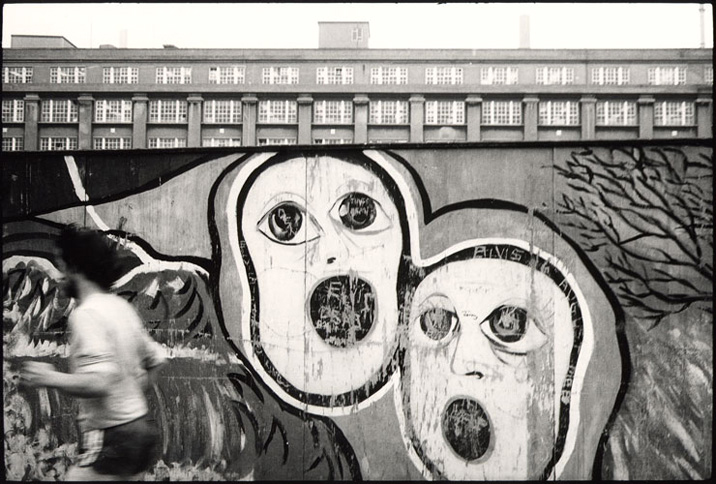
Hoarding opposite National Theatre. © David Secombe 1982.
After the Gasometers.
Posted: March 5, 2013 Filed under: Dereliction, Monumental, Vanishings | Tags: Gasometers, Haggerston, Regents Park Canal Comments Off on After the Gasometers.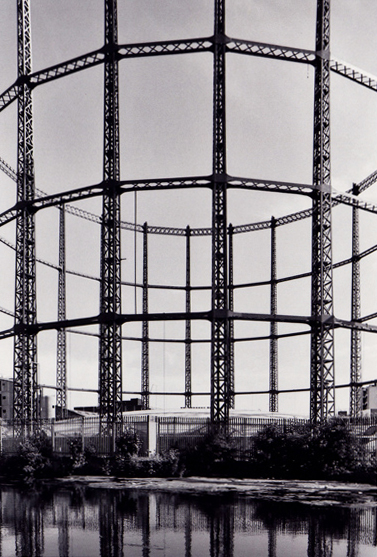
Gasometer, Regents Canal, Haggerston. © David Secombe 2010.
After the Gasometers by Katy Evans-Bush
If those were crowns, the kings
must have stretched out underground
from Regents Canal to Stepney Green.
At that size, they were gods. But no,
the earth was level: a thick eiderdown
of chemicals and dirt, beneath the play
of air on iron filigree, the orange light
that danced at sunset through the rings.
… from Egg Printing Explained, Salt Publishing, 2011.
A Psychogeographical Christmas. Photo & text: David Secombe.
Posted: December 20, 2012 Filed under: Architectural, Crime and Punishment, Food, Health and welfare, Hospitals, Housing, Literary London, London Labour, Monumental | Tags: Billy Butlins, BT Tower, charles dickens, Christmas Day in the Workhouse, Cleveland Street Workhouse, Cold War, Noel Edmonds, Post Office Tower, White Heat of Technology Comments Off on A Psychogeographical Christmas. Photo & text: David Secombe. The Cleveland Street Workhouse and the BT Tower. Photo © David Secombe 2011.
The Cleveland Street Workhouse was built in 1775 as a workhouse infirmary and ended up as part of the Middlesex Hospital until that institution closed in 2005. According to The Cleveland Street Workhouse it ‘has survived largely unchanged since the Georgian era. Its austere appearance is a rare testimony to the bleak and utilitarian institution it was designed to be. Its back yard was a graveyard for the poor, full of dead to a depth of at least 20 feet. Recent research has revealed that the building was the likely inspiration for Charles Dickens’ Oliver Twist, since the famous author lived a few doors away, on the same side of the road, for nearly five years of his young life, before he became famous as ‘Boz’’.
As it is Dickens’s bicentennial year, I offer here a glimpse of the grim edifice that loomed over the infant Dickens’s early years in the city. He was only two years old when his parents, fresh from Portsmouth, found lodgings in Norfolk Street – now Cleveland Street – in 1814. At that time the area still had a semi-rural character, with fields and farms lying just east of Tottenham Court Road – although the grand houses of Fitzroy Square were under construction and the churning awfulness of Oxford Street was only a few yards away. Dickens’s friend John Forster said that the novelist was able to recall vivid details of his early childhood, so it is an attractive proposition to believe that the workhouse in the picture above marked itself indelibly upon young Charles’s imagination during the three years (not five) in which he and his family lodged in the district. By 1817, Charles’s father had got a job in Chatham, and it was another five years before Dickens returned to the city, leaving his idyllic years in the Kent countryside for a more permanent engagement with ‘the great wilderness of London’.
The traditional Christmas is in many ways Dickens’s own creation, marked in particular by his characteristic juxtaposition of seasonal conviviality against the bleakness outside: ‘exaggerating the darkness beyond the small circle of light’ as Peter Ackroyd puts it. Dickens described composing A Christmas Carol whilst walking ‘the black streets of London, fifteen and twenty miles, many a night when all the sober folks had gone to bed’ and, for all its fairy-tale sentiment, it succeeded in rousing the conscience of his contemporary audience. The following year he produced The Chimes, another seasonal polemic. According to Ackroyd, The Chimes was partially inspired by a complacent review of A Christmas Carol and also by a story in The Times concerning a young woman, terrified of the workhouse, who had thrown herself and her baby into the Thames – the baby drowned, but the mother was rescued and condemned to death for murder of her child. The Cleveland Street Workhouse was Grade II listed in 2011 and, given Dickens’s agitating for reform of the Poor Law and his disdain for old buildings in general, he would probably have been appalled that this symbol of misery had been preserved for the nation – but there’s no question that the building retains its cruel power, an emblem of the darkness and suffering against which Dickens created some of his most brilliant effects..
Further north on Cleveland Street is the BT Tower, built as The Post Office Tower in 1961, the tallest building in London for nearly 300 years (it was taller than St Paul’s), its construction flattening a block of Workhouse-era buildings on the corner of Howland Street, including the one where Paul Verlaine and Arthur Rimbaud had lived during their stay in the city. The cylindrical form of the Tower was intended to lend stability in high winds – especially, it was darkly muttered, those from a nuclear blast. The Tower is also Grade II listed, and it too is an emblem of its time, redolent of the Cold War and the avowed technological modernity of the MacMillian/Wilson ‘White Heat of Technology’ era. When it opened in 1965, it boasted a revolving restaurant at its top, a concession operated by Billy Butlin; but if a nuclear exchange had taken place, the Tower would have been essential in maintaining contact between whatever was left of Britain and whatever was left of everywhere else. Today, advances in communication technology and the end of the Cold War have left the Tower almost as obsolete as its neighbour the Workhouse. The revolving restaurant was closed after an IRA bomb incident in 1971, and plans to re-open the venue for the 2012 Olympics were quietly shelved – which is a pity, as it would have made a suitably elevated position for the ego of some superchef or other. But, as this is a Christmas post, it is pleasing to report that on Christmas Day 1984, Noel Edmonds’s Live Live Christmas Breakfast Show was broadcast from the top of the Tower, an event described by its coiffed and beaming host as ‘one of the greatest communications projects ever put forward’. Noel went on to present several such Christmas Day TV events from the Tower throughout the 1980s, thus associating an icon of post-war modernity with the traditional late-20th Century Christmas: bored, over-fed and in front of the telly.
(NB: My friend and colleague Chris Brand has just pointed out that I have overlooked the Post Office Tower’s finest moment, in The Goodies’s Kitten Kong episode. Was this a Christmas special? Who cares.)
And on that tenuous and tortuously established link, we would like to wish all our readers a very Happy Christmas.
… for The London Column.
See also: The London Nobody Knows – revisited, Christmas on Greek Street


 The London Column