Hockley Hole, AKA Central Saint Martins. Photo & text: David Secombe.
Posted: May 16, 2012 Filed under: Amusements, Artistic London, Bohemian London, Public Art, Vanishings | Tags: Back Hill, Central Saint Martins, Common People, Hockley in the Hole, John Driscoll, Johno's Darkroom 2 Comments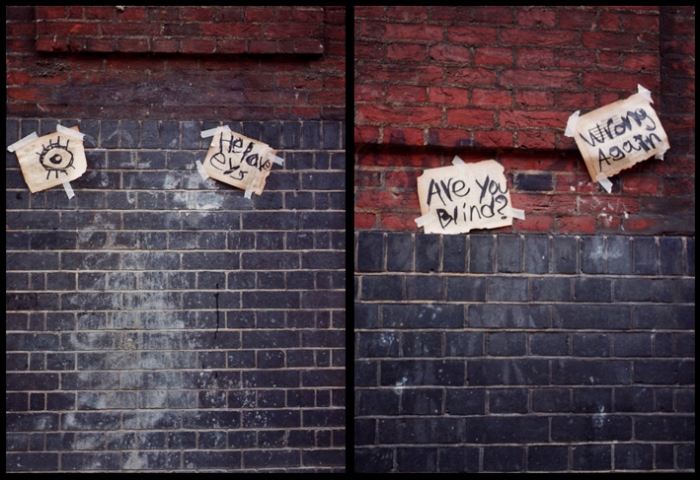
Back Hill, 2010. © David Secombe.
From The Fascination of London: Holborn and Bloomsbury, edited by Sir Walter Besant 1903:
The lower part of Saffron Hill was known at first as Field Lane, and is described by Strype as “narrow and mean, full of Butchers and Tripe Dressers, because the Ditch runs at the back of their Slaughter houses, and carries away the filth.” Just here, where Back Hill and Ray Street meet, was Hockley Hole, a famous place of entertainment for bull and bear baiting, and other cruel sports that delighted the brutal taste of the eighteenth century. One of the proprietors, named Christopher Preston, fell into his own bear-pit, and was devoured, a form of sport that doubtless did not appeal to him. Hockley in the Hole is referred to by Ben Jonson, Steele, Fielding, and others. It was abolished soon after 1728. All this district is strongly associated with the stories of Dickens. In later times Italian organ-grinders and ice-cream vendors had a special predilection for the place, and did not add to its reputation.
David Secombe writes:
One might add that in the 20th century, the area described above became associated with the photographic profession: at one time Clerkenwell was said to have more darkrooms and studios per square foot than anywhere else in the world. As a coda to yesterday’s post remembering the great Johno Driscoll, here’s a picture of ‘found art’ posted to the wall of John’s old premises, Holborn Studios, which is now a campus for Central Saint Martins art college. The building is situated within ‘the Hole’ – although the site of the bear-pit itself is now occupied by the pub opposite, The Coach and Horses. (Allegedly, the pub once afforded access to the Fleet river from its cellars, providing 18th Century fugitives with an escape route to the Thames.) Somehow, it seems right and proper that one of the most disreputable spots in 16th and 17th Century London should have gone on to be associated with photography, fashion, and art: the favoured trades of chancers, ne’er-do-wells and diamond geezers.
… for The London Column. See also: Little Jimmy, King of Clerkenwell.
London Monumental. Photo & text: David Secombe (5/5)
Posted: September 10, 2011 Filed under: London Places, Public Art | Tags: Art Deco, Broadcasting House, Eric Gill, The Tempest Comments Off on London Monumental. Photo & text: David Secombe (5/5)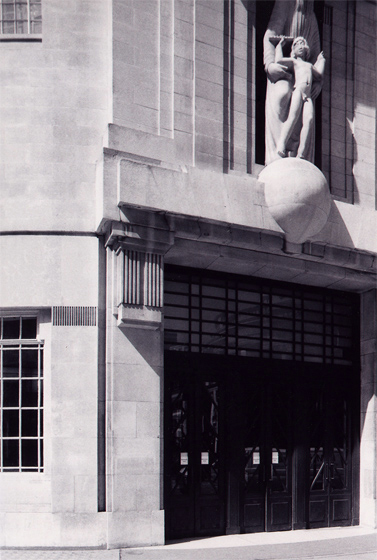
Gill’s Prospero and Ariel, Broadcasting House, 99 Portland Place, W1. Photo © David Secombe 2010.
The artistic legacy of Eric Gill (1882 – 1940) has been irretrievably sullied by the revelations made public in Fiona MacCarthy’s 1988 biography. MacCarthy quoted passages from Gill’s diaries in which he recorded a grotesque catalogue of perversions, including incest with his sister and daughters, as well as a passing liason with the family dog. Gill’s reputation was thus transformed from brilliant bohemian, who fused medieval craftsmanship with modernist practice, to that of a paedophile whose erotic carvings and prints are queasy evidence of a diseased mind.
Many of Gill’s admirers were appalled that MacCarthy had put this knowledge into her book, a sharp contrast to previous biographers who had resolutely ignored the evidence of the diaries. (That MacCarthy was blamed for her act of biographical integrity is appalling in itself.) At any rate, it is no longer possible to survey Gill’s huge output – his many religious carvings in cathedrals and churches, his monuments to the fallen carved in the wake of the First World War, his engravings, even his supremely elegant typefaces (Gill Sans, Perpetua, etc.) – without confronting the upsetting truth about their creator.
There are some fine examples of Gill’s public art in London: in Westminster Cathedral, on 55 Broadway, above St.James’ tube station, and his epic embellishments to the BBC’s flagship headquarters, Broadcasting House in Portland Place. B.H. features a cluster of works by Gill, most prominently his awe-inspiring Prospero and Ariel, two monumental carved stone figures which loom above the main entrance. There are many photographs of Gill working on the statues in situ: dressed in his customary monastic habit (affording passers-by glimpses of his genitals, as he considered underwear an ‘abomination’), Gill resembles a medieval stonemason carving for his God – or, perhaps, an extra who has wandered off the set of a period epic being filmed by Alexander Korda at Denham Studios. Broadcasting House is a sleek hymn to the Moderne set in Portland Stone, a Deco jewel keen to slip its moorings and set sail down Regent Street. And, for all Gill’s avowed medievalism, his sculptures are in keeping with the spirit of the times: Prospero and Ariel look fully at home at the prow of the BBC’s own dry-docked ocean liner.
… for The London Column. © David Secombe 2011.


 The London Column