London Gothic. Photo: David Secombe, text: Andrew Martin (3/5)
Posted: July 4, 2012 Filed under: Architectural, Dereliction, Housing | Tags: Andrew Martin, Avoided House, Bates Motel, Camberwell, haunted London Comments Off on London Gothic. Photo: David Secombe, text: Andrew Martin (3/5)
Camberwell. © David Secombe 1988.
From Ghoul Britannia (2010) by Andrew Martin:
THE AVOIDED HOUSE
In a street of any length, there’s one of these: a vacant house, or one that changes hands too often, or not often enough; a house in shadow or being taken over by its own garden. There were a couple of these on my paper round when I was a boy. One had cracked windows, and a decaying Transit van parked immediately in front of the front door. Another had the curtains permanently closed and a front garden filled with rubble. I was encouraged by this rubble. I thought: ‘One day soon they’re going to use it to construct something marvellous like a pond with a fountain.’ But the rubble just remained. I never saw the occupants of either house and I didn’t want to. I found it hard to imagine them going into Ellis’s newsagents and paying for the papers I delivered to them. That would require a degree of normality incompatible with the state of their homes.
It didn’t take much for me to condemn a property; it didn’t have to be semi-derelict. For example, I wasn’t very keen on any of the house facing our own because they didn’t have the sun on them in the morning; and some of my friends’ houses just felt wrong inside. I am not going to broach the subject of psycho-geography because I find myself dying with exhaustion at the typing of the word, but it has been argued that houses with a reputation for being haunted occupy sites where ley lines intersect. Also blamed – and I like this – is carbon monoxide poisoning. This occurs where carbon combustion occurs with too little ventilation, and there’s quite a neat fit with ghostliness in that the symptoms can include anxiety and hallucinations. People burning wood or coal, or using coal-gas lighting in a shuttered room might be at risk, which connects the condition with Victorian winters – a fertile time for ghost stories.
When I first came to London I was amazed at the number of avoided houses. They constitued about fifteen percent of the total stock.
© Andrew Martin. Ghoul Britannia is published by Short Books.
See also: Halloween, The Haunted House.
London Gothic. Photo & text: David Secombe (2/5)
Posted: July 3, 2012 Filed under: Crime and Punishment | Tags: Cranley Gardens, Cricklewood, Dennis Nilsen, killing for company, Muswell Hill, The Salisbury Comments Off on London Gothic. Photo & text: David Secombe (2/5)
Parkway, Camden. Photo © David Secombe 1989.
From This is London, 9th November 2006:
Serial killer Dennis Nilsen confesses to first murder
London serial killer Dennis Nilsen speaks today about his first victim – a boy of 14. In an extraordinary letter sent from his prison cell, Nilsen tells how he picked up Stephen Holmes in December 1978 in a Cricklewood pub. He took the boy to his home where he killed him. It was the beginning of a series of gruesome murders of young men that went on until his arrest in 1983 after human remains were found in a blocked drain at his Muswell Hill home. In the letter sent to the Evening Standard Nilsen, 60, confesses: “Stephen Dean Holmes was the first of 12 homicide victims.” In fact it is known he killed at least 15 men, among them rent boys, students and the homeless he lured back to his homes in Cricklewood and Muswell Hill. At least seven victims remain unidentified.
Nilsen promises to help police identify the rest of his victims although Scotland Yard has ruled out ever knowing definitively the names of the other men he murdered, usually by strangulation. Nilsen, a civil servant who had previously worked in the Army and police, was never charged with the offence because at the time of his trial in 1983, Stephen could not be identified. But a photograph of the boy, who was reported missing by his family, was shown to Nilsen last year by police visiting him at Full Sutton. The killer confirmed to detectives that the boy in the photograph was his first victim. He kept the body stuffed under the floorboards of his flat in Melrose Avenue, Cricklewood, for eight months before burning the remains in the back garden. He used the same method to dispose of several victims. Nilsen was only caught out after moving to a flat in Cranley Gardens, Muswell Hill, where he lived in the attic and had no access to a garden. He chopped up three victims and stuffed their bodies down the drain. After complaints about the smell, a plumber found 30 to 40 pieces of human flesh beneath the manhole cover, leading to Nilsen’s arrest and eventual conviction on six counts of murder.
David Secombe:
Nilsen’s grim story is well know and has been much picked over by writers (e.g.Brian Masters in Killing for Company) seeking to examine the nature of evil and the way London – or any big city – swallows the unwary. The police hadn’t been looking for a serial killer, Dennis simply made his victims disappear without trace – until Dyno-Rod were called in to investigate a blocked drain.
There is a rich seam of modern folklore surrounding Nilsen. There are Nilsen’s own work colleagues at the job centre in Denmark Street – he was popular – who helped him move between Cricklewood and Muswell Hill (‘What have you got in here, Dennis? Bodies!’ ‘Yeah’) or who drank his punch at the office Christmas party, Dennis doling it out from the same enamel pot he used to boil heads in. A man living adjacent to Nilsen’s Cricklewood house who was plagued by ghoulish treasure hunters. The woman who went to look at an ‘amazingly cheap’ flat in Muswell Hill and was about to make an offer when a work colleague asked if it was a top floor flat in Cranley Gardens? (She didn’t buy the flat, it was then sold to a foreign couple who discovered what had gone on there after they’d bought it and then couldn’t live there … ) I have met people who have told me all of these stories – although they didn’t actually happen to them, but someone they knew. In a way, Nilsen has become a much a part of London folklore as Sweeney Todd – except that the latter (‘Attend the tale of Sweeney Todd/His skin was pale and his eye was odd’, according to that alleged lyrical genius Stephen Sondheim) never existed in reality as anything other than a Penny Dreadful ballad. Nilsen was the real thing: nemesis in the form of a good samaritan helping a homeless youth; the friendly chap propping up the bar at The Salisbury or The Coleherne, always willing to buy a stranger a drink and offer him a bed for the night.
… for The London Column.
London Gothic. Photo & text: David Secombe. (1/5)
Posted: July 2, 2012 Filed under: Dereliction, Literary London, Vanishings, Wildlife | Tags: Arthur Machen, Camden, Holloway, London Gothic, Peter Ackroyd, tea party Comments Off on London Gothic. Photo & text: David Secombe. (1/5)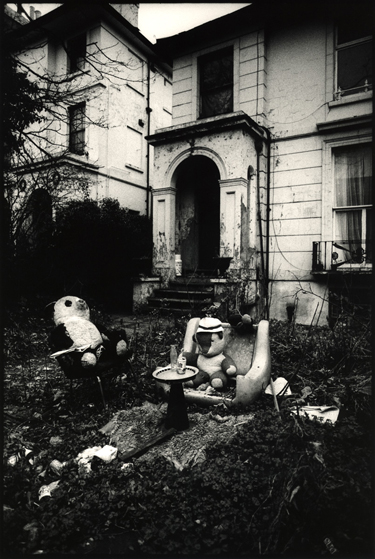
Camden Road. © David Secombe 1987.
From London The Biography by Peter Ackroyd, 2000:
Whole areas can in their turn seem woeful or haunted. Arthur Machen had a strange fascination with the streets north of Gray’s Inn Road – Frederick Street, Percy Street, Lloyd Baker Square – and those in which Camden Town melts into Holloway. They are not grand or imposing; nor are they squalid or desolate. Instead they seem to contain the grey soul of London, that slightly smoky and dingy quality which has hovered over the city for many hundreds of years. He observed ‘those worn and hallowed doorsteps’, even more worn and hallowed now, and ‘I see them signed with tears and desires, agony and lamentations’. London has always been the abode of strange and solitary people who close their doors upon their own secrets in the middle of the populous city; it has always been the home of ‘lodgings’, where the shabby and the transient can find a small room with a stained table and a narrow bed.
David Secombe:
In the midst of our jingoistic Olympic summer, I thought it might refreshing to explore the aspect of London so eloquently evoked by Peter Ackroyd in the passage above. A city of silent yet inhabited houses, anonymous windswept streets, overgrown front lawns, strange objects on the back seats of abandoned cars, forbidding municipal playgrounds, etc. (This is essentially the same territory explored by Geoffrey Fletcher in The London Nobody Knows, and as the last series on The London Column was a revisiting of Fletcher’s book, this one may be seen as a continuation of the same theme.) ‘London Gothic’ is becoming increasingly rare; most of the streets that Arthur Machen thought of as woeful are now exemplars of prosperous gentrification. London is a cleaner, neater place: even King’s Cross is a landscaped zone now. The photo above was taken a quarter of a century ago, and Holloway has come up in the world since then. The specific, shabby London charm that Machen and Ackroyd describe may still be found, but one has to look harder. As a small boy visiting the city from the suburbs, I was amazed by the soft enveloping greyness which made the occasional bursts of colour all the more striking. That quiet visual texture is vanishing, when even municipal housing wears screaming day-glo colours, as 1960s & 70s blocks are clad in blue, yellow, or turquoise panels. London wears its dread in brighter shades these days.
… for The London Column.
The London Nobody Knows – revisited. Photos & text: David Secombe. (4/4)
Posted: June 22, 2012 Filed under: Pavements, Public Art | Tags: Charles Mayhew, Geoffrey Fletcher, London Labour and the London Poor, The London Nobody Knows Comments Off on The London Nobody Knows – revisited. Photos & text: David Secombe. (4/4)
London Bridge. Photo © David Secombe, 2002.
From The London Nobody Knows, Geoffrey Fletcher, 1962:
Begging, pure and simple, seems to have almost disappeared from the London streets, even the most impoverished making an attempt to offer some trifle in exchange for a coin. Mayhew’s book on the London poor is one of several books necessary for a study of the city’s pavement life, of which now only fragments remain. Victorian London was full of such harrowing sights as the man I saw years ago, legless and armless, selling ballads, or the festering bundel of rags covering the remains of a woman I saw more recently on the Embankment – a bundle of rags, however, that did not lack vocal abilities. On my starting to draw her, she cursed in language which would have given a bargee the shudders, and so I pushed off.
David Secombe:
The dolls in the photograph above were situated in the elevated walkway which links London Bridge with London Bridge Station, and formed part of an elaborate and idiosyncratic beggar’s pitch. The beggar in question had taped dolls holding lit joss sticks to three posts in the walkway, and as commuters hurried past him and his installation he performed a manic, shuffling dance, jerking back and forth violently, lunging at them with his cap. I asked him if he would mind having his photo taken and he declined, although he didn’t object to me picturing the dolls. He was clearly very proud of his pitch, which seemed more suited to White Cube or Flowers East than a begging bowl on London Bridge Station. There is probably some earlier precedent for his particular schtick, but I can find nothing like it in Mayhew, and he may have invented a new form: avant-garde panhandling.
Given time, certain members of London’s homeless communities become landmarks. In his ‘biography’ of London, Peter Ackroyd mentions the lady who appeared to live in a doorway near the shop Forbidden Planet on New Oxford Street for much of the 1990s: as Ackroyd noted, she had sat there day in, day out for so long that her outline was impressed upon the stone behind her. And there was the eccentrically dressed but actually quite beautiful woman who was a fixture in Lincoln’s Inn Fields for many years. I don’t know what became of the doll man, but I rather hope that his fate was less grim than the elderly oriental man who is a current fixture on Hungerford Bridge. He has a kind of toy guitar equipped with one string and a little hammer which he taps on it, feebly hitting the same note over and over again. He is worthy of Mayhew, and Fletcher, in authentic human misery.
… for The London Column.


 The London Column