Flotsam and jetsam. Photo & text: David Secombe. (1/5)
Posted: April 16, 2012 Filed under: Housing, The Thames | Tags: Canary Wharf, corporate London, Isle of Dogs, Piers Gough, River Thames Comments Off on Flotsam and jetsam. Photo & text: David Secombe. (1/5)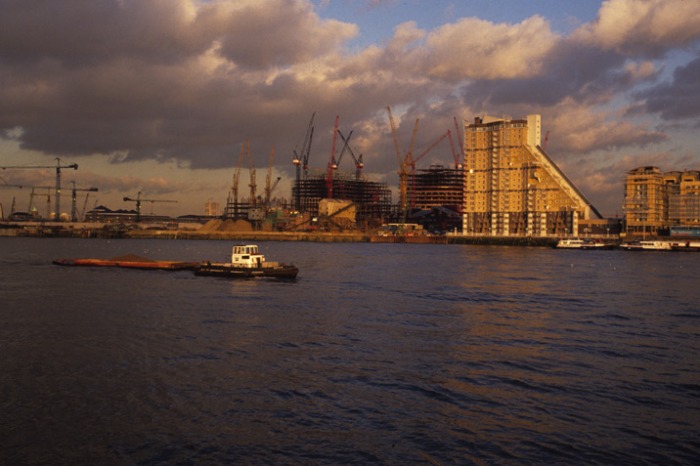
Isle of Dogs, 1988. Photo © David Secombe.
From Without the City Wall, Hector Bolitho and Derek Peel, 1952:
No part of London endured more bombing during the Second World War than the Isle of Dogs. Anyone who has flown over the Thames at night will recall how the river makes a splendid curve here, and how the moonlight shining on the slow oily waters turns the peninsula into a perfect target. The German bombers came to know it well, and the dock and warehouses suffered night after night. The rebuilding has covered many of the scars, but also many of the old romantic streets …”
David Secombe writes:
The photo above – taken for a magazine assignment to illustrate the growth of London’s Docklands – gives a small indication of the speculative building frenzy which characterised the mid-1980s. The building on the right in the photo above, newly constructed when this picture was taken, is Cascades, designed by Piers Gough for CZWG architects. Cascades was the first private apartment block to be built on the Isle of Dogs – a trailblazer for all the other developments of ‘executive homes’ (marginalising the ‘indigenous’ population, naturally) which – despite the occasional market wobble – have followed in its wake. Elsewhere on the Isle of Dogs at the time of this image, the massive foundations of Olympia and York’s Canary Wharf were being laid; gradually, the ethereal, silver profile of 1 Canada Square (the “tallest habitable building in Britain” according to Wikipedia) rose into the sky, elegantly dominating the landscape for miles around – until it was crowded by a cluster of far more vulgar towers belonging to big, bad corporations like Barclays and HSBC. If anyone wants to look for physical manifestations of the arrogance of capitalism, the Isle of Dogs has to be London’s most conspicuous example.
… for The London Column.
Street traders. Photo David Secombe, text Susan Grindley. (3/3)
Posted: March 30, 2012 Filed under: Food, London Types, Markets, Street Portraits | Tags: Bobby Redrupp, Chapel Market, fruit and veg, Islington, London markets, Susan Grindley Comments Off on Street traders. Photo David Secombe, text Susan Grindley. (3/3)
Bobby Redrupp and customer, Chapel Market, 1990. © David Secombe.
Leakage in Chapel Market, N1
She’s hanging on. I go to lunch.
An old man with a dewdrop on his nose
shuffles towards the market, inching round
a rotting mango and the discarded cartons
propped against the shop that takes my eye
with its display of candyfloss-pink chairs.
A boy reads from a placard to his friend
that Superman has lost his fight for life.
It’s only the cold wind that fills my eyes
and cyclamen in a new shade of purple.
© Susan Grindley.
Street traders. Photo & text: David Secombe. (2/3)
Posted: March 29, 2012 Filed under: London Types, Markets | Tags: Brixton Market, Christopher Columbus, Oswald Denniston 1 Comment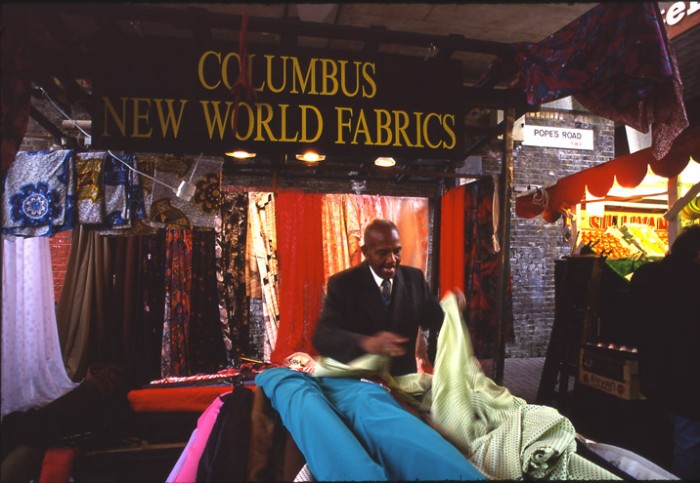
Oswald ‘Columbus’ Denniston, Brixton Market, SW9. Photo © David Secombe, 1990.
From Of the street-sellers of textile fabrics: London Labour and the London Poor, Volume 1, Henry Mayhew, 1851:
These street-folk present perhaps as great a diversity of character as any of which I have been called upon to treat.Among them are the strong persevering men, who carry rolls of linen or cotton manufacture in packs on their backs, and trudge along holding a yard-wand by the middle, which – it is a not uncommon joke against them – is always worn down an inch or two, by being used as a walking-stick in their long pedestrian journeys. Some of these men love to tell of the many hundreds of miles they have walked in their time, and in the three kingdoms.
From The Daily Express, 23 June 1948:
Oswald M. Dennison – the first of 430 job-seeking Jamaicans to land at Tilbury yesterday morning from the trooper Empire Windrush – started a £4-a-week job last night. Wrapped in two warm blankets to keep warm, he settled in as a night watchman of the meals marquee in Clapham Common, SW where 240 of the Jamaicans are staying in deep wartime shelters. All of them sat down there to their first meal on English soil: roast beef, potatoes, vegetables, Yorkshire pudding suet pudding with currants and custard. A bed and three hot meals will cost them 6s.6d (32.5p) a day. Most of the Jamaicans have about £5 to last them until they find work. Oswald Dennison, 35-year-old sign painter, got his job after making a speech of thanks to government officials. He called for three cheers for the Ministry of Labour and raised his Anthony Eden hat. Others clapped. Panamas, blue, pink, and biscuit trilbys and one bowler were waved.
David Secombe:
When this picture was taken, Oswald ‘Columbus’ Denniston was a sprightly 76, and had been selling fabrics in Brixton for nearly thirty years – the first Afro-Caribbean trader in Brixton market. The photo was commissioned for a Sunday Times Magazine article on London street traders (which never appeared as the ‘London’ section of the magazine folded before the feature was published). By this time in his life, Oswald Denniston had become a potent symbol for the black community in London, his manifest virtues of charm, capability and decency commanding widespread fondness and admiration. The quote from Mayhew seems appropriate here, for surely no-one has ever travelled so far to sell fabrics as Columbus Denniston.
In 1998, he was interviewed by the BBC to mark the 40th anniversary of the Windrush sailing: the interview may be read here. He died in 2000; his Guardian obituary was written by Mike Phillips.
Street traders. Photo & text: David Secombe (1/3)
Posted: March 27, 2012 Filed under: Amusements, Fictional London, London on film, London Types, Markets, Street Portraits | Tags: Del Boy and Rodney, east street market, John Sullivan, Johnny Wallington, only fools and horses 3 Comments Johnny Wallington, East Street Market. Photo © David Secombe 1990.
Although only officially designated a market in the 1880s, East Street Market continues a tradition of street trading in Walworth that goes back to Tudor times. Perhaps more germane to the purposes of the current post is the identification of the market with the 1980s & 90s situation comedy Only Fools and Horses, which is set in Peckham and uses photographs of East Street Market in its opening titles.
The popularity of John Sullivan‘s TV series has given this stretch of south London its own place in modern popular culture. Sullivan himself was from Balham, and he knew the milieu very well. He was working as a scene shifter at the BBC when he approached producer Dennis Main Wilson with an idea for a comedy. Main Wilson was a genuine enthusiast for comedy, a quality not always found in producers of ‘light entertainment’, and had an impeccable gift for searching out the genuine article. The idea was commissioned and became Citizen Smith.
Sullivan’s south London is a fabled place: Del and Rodney live in the mythical Nelson Mandela House (although there is a Nelson Mandela Way not too far away), the local boozer is a haunt of cartoon geezers and Peckham the bucolic playground for an assortment of genial chancers, through whom Sullivan has contributed several phrases to colloquial English. Television writers such as Sullivan and Galton & Simpson (Hancock’s Half Hour, Steptoe and Son) have created Dickensian characters for modern times, refashioning London in the image of their creations. Peckham has become Del Boy’s manor, just as any mention of Cheam conjures up the ghost of Anthony Aloysius St John Hancock – and Surbiton still bears the scars of The Good Life.


 The London Column