Boxers of Bethnal Green. Photo & text: Alex Hocking. (2/5)
Posted: February 7, 2012 Filed under: London Places, London Types, Sport | Tags: blood lust, the Fairest Sport in the World, York Hall Comments Off on Boxers of Bethnal Green. Photo & text: Alex Hocking. (2/5)
York Hall, Bethnal Green. © Alex Hocking 2011.
Alex Hocking:
I had never been into boxing. My granddad had been (“The fairest sport in the world,” I remember him saying), but my dad wasn’t and my mum thought it was brutal. I’d never really been into boxing films either. Rocky was too silly, with Stallone too incomprehensible and the outcomes too predictable. I preferred Raging Bull’s storyline, but didn’t consider it A Great Film because it was about boxing, a sport I wasn’t interested in. I came to see the appeal of boxing through the viewfinder.
Although I turned up at York Hall in Bethnal Green for aesthetic reasons I left with an appreciation of the sport and the atmosphere a good event generates. From the edge of the ring, camera jutting between the ropes and elbows on the canvas, one can hear the difference between a body shot (hollow) and a punch to the face (quieter but sharper, slappier), one can feel the canvas move as the fighters advance, stumble or collapse. I saw blood drip from an eyebrow, land beside my camera and get smeared by a boot. Between matches, fights break out among the crowd and heavily made-up girls look on approvingly.
Fans spilling out from the neo-Georgian building’s small bar are ushered to the sides to make way for the boxers as they approach the ring, twitching and keyed-up, surrounded by coaches, medics and hangers-on looking for vicarious thrills. The crowd cheers or boos the glittering pantomime as they try to gauge the fighters’ disposition and energy. Is the outcome portended by the manner of slipping between the ropes? The small flurries of punches cast into the air as the music diminishes? The shimmer of an eye or the angle of a chin? Sometimes they walk nonchalantly, eyes untelling, others swagger top-hatted and confident.
Some fighters have a routine they go through before a fight, every step and gesture recreated so as not to risk offending the fates. Bounce off the ropes, dance to the centre with fists high, turn once then twice, pass the cloak to the trainer, skip on the spot to warm the feet.
Up on the balcony, flags are unfurled: Albanian Eagles, Irish tricolours, slogans of support and abuse. The music ebbs away, lights drop, fighters bounce into their corners for a last minute pep talk. Gumshields go in. gloves are checked. By this point, some fighters will already know the outcome and are bracing themselves for noble defeat. Suits and sovereigns worn over crisp white shirts in the front rows, hushed predictions, t-shirts and last minute taunts from the cheaper seats, then a moment’s reverence before the cacophony that accompanies the first bell.
Watching boxers pummel each other made me feel a mixture of blood lust (I think I shouted for one guy to kill the other) and a kind of giddy revulsion, an awareness that I shouldn’t be getting an illicit kick out of someone taking punches. It’s brutal, but also fair and an accurate distillation of what all sport is at its core: opponents using everything they can to win, whether it is speed, composure, anger, fear, technique or strength.
Most interesting to me are the slower moments of pathos where the fighters slump into each others’ arms, sometimes in no hurry to extricate themselves as they agree to take a breather, or where a fighter sits sullenly in a corner, advice bouncing off him as he readies himself to go back for another painful round of inevitable beating. It’s in these moments rather than the sporty moments of competitors hitting each other that boxing gains its power and epic proportions.
Boxers of Bethnal Green. Photos Alex Hocking, text: David Secombe. (1/5)
Posted: February 6, 2012 Filed under: London Types, Sport | Tags: Bethnal Green, boxing, Everlast, Raging Bull, The Set-Up, York Hall Comments Off on Boxers of Bethnal Green. Photos Alex Hocking, text: David Secombe. (1/5)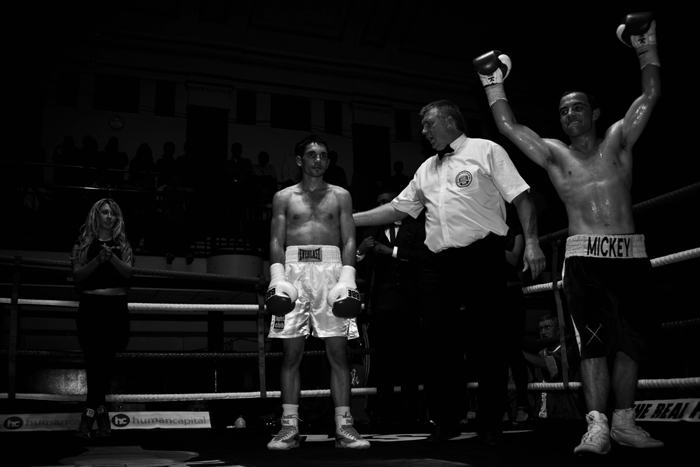
York Hall, Bethnal Green. © Alex Hocking 2011.
David Secombe writes:
Theoretically, boxing is a bracingly pure sport: two men hit each other until one of them falls over. Apart from bullfighting, it remains the modern world’s last remaining link to the primal brutality of the arenas of antiquity, the fighters acting as vessels for the aspirations and prejudices of the crowd.
The iconography of the modern sport was configured in the early-mid 20th century: press photographs by the likes of Weegee and Hollywood B-movies of the 1940s and 50s continue to inform our perception of the spectacle. In cinema, the boxing narrative generally involves a heroic and inarticulate outsider, loved by his doting wife/girlfriend/mother/child, fighting against the odds to claim redemptive victory in an unequal contest. Films such as The Set-Up, Somebody Up There Likes Me, Requiem for a Heavyweight and, most recently The Fighter, all use this template or variations on it. Dramatically, the boxing movie format is as clear and simple as the sport itself. And whilst there are many notable boxing films made in colour (Rocky, The Champ, Fat City, etc.) it is significant that Martin Scorsese chose to make Raging Bull in black and white. Raging Bull is an explicit homage to the golden era of boxing – although the protagonist of his story, the real-life boxer Jake La Motta, was a far cry from the noble chump played by Robert Ryan in The Set-Up, a model of the classic boxing movie. In black and white, boxers are mythologised; and since we don’t see the colour of blood, the suffering is rendered more abstract and perhaps less vulgar.
It is hard not to think of such precedents when looking at Alex Hocking’s pictures of boxers at Bethnal Green’s York Hall, a venue with a mythology of its own. This is not a sport inhabited by academic high achievers. Boxing allows these young men an opportunity for real-life redemption: intense, brightly-lit moments of aggression and pain in exchange for a shot at a better life. The picture above suggests a clear narrative for this particular fight: I don’t know anything about the boxers, what the outcome of the bout was, what interest – if any – the young woman took in the proceedings; but the image encourages me to imagine my own B-movie scenario for this particular match, featuring a noble and gifted newcomer, a tough but honest coach, a sick mother, a manipulative manager, a towering opponent and a girl with a heart of gold.
… for The London Column. © David Secombe 2012.
Speciality Acts. Photo: David Secombe, text: Claire Muldoon. (3/3)
Posted: January 13, 2012 Filed under: Amusements, Entertainment, Performers, Theatrical London | Tags: Claire Muldoon, Hackney Empire, Roland Muldoon, Sid the balloon-juggling dog, Terri Carol, Variety Theatre 1 Comment
Terri Carol, Hackney Empire. © David Secombe 1990.
From the Obituary column of The Guardian, 19 March 2002:
Terri Carol by Claire Muldoon
What was unique about the music hall performer Terri Carol, who has died aged 87, was that she bridged the gap between pre-television era variety and the variety which re-emerged in the 1980s. Terri was a paper tearer – she balked at the term origami – and became a symbol of the resurrected Hackney Empire in London’s east end.
Her presentation stunned modern audiences. Coiffured, magnificently gowned, the grand old lady – who called people “darling” or “sweetie” – astonished young audiences with her skill. The act was a series of age-old paper tricks, accompanied by a patter delivered as asides. “If the government,” she would observe to the incredulous onlookers, “gave me a bit more pension I wouldn’t have to do this bloody thing.
“I don’t drink, I don’t smoke,” she would add, “but I’m not a spoilsport.” The show proved it. Out of a flurry of paper would be launched ships, palm trees, lace doilies, steering wheels, occasionally enhanced by a dash of audience participation. The performance culminated with her astounding “tower of progress”, a 30ft- tall paper ladder which she would dedicate to a cause dear to her heart.
The daughter of a music hall paper tearer, Terri was born in a Mitcham funeral parlour. She was educated at a convent school until, at the age of nine, her father taught her the paper tearer’s art and carried her off on a world tour with Sir Harry Lauder. The act, her father opined, was clean, and it would make her a living. By the time she was 12, she reckoned she had circumnavigated the world twice. She played Tokyo, took Paper Capers to the Radio City in New York, and claimed that, while doing seven shows a day in the US, she never saw the light of day.
Her career peaked in wartime and she was described by the Daily Mirror in 1942 as “the pluckiest girl in showbusiness”. She performed with her baby in a crib, in the care of a stagehand in the wings. She played with Buster Keaton (“never sober to tell you the truth”), Carmen Miranda, Phil Silvers, Lena Horne, Max Miller and Laurel and Hardy. There was even a time when, she said, she lived in Park Lane, complete with a maid.
Terri was married three times. Her first husband was killed, and after a brief marriage to a Pole she met on a train to York, she married Bill Lowe, one half of a popular comedy double of the 1940s whom she met – with his then wife – on a troop plane back from Germany. As the music hall declined, she toured the continent in the early 1950s, but by the mid-1950s her marriage had collapsed.
Her father’s advice did earn Terri a living, apart from a spell which began in the 1960s when variety was dying. So she worked in the civil service at the ancient monuments department. A decision in the early 1980s to move to South Africa – and visit one of her daughters – was a disaster.
Back in London and virtually penniless, she moved into sheltered housing in Croydon. But then, after the Hackney Empire reopened in l986, I spotted Terri performing in a “good old days” show, and became her agent. She subsequently appeared on Wogan, Friday Night Live, Barrymore, the Generation Game, and the Just For Laughs Festival in Montreal; she toured the New Variety circuit in London and went back to Japan for Nippon TV’s Comical Performers. There she was the only person present able to recall pre-war, pre-fire-bombed Tokyo. She performed for the Eurythmics in Nice, and at Tina Turner’s 50th birthday party.
Terri retired officially when arthritis finally took its toll at the age of 80, and she found it too difficult to tear paper, yet she was still planning to perform for the reopening of the Empire’s main auditorium later this year. She is survived by two daughters.
Terri Carol (Ivy Rosina Victoria Morse), entertainer, born May 25 1914; died January 31 2002.
David Secombe:
This photo of Terri Carol was taken in the foyer of the Hackney Empire as part of a series on ‘Speciality Acts’ which I shot for The Sunday Times Magazine. The feature was facilitated by Claire and Roland Muldoon, sponsors of new and old Variety theatre by virtue of their heroic work managing performers and rescuing the Hackney Empire from its fate as a defunct Bingo hall. Some might say that their achievement has not been properly appreciated: without their effort and enthusiasm, this grand Frank Matcham-designed theatre would have been pulled down in the 1980s. Some of the most magical nights I have ever experienced in a theatre have been at the Hackney Empire; sadly, since the Muldoons departed, the theatre may have said to have lost its pristine sense of purpose. The love has left the building. If there was any justice in the world, the Muldoons would still be in charge of the finest Variety Theatre in Britain and there would be a statue of Claire, Roland and Sid the balloon-juggling dog outside Hackney Town Hall.
See also: Comics 1 (Spike Milligan)
Speciality Acts. Photos & text David Secombe (2/3)
Posted: January 12, 2012 Filed under: Amusements, London Types, Performers, Theatrical London | Tags: Britain's Got Talent, Goldfish, regurgitation, Stevie Starr, Variety entertainers Comments Off on Speciality Acts. Photos & text David Secombe (2/3)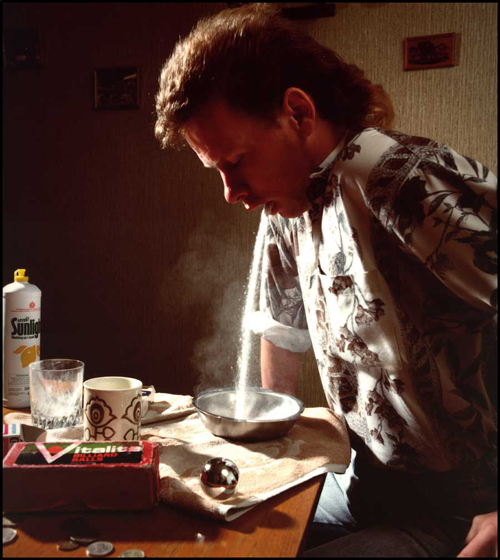
Stevie Starr, Finchley. © David Secombe 1990.
Stevie Starr swallows things; then he brings them back up again. He is a professional regurgitator.
In the picture above he is bringing up a fountain of sucrose powder – which , bizarrely, is coming up dry – one of a number of different items and substances which disappeared and then reappeared before our eyes: a lightbulb, a billiard ball, coins … Another routine involved swallowing soapy water, smoking a cigarette and blowing smoke-filled bubbles. He refrained from performing his famous goldfish routine, a trick which had got him into some trouble with the RSPCA. Stevie pointed out to the animal welfare inspector who came to see his show that he drank six pints of water before he swallowed the fish, that he had never had one die on him and that, as their memory span was only eight seconds, by the time they were in his stomach they couldn’t remember how they got there.
Stevie’s story of how he came to acquire such a skill was touching, if perhaps calculated; he said that he was bullied at school and had to swallow his pocket money to stop it from being stolen; he then discovered that he could bring the change back at will.
I heard nothing of Stevie for many years – until last year, when he appeared as a contestant on Britain’s Got Talent. Stevie’s talent is specialist but genuine: in an earlier era, he might have become as well-known as the celebrating farting turn Le Petomane, but Stevie’s skill is perhaps too unnerving for contemporary taste. Seeing his routine close-up was a hugely memorable yet faintly worrying experience: I thought he was going to choke to death on that billiard ball.
… for The London Column. © David Secombe 2012.


 The London Column