Speciality Acts.Photos & text: David Secombe (1/3)
Posted: January 11, 2012 Filed under: Entertainment, London Types, Performers, Theatrical London | Tags: Harry Houdini, Larry Barnes, New Variety, Straitjacket escape routine, The Viceroy of Versatility Comments Off on Speciality Acts.Photos & text: David Secombe (1/3)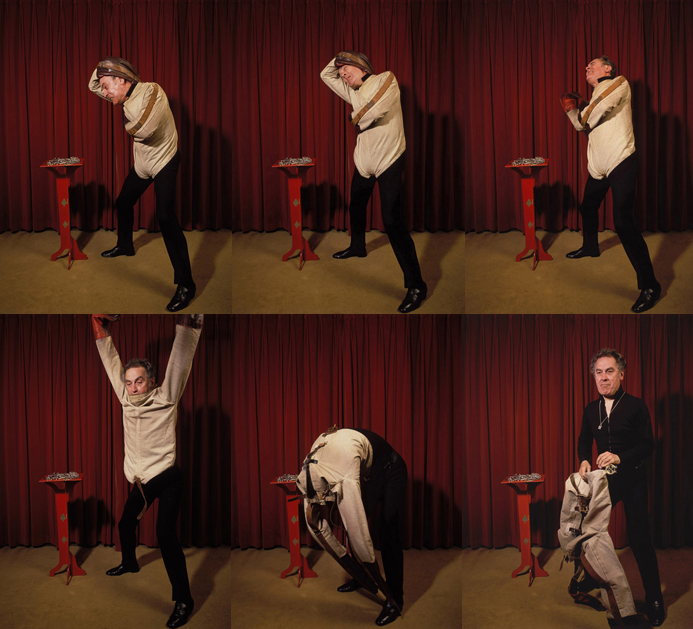
Larry Barnes, ‘The Viceroy of Versatility’, Finchley. © David Secombe 1990.
From the Obituary column of The Stage:
Larry Barnes
Published Monday 15 August 2011 at 17:42 by Richard Anthony Baker
Billed as the Viceroy of Versatility, Larry Barnes lived up to the promise. As one of the variety theatre’s last speciality acts, he was a magician, an escapologist, a balloon sculptor and most famously a paper tearer.
His father introduced him to music hall when he was still a boy and, after only a brief stint at the Italia Conti Academy of Theatre Arts, he made his stage debut at the Adelphi in 1941/42 playing a pirate in Peter Pan with Barbara Mullen in the title role. After serving in the Second World War, he resumed his stage career and also worked as a stunt man in films, including The Colditz Story (1955).
After contracting arthritis following an accident on stage, he furthered his interest in magic and took part in the Tower’s annual music hall shows. He also recreated the escapology act of Houdini, releasing himself from a range of ancient handcuffs and a straitjacket in less than a minute. In addition, he built up a repertoire of songs that he combined with his conjuring and paper tearing. His most famous was If It Wasn’t For the ‘Ouses in Between, originally sung by the Cockney comedian, Gus Elen. Barnes’ gimmick was this – as he reached certain words in the song, such as ‘a ladder’, or ‘a tree’, or ‘a row of houses,’ he would produce his paper representation of them. “Wiv a ladder and some glasses, you could see to ‘Ackney Marshes, if it wasn’t for the ‘ouses in between.”
David Secombe writes:
These photos showing Larry Barnes demonstrating his version of Harry Houdini’s straitjacket routine were made at the home of Larry’s assistant (who was also a Justice of the Peace) in Finchley. The photos were commissioned for a Sunday Times Magazine feature on ‘Speciality Acts’, which were having something of a revival at the time – the term covered old-timers like Larry and the new breed of more outre ‘New Variety’ performers such as the ‘regurgitator’ Stevie Starr, another on my list of subjects. Larry arrived at his assistant’s later than billed, dressed in an extravagant outfit which spoke of the theatricality of an earlier era; unfortunately, his stylish presentation was the reason for his lateness, as he had been mugged on the Victoria Line by some football supporters who took exception to his appearance and stole his carpet-bag of props. The bag was thrown onto the platform at the next stop, but Larry had had to go to Brixton to retrieve them from lost property.
Amongst other things, the bag contained Larry’s prized handcuffs, allegedly the property of Houdini himself – although it has to be said that Larry was a bit vague on their provenance. But Larry’s tour-de-force was his straitjacket escape, which provided this photographer with a sequence of a dozen images which – by accident rather than design – look like some kind of collaboration between Edward Muybridge and Francis Bacon. The pictures only give a hint of the tremendous effort Larry put into this stunt, but I like to think that his expression in the final image gives an indication of the nature of his achievement. Quite literally, Larry shows us what it means to be free.
Larry Barnes, born Islington May 16, 1926; died Hackney, July 2, 2011.
… for The London Column. © David Secombe 2012.
Edward Heath’s Feet. Photo & text: Angus Forbes
Posted: January 3, 2012 Filed under: Corridors of Power, London Places, Sartorial | Tags: 10 Downing Street, Edward Heath, hand-made shoes Comments Off on Edward Heath’s Feet. Photo & text: Angus Forbes
10 Downing Street, June 19, 1970. © Angus Forbes.
Angus Forbes writes:
1964, October 16: Sir Alec Douglas-Home, UK prime minister, had been defeated by Harold Wilson at yesterday’s general election. Your photographer went to number 10 Downing Street and took pictures of a remarkable event – the ritual departure of the vanquished incumbent. To boos and jeers from the crowd opposite, Home came out the front door, waved cheesily, climbed into the ministerial car and was whisked away for ever.
1970, June 19: Harold Wilson had been defeated by Edward Heath at yesterday’s general election. Your photographer, who was working on a shoe catalogue at the time, left the studio for Downing Street to make the second in a possible portfolio of prime ministers leaving their official residence for the last time. Finding Fleet Street there in force, he asked what was going on. He was told that Wilson had ducked out the back way and no one had got a shot, but Heath’s arrival was imminent.
When Heath’s car drove up media crews formed a solid phalanx around him. Your photographer couldn’t get a look-in. All he was seeing was backs of heads. A clear aspect could only be achieved by lying flat on the ground and framing between the legs of the cameramen. Suddenly your photographer seemed to be back in his studio, shooting the shoe catalogue; the difference being that the shoes now confronting his lens were those being worn by a newly-elected head of government who for the first-ever time had his feet on the actual threshold of power and was making his victory speech live on national television.
Next day a woman threw a tin of paint over Edward Heath at Downing Street and since then security has been too tight for exercises such as your photographer was twice lucky enough to perform.
… for The London Column. © Angus Forbes 2011.

…………………………………….© Angus Forbes 1970.
Christmas on Greek Street.
Posted: December 22, 2011 Filed under: Literary London, London Labour, Theatrical London 2 Comments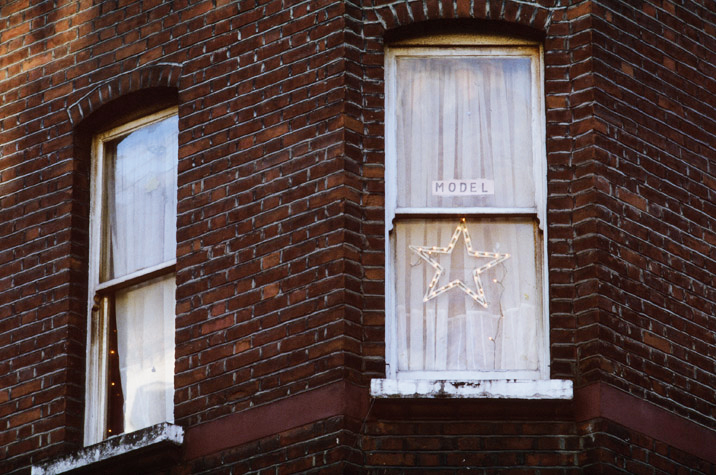
© David Secombe 2010.
From Act Two of The Homecoming, Harold Pinter, 1965:
LENNY: […] I’ve got a better idea. Why don’t I take her with me up to Greek Street?
Pause.
MAX: You mean put her on the game?
Pause.
We’ll put her on the game. That’s a stroke of genius, that’s a marvellous idea. You mean she can earn the money herself – on her back?
LENNY: Yes.
MAX: Wonderful. The only thing is, it’ll have to be short hours. We don’t want her out of the house all night.
LENNY: I can limit the hours.
MAX: How many?
LENNY: Four hours a night.
MAX: (dubiously) Is that enough?
LENNY: She’ll bring in a good sum for four hours a night.
MAX: Well, you should know. After all, it’s true, the last thing we want to do is to wear the girl out. She’s going to have her obligations this end as well. Where you going to put her in Greek Street?
LENNY: It doesn’t have to be right in Greek Street, Dad. I’ve got a number of flats all around that area.
MAX: You have? Well, what about me? Why don’t you give me one?
LENNY: You’re sexless.
… and a Merry Christmas to all our readers.
(see also: Old and New Soho no.5)
Zoo. Photos: Britta Jaschinski, text: Randy Malamud. (5/5)
Posted: December 9, 2011 Filed under: London Places, Wildlife 2 Comments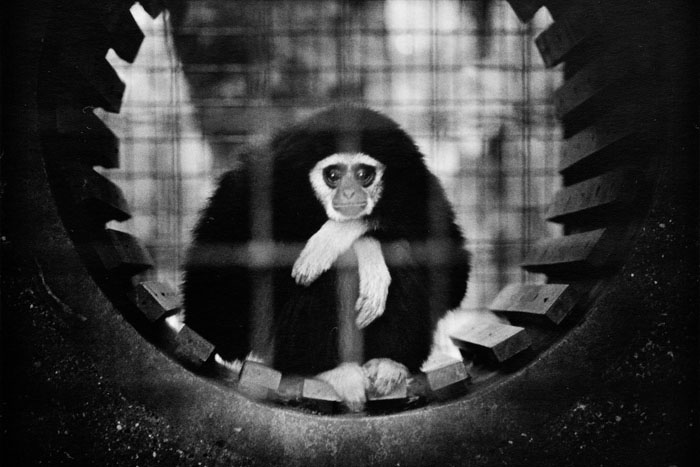
Lar Gibbon, Zoo Series, London 1992. © Britta Jaschinski.
Randy Malamud writes:
An otherworldly darkness permeates Jaschinski’s work, a troubling philosophical depth that touches both the animal inside the frame and the human spectator who is outside looking at the creature. A sense of uncertainty resonates in her photography—uncertainty about the animal’s context, the animal’s sentience, the animal’s feelings. This sense of the unknown challenges the human audience’s habitual expectations of omniscient insight with regard to other animals.
I believe that it is wrong for us to see the monkey in the way we are seeing it, in a zoo, or even in a photograph from a zoo, and yet it is at the same time mesmerizing. Is this lar gibbon as fascinated by his spectators as we are of him? What does he think of us? We cannot know. The energy that Jaschinski’s image conveys is at the same time profound and profane. The longer we regard this gibbon, if we learn anything, it is how much we cannot know.
Our relationship with non-human animals is rich, intricate, and troubled. People are fascinated by animals, and respond to them in ways that are at times full of homage and awe, and at other times oppressive and perverse. We are prone to appreciate, or to fetishize, animals in isolation as discretely framed specimens (in a zoo, or as a pet, or a meal, or a toy) distanced from their groups, alienated from their contexts. But still they are there, all around us.
What is wrong here? What is missing? Where is the viewer situated in relation to the subject? What is the connection between imagining and exploiting animals? What has the photographic aesthetic done – and what have we done – to capture, and to betray, these creatures? What are these animals doing as we look at the sliver of their existence that is frozen and framed in the moment of each photograph? What kinds of movements, instinctual urges, behavioral patterns are suggested in the picture? And more to the point, what sorts of movements, instincts, and behaviors are suppressed in these images? A large “negative text” pervades Jaschinski’s photography. We are asked to see many things – habitat, activities – that are not there; we are confronted with their absence.
© Randy Malamud.
Zoo by Britta Jaschinski is published by Phaidon.


 The London Column