Point of Interest. Photos Peter Marlow (2/3)
Posted: June 2, 2011 Filed under: Housing, Transport | Tags: HACAN, Heathrow Airport, Magnum, Peter Marlow Comments Off on Point of Interest. Photos Peter Marlow (2/3)
Approach to Runway 27, West, Heathrow Airport, 2001. © Peter Marlow (from Point of Interest, courtesy of the photographer and The Wapping Project Bankside*).
From Heathrow Noise Damage Across London – a report prepared by Charles Rolls for HACAN (Heathrow Association for the Control of Aircraft Noise), June 1997:
Quotes from the social surveys
The nature of the problems mentioned in the surveys fell into well-defined categories. The majority of people who experienced severe annoyance or said it was unbearable mentioned an impact on Quality of Life (ability to use the garden, have the windows open, listen to music/TV, have dinner parties) or Impairment of some Function (doctor’s inability to think during surgery, sleep deprivation,increased family stress).
Some typical quotes on the impact on Quality of life:
“It affects my ability to listen to music.” Paultons Square
“We have to keep our windows closed, we have spent extra money on noise insulation, and we can’t use the garden” Paultons Square
“Hard to concentrate on reading” Paultons Square
“Deters us from sitting in the garden. The noise is too frequent” Christchurch Street “Severely affects TV reception” Camberwell
“The intrusive effect on an otherwise peaceful environment” Camberwell
Some typical quotes on the Impairment of Function:
“Intrusion on thoughts/conversation/examining patients” MD Paultons Square
“Early morning it wakes me and any visitors” Paultons Square “Loss of sleep is extremely debilitating” Paultons Square
“It disrupts the children’s sleeping patterns and causes stress to all the family” Christchurch Street
“Level of noise in the early morning. Often shakes the windows and invariably wakes the children” Christchurch Street
“When we are trying to relax it causes angst” Christchurch Street
“My sleep pattern has been greatly and increasingly disturbed by it” Camberwell
“You cannot get away from noise, it is very invasive and stressful to live with noise you can do nothing about” Camberwell
“Often woken around 4.30 – 5am then very difficult to sleep again – am very tired as a result but how do you prove this?” Camberwell
What is it about the noise that is most annoying?
“There is an increase to a peak then a lull, but with the certainty of the next cycle being repeated” Paultons Square
“No other capital city has been so foolish as to land itself with this level of aircraft noise pollution” Paultons Square
“Hearing one plane and just waiting for the next” Christchurch Street “We end up shouting at each other in the garden” Christchurch Street
“Engine noise – screaming of the engines” Christchurch Street
“The noise in Camberwell is continuous due to the height of the aircraft” Camberwell
“That an area like Camberwell, miles from the airport but seriously affected by the noise does not feature in any consultation process” Camberwell
“You cannot get away from the noise” “I love my home and neighbourhood but the aircraft noise is literally the only thing which is making me consider moving home” Camberwell
“Couldn’t the flight paths be broader, so spreading the noise?” Camberwell
“BAA say we are outside the area seriously affected – this is quite wrong” Camberwell
* Point of Interest is showing at The Wapping Project Bankside, London SE1, until 2 July 2011.
Point of Interest. Photos Peter Marlow (1/3)
Posted: June 1, 2011 Filed under: Interiors, London Labour Comments Off on Point of Interest. Photos Peter Marlow (1/3)
Empty Office, Clerkenwell, 2002. Photo © Peter Marlow (from Point of Interest, courtesy of the photographer and The Wapping Project Bankside*).
Katy Evans-Bush writes:
The Future Tense
The office as its redundant workers move out is spotted with relics of human degradation: that is, of the letdown from future perfect to mere life.
The screw stuck in the wall, reminder of that award for the old campaign that no one still here now remembers – although it was great work and targets were exceeded – surrounded by nails that hold their heads proud, knowing they held up the proofs of its successes.
Comfortable tea stains, paper clips wedged where the desk didn’t quite meet the wall, a blotched photo of Sarah who worked here half a decade ago, with a small child; she’d be wanting that back, if anyone knew where to find her now. Bits of phone chargers. A chocolate egg in foil. A bit of silk ribbon, some one-legged scissors, a dusty old bottle of Bristol Cream: why is it blue? Are they really that colour? A sad pile of paperbacks no one will ever read: Windows for Dummies and guides to blogging for businesses. Blu-Tack smears where no one thought they’d matter. Sticker-marks on the phones, where someone put the new supplier’s number. Dirt on the sills from the plants the receptionist had to water, because optimism always wins out. Optimism and sheer daily labour.
The pure pristine will deepen even out the window, with a screaming green that seems to creep from the trees and into the souls of the workers. Like algae. The natural world takes over, and things get done because they can’t be prevented, like dental decay or ambition.
Things can’t stay clean forever. People are people and every negotiation will be tarnished. Its spreading spots will eat at your blind belief in silver and grey and the functional streamline that bypasses doubt and loops back to the bank, via mobile phones, and suits with reinforced shoulders, and platinum cardholders.
Forget your cheap tiles screaming masculine thrust from the Carpetland down on the roundabout. This office was made for pink fluffy sweaters, cake crumbs, to-do lists, pictures of cats, the darkening water in a vase, nail files and overstuffed folders.
… for The London Column. © Katy Evans-Bush 2011.
* Point of Interest is showing at The Wapping Project Bankside, London SE1, until 2 July 2011.
Old and New Soho. Photo & text by Eric Hands, Adam Macqueen (5/5)
Posted: May 27, 2011 Filed under: Literary London, Street of Shame | Tags: Auberon Waugh, Gannex Macs, Harold Wilson, Private Eye, Richard Ingrams Comments Off on Old and New Soho. Photo & text by Eric Hands, Adam Macqueen (5/5)
Christopher Booker, Richard Ingrams, Auberon Waugh and Barry Fantoni at the Private Eye office, Greek Street. Photo © Eric Hands
Eric Hands writes:
I arrived at Private Eye as a token working-class boxwallah – Ingrams’ term of endearment for non-editorial staff – following a mystical experience on Clapham Common (the drugs were better in those days) and a subsequent introduction to Barry Fantoni by the local vicar. My first job was to write up the ledgers for the advertising sales and, such was the shortage of space in the Greek Street premises, I shared a small smoke-shrouded cubicle with Auberon Waugh and Paul Foot. Bron had a habit of throwing his cigarette ends out of the window and on more than one occasion laid waste to a few fancy hats. I spent my first decent wage packet on a camera and the rest of my life trying to use one.
Regarding the above photo, Adam Macqueen – who is working on a definitive history of Private Eye – supplies the following which sounds about right. I’d date it circa 1974 as the poster was being used as a prop – rather than the photo being taken to celebrate the poster (if that makes sense). It was from a series of shots I took for a feature in the New York Times. Lighting by Anglepoise.
Adam Macqueen writes:
As far as I can tell, the poster must refer to Wilson’s legal action against the Eye for a joke about the trademark Gannex macs he always wore: they were manufactured by a company owned by his friend Joe Kagan, and the Eye wrote that Kagan had “employed Wilson as a commercial traveller and male model for the last seven years at an annual salary of £5-£10,000.” His solicitor Lord Goodman – himself a regular target and sworn enemy of the Eye – brokered an apology that was printed in February 1973: “This reference was not intended to be take literally, and we apologise to Mr Wilson for any suggestion that he was employed by or received payments of any kind from a commercial concern whilst he was a Minister of the Crown.”
Kagan, who did provide funding for Wilson’s private office, later got a peerage in his resignation honours list – the ‘Lavender List’ – and was imprisoned for theft and false accounting in 1980. And Wilson continued his feud after his resignation as prime minister in 1976, when he started touting what he called a “Private Eye address book” around friendly journalists. It was presumed to have been compiled from information private detectives working for his friend James Goldsmith had acquired from the magazine’s dustbins during his epic legal battle that year.
… for The London Column. © Eric Hands, Adam Macqueen 2011
Old and New Soho. Photo & text by Mark Granier (4/5)
Posted: May 26, 2011 Filed under: Amusements, Bohemian London, Interiors, Lettering, London Labour Comments Off on Old and New Soho. Photo & text by Mark Granier (4/5)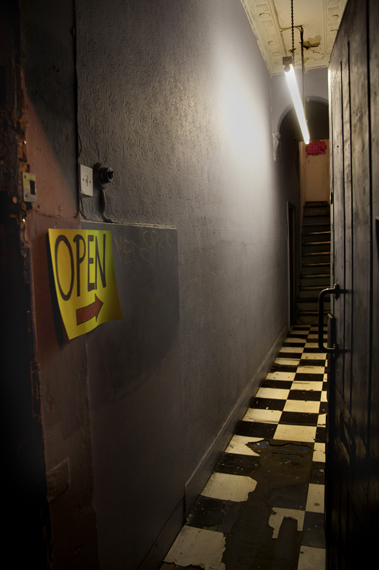
Soho, 2010. Photo © Mark Granier.
Mark Granier writes:
My cousin was working in London for a few months, so when I came over from Dublin we met up a couple of times. One evening we went to the ‘Exposed’ exhibition of photography at Tate Modern, concerned with ‘Voyeurism, Surveillance and the Camera.’ They had stretched the theme a little, so that it practically became a history of the art, taking in all kinds of street/reportage/war photography, from the 1930s (or possibly earlier) – Brassaï, Cartier-Bresson, Robert Frank, etc. – right up to contemporaries such as Nan Goldin. Afterwards, we found a little restaurant in her favourite part of the city, Soho. My cousin is a smoker, so we sat at a table on the sidewalk, talking and watching the variegated street-life. When the place closed we ambled through the surrounding streets.
I love the blurring of boundaries in Soho – music, art, food, sex – the city in microcosm. Just before hailing a taxi, we noticed this doorway, with its eloquent one-word sign, and it was like encountering an annex to the exhibition, an intimate little theatre/Tardis that opened a corridor between centuries. The photograph took itself before I clicked the shutter. The poem, such as it is, took a little longer:
OPEN
said the handmade sign
(underscored by a red arrow)
inside a doorway one step
from a Soho street. We stopped
just a tick, then longer, as if
we had some business here
other than letting our eyes
travel the strip-lit grey
narrowing walls, torn lino,
lines draining like a sink
to a high arch, behind which
steel-edged stairs further the lesson
in perspectives: the whoosh of
compressed centuries, a lost
hunting cry, razzmatazz, brass
rubbings of jazz, appetite’s
arrows, harnesses, taxies
and here’s one now –
… for The London Column. © Mark Granier 2011


 The London Column