A Clockwork London. (3)
Posted: April 15, 2013 Filed under: Dereliction, London on film | Tags: East Ham, Full Metal Jacket, Millennium Mills, Sgt Lee Ermey, Stanley Kubrick Comments Off on A Clockwork London. (3)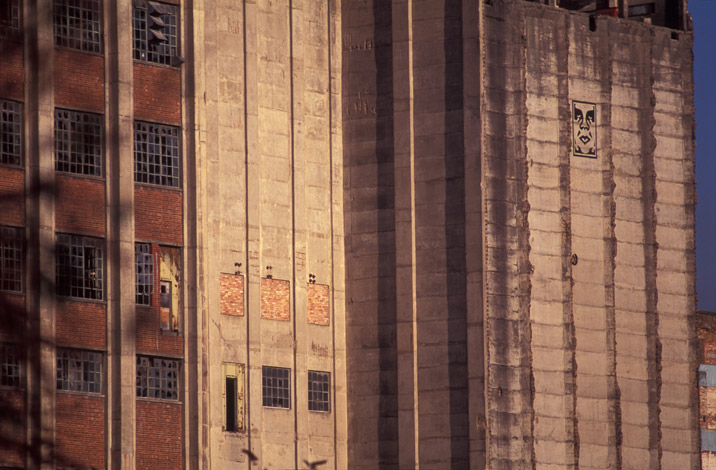
Millennium Mills. © David Secombe 2013.
The Road to East Ham – Micheal MacCumiskeigh:
East Ham. I’m still only in East Ham. I walk down the cracked concrete road under an arborial sky on the road to Vietnam in all its artifice.
The derelict gas works is dressed with imported Spanish palm trees hanging their heads, famished in a cold climate. The wrong choppers and the wrong soldiers. A bellicose nest of English squaddies squat in a huge marquee, drinking tea and intermittently stuffing their faces with carbs and gravy.
Further still from here the final act is played out, the monolith that is Millennium Mills made of indestructible stuff: concrete and thick muscle-studded girders and lots and lots of asbestos. Made of all these things yet held together with an austere elegance. She casts a shadow of disdain across the ticky-tacky Barrett homes that now blister one side of the elegant watery fingers of Albert Docks.
I left the day I arrived, after a morning of basic drilling, Sgt. Lee Ermey’s venom still damp on my face. I walked back the way I came. I was a kid. I didn’t know any better, I didn’t know Kubrick was one of my favourite directors. I kicked my heels walking slowly down the road. I’ve been kicking myself ever since.
Micheal – who was a young dance student at the time – was engaged as a ‘marine’ extra on Stanley Kubrick’s Vietnam epic Full Metal Jacket, which recreated Saigon and Hue in East Ham. The unit base was at Millennium Mills. Lee Ermey played the drill sergeant in the film, having been originally hired as a military adviser.
A Clockwork London. (2)
Posted: April 4, 2013 Filed under: Fictional London, Housing, London on film | Tags: A Clockwork Orange, Binsey Walk, Bird's Eye View, George Plemper, John Betjeman, Owen Hatherley, Stanley Kubrick, Thamesmead 1 Comment
Southmere Lake and Binsey Walk, Thamesmead. © George Plemper 1976.
George Plemper:
In late 1972 I made the journey to Leicester Square to see A Clockwork Orange. As with all Kubrick’s
films I thought the film was visually stunning and I loved the use of music throughout. The physical
and sexual violence seemed to me more theatrical than factual and I was astonished to hear a year
later the film had been banned.
All thoughts of the film had long gone when I crossed the footbridge across Yarnton Way
to Riverside School, Thamesmead in 1976. I had no idea I was entering a scene from Kubrick’s vision
of a desolate and violent Britain. My aims were simple; I was going to use the camera to show my
pupils that they were great, to show them that we were all worthwhile.
From A Guide to the New Ruins of Great Britain by Owen Hatherley:
It’s impossible to praise the original Thamesmead without caveats. There were never enough facilities, the transport links to the centre were always appalling, and the development was always shockingly urban for its outer-suburban context. Regardless, it is something special, a truly unique place. It always was, and remains so in its current, amputated form.
Unlike its successors, it’s flood-proof and still architecturally cohesive, after decades of abuse. Around Southmere lake you can see, just about, how with some decent upkeep and with tenants being given the choice rather than being dumped here, this could have been a fantastic place … This is basically a working-class Barbican, and if it were in EC1 rather than SE28 the price of a flat would be astronomical. Today it feels beaten and downcast, and it only ever gets into the news through vaguely racist stories about the Nigerian fraudsters apparently based here; but its architectural imagination, civic coherence and thoughtful detail, its nature reserves and wild birds, have everything that the ‘luxury flats’ lack.

Southmere Lake and Binsey Walk today. © David Secombe 2013.
Where Alex walked … watch him pitch his droogs into the cold, cold waters of Southmere Lake here.
See also: Pepys Estate 1, Pepys Estate 2, Domeland, Metro-Land.
A Clockwork London. (1)
Posted: April 2, 2013 Filed under: Bohemian London, London on film, Pavements | Tags: A Clockwork Orange, Alton Estate Roehampton, Anthony Burgess, Clockwork orange locations, Fahrenheit 451, Stanley Kubrick, Wandsworth roundabout Comments Off on A Clockwork London. (1)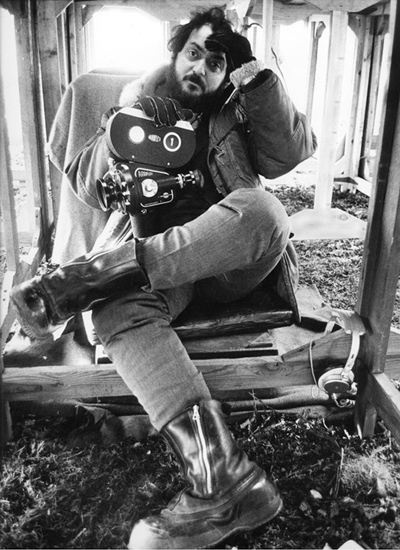
Stanley Kubrick on the set of A Clockwork Orange. © Dmitri Kasterine 1969.
From A Clockwork Orange, dir.: Stanley Kubrick, 1971:
……………………………………………………………………..ALEX:
………………………………One thing I could never stand was to see a filthy, dirty old drunkie,
………………………………howling away at the filthy songs of his fathers and going blurp
………………………………blurp in between as it might be a filthy old orchestra in his stinking,
………………………………rotten guts. I could never stand to see anyone like that, whatever his
………………………………age might be, but more especially when he was real old like this one
………………………………was.
(… and with that, Alex and his three droogs start attacking an old tramp lying in the underpass shown below.)
This week’s offering on The London Column is a short series on Stanley Kubrick’s use of London as a giant prop basket. Dmitri Kasterine’s portrait shows the director in his pomp: extravagantly booted, Arriflex to the ready, the world-conquering auteur of 1969. Only 41, he already has The Killing, Spartacus, Lolita, Dr. Strangelove and 2001: A Space Odyssey behind him, an amazing achievement – which might explain why he looks a little weary. But his tiny camera and huge boots suggest the nature of his new project, a film far removed from the 70mm, Cinerama world of 2001. SK’s new one is set much nearer home.
Kubrick’s withdrawal of A Clockwork Orange in the UK – a ban that lasted from the late ’70s until his death – lent the film a mystique for all those British film fans unable to see it. I bought a pirated VHS tape of it (£15 in 1991) from a stall in Greenwich market and was, inevitably, hugely disappointed. A friend who watched it with me commented ‘Whatever I expected, this isn’t it.’ It is prescient in many ways, especially in its depiction of the dissemination of sexualised imagery (even if it exhibits some old-world sexism in the process), but time has not been kind to the Kubrick/Burgess brand; Kubrick’s other films of the ’60s and ’70s stand up much better. But it remains a terrific showcase for 1960s architecture.
Kubrick shot A Clockwork Orange quickly and cheaply in found locations within easy reach of his Hertfordshire lair. Carefully chosen new builds in Wandsworth, Uxbridge, Sydenham, West Norwood, Borehamwood and, most famously, Thamesmead, served as ready-made cycloramas for the director’s realisation of Burgess. The film’s opening atrocity is committed by Alex and co. in an underpass beneath Wandsworth roundabout. Like the Westway and the approaches to the Blackwall Tunnel, the roundabout and its environs constitute a sort of Birmingham in London: an imposing 1960s circulatory system just south of Wandsworth Bridge, complete with truncated and pointless autostrada carrying traffic to and from Wandsworth Common, where the motorway peters out in despair. (Wandsworth roundabout’s other claim to cultural distinction is the Sunday in 1973 when, during a furious row with his wife Jill Bennett, John Osborne drove his Mercedes into it.)
The pedestrianised centre of the roundabout is an assemblage of geometric concrete forms, served by brooding, permanently shadowed underpasses: ideal for Kubrick’s purposes and, subsequently, anyone else seeking to create representations of urban anomie. In fact, the association of Brutalist buildings with urban hopelessness has become such a cliché that it is worth noting that A Clockwork Orange pioneered the look. Francois Truffaut had shot Fahrenheit 451 in similar fashion a couple of years earlier, using Roehampton’s Alton Estate as a setting for a future society where the printed word is forbidden; but the dreamy, otherworldly mood of his film is worlds away from Kubrick’s visceral scenario. In seeking a cinematic equivalent for Burgess, Kubrick used Brutalism to create a visual shorthand for future awfulness. One can only imagine the dismay of early seventies architects and civic engineers seeing the finished film, which simultaneously treasures and trashes the well-meaning buildings on show, and explicitly links massed concrete with looming dread.
If Kubrick were making the film now, one wonders what visual cues he would employ. The social idealism of Brutalism has been supplanted now by an aggressively ingratiating public architecture based on consumerism, a landscape pithily described by Owen Hatherley as ‘the post-1979 England of business parks, Barratt homes, riverside ‘stunning developments’, out-of-town shopping and distribution centres.’ Which locations would Kubrick use today? Bromley? Woking, maybe? Corporate faux-vernacular would offer the right look. Saturday night in a modern British provincial town offers ample scope for rape and pillage, the pedestrianised shopping precinct the perfect setting for a spot of ultra-violence. Hell is the walkway between Nando’s and Asda.
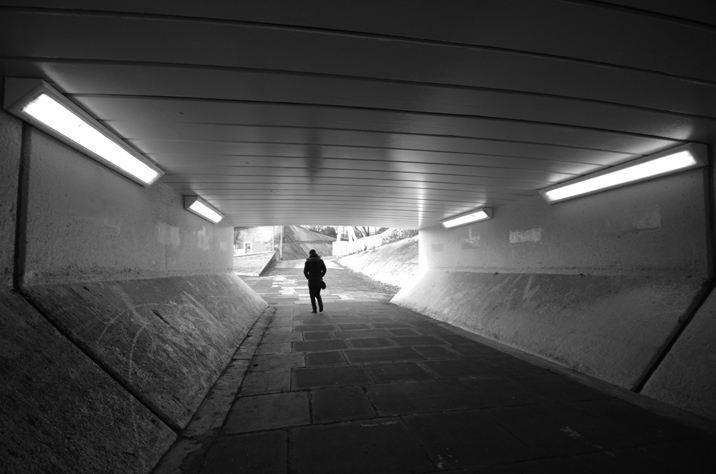
Southern underpass, Wandsworth Roundabout. © David Secombe 2012.
… for The London Column.
At Home with Mrs John Profumo.
Posted: March 25, 2013 Filed under: Architectural, Class, Corridors of Power, Events, Housing, Interiors, London scandals | Tags: Chester Terrace, Christine Keeler, Evening Standard Homes and Property, House and Garden, John Profumo, London property market, Profumo Affair, Scandal, Stephen Ward, Toynbee Hall, Valerie Hobson Comments Off on At Home with Mrs John Profumo.
‘Mrs Profumo in the drawing-room with her white French faience hound.’ Uncredited photo from House and Garden, Conde Nast Publications, 1962.
From The House and Garden Book of Interiors, 1962:
Mr. and Mrs. Profumo (she is Valerie Hobson, the actress) live in a typical-looking Regent’s Park stuccoed villa, which has certain highly individual touches, the most covetable being a large garden and a magnificent drawing room.
An improbably large area of the house is given over to the drawing room, which must be one of the largest rooms in London to be found in a house of comparatively modest size. With its double-cube proportions, three fine windows, opening on to the garden, and gaily disciplined Nash decorations, this is a perfect room for a couple who must, perforce, engage in a great deal of entertaining.
A quick glance into Mr. Profumo’s own study provokes the wish that more masculine, magisterial ministerial rooms were half so attractive! Needless to say, the desk is large and if you look carefully you will see a highly decorative as well as highly confidential red ministerial despatch box on it, doubtless often impelling the owner of this charming house away from the family circle to the chores inseparable from high office.
From John Profumo’s statement in the House of Commons, 22nd March, 1963:
“My wife and I first met Miss Keeler at a house party in July 1961 at Cliveden. … Between July and December 1961, I met Miss Keeler on about half-a-dozen occasions at Dr Ward’s flat, when I called to see him and his friends. Miss Keeler and I were on friendly terms. There was no impropriety whatsoever in my acquaintanceship with Miss Keeler. … I shall not hesitate to issue writs for libel and slander if scandalous allegations are made or repeated outside the House.”
From Confessions of Christine, Christine Keeler, News of the World, June 1963:
Our meetings were very discreet. Jack [Profumo] drove a little red mini car. … If we were not in the flat, then we would just drive and drive for hours. Of course, it was impossible that our discretion would be absolutely complete. There was that amazing evening when Jack was round, and an army colonel showed up suddenly looking for Stephen [Ward]. The colonel couldn’t believe it. Jack nearly died. The funny thing is I never used to think of Jack as a Minister. I can not bow down to a man who has just got money or a position. And I liked Jack as a MAN.
David Secombe:
The passage of time has rendered the uncredited House and Garden text as poignant as it is comic. The gushing prose is at odds with the attitude of Valerie Hobson in the picture, lost amidst the chilly perfection of her vast drawing-room. Her husband, despite his vivid presence in the editorial copy, fails to appear in any of the pictures of the interior of their Regency villa, presumably due to the demands of the business of state – or, as implied by Christine Keeler’s racy memoir, some other kind of business.
This issue of House and Garden appeared in 1962, not long before Profumo’s mendacious statement to Parliament, which left a host of hostages to fortune, eventually leading – as everyone knows – to his resignation as Secretary of State for War. Today, politicians have ample opportunities to reinvent themselves after a career-ending debacle: Neil Hamilton, Jonathan Aitken and even Jeffrey Archer have achieved a degree of rehabilitation and it seems likely that Chris Huhne and Vicky Pryce will eventually re-enter ‘public life’ in some form or other. As the pioneer of modern political scandal, John Profumo had no such option: instead, he chose a practically Roman form of self-abasement, cleaning the toilets at Toynbee Hall in Whitechapel (a task he continued to do until the management suggested that there might be better ways of using his skills). He did, eventually, gain a limited re-admittance into high society but even that took him decades.

Former home of Mr. and Mrs. John Profumo, Chester Terrace. Photo © David Secombe 2011.
From Evening Standard Homes and Property, 14 Feb 2012:
This Grade I-listed property at prestigious Chester Terrace overlooking Regent’s Park, was once the home of shamed politician John Profumo, who lived in the splendid stucco townhouse during his much-publicised affair with model Christine Keeler in the Sixties. The scandal forced his resignation as secretary of state for war and damaged the reputation of Harold Macmillan’s government. Designed by John Nash, the architect responsible for much of Regency London, the elegant, four-bedroom house now has a cinema room, wine cellar and enchanting garden. If only walls could talk… Call [estate agent] if you have £10.95 million.


 The London Column