A Personal History of Indian Cuisine.
Posted: March 14, 2013 Filed under: Eating places, Food, Out Of Town, Tall Tales | Tags: Anglo-Indian cuisine, eating out in london, Indian restaurants in London, suburban dining in London Comments Off on A Personal History of Indian Cuisine.
Tandoori restaurant, Deptford. © David Secombe 2001.
David Secombe:
It is 1975, I am 13 and, like most white British people of my generation, my experience of Indian food is limited to a small, local curry house. Remote, distant Cheam in the remote, distant 1970s offered few opportunities for culinary experiment and a trip to an Indian offered the prospect of an exotic night out. Visits to The Partition of India – or whatever it was called – were made in the company of my two elder siblings; I was taken there with some ceremony by my sister and no ceremony at all by my brother. (I was never taken there by my parents, who were not attracted by its charms.)
The suburban Indian restaurant is one of the cultural phenomena of post-war British life, signifying social change, and a broadening of the scope of what is considered our national cuisine. But the 1970s offers very few excuses for Proustian reverie; even as a teenager I was aware that my local Indian didn’t cut it, as the food was barely adequate and served by staff who seemed either torpid or desperate. I also knew that part of its appeal was its very inability to deliver the experience you were looking for; it confirmed my adolescent conviction that the suburbs were a pale shadow of the real, yet-to-be-discovered world. (Incidentally, the restaurant in question appeared to be popular with adulterers. This was my brother’s theory, and we would giggle at furtive couples in corner booths, whispering as best they could over the sitar tape whilst poking at bits of Bombay Duck. Adulterous or not, these couples were also seeking a dining experience that was clearly not forthcoming.)
By the early 1980s I had arrived in the flesh pots of south London; just a few miles away from provincial Cheam, yet Wandsworth, Clapham and Tooting were home to tempting, ‘authentic’ Indian restaurants which delighted in their specific regionality – Nepalese, Goan, Bengali. Fabled establishments like The Concert for Bangladesh, Midnight’s Children, and Sherpa Tenzing offered dishes worlds away from the generic beige goo I knew from my sheltered youth. But you could still get caught out: during a meal at an unfamiliar establishment in Battersea, circa 1985, an ordinary-looking lamb passanda arrived at my table and, before anyone could say anything, the waiter produced a can of UHT whipped cream and sprayed foam all over it. It was a brilliant comic gesture, but it was supposed to be my dinner. Despite such misadventures, my local dining preference remained the curry house; I bypassed Nouvelle Cuisine and other foodie trends and stayed true to my suburban roots.
The ubiquity of Indian restaurants has generated an urban mythology particular to them. A sudden closure was darkly ascribed to the discovery of a skinned dog in the kitchen. Tales were told of a legendary establishment which offered a Chicken Bastard, a dish so hot that it was not intended to be eaten. ‘Witnesses’ spoke of an unwise party who took the challenge, goading the waiters who brought him his order, forcing it down with Carlsberg as kitchen staff emerged to watch, and of the ambulance that was summoned to take him to A&E. Such stories were clear evidence of cultural antagonism, but my own favourite tall tale is actually quite sweet, and is very possibly true. I knew a pair of Egyptian brothers who were my schoolmates at a boarding school on the outer fringes of London. It was said that at the end of term, they went into Leatherhead, ordered three dinners from the Siege of Delhi, packed them in their luggage (did they order poppadoms?), got a cab to Heathrow, flew to Cairo, and consumed the congealing banquet with their father as a festive, homecoming dinner: the ultimate Indian takeaway.
After decades of enjoying Indian food in almost every postcode within the M25, my love affair with it ended in a way my brother might have predicted. I became romantically involved with someone who remained very slightly married, and our lunchtime venue was a classy Indian in St James’s. The Cawnpore Massacre is one of London’s best restaurants, but its convenience for my beloved made it a kind of hell for me. As the months dragged on, I became all too familiar with the delicacies on offer, and the wonders of its kitchen paled against the looming inevitability of my defeat. To paraphrase Robert Shaw in Jaws, ‘I’ll never order Rhogan Josh again’.
© David Secombe 2013.
Sweet Toof.
Posted: March 7, 2013 Filed under: Artistic London, Graffiti, Public Art | Tags: Haggerston, London graffiti, London street art, Regent's Canal, sweet toof Comments Off on Sweet Toof.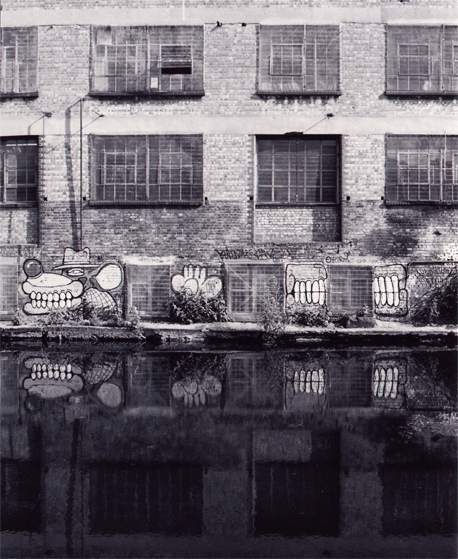
Sweet Toof artwork, Regents Canal, Haggerston. © David Secombe 2010.
From Wikipedia entry ‘Sweet Toof’:
Sweet Toof is the pseudonymous name of well-known United Kingdom graffiti and street artist.
Meaning of Mouth, Teeth and Gum imagery
According to an account by Olly Beck, Sweet Toof looked at himself in a looking glass “in crisis after a messy break-up”, with the enlarged and distorted imagery of the “crescents of teeth”, the “visible part of our skeletal frame” as a reminder of mortality. Beck relates Sweet Toof’s concerns and imagery with the 16th Century Northern European “Vanitas” tradition of reminding of the transience and vanity of life, and to the Mexican celebration of skull imagery to accepting, honouring and celebrating death as part of the life trip.
Sweet Toof’s own comments seem to uphold this interpretation, in which the artist comments, “To get one’s teeth into things, before it’s too late.” Elsewhere he notes, “Teeth can be really sexy, or aggressive, but they’re also constant reminders of death. They’re how we get recognised by police when there’s nothing else left.”
After the Gasometers.
Posted: March 5, 2013 Filed under: Dereliction, Monumental, Vanishings | Tags: Gasometers, Haggerston, Regents Park Canal Comments Off on After the Gasometers.
Gasometer, Regents Canal, Haggerston. © David Secombe 2010.
After the Gasometers by Katy Evans-Bush
If those were crowns, the kings
must have stretched out underground
from Regents Canal to Stepney Green.
At that size, they were gods. But no,
the earth was level: a thick eiderdown
of chemicals and dirt, beneath the play
of air on iron filigree, the orange light
that danced at sunset through the rings.
… from Egg Printing Explained, Salt Publishing, 2011.
Urban Myths. No.1: The Supermarket Spider.
Posted: February 9, 2013 Filed under: Amusements, Parks, Wildlife | Tags: climbing frame, Hillyfields, spider in bananas, spider in supermarket Comments Off on Urban Myths. No.1: The Supermarket Spider.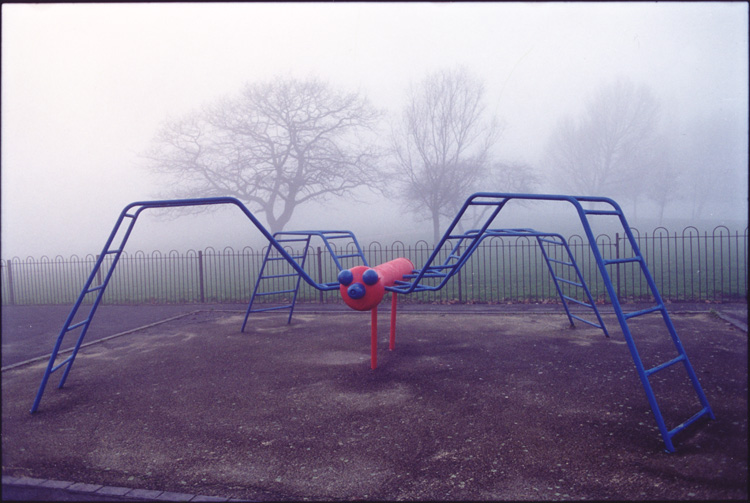
Hillyfields, Lewisham. Photo © David Secombe 1999.
Deadly spider eggs found in supermarket bananas *
WHEN Heidi Slopes did her weekly food shop she picked up an innocent looking pack of bananas – little did she know that between the yellow fruit lurked a nest of spiders. The 53-year-old, who is scared of spiders, had the shock of her life when she spotted the white furry eggs.
“I usually buy a bunch of bananas but, ironically, I thought buying packaged ones would eliminate the chance of any creepy crawlies!” said Heidi, who lives in Lewisham with her husband Laszlo, 53. “My husband opened them and put them in the fruit bowl. I looked down and saw little white balls and suddenly panic stations were all go!”
Heidi wanted to get the suspicious package checked out, and after a phone call to health and safety at Lewisham council she was advised to take them back to the supermarket. “It took almost five hours of numerous phone calls to get hold of someone at the store, only to be told that I would need to bring the packaging and the receipt in for a refund,” said mother-of-three Heidi.
RSPCA animal collection officer Terence Whipps subsequently confirmed that the eggs were those of the Brazilian Wandering Spider, listed in the Guinness Book of Records a the most venomous animal in the world. It’s scientific name is Phoneutria nigriventer – the first element is Greek for ‘murderess’ – but it is also known as the banana spider because of its habit of stowing away in shipments of the fruit.
A supermarket spokesman said: “We want to reassure customers this was a very unusual and rare occurrence and we are really sorry for what must have been a real scare”.
Heidi is unmoved. “My little Juanita recently watched the film Charlotte’s Web and told me that there can be 64,000 eggs in one nest, so that made me even more paranoid! I just thought of my kids and how a spider bite could have changed things completely. I’m just so relieved they didn’t hatch. I wasn’t about to go rifling through my recycling bin just to claim £1.49 back. I was surprised that they were more concerned about the packaging than deadly spiders in their bananas.”
Mr.Slopes commented: “It gave us a real fright and no mistake. Supermarkets should be more careful. Horse meat I can cope with, but venomous spiders are another matter.”
* NB: not real news item … the above was drawn from The Daily Mail, BBC News website, Cardiff Online, etc. The first in an occasional series …


 The London Column