On the South Bank. (3)
Posted: August 8, 2013 Filed under: Amusements, London Places, Pavements | Tags: skateboarding poem, southbank skate park, Thomas Hogan artwork Comments Off on On the South Bank. (3)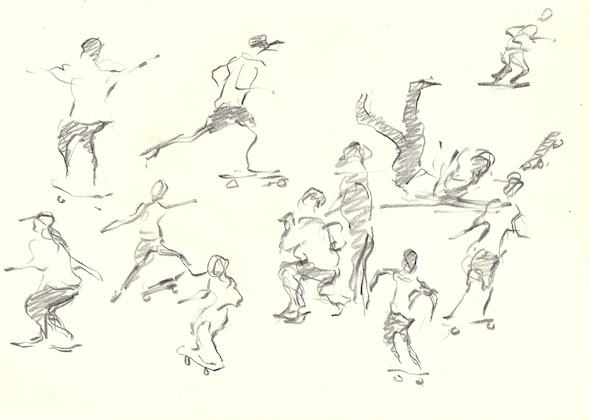
Sketchbook, Southbank, 2013 © Thomas Hogan
Lawrence Schimel, Skating Beauty
Like the uninvited
thirteenth fairy at the christening,
I am standing just outside
the place where they’re skating
and I want to curse them
for my not being a part
of such easy youthful
masculine fellowship.
Forget the prick of a finger
on a spinning wheel’s needle,
let them crush their hands
beneath the spinning wheels
of their skateboards!
But I want more than just
belonging; it is you I crave:
a beauty that could exist
only in fairy tale,
where magic or alchemy
transforms a catalogue of parts–
eyes, lips, lithe torso that twists
just so at the waist–into something
wondrous and unique, delicate and fierce,
hovering on that threshold
between boyhood and manhood.
Almost shy when on the ground,
unaware of your own desirability,
your board, tucked under your arm
like a shield, blocks the view of your
naked torso as you constantly shift
position, less nervousness than
restless excess of energy.
Then you mount your board.
Everything changes: you are
a modern-day centaur, board and boy
a single being whose grace
and almost preternatural calm
draws the attention of every eye.
Suddenly you launch into the air
legs bent at the knees. You soar,
your board flying up beneath you
and time stops
…………………………..for a hundred years
with you suspended in this moment
and only a kiss from me
could make it start again.
© Lawrence Schimel.
Lawrence Schimel was born in New York and lives in Madrid where he is a Spanish-English translator. His most recent poetry collection is DELETED NAMES (A Midsummer Night’s Press, 2013).
On the South Bank. (2)
Posted: August 7, 2013 Filed under: Amusements, London Places, Monumental | Tags: BMX Southbank, peadar o'donoghue, southbank poem, southbank skate park, Southbank Undercroft 4 Comments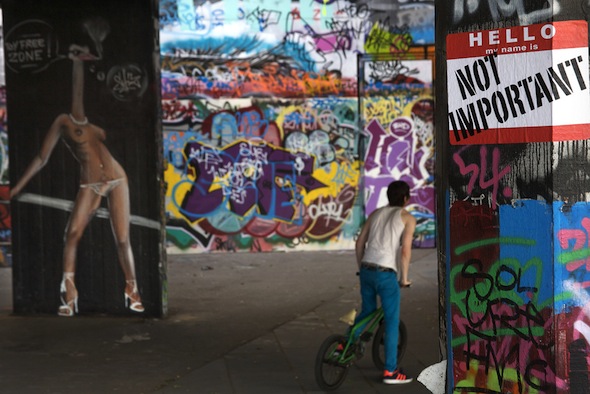
BMX Bike, Southbank Photo: © Mark Granier
Southbank
Everything is neither synonym nor like-
We bruise easy, for example;
Peach. Mottled. Punch.
A fib to say more Lyre than Lear,
The juice of the word ‘apophysis’
The bathos of bone, splintered,
Bowdlerized, a coda of this melancholy,
This street theatre, this effervescent
Promenade, this cultural quarter
This street-beat named desire,
This sliding scale on the spinning,
This leave us be moment,
This warmth from the city.
© Peadar O’Donoghue
Peadar O’Donoghue’s first collection, Jewel, is published by Salmon Poetry, and he edits The Poetry Bus magazine.
Urban Myths. No.1: The Supermarket Spider.
Posted: February 9, 2013 Filed under: Amusements, Parks, Wildlife | Tags: climbing frame, Hillyfields, spider in bananas, spider in supermarket Comments Off on Urban Myths. No.1: The Supermarket Spider.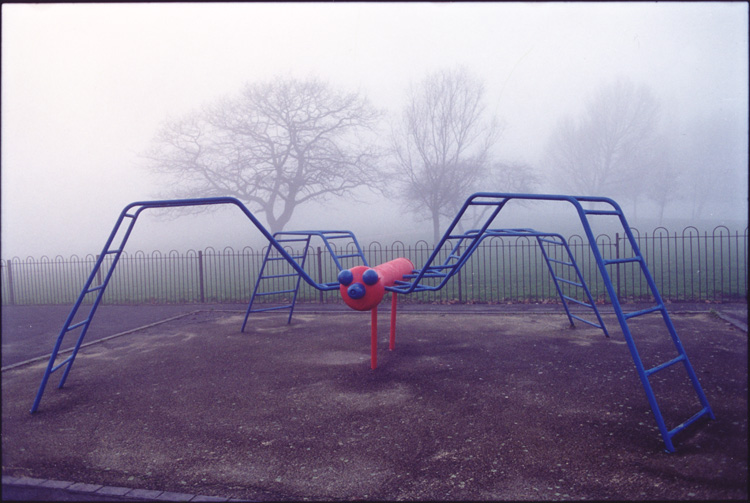
Hillyfields, Lewisham. Photo © David Secombe 1999.
Deadly spider eggs found in supermarket bananas *
WHEN Heidi Slopes did her weekly food shop she picked up an innocent looking pack of bananas – little did she know that between the yellow fruit lurked a nest of spiders. The 53-year-old, who is scared of spiders, had the shock of her life when she spotted the white furry eggs.
“I usually buy a bunch of bananas but, ironically, I thought buying packaged ones would eliminate the chance of any creepy crawlies!” said Heidi, who lives in Lewisham with her husband Laszlo, 53. “My husband opened them and put them in the fruit bowl. I looked down and saw little white balls and suddenly panic stations were all go!”
Heidi wanted to get the suspicious package checked out, and after a phone call to health and safety at Lewisham council she was advised to take them back to the supermarket. “It took almost five hours of numerous phone calls to get hold of someone at the store, only to be told that I would need to bring the packaging and the receipt in for a refund,” said mother-of-three Heidi.
RSPCA animal collection officer Terence Whipps subsequently confirmed that the eggs were those of the Brazilian Wandering Spider, listed in the Guinness Book of Records a the most venomous animal in the world. It’s scientific name is Phoneutria nigriventer – the first element is Greek for ‘murderess’ – but it is also known as the banana spider because of its habit of stowing away in shipments of the fruit.
A supermarket spokesman said: “We want to reassure customers this was a very unusual and rare occurrence and we are really sorry for what must have been a real scare”.
Heidi is unmoved. “My little Juanita recently watched the film Charlotte’s Web and told me that there can be 64,000 eggs in one nest, so that made me even more paranoid! I just thought of my kids and how a spider bite could have changed things completely. I’m just so relieved they didn’t hatch. I wasn’t about to go rifling through my recycling bin just to claim £1.49 back. I was surprised that they were more concerned about the packaging than deadly spiders in their bananas.”
Mr.Slopes commented: “It gave us a real fright and no mistake. Supermarkets should be more careful. Horse meat I can cope with, but venomous spiders are another matter.”
* NB: not real news item … the above was drawn from The Daily Mail, BBC News website, Cardiff Online, etc. The first in an occasional series …
A Haunted Bus. Photo: David Secombe, text: Andrew Martin.
Posted: November 2, 2012 Filed under: Amusements, Literary London, Tall Tales, Transport | Tags: haunted bus, L.P. Hartley, Walter de la Mare Comments Off on A Haunted Bus. Photo: David Secombe, text: Andrew Martin.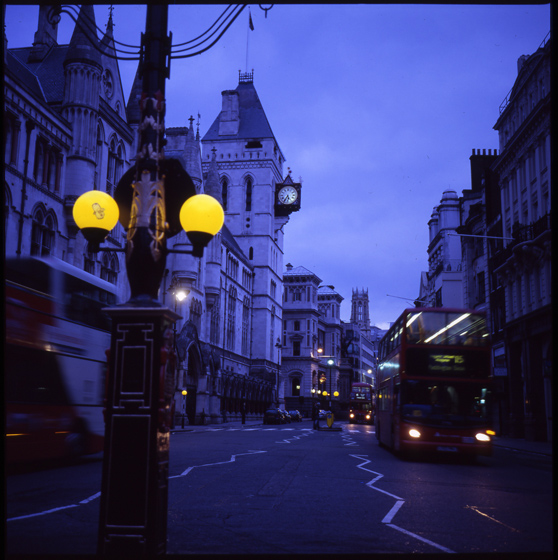
Strand, looking towards Temple Bar. © David Secombe 2010.
An attempt at Putting on a Brave Face
In A Visitor from Down Under by L.P. Hartley, which was published in a collection called The Ghost Book, edited by Walter de la Mare in 1932, we are on the top decl of an open-topped bus ‘making its last journey through the heart of London before turning in for the night’. The loquacious bus conductor encounters a silent, pale passenger with hat pulled down and collar up. ‘Jolly evening,’ says the conductor. (He is being ironic; it is wet and foggy.) There is no reply from the passenger, who holds up his fare between the fingers of stiff, apparently immobile fingers. The conductor takes the money and goes back downstairs. Later, the mysterious passenger is not there. The conductor never saw him come down the stairs, but he rationalises the situation with a very good example of sceptical wishful thinking: ‘He must have got off with that cup-tie crowd’.
From Ghoul Britannia by Andrew Martin, published by Short Books. © Andrew Martin 2009.


 The London Column