Clapham Common Clowns. Photo: Tim Marshall, text: David Secombe. (2/4)
Posted: May 9, 2012 Filed under: Amusements, Entertainment, Performers, Wildlife | Tags: 'I am Grock', Bruce Davidson, Clapham Common, clowns, Pagliacci, Tim Marshall, Waiting for Godot Comments Off on Clapham Common Clowns. Photo: Tim Marshall, text: David Secombe. (2/4)
Sir Robert Fosset’s Circus. © Tim Marshall 1984.
From The Greatest Show on Earth, director: Cecil B. DeMille, 1952:
BUTTONS’ MOTHER: They’ve been around again, asking questions
BUTTONS: I know Mother. They’ll never find me, behind this nose.
From Pagliacci by Ruggero Leoncavallo, 1892:
Bah! Sei tu forse un uom? Tu se’ Pagliaccio!
(Bah! Are you not a man?
You are a clown!)
David Secombe writes:
Clowns always make good subjects for photographers – the ‘tragic’ ones, that is, the sad clowns of popular cliché: gentle misfits of the travelling show, forever on the move, ageing into a fragile future. ‘I am Grock’ – that sort of thing. The quintessential clown photo remains Bruce Davidson’s unforgettable image of a dwarf clown in a bleak field somewhere in America. After Waiting for Godot, this image has become a different sort of cliché, foregrounding a forbiddingly grim-faced little clown against a drab urban wasteland. It’s a clown out of Beckett, a vertically-challenged Pagliacci for a nuclear world.
Tim Marshall’s clowns are a little more nuanced; for a start, they are full-size, but the gentleman who features in three out of the four pictures in this week’s series has impeccably tragic eyes – like a refugee from a silent film, we feel we know this clown’s backstory: the unfaithful wife, the vanished child, the dying mother … but it’s all conjecture, based on our cultural preconceptions and his amazing face. In a theatre or a circus tent we aren’t guaranteed a close look at the performers’ eyes – but in Tim’s portraits this gent becomes an archetype, as timeless and monumental as Nadar’s study of that ur-clown, Debureau, inspiration for the greatest film about the theatre (perhaps the greatest film about anything anywhere) Les Enfants du Paradis. We don’t have to know what this clown was like as a performer, we don’t need to see him working a Bank Holiday crowd (“the smell of wet knickers and oranges”) to decide whether or not he was any good: Tim’s picture immortalises him as one of the greats. He has the look of tragedy all about him.
… for The London Column.
Clapham Common Clowns. Photo: Tim Marshall, poem: Tim Turnbull. (1/4)
Posted: May 8, 2012 Filed under: Amusements, Performers | Tags: Clapham Common, clowns, Tim Turnbull Comments Off on Clapham Common Clowns. Photo: Tim Marshall, poem: Tim Turnbull. (1/4)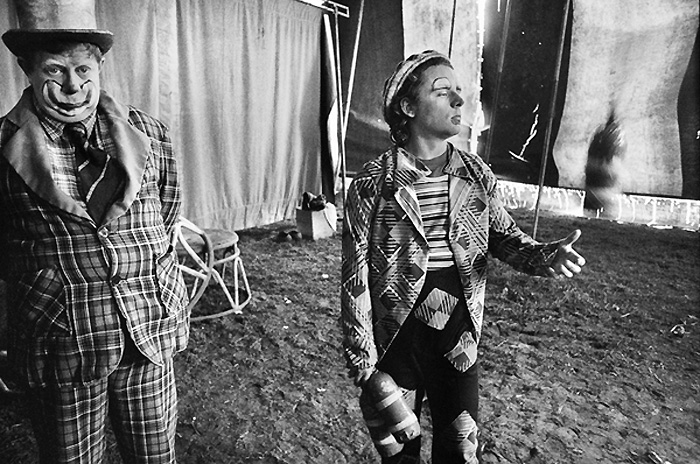
Sir Robert Fosset’s Circus. © Tim Marshall 1984
Clown Rapture Imminent
See them assemble under tarpaulin,
raggy-arsed, rowdy, dim-wit conventicle,
googling their eyes, goofing and pratfalling,
red-nosed and panstuck, no two identical.
The Jingles and Joeys, Buttons and Beppos
stream, in their thousands, the dusty back roads
trudging with bindles and holes in their boot toes,
arrive in jalopies which promptly explode,
but nobody’s certain why they are here –
on the ramshackle outskirts of showbiz –
none of them has the remotest idea
who ought to feed, what, even, the joke is.
So, on they caper, cavort through the night,
dance by the light of a torched charabanc,
engaging in ever more savage pie-fights
with nail-studded slapsticks and ironwood planks.
They wake where they fell, spent and depleted,
clown-pants beshitten, all covered with flies
as Weary Willy, throwing back his head,
howls ‘We are forsaken!’ to an empty sky.
… for The London Column. © Tim Turnbull 2012.
Flotsam and jetsam. Photo & text David Secombe. (2/5)
Posted: April 17, 2012 Filed under: Amusements, Artistic London, The Thames, Transport | Tags: Britart, commercial Thames, corporate London, Damien Hirst, Spot paintings, Tate Boat, Tate Britain, Tate Modern, tate to tate 1 Comment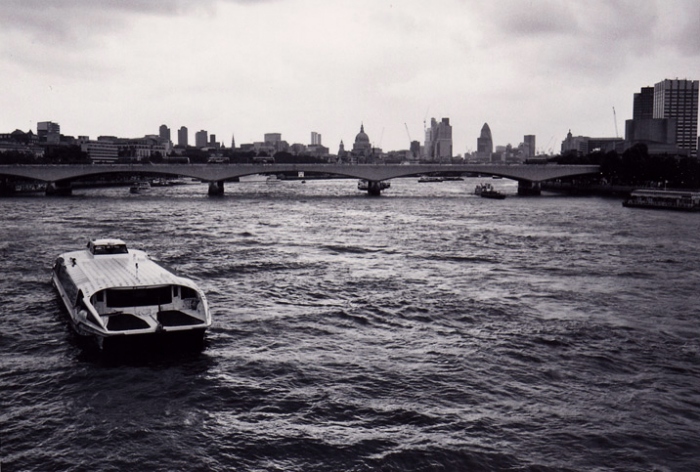
The Thames, looking east from Hungerford Bridge, 2010. Photo © David Secombe.
From Tate Online : 1 May 2003:
From 23 May Tate to Tate, a new boat service on the river Thames, will be available for gallery lovers. The service, which runs every forty minutes during gallery opening hours between Tate Modern and Tate Britain, will be launched on 22 May by The Mayor of London, Ken Livingstone. The boat also stops at the London Eye.
The Tate to Tate boat service, operated by Thames Clippers, is a state-of-the art 220 seat catamaran with specially commissioned exterior and interior designs by leading artist Damien Hirst. The boat is sponsored by St James Homes, a property developer.
David Secombe writes:
Now that Damien Hirst is the richest artist in the world (proof if any were needed of the global success of that strange London-based phenomenon known as ‘BritArt’), it seems entirely fitting that ‘the fastest’ commercial vessel on the Thames, ferrying passengers to and from the world’s most popular – some might say populist – art gallery, bears one of his patented designs. The Tate boat is decorated with Hirst’s bright, multi-coloured dots, and travels between those twin bastions of culture, Tate Modern and Tate Britain – the former fashioned from a derelict power station, the latter built on the site of a penitentiary.
For good or ill, Hirst seems to be the artist who best embodies his time; one can’t imagine a Bacon Barge or a Rothko Raft, whereas our Damien’s spotty pleasure cruiser – made possible by a property consortium – seems completely, depressingly, apt.
(The London Column has not yet felt the siren call of the current Hirst exhibition at the Tate, but you can read a response to the Sotheby’s extravaganza of 2008 on Baroque in Hackney. For another view of Hirst and his influences, see: http://www.stuckism.com/Hirst/StoleArt.html.)
Street traders. Photo & text: David Secombe (1/3)
Posted: March 27, 2012 Filed under: Amusements, Fictional London, London on film, London Types, Markets, Street Portraits | Tags: Del Boy and Rodney, east street market, John Sullivan, Johnny Wallington, only fools and horses 3 Comments Johnny Wallington, East Street Market. Photo © David Secombe 1990.
Although only officially designated a market in the 1880s, East Street Market continues a tradition of street trading in Walworth that goes back to Tudor times. Perhaps more germane to the purposes of the current post is the identification of the market with the 1980s & 90s situation comedy Only Fools and Horses, which is set in Peckham and uses photographs of East Street Market in its opening titles.
The popularity of John Sullivan‘s TV series has given this stretch of south London its own place in modern popular culture. Sullivan himself was from Balham, and he knew the milieu very well. He was working as a scene shifter at the BBC when he approached producer Dennis Main Wilson with an idea for a comedy. Main Wilson was a genuine enthusiast for comedy, a quality not always found in producers of ‘light entertainment’, and had an impeccable gift for searching out the genuine article. The idea was commissioned and became Citizen Smith.
Sullivan’s south London is a fabled place: Del and Rodney live in the mythical Nelson Mandela House (although there is a Nelson Mandela Way not too far away), the local boozer is a haunt of cartoon geezers and Peckham the bucolic playground for an assortment of genial chancers, through whom Sullivan has contributed several phrases to colloquial English. Television writers such as Sullivan and Galton & Simpson (Hancock’s Half Hour, Steptoe and Son) have created Dickensian characters for modern times, refashioning London in the image of their creations. Peckham has become Del Boy’s manor, just as any mention of Cheam conjures up the ghost of Anthony Aloysius St John Hancock – and Surbiton still bears the scars of The Good Life.


 The London Column