Speciality Acts. Photo: David Secombe, text: Claire Muldoon. (3/3)
Posted: January 13, 2012 Filed under: Amusements, Entertainment, Performers, Theatrical London | Tags: Claire Muldoon, Hackney Empire, Roland Muldoon, Sid the balloon-juggling dog, Terri Carol, Variety Theatre 1 Comment
Terri Carol, Hackney Empire. © David Secombe 1990.
From the Obituary column of The Guardian, 19 March 2002:
Terri Carol by Claire Muldoon
What was unique about the music hall performer Terri Carol, who has died aged 87, was that she bridged the gap between pre-television era variety and the variety which re-emerged in the 1980s. Terri was a paper tearer – she balked at the term origami – and became a symbol of the resurrected Hackney Empire in London’s east end.
Her presentation stunned modern audiences. Coiffured, magnificently gowned, the grand old lady – who called people “darling” or “sweetie” – astonished young audiences with her skill. The act was a series of age-old paper tricks, accompanied by a patter delivered as asides. “If the government,” she would observe to the incredulous onlookers, “gave me a bit more pension I wouldn’t have to do this bloody thing.
“I don’t drink, I don’t smoke,” she would add, “but I’m not a spoilsport.” The show proved it. Out of a flurry of paper would be launched ships, palm trees, lace doilies, steering wheels, occasionally enhanced by a dash of audience participation. The performance culminated with her astounding “tower of progress”, a 30ft- tall paper ladder which she would dedicate to a cause dear to her heart.
The daughter of a music hall paper tearer, Terri was born in a Mitcham funeral parlour. She was educated at a convent school until, at the age of nine, her father taught her the paper tearer’s art and carried her off on a world tour with Sir Harry Lauder. The act, her father opined, was clean, and it would make her a living. By the time she was 12, she reckoned she had circumnavigated the world twice. She played Tokyo, took Paper Capers to the Radio City in New York, and claimed that, while doing seven shows a day in the US, she never saw the light of day.
Her career peaked in wartime and she was described by the Daily Mirror in 1942 as “the pluckiest girl in showbusiness”. She performed with her baby in a crib, in the care of a stagehand in the wings. She played with Buster Keaton (“never sober to tell you the truth”), Carmen Miranda, Phil Silvers, Lena Horne, Max Miller and Laurel and Hardy. There was even a time when, she said, she lived in Park Lane, complete with a maid.
Terri was married three times. Her first husband was killed, and after a brief marriage to a Pole she met on a train to York, she married Bill Lowe, one half of a popular comedy double of the 1940s whom she met – with his then wife – on a troop plane back from Germany. As the music hall declined, she toured the continent in the early 1950s, but by the mid-1950s her marriage had collapsed.
Her father’s advice did earn Terri a living, apart from a spell which began in the 1960s when variety was dying. So she worked in the civil service at the ancient monuments department. A decision in the early 1980s to move to South Africa – and visit one of her daughters – was a disaster.
Back in London and virtually penniless, she moved into sheltered housing in Croydon. But then, after the Hackney Empire reopened in l986, I spotted Terri performing in a “good old days” show, and became her agent. She subsequently appeared on Wogan, Friday Night Live, Barrymore, the Generation Game, and the Just For Laughs Festival in Montreal; she toured the New Variety circuit in London and went back to Japan for Nippon TV’s Comical Performers. There she was the only person present able to recall pre-war, pre-fire-bombed Tokyo. She performed for the Eurythmics in Nice, and at Tina Turner’s 50th birthday party.
Terri retired officially when arthritis finally took its toll at the age of 80, and she found it too difficult to tear paper, yet she was still planning to perform for the reopening of the Empire’s main auditorium later this year. She is survived by two daughters.
Terri Carol (Ivy Rosina Victoria Morse), entertainer, born May 25 1914; died January 31 2002.
David Secombe:
This photo of Terri Carol was taken in the foyer of the Hackney Empire as part of a series on ‘Speciality Acts’ which I shot for The Sunday Times Magazine. The feature was facilitated by Claire and Roland Muldoon, sponsors of new and old Variety theatre by virtue of their heroic work managing performers and rescuing the Hackney Empire from its fate as a defunct Bingo hall. Some might say that their achievement has not been properly appreciated: without their effort and enthusiasm, this grand Frank Matcham-designed theatre would have been pulled down in the 1980s. Some of the most magical nights I have ever experienced in a theatre have been at the Hackney Empire; sadly, since the Muldoons departed, the theatre may have said to have lost its pristine sense of purpose. The love has left the building. If there was any justice in the world, the Muldoons would still be in charge of the finest Variety Theatre in Britain and there would be a statue of Claire, Roland and Sid the balloon-juggling dog outside Hackney Town Hall.
See also: Comics 1 (Spike Milligan)
Speciality Acts. Photos & text David Secombe (2/3)
Posted: January 12, 2012 Filed under: Amusements, London Types, Performers, Theatrical London | Tags: Britain's Got Talent, Goldfish, regurgitation, Stevie Starr, Variety entertainers Comments Off on Speciality Acts. Photos & text David Secombe (2/3)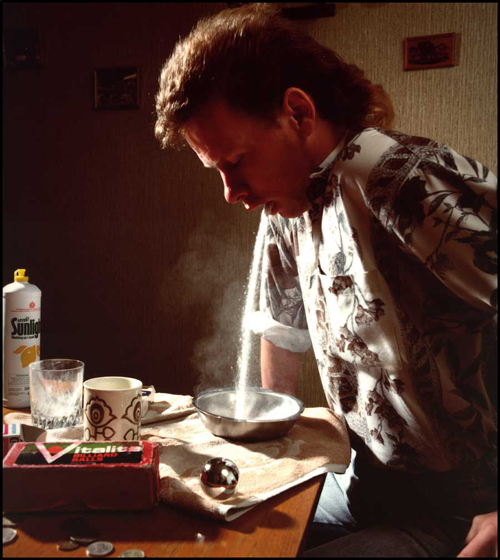
Stevie Starr, Finchley. © David Secombe 1990.
Stevie Starr swallows things; then he brings them back up again. He is a professional regurgitator.
In the picture above he is bringing up a fountain of sucrose powder – which , bizarrely, is coming up dry – one of a number of different items and substances which disappeared and then reappeared before our eyes: a lightbulb, a billiard ball, coins … Another routine involved swallowing soapy water, smoking a cigarette and blowing smoke-filled bubbles. He refrained from performing his famous goldfish routine, a trick which had got him into some trouble with the RSPCA. Stevie pointed out to the animal welfare inspector who came to see his show that he drank six pints of water before he swallowed the fish, that he had never had one die on him and that, as their memory span was only eight seconds, by the time they were in his stomach they couldn’t remember how they got there.
Stevie’s story of how he came to acquire such a skill was touching, if perhaps calculated; he said that he was bullied at school and had to swallow his pocket money to stop it from being stolen; he then discovered that he could bring the change back at will.
I heard nothing of Stevie for many years – until last year, when he appeared as a contestant on Britain’s Got Talent. Stevie’s talent is specialist but genuine: in an earlier era, he might have become as well-known as the celebrating farting turn Le Petomane, but Stevie’s skill is perhaps too unnerving for contemporary taste. Seeing his routine close-up was a hugely memorable yet faintly worrying experience: I thought he was going to choke to death on that billiard ball.
… for The London Column. © David Secombe 2012.
Dmitri Kasterine. Text: Andrew Martin. (2/5)
Posted: October 25, 2011 Filed under: Amusements, The Thames | Tags: Andrew Martin, Cabinet War Rooms, James J. Fox, the end of me old cigar 1 Comment
Man with cigar, Putney, 1967. © Dmitri Kasterine.
Andrew Martin writes:
This chap is, to my jaundiced mind, committing the error of smoking outside at a time in history when he could have been smoking inside, so he seems to me complacent, lacking in foresight. I think it was Freud, who said that oral satisfaction of smoking comes from blowing a concentrated stream of smoke, and you can’t do that out of doors, as I know because I am forced to smoke most of my half dozen weekly cigars out of doors, ideally on a fine day in Green Park, where the price of the deckchair adds £1.50 to the cost of my cheap (‘inexpensive’, my tobacconist calls them) Honduran cigars.
My tobacconist is James J. Fox in St James’s Street, one of – I think – half a dozen left in central London, where twenty years ago there were forty. I once asked the man who serves me at Fox when the shop was founded, ‘1730,’ he said, with great trenchancy, but the shop was called Carlin in those days, and sold mainly snuff. It was called Robert Lewis from 1787 to 1991, when Fox moved there from Burlington Arcade. ‘Did you ever supply Churchill?’ I asked my man. ‘Sole supplier, sir, sole supplier.’
To think that in Churchill’s London you could smoke cigars in pubs, restaurants, on Tube trains, in Tube stations. When the subterranean Cabinet War Rooms were being fixed up early in the War, Churchill repaired to the safety of the disused Down Street Tube station, which had been taken over by the Railway Executive. He smoked cigars there, and it was said the fumes from them – and from his rich food and brandy – floated along the tunnel to the shelterers at Green Park station, and tormented them.
The only place I now smoke an indoor cigar in London, is in the upper room at Fox, where it is allowed providing you are sampling one to buy a larger amount, or providing you say that’s what you say you’re doing. I listen to a lot of plutocrats in there, as they drink coffee and smoke fifty quid double coronas. (Double coronaries, more like). The other day, one of the millionaires was Australian, and he was saying you can’t smoke outdoors in many places in his country. So I shouldn’t moan really.
… for The London Column. Andrew Martin’s book, Underground, Overground – A Passenger’s History of the Tube is published by Profile Books in May 2012.
Dmitri Kasterine. Text: David Secombe (1/5)
Posted: October 24, 2011 Filed under: Amusements, London Types, Sartorial, Sport | Tags: croquet, Dmitri Kasterine, Existentialism, H.M. Bateman, Hurlingham Club, shorty mac Comments Off on Dmitri Kasterine. Text: David Secombe (1/5)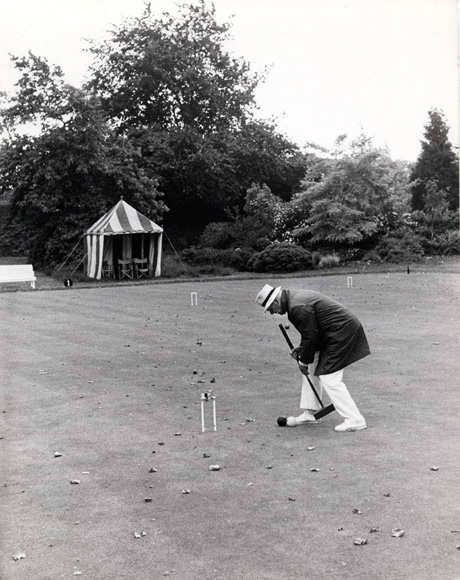
Croquet, Hurlingham Club, 1980. © Dmitri Kasterine.
This week, The London Column is featuring the work of Dmitri Kasterine. Before leaving London for New York thirty years ago, Kasterine was a sympathetic and perceptive commentator on the English scene: his portraits of artists and writers (including Samuel Beckett, Graham Greene, Tom Stoppard, etc.) are familiar and definitive images for posterity – and his social documentary work, which we are showing, is impeccably witty and elegant.
In this photograph, we see a croquet player in a shortie raincoat (clothes are important in Kasterine’s pictures) braving inclement weather to play against – whom? The field is empty, autumn leaves strewn across the lawn; summer is over, the spectators have left, hours or possibly days earlier. His grip on the mallet is assured yet faintly desperate. He is playing against himself and no-one cares – except the photographer. This is croquet transformed into an existential game – or, perhaps, a nightmare from an H.M. Bateman cartoon: The Man Who Played Croquet After the Pleasure Garden Had Shut. D.S.


 The London Column