On the South Bank. (5)
Posted: August 10, 2013 Filed under: Artistic London, London Music | Tags: London's South Bank, Royal Festival Hall Comments Off on On the South Bank. (5)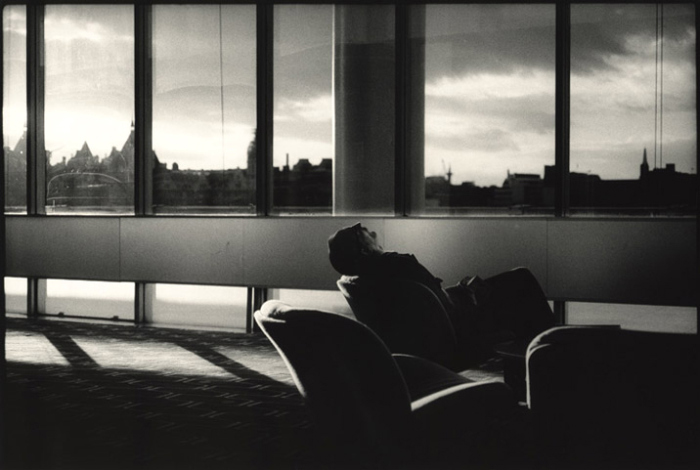
Before a concert, Level 3 terrace, Royal Festival Hall. Photo © David Secombe 1988.
In the years since The Royal Festival Hall opened in 1951, people have sat in this foyer waiting to hear:
Claudio Abbado, Laurie Anderson, Louis Armstrong, Burt Bacharach, Dame Janet Baker, Sir John Barbirolli, Daniel Barenboim, Count Basie, The Bee Gees, Luciano Berio, Leonard Bernstein, Pierre Boulez, Sir Adrian Boult, David Bowie, Alfred Brendel, John Cale, Maria Callas, Ornette Coleman, Elvis Costello, Sir Colin Davis, Miles Davis, Neil Diamond, Christophe von Dohnanyi, Nick Drake, Jacqueline Du Pre, Bob Dylan, Electric Prunes, Duke Ellington, Fairport Convention, Marianne Faithfull, The Fall, Ella Fitzgerald, John Eliot Gardiner, Valery Gergiev, Carlo Maria Giulini, Goldfrapp, Benny Goodman, Bernard Haitink, Herbie Hancock, Tony Hancock, Jimi Hendrix, Vladimir Horowitz, Keith Jarrett, Jethro Tull, Elton John, Tom Jones, Herbert von Karajan, Rudolf Kempe, B.B. King, Carlos Kleiber, Otto Klemperer, Radu Lupu, Humphrey Lyttleton, Lorin Maazel, Wayne Marshall, Steve Martin, John Martyn, Johnny Mathis, John McLaughlin, George Melly, Modern Jazz Quartet, Thelonius Monk, Pierre Monteux, Motorhead, Riccardo Muti, Evgeny Mvravinsky, Randy Newman, New York Dolls, The Nice, Jessye Norman, Murray Perahia, Pere Ubu, Oscar Peterson, Pink Floyd, Maurizio Pollini, Lucia Popp, Simon Rattle, Lou Reed, Buddy Rich, Sviatoslav Richter, Mstislav Rostropovich, Artur Rubinstein, Sir Malcolm Sargent, Saint Etienne, Andras Schiff, Elisabeth Schwarzkopf, Ronnie Scott, George Shearing, Frank Sinatra, Nina Simone, Soft Machine, Georg Solti, Patti Smith, Karlheinz Stockhausen, Leopold Stokowski, Igor Stravinsky, Jack Teagarden, Klaus Tennstedt, T-Rex, Richard Thompson, Arturo Toscanini, Stan Tracey, Tricky, McCoy Tyner, William Walton, Brian Wilson, Yes, Frank Zappa, Krystian Zimmerman . . . amongst others.
This entry is the 200th post on The London Column. Thanks to all our contributors and readers … D.S., K.E.B.
On the South Bank. (1)
Posted: August 6, 2013 Filed under: Architectural, Artistic London, Monumental | Tags: london civic space, southbank skate park, The Southbank Centre Comments Off on On the South Bank. (1)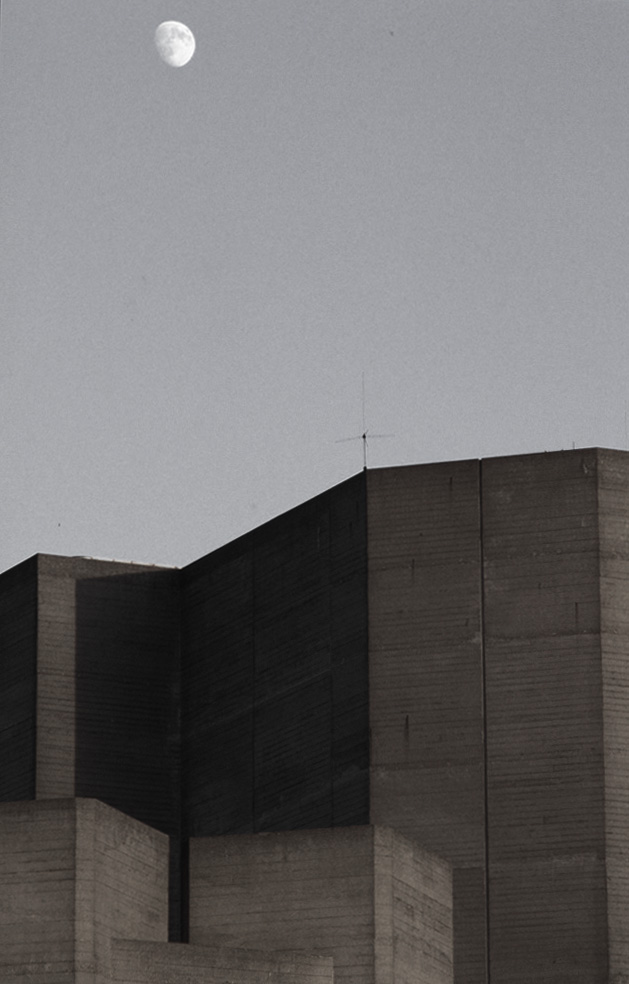
National Theatre. © David Secombe 2010.
Brutalist architecture has never been popular in Britain. The garden, the milk float, the net curtain, all work to alienate the British sensibility from the modernist, and especially the Brutalist, vision. We don’t care how pure its aesthetic is. We like things Nice.
Maybe the one exception is the good old South Bank. For some reason, despite decades of controversy, two murders, and several refits and remodellings, this complex of buildings is that genuine thing, beloved of the people. Unpromising as one may think it looks (though it is now dotted all over with bright structures, a giant yellow stairway, a turquoise Mexican place in shipping containers, pink things, green bits; they do certainly brighten it up). This is by accident as much as design. Maybe familiarity. Maybe proximity to Tate Modern. Maybe the development of Gabriel’s Wharf and that whole stretch of the river into something a little more friendly. Partly the skateboarders, who just seem to exist alongside everything else, whose thwack thwacks have followed us along that path by the river since the seventies. Certainly the restaurants: people always want something to eat, and the current proposed redevelopment is essentially an opportunity to expand on this.
At just that point, it stops being accident and becomes something more sinister. The space, rejuvenated as it is, has felt increasingly managed (that is, filled with things to be bought) for the past span of years. This is in keeping with a trend, as civic space becomes more and more tied to retail; we are forgetting how to occupy a city without buying, without being told what to look at. If this plan goes ahead, the stretch of river we love most will end up like the renovated Brunswick Centre, with added Thames.
But the Brunswick doesn’t incorporate two of Britain’s most important cultural venues – or the Thames. There is a debate that Londoners (particularly; but also the whole country) need to have about what kind of shared space this complex is supposed to be – who is it for? what is it for? what do we value about it? what do we want it to be like? And, if nothing else, we appear now to be beginning to have that debate (this link is the most informative article we’ve seen on the subject).
The South Bank is important on a personal level. Many of us – most of us, in London – have played out our lives with it as a backdrop. Much as it pains us to admit it, Richard Curtis got that much right; every new relationship seems to have a South Bank moment, and serendipity multiplies there. You meet people, you see things, you get some space to contemplate the sky, you feel the proximity of the physical river, suddenly London feels open and mysterious. But serendipity only happens if you’re left alone to find it. The existing Southbank Centre has more than enough cafés, about 2000% more than ten years ago, and we liked it even then. (Very fond memories of the unassuming old canteen, going back further.) It has been that rare thing: a public space where one can feel private.
These shop-heavy proposals – necessitated by the desperate need for funding to maintain ever-growing levels of activity – will transform the area into yet another crowdfuelled, corporatised zone (art needs people; corporations need crowds). They will gut the Festival Hall embankment in the way that the Royal Opera House extension (also paid for by shiny shops) eviscerated Russell Street. No one can argue that the Royal Opera extension didn’t effectively kill the life (as distinguished from the shopping and eating) of the eastern end of Covent Garden Piazza; and you only have to look at what has been done to Spitalfields and Borough markets in the past few years to be afraid for the South Bank.
Aside from which, everyone seems to have forgotten a principle that was voiced by the influential architect Cedric Price (who designed a radical overhaul for the South Bank in 1983, complete with giant ferris wheel). He said that cities and buildings should never be empty, but nor should they ever be full. For all the recently-added ‘lifestyle opportunities’, this stretch of embankment has been one of the few areas left in London that retains some of this balance; and it’s going.
This is a big thing to say, and it is the crux of the debate the nation needs to have about the South Bank. (And indeed London.) The Southbank Centre has apparently got all kinds of educational remits to fulfil, and outreach, and developing the audiences of tomorrow, and family-friendly holiday activities to lay on, and tourists to first attract and then cater for, and the developments are partly to enable all of this. They’re also, to create badly-needed space for existing facilities: the Poetry Library, for one. Billy Bragg wrote compellingly the other day about the needs of performers, and the projects he describes that are going on at the Southbank Centre are inspiring. Itislovely to go there and have a roof garden. Both of your correspondents here love the South Bank: we use the centre constantly and depend on it hugely. But none of that means the developments in their current form – new shops and restaurants, an obstructive building in the middle, an even more ruined skyline over the river, a giant glass box squatting on top of everything, put through at speed and not consulted on – look like improvements to the actual city. (Sir Nicholas Hytner may have a point.) It’s time to stop, take a breath, have the conversation. This has been as good as said by architects who could have pitched for the contract, but didn’t. As the Architect’s Journal reported:
Bennetts Associates had already withdrawn from the competition, claiming that it had too much work and that it had ‘reservations about the brief’ (see AJ 20.09.2012). Rowan Moore, writing in the Observer, also raised concerns about the ‘commercially-led’ plans which he said could ‘make the Southbank Centre resemble Terminal 5 or Canary Wharf or any moderately upmarket shopping mall.’
After the Tories won the 1951 election, they prioritised the destruction of the Festival of Britain site, for ideological reasons. The current government’s attitudes both to the arts and to public space, similarly ideological, have put institutions large and small under pressure to prove they have a right to exist (you earn the right by making money). The current proposed Southbank scheme is thus about to act out the contemporary version of this philistinism, and the fact that it is presented in the language of ‘inclusivity’ makes it more chilling.
This idea of inclusivity is being underpinned by branding, some of it quite subtle, and the brand seems increasingly personality-driven. Artistic Director Jude Kelly is the driver of these developments, and indeed of the whole ongoing ‘revitalisation’ of the centre. She has made herself admirably available to defend the proposals, and her vision, but the danger is that the whole vision for the South Bank feels like a personal vision. If one wants an ice cream in the interval at the Festival Hall, one even buys a ‘Jude’s Ice Cream’! (The franchise is Minghella.) ‘Southbank Centre’, having already joined up the words South and Bank, has now dropped ‘The’ from its name – turning it from a place into a brand – Southbank Centre – rather as if it were a restaurant or shop. It begins to feel like a sort of Boden or Orla Kiely cultural space, where middle class people (because we are all middle class now) are safe to consume culture en masse along with our pizzas, noodles, and extra-large caramel lattes. But where’s the space for the genuine, austere surprise ? The one no one could plan for you?
We know times have changed – we certainly do know it – but if this blog post is anything, it’s a plea for a deep breath and a deep look at what things really mean. And we’ve barely even mentioned the skateboarders.
We’ll be posting the rest of the week with pictures and impressions – poems, not polemics – of the South Bank and the people who use it.
© Katy Evans-Bush
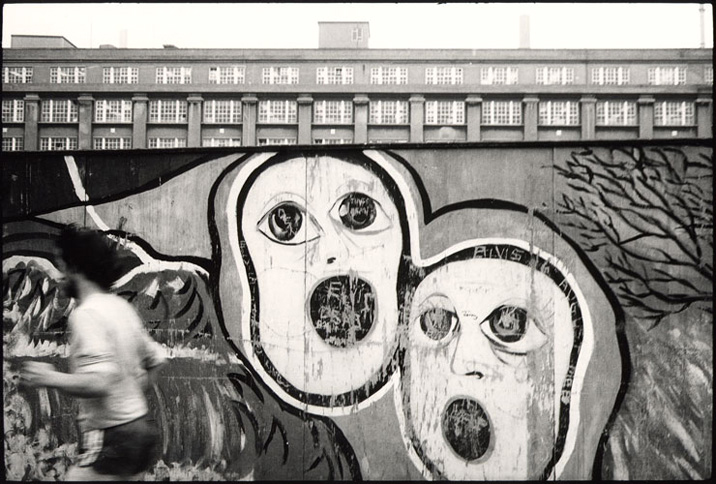
Hoarding opposite National Theatre. © David Secombe 1982.
Sweet Toof.
Posted: March 7, 2013 Filed under: Artistic London, Graffiti, Public Art | Tags: Haggerston, London graffiti, London street art, Regent's Canal, sweet toof Comments Off on Sweet Toof.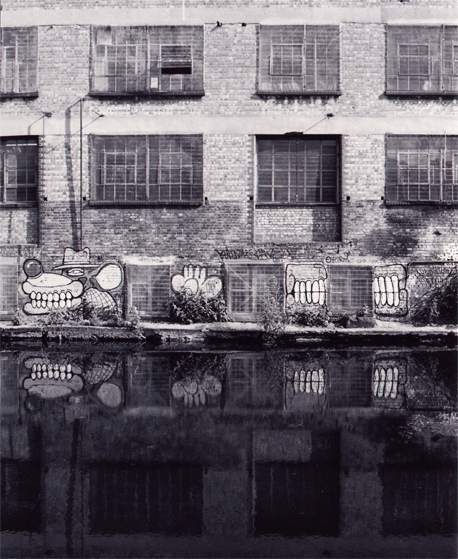
Sweet Toof artwork, Regents Canal, Haggerston. © David Secombe 2010.
From Wikipedia entry ‘Sweet Toof’:
Sweet Toof is the pseudonymous name of well-known United Kingdom graffiti and street artist.
Meaning of Mouth, Teeth and Gum imagery
According to an account by Olly Beck, Sweet Toof looked at himself in a looking glass “in crisis after a messy break-up”, with the enlarged and distorted imagery of the “crescents of teeth”, the “visible part of our skeletal frame” as a reminder of mortality. Beck relates Sweet Toof’s concerns and imagery with the 16th Century Northern European “Vanitas” tradition of reminding of the transience and vanity of life, and to the Mexican celebration of skull imagery to accepting, honouring and celebrating death as part of the life trip.
Sweet Toof’s own comments seem to uphold this interpretation, in which the artist comments, “To get one’s teeth into things, before it’s too late.” Elsewhere he notes, “Teeth can be really sexy, or aggressive, but they’re also constant reminders of death. They’re how we get recognised by police when there’s nothing else left.”
Jeremy Ramsden.
Posted: January 30, 2013 Filed under: Artistic London, Bohemian London, London Labour, Vanishings | Tags: Brian Griffin, Harry Borden, Jeremy Ramsden, Labyrinth Photographic, Tim Walker 3 Comments
Jeremy Ramsden in his darkroom at Labyrinth, Bethnal Green. © David Secombe 2011.
David Secombe:
One of the things that is being lost in our back-lit, screen-bound digital world is the texture associated with older forms of image-making. As someone who became a photographer because I liked the idea of making something, of leaving something tangible behind me, I mourn the gradual passing of the physical photograph: the transparency, the negative and the print.
Traditionally, the relationship between photographers and their printers was not always easy; not every photographer could print their images like Eugene Smith or Don McCullin, and even if they could, they couldn’t always spend hours in the darkroom when they were busy shooting. Some printers would – justifiably – resent having to fix their clients mistakes or deal with photographers who didn’t really know what they wanted their prints to look like. But others took a more lenient view of photographers’ foibles and would, where necessary, give them an informal technical training to go with their prints. And from the mid-1980s,advances in reproduction technology and an increasing acceptance of colour negative film as a serious format for serious photography ushered in a new era of image-making. Professionals were liberated from the unforgiving tyranny of the transparency – more room for manoeuvre after the shoot, more latitude of exposure and expression, a level of freedom previously available only to those who shot black and white. It was in this arena that colour printers like Brian Dowling and Jeremy Ramsden reigned supreme.
Jeremy Ramsden, who died last week, was one of the finest colour printers of his generation. Jeremy could take a frame of anyone’s film and turn it into a work of art on paper. The quality of Jeremy’s work is only partially discernible on a website, because the sheer physical beauty of his prints, their intensity and almost holographic clarity, can only be experienced by personal appointment. Jeremy’s fanatical attention to detail was apparent in the way he would, as a matter of course, produce a variety of prints from the same frame, with each print having its own distinct mood and character. Variations on a theme, if you like, the creation of totally different images from a single piece of film. And when you got your negatives back, you’d see his meticulous notes written on little strips of masking tape affixed to the protective sheets. Jeremy went to these lengths because he cared, because he was an enthusiast for photography. And when you consider the names on his client list – which included the likes of Tim Walker, Elaine Constantine, Harry Borden, Brian Griffin – the breadth of his achievement becomes clear.
Jeremy was Australian (not for nothing was his erstwhile lab in Shoreditch called Outback) and he arrived in London as a merchant sailor in the early 1970s. He knocked around London’s photo scene in a variety of capacities – studio assistant to the likes of Brian Duffy and Angus Forbes, freelancing as a photojournalist (he was a very fine photographer in his own right) and mastering all aspects of the arcane art of colour printmaking. His experiences of the glory days of Soho in the advertising boom of the 1970s and 80s would have made a very interesting book. Jeremy had a stereotypical Ozzie enthusiasm for travel, people and a good story – but, above all, he liked sharing his enthusiasm for the world and how we see it. He was generous with his time and, like our friend John Driscoll, who died last year, he was a champion of photographers. Having Jeremy or Brian or John in your corner was like having a secret weapon; if you had the nod from them, you could breathe a little easier. They knew the score. I always thought it was important to earn the respect of the people who handled my pictures, and I think most photographers would agree – although there were some ‘celebrated’ photographers who relied a little too heavily on the expertise of darkroom staff to produce their meisterwerks. But Jeremy spoke of his clients very warmly, and this was because he was reluctant to print for anyone he didn’t respect; so an unsolicited compliment from Jeremy was worth far more than one from almost any picture editor.
It is hard to write a piece like this without sounding nostalgic or merely old; but it seems to me that apart from the loss of the tactile aspect, the ubiquity of digital imaging has led to the erosion of a social element within photography. I’m not the only one who misses that. It is hard to think of Jeremy not being there to work his magic on a print, to offer his take on it, see the potential of a negative fully realised – and then discuss the competition and swap stories over a pint. A couple of years ago, Jeremy co-founded Labyrinth, a darkroom in the East End which has become a mecca for new and established photographers. Jeremy was full of excitement for the young talents who were bringing their pictures to him, the brave ones who had chosen to render their images on film rather than as pixels on a chip. He was rejuvenated by the challenge and, apart from anything else, it is a tragedy that he will not see his fledglings develop and mature.
He gave a great deal and asked for very little in return. Personally, I owe him a huge amount – and the shock of his sudden passing still hasn’t sunk in. I can’t quite believe it. The industry will feel a lot colder without him. The world will too.
… for The London Column.


 The London Column