At Home with Mrs John Profumo.
Posted: March 25, 2013 Filed under: Architectural, Class, Corridors of Power, Events, Housing, Interiors, London scandals | Tags: Chester Terrace, Christine Keeler, Evening Standard Homes and Property, House and Garden, John Profumo, London property market, Profumo Affair, Scandal, Stephen Ward, Toynbee Hall, Valerie Hobson Comments Off on At Home with Mrs John Profumo.
‘Mrs Profumo in the drawing-room with her white French faience hound.’ Uncredited photo from House and Garden, Conde Nast Publications, 1962.
From The House and Garden Book of Interiors, 1962:
Mr. and Mrs. Profumo (she is Valerie Hobson, the actress) live in a typical-looking Regent’s Park stuccoed villa, which has certain highly individual touches, the most covetable being a large garden and a magnificent drawing room.
An improbably large area of the house is given over to the drawing room, which must be one of the largest rooms in London to be found in a house of comparatively modest size. With its double-cube proportions, three fine windows, opening on to the garden, and gaily disciplined Nash decorations, this is a perfect room for a couple who must, perforce, engage in a great deal of entertaining.
A quick glance into Mr. Profumo’s own study provokes the wish that more masculine, magisterial ministerial rooms were half so attractive! Needless to say, the desk is large and if you look carefully you will see a highly decorative as well as highly confidential red ministerial despatch box on it, doubtless often impelling the owner of this charming house away from the family circle to the chores inseparable from high office.
From John Profumo’s statement in the House of Commons, 22nd March, 1963:
“My wife and I first met Miss Keeler at a house party in July 1961 at Cliveden. … Between July and December 1961, I met Miss Keeler on about half-a-dozen occasions at Dr Ward’s flat, when I called to see him and his friends. Miss Keeler and I were on friendly terms. There was no impropriety whatsoever in my acquaintanceship with Miss Keeler. … I shall not hesitate to issue writs for libel and slander if scandalous allegations are made or repeated outside the House.”
From Confessions of Christine, Christine Keeler, News of the World, June 1963:
Our meetings were very discreet. Jack [Profumo] drove a little red mini car. … If we were not in the flat, then we would just drive and drive for hours. Of course, it was impossible that our discretion would be absolutely complete. There was that amazing evening when Jack was round, and an army colonel showed up suddenly looking for Stephen [Ward]. The colonel couldn’t believe it. Jack nearly died. The funny thing is I never used to think of Jack as a Minister. I can not bow down to a man who has just got money or a position. And I liked Jack as a MAN.
David Secombe:
The passage of time has rendered the uncredited House and Garden text as poignant as it is comic. The gushing prose is at odds with the attitude of Valerie Hobson in the picture, lost amidst the chilly perfection of her vast drawing-room. Her husband, despite his vivid presence in the editorial copy, fails to appear in any of the pictures of the interior of their Regency villa, presumably due to the demands of the business of state – or, as implied by Christine Keeler’s racy memoir, some other kind of business.
This issue of House and Garden appeared in 1962, not long before Profumo’s mendacious statement to Parliament, which left a host of hostages to fortune, eventually leading – as everyone knows – to his resignation as Secretary of State for War. Today, politicians have ample opportunities to reinvent themselves after a career-ending debacle: Neil Hamilton, Jonathan Aitken and even Jeffrey Archer have achieved a degree of rehabilitation and it seems likely that Chris Huhne and Vicky Pryce will eventually re-enter ‘public life’ in some form or other. As the pioneer of modern political scandal, John Profumo had no such option: instead, he chose a practically Roman form of self-abasement, cleaning the toilets at Toynbee Hall in Whitechapel (a task he continued to do until the management suggested that there might be better ways of using his skills). He did, eventually, gain a limited re-admittance into high society but even that took him decades.

Former home of Mr. and Mrs. John Profumo, Chester Terrace. Photo © David Secombe 2011.
From Evening Standard Homes and Property, 14 Feb 2012:
This Grade I-listed property at prestigious Chester Terrace overlooking Regent’s Park, was once the home of shamed politician John Profumo, who lived in the splendid stucco townhouse during his much-publicised affair with model Christine Keeler in the Sixties. The scandal forced his resignation as secretary of state for war and damaged the reputation of Harold Macmillan’s government. Designed by John Nash, the architect responsible for much of Regency London, the elegant, four-bedroom house now has a cinema room, wine cellar and enchanting garden. If only walls could talk… Call [estate agent] if you have £10.95 million.
Metro-Land.
Posted: January 10, 2013 Filed under: Architectural, Fictional London, Housing, Literary London, Meteorological, Transport | Tags: Art Deco, Edward Mirzoeff, John Betjeman, Metroland, Metropolitan Line 1 Comment
Pinner Station at dusk. © David Secombe 2011.
From Murder at Deviation Junction by Andrew Martin*:
‘Londoner,’ said Bowman, shaking his head, ‘born in some tedious spot like … I don’t know… Pinner’.
From Pennies from Heaven by Dennis Potter:
ACCORDION MAN: We’re all going to hell. We’re all going to burn in hell. Thank you very, very much, sir. Thank you very, very much, madam. Thank you very, very much, sir.
David Secombe:
Today marks the 150th birthday of The Tube – and for The London Column’s modest contribution to this anniversary I would like to draw our readers’ attention to the BBC4 repeat at 10 pm tonight of TLC contributor Edward Mirzoeff’s classic 1973 documentary Metro-Land, written and presented by John Betjeman. For anyone that hasn’t seen it, this film is a glorious relic of the golden age of the British television documentary, and takes as its subject the early 20th Century suburbs that grew up alongside the Metropolitan Line as it extended deep into rural Middlesex. As the poet laureate of inter-war suburbia and the Met line in particular, Betjeman is the ideal tour guide for this trip from Baker Street to Neasden, Wembley, Harrow, Pinner and beyond.
Pinner is the quintessence of inter-war residential development: serried rows of polite, cheerful villas and semi-detached houses spreading outwards from the remnants of an ancient hamlet. So whilst Pinner Village contains some very old houses indeed, the Metropolitan Line is the reason we are here: Met Line trains from Pinner station take just 25 minutes to reach Baker Street. Pinner’s tidy crescents and avenues were intended as havens from the dirt and clamour of the city – with desirable residences, clean air, the Met Line to take you into town, and the shops and cinema of the new parade just a few steps away, what more could life offer? Naturally, Metro-Land’s quasi-rural calm came at the expense of Middlesex’s actual rural landscape, which entirely disappeared beneath the streamlined semis, but this is a very English approach to Moderne living (as opposed to Modernism, which the British didn’t exactly take to their hearts) – tidy, domesticated, and hungry for acreage. Metro-Land is not so much a place as a state of mind, a dream of what life might be; a bucolic idyll with all the benefits that the Tube, the ring roads, the wireless and state-of-the-art plumbing could bring.
But the near-identical streets of Pinner, Eastcote, Ruislip, Rayners Lane and their neighbours are also an expression of a state of unease. The cosy, complacent sprawl of these suburbs comes at a price. The new suburban landscape goaded and inspired Betjeman (‘Your lives were good and more secure/Than ours at cocktail time in Pinner’), as it did George Orwell (Coming up for Air), Louis MacNeice ( ‘But the home is still a sanctum under the pelmets’), Graham Greene (‘a sinless, empty, graceless, chromium world’), Patrick Hamilton (The Plains of Cement) and other writers of the period. They saw fear behind the Deco stained glass. In Dennis Potter’s 1930s-set masterpiece Pennies from Heaven, his doomed travelling-salesman hero Arthur Parker lives in just such a suburb, and oscillates between a joyous fantasy life and an actual life of frustration and anguish. Metro-Land is a perennially vanishing landscape of promise. Close the windows and draw the curtains, a storm is coming.
… for The London Column.
* You can read Andrew Martin‘s hymn of praise to the Tube here – and buy his wonderful history of same here.
See also: Pepys Estate, Nights at the Opera, St Pancras, Jubilee, Dmitri Kasterine, Underground, Overground, London Gothic, Trainspotters, Halloween, The Haunted House, A Haunted Bus.
A Psychogeographical Christmas. Photo & text: David Secombe.
Posted: December 20, 2012 Filed under: Architectural, Crime and Punishment, Food, Health and welfare, Hospitals, Housing, Literary London, London Labour, Monumental | Tags: Billy Butlins, BT Tower, charles dickens, Christmas Day in the Workhouse, Cleveland Street Workhouse, Cold War, Noel Edmonds, Post Office Tower, White Heat of Technology Comments Off on A Psychogeographical Christmas. Photo & text: David Secombe. The Cleveland Street Workhouse and the BT Tower. Photo © David Secombe 2011.
The Cleveland Street Workhouse was built in 1775 as a workhouse infirmary and ended up as part of the Middlesex Hospital until that institution closed in 2005. According to The Cleveland Street Workhouse it ‘has survived largely unchanged since the Georgian era. Its austere appearance is a rare testimony to the bleak and utilitarian institution it was designed to be. Its back yard was a graveyard for the poor, full of dead to a depth of at least 20 feet. Recent research has revealed that the building was the likely inspiration for Charles Dickens’ Oliver Twist, since the famous author lived a few doors away, on the same side of the road, for nearly five years of his young life, before he became famous as ‘Boz’’.
As it is Dickens’s bicentennial year, I offer here a glimpse of the grim edifice that loomed over the infant Dickens’s early years in the city. He was only two years old when his parents, fresh from Portsmouth, found lodgings in Norfolk Street – now Cleveland Street – in 1814. At that time the area still had a semi-rural character, with fields and farms lying just east of Tottenham Court Road – although the grand houses of Fitzroy Square were under construction and the churning awfulness of Oxford Street was only a few yards away. Dickens’s friend John Forster said that the novelist was able to recall vivid details of his early childhood, so it is an attractive proposition to believe that the workhouse in the picture above marked itself indelibly upon young Charles’s imagination during the three years (not five) in which he and his family lodged in the district. By 1817, Charles’s father had got a job in Chatham, and it was another five years before Dickens returned to the city, leaving his idyllic years in the Kent countryside for a more permanent engagement with ‘the great wilderness of London’.
The traditional Christmas is in many ways Dickens’s own creation, marked in particular by his characteristic juxtaposition of seasonal conviviality against the bleakness outside: ‘exaggerating the darkness beyond the small circle of light’ as Peter Ackroyd puts it. Dickens described composing A Christmas Carol whilst walking ‘the black streets of London, fifteen and twenty miles, many a night when all the sober folks had gone to bed’ and, for all its fairy-tale sentiment, it succeeded in rousing the conscience of his contemporary audience. The following year he produced The Chimes, another seasonal polemic. According to Ackroyd, The Chimes was partially inspired by a complacent review of A Christmas Carol and also by a story in The Times concerning a young woman, terrified of the workhouse, who had thrown herself and her baby into the Thames – the baby drowned, but the mother was rescued and condemned to death for murder of her child. The Cleveland Street Workhouse was Grade II listed in 2011 and, given Dickens’s agitating for reform of the Poor Law and his disdain for old buildings in general, he would probably have been appalled that this symbol of misery had been preserved for the nation – but there’s no question that the building retains its cruel power, an emblem of the darkness and suffering against which Dickens created some of his most brilliant effects..
Further north on Cleveland Street is the BT Tower, built as The Post Office Tower in 1961, the tallest building in London for nearly 300 years (it was taller than St Paul’s), its construction flattening a block of Workhouse-era buildings on the corner of Howland Street, including the one where Paul Verlaine and Arthur Rimbaud had lived during their stay in the city. The cylindrical form of the Tower was intended to lend stability in high winds – especially, it was darkly muttered, those from a nuclear blast. The Tower is also Grade II listed, and it too is an emblem of its time, redolent of the Cold War and the avowed technological modernity of the MacMillian/Wilson ‘White Heat of Technology’ era. When it opened in 1965, it boasted a revolving restaurant at its top, a concession operated by Billy Butlin; but if a nuclear exchange had taken place, the Tower would have been essential in maintaining contact between whatever was left of Britain and whatever was left of everywhere else. Today, advances in communication technology and the end of the Cold War have left the Tower almost as obsolete as its neighbour the Workhouse. The revolving restaurant was closed after an IRA bomb incident in 1971, and plans to re-open the venue for the 2012 Olympics were quietly shelved – which is a pity, as it would have made a suitably elevated position for the ego of some superchef or other. But, as this is a Christmas post, it is pleasing to report that on Christmas Day 1984, Noel Edmonds’s Live Live Christmas Breakfast Show was broadcast from the top of the Tower, an event described by its coiffed and beaming host as ‘one of the greatest communications projects ever put forward’. Noel went on to present several such Christmas Day TV events from the Tower throughout the 1980s, thus associating an icon of post-war modernity with the traditional late-20th Century Christmas: bored, over-fed and in front of the telly.
(NB: My friend and colleague Chris Brand has just pointed out that I have overlooked the Post Office Tower’s finest moment, in The Goodies’s Kitten Kong episode. Was this a Christmas special? Who cares.)
And on that tenuous and tortuously established link, we would like to wish all our readers a very Happy Christmas.
… for The London Column.
See also: The London Nobody Knows – revisited, Christmas on Greek Street
Old couple facing eviction. Photo: Dave Hendley, text: David Secombe.
Posted: November 16, 2012 Filed under: Housing, Street Portraits | Tags: Dave Hendley, Digital Gap, Fulham eviction Comments Off on Old couple facing eviction. Photo: Dave Hendley, text: David Secombe.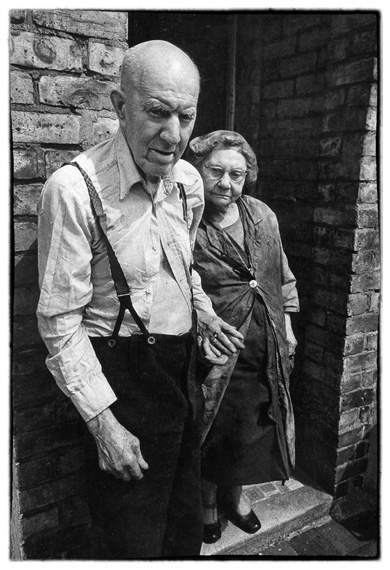 © Dave Hendley 1973.
Overheard pub conversation:
Everyone’s got an uncle Bill. And everyone’s got just one picture of him. Uncle Bill died before you were born. The photo is your mum’s, taken on a trip to Hayling Island when she was a girl. And she shows you this photo, a tear at the corner of her eye, ‘That’s your Uncle Bill’ she says. And she hands you a tiny black and white picture of a man in a suit standing in the middle of a field. That’s your Uncle Bill. Well, it was my Uncle Bill. Who was called Norman. Your Uncle Bill was probably called Cliff. Or Lance.
In the final of the series of Dave Hendley’s rediscovered 1970s photos, this image shows an elderly couple outside their house in Fulham; they were facing eviction from their home after living there for decades. That is as much as I can tell you about the facts of the picture; Dave doesn’t know what became of them or the house itself (if it wasn’t flattened for redevelopment, it is probably now one of those candy-coloured terraced houses that go for over a million pounds). I’d like to know the full story, but perhaps it’s as well I don’t. I imagine the outcome was shabby and depressing: the early 1970s was not a glorious era for social housing in London.
Dave’s photographs this week are fragments of a lost career, and these pictures only exist because he left some old prints at his mother’s house. I don’t know why Dave felt compelled to chuck his old negatives, but he was young when he did it and perhaps didn’t reckon on their value as a permanent record. Now that almost all photographs exist as pixellated images that never get preserved as hard copy, it is sobering to consider the implications for the future. Dave ditched his negatives and got old enough to regret it, but fine prints were (accidentally) preserved. Today’s toy-like cameras make images that are no more durable than an ice sculpture. Photography is becoming utterly ephemeral: you aren’t creating a graven image, you are generating a string of code. Then, a bit later, maybe you get short of space on a memory card so you ditch a few images you don’t think you’ll need, or you forget to back them up, or the hard drive they were on went down … you won’t recover those pictures in anyone’s attic, they are gone. The future is bright and shiny and cares not for the past. Even those of us still using film wince at the price of ‘traditional’ materials: posterity carries a premium. What did Uncle Bill look like again?


 The London Column