Dmitri Kasterine. Text: Tim Wells. (3/5)
Posted: October 26, 2011 Filed under: London Types, Sartorial, Shops | Tags: Bespoke tailoring, Dmitri Kasterine, Tim Wells Comments Off on Dmitri Kasterine. Text: Tim Wells. (3/5)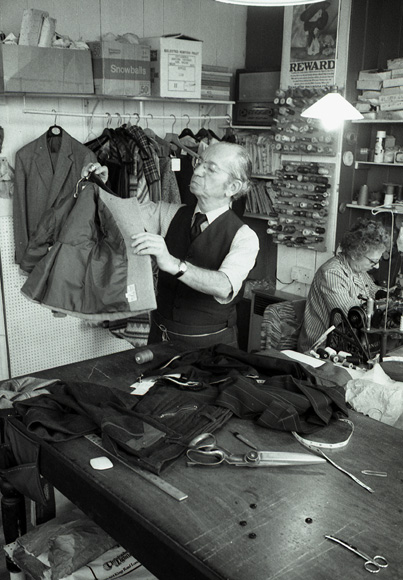
Tailor, Putney. Photo © Dmitri Kasterine.
Dead Man’s Pockets by Tim Wells:
Things found in the pockets of Tim Wells, Saturday Night, 28.02.09
Right coat pocket – mobile phone (Liquidator as ringtone), spectacles.
Ticket pocket – a dozen of his own business cards, business cards for Niall O’Sullivan, Alice Gee and S. Reiss Menswear, return train ticket to Epsom.
Left coat pocket – keys – England fob, poem entitled ‘Self-Portrait as a P G Tips Chimp’, flyer for 14 Hour 14th march show with Karen Hayley, Ashna Sarkar, Amy Blakemore and others.
Inside coat pocket – an Elvis pen.
Right trouser pocket – £8.56 in assorted change.
Left trouser pocket – empty
Hip pocket – Oyster card and wallet
Wallet (black leather) – £160 in twenty pound notes, dry cleaning ticket, Leyton Orient FC membership card from 87/88 season, visa and cash card, picture of Joan Collins in window nook, horoscope stating ‘The first thing you have to ask yourself is what has to go; the second is what is going to take its place; and the third is where will I go to celebrate. Day done.’
© Tim Wells 2009.
Dmitri Kasterine. Text: David Secombe (1/5)
Posted: October 24, 2011 Filed under: Amusements, London Types, Sartorial, Sport | Tags: croquet, Dmitri Kasterine, Existentialism, H.M. Bateman, Hurlingham Club, shorty mac Comments Off on Dmitri Kasterine. Text: David Secombe (1/5)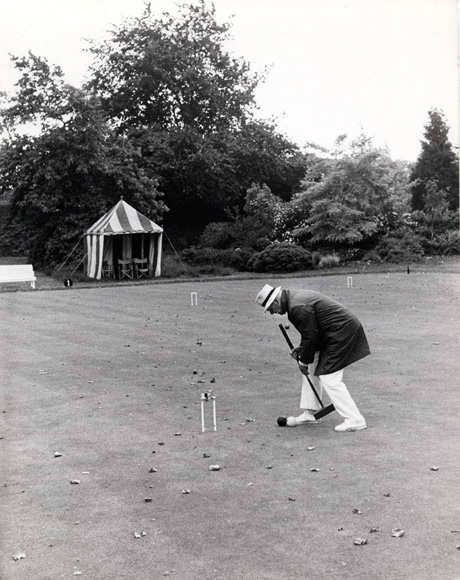
Croquet, Hurlingham Club, 1980. © Dmitri Kasterine.
This week, The London Column is featuring the work of Dmitri Kasterine. Before leaving London for New York thirty years ago, Kasterine was a sympathetic and perceptive commentator on the English scene: his portraits of artists and writers (including Samuel Beckett, Graham Greene, Tom Stoppard, etc.) are familiar and definitive images for posterity – and his social documentary work, which we are showing, is impeccably witty and elegant.
In this photograph, we see a croquet player in a shortie raincoat (clothes are important in Kasterine’s pictures) braving inclement weather to play against – whom? The field is empty, autumn leaves strewn across the lawn; summer is over, the spectators have left, hours or possibly days earlier. His grip on the mallet is assured yet faintly desperate. He is playing against himself and no-one cares – except the photographer. This is croquet transformed into an existential game – or, perhaps, a nightmare from an H.M. Bateman cartoon: The Man Who Played Croquet After the Pleasure Garden Had Shut. D.S.
Jimmy, King of Clerkenwell. Photo & text John Londei.
Posted: October 5, 2011 Filed under: London Types | Tags: Dickensian, John Londei, King of Clerkenwell, Little Jimmy, London characters 1 Comment
Photo © John Londei 1983.
John Londei writes:
Some people might think little Jimmy Cleary eccentric, but to me he was a walking landmark: someone whose presence brings a touch of magic to an area. Whenever I saw Jimmy I knew I was in Clerkenwell.
Jimmy’s speciality was annoying motorists. He would not tolerate errant parking; his life seemed devoted to chasing drivers on from yellow lines. And woe betide anymore who ignored his orders! Bringing out a tattered notebook he took their number, and created such a commotion that the poor motorist found himself the centre of attention.
I’d always wanted to photograph Jimmy. He’s an elusive person and I knew it would be difficult to persuade him. I couldn’t believe my luck when he said yes. On shoot day we picked Jimmy up in a van – he enjoyed being in a vehicle – and took him to the location I’d chosen.
I was ready to take the shot, then a car decided to go up the road where Jimmy stood, only to meet by a car coming the other way. Each refused to move, it became a stand off and Jimmy was mesmerised watching the ensuing argument.
The standoff went on for twenty minutes, the weather deteriorated and the shoot was under threat. When they’d finally settled their argument I was at last able to take Jimmy’s picture.
It’s strange how serendipity can contribute to a shot Were it not for the delay I’d have missed that moment when, fleetingly, the sun broke through a cloud, hit a bronze tinted office window across the street, and bathed Jimmy in a pool of golden light.
© John Londei 2011.
London Perceived. Text V.S. Pritchett, photos Evelyn Hofer (4/5).
Posted: July 28, 2011 Filed under: London Labour, London Types | Tags: Evelyn Hofer, London Perceived, V.S. Pritchett Comments Off on London Perceived. Text V.S. Pritchett, photos Evelyn Hofer (4/5).
Warehousemen, Southwark, 1962. Photo © Estate of Evelyn Hofer.
V.S. Pritchett writing in London Perceived *, 1962:
One goes up-river now enclosed in noise and caught up in work. This is a working river. Hour after hour the radio-telephone is cackling on the tugs. “Calling Sun 17, take the Florian and go in with her. Calling Sun 16, has that little Spaniard moved yet? What’s the matter with her?” Language, old river hands complain, has become politer on the river. Education, they say, is the curse of everything, and the bad-language joke, refined to a high polish of London irony by the characters of W.W. Jacobs (“The langwidge ‘e see fit to use was a’most as much as I could answer”), has lost its anchorage. The Florian is one of the ships lying under the tall sky in the sweep of Gravesend water. It bears down like an hotel upon the tug, and the tug’s cabin boy brings up the eternal mug of strong tea on which working London lives. If you were to go with him to the dock gate, you would see the beauty of the skipper’s job. You would understand why there is all that clever waltzing and pulling this way and that, all that threshing at the stern of the tug as it gently but decisively takes 15,000 tons round a series of sharp right-angle turns into the lock and the alleyways of a dock basin, without touching a quay or any other craft by so much as a graze. These skippers are artists: they bolt down a mutton chop between crise, ruin their digestions, grouse because fog in the estuary has kept them on duty for forty-eith hours without a wink of sleep; but they play their game with the wind, the strong Thames tide, the current and the heavy traffic.
The Thames is a main road. It is our Grand Canal, and if you half close your eyes at the Pool, the brown warehouses look like palaces in a smoky Venice. The river men have always quarrelled with the City, and nowadays the quarrel is with the roads, for road transport is killing the coastwise traffic. Some say that in fifty years half the area will revert to what it once was: a pleasure ground, and, heaven knows, the warehousemen and wharfingers of London have up to now killed the waterside as a place of pleasure and amusement. Tug skippers growl when they pass the wharves of the Ford plant at Dagenham, where the iron ore is being grabbed out of lighters, swung high, and sent by conveyors to the furnaces, where it turns into red liquid and where the liquid turns into cars and trucks. “It comes in by water and goes out on wheels”, they say. They hate wheels, for wheels are the enemy of water. But, in London, in England generally, nothing is ever given up if it has a point of law attached to it. The docks were built because the mass of shipping in the Pool became impenetrable; but the lightermen and wharfingers fought for their rights, as hard as Defoe fought for the Dissenters, as the City fought against the King, as Wilkes fought for the press, as the early trade unionists fought. The lighters can be loaded on the water side of the ship, free of dock duties. There is usually money at the bottom of London liberties: there has been nothing abstract in the London view of the desirable life.
* © 1962 and renewed 1990 by V.S. Pritchett. Used by permission of David R. Godine, Publisher, Inc.
[Special thanks in assembling this week’s feature are due to: Jim McKinniss at The Photo Exchange; Mark Giorgione of the Rose Gallery in Santa Monica, California; Andreas Pauly at the Hofer Estate; and Carl Scarbrough at David Godine. D.S.]


 The London Column