Sweet Toof.
Posted: March 7, 2013 Filed under: Artistic London, Graffiti, Public Art | Tags: Haggerston, London graffiti, London street art, Regent's Canal, sweet toof Comments Off on Sweet Toof.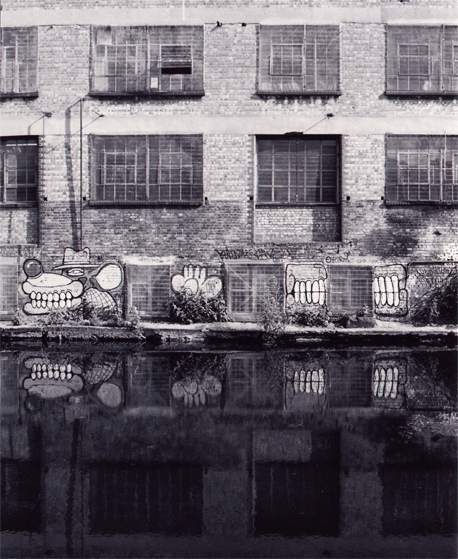
Sweet Toof artwork, Regents Canal, Haggerston. © David Secombe 2010.
From Wikipedia entry ‘Sweet Toof’:
Sweet Toof is the pseudonymous name of well-known United Kingdom graffiti and street artist.
Meaning of Mouth, Teeth and Gum imagery
According to an account by Olly Beck, Sweet Toof looked at himself in a looking glass “in crisis after a messy break-up”, with the enlarged and distorted imagery of the “crescents of teeth”, the “visible part of our skeletal frame” as a reminder of mortality. Beck relates Sweet Toof’s concerns and imagery with the 16th Century Northern European “Vanitas” tradition of reminding of the transience and vanity of life, and to the Mexican celebration of skull imagery to accepting, honouring and celebrating death as part of the life trip.
Sweet Toof’s own comments seem to uphold this interpretation, in which the artist comments, “To get one’s teeth into things, before it’s too late.” Elsewhere he notes, “Teeth can be really sexy, or aggressive, but they’re also constant reminders of death. They’re how we get recognised by police when there’s nothing else left.”
Halloween. Photo: David Secombe, text: Andrew Martin.
Posted: October 31, 2012 Filed under: Anniversaries, Churches, Funereal, Gargoyles, Interiors, Monumental, Out Of Town, Public Art | Tags: Chaldon Church, demon, ladder of salvation, Purgatory and Hell, Trick or Treat 2 Comments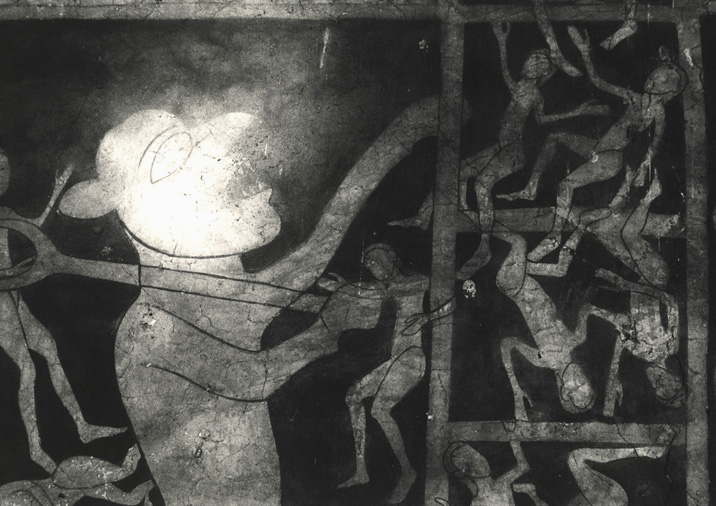
Mural, Chaldon Church, Surrey. Photo © David Secombe, 1989.
Halloween
When I was a boy, Halloween was a shadowy, elusive affair; the occasional carved pumpkin glowing in a window; the occasional fleeting glimpse of a reveller skipping away in a witch’s hat – usually some person you didn’t know and had never seen before. As a festival, it was upstaged by Bonfire Night, and I was frustrated by Halloween in those days. There was nothing you could buy, or be given in connection with it. Today, there is a great deal you can buy, as a result of the promotion of Trick or Treat, by which Halloween has eclipsed Bonfire Night and ghostliness has given way to mock horror. In the weeks before Halloween, Asda stores offer, amid a landslide of plastic tat; the Asda Squeezy Eyeball, the Asda Rat, the Asda Inflatable Coffin, the Child Grim Reaper Outfit (‘one size fits all’), the Adult Grim Reaper Outfit, the Inflatable Pumpkin Cooler (not for cooling pumpkins, you understand), the Skull Martini Shaker.
Asda is American-owned, and Trick or Treat came to us from America. The British folklorist Doc Rowe, believes that the Trick or Treat contagion began with a programme broadcast on BBC2 in the early ’70s as part of a documentary strand called Look Stranger. It depicted life on the American airbase in Woodbridge, Suffolk, and showed the children trick-or-treating. ‘Within two years,’ Doc Rowe told me, ‘all the tabloids were running features on how to dress up for the occasion.’ But his point is that this was merely the re-introduction into this country of a tradition rooted in psychology.
It helps to think of both Halloween and Bonfire Night as outgrowths of the Celtic celebration called Samhain, which marked the turning of their year and the beginning of winter. Samhain was associated with the lighting of fires to honour the dead, and defy malevolent spirits. The medieval church both denounced the festivals as diabolic and sought to appropriate aspects of them in the shape of All Saints Day on November 1st (on which the sanctified are honoured), and All Souls Day on November 2nd (a more democratic honouring of all Christian souls). According to Doc Rowe, ‘By tarring Halloween with an occult brush, by caricaturing it that way, the church made it an occult event.’ But while the original Halloween might not have been thoroughgoingly sinister, it did incorporate games and rituals of licensed naughtiness. All Souls Day, for example, was associated with Soul Caking, wherein poor Christians would say prayers for the departed relations of wealthier ones in return for food – and you can see how there might have been trouble if the rich didn’t play along.
It is likely that these traditions, these precursors of Trick or Treat, were taken to America by Scottish and Irish emigrants of the mid-nineteenth century … so the Asda Inflatable Coffin is actually our fault. But Doc Rowe believes these customs are ineradicable in any case. ‘The more you suppress these things, the greater they become.’ Apart from the Church, he identifies the main suppressors as ‘the health and safety camp’. I know what he means, and I wonder how long it will be before the words ‘high visibility vest’ come up in a ghost story.
… from Ghoul Britannia, published by Short Books. © Andrew Martin 2009.
David Secombe:
Chaldon Church is a tiny and ancient (11th Century) church tucked away in an unnervingly isolated hillside location about a mile north of the junction of the M23 and the ‘Magic Roundabout’ (a.k.a. the M25, London’s present-day Roman Wall). The church is famous for its terrifying medieval wall painting, described by Exploring Surrey’s Past thus: ‘The mural on the west wall of Chaldon church is one of the earliest known English wall paintings – it dates from about 1200 and is without equal in any other part of Europe. It is thought to have been painted by a travelling artist-monk. The picture depicts the ‘Ladder of Salvation of the Human Soul’ together with ‘Purgatory and Hell’. Wall paintings of this kind were intended as a visual aid to religious teaching. The whole picture is in the form of a cross, formed by the Ladder and the horizontal division between Heaven and Hell.’ No photo can adequately convey the power of this mural, or the sense of unease I experienced whilst photographing it on a bleak, windswept afternoon 20+ years ago.The medieval imagination retains its capacity to disturb; and the thrum of traffic from the nearby motorways seemed very distant indeed.
See also: The Avoided House.
Park Life. Photo: David Secombe. (2/5)
Posted: August 7, 2012 Filed under: Parks, Public Art | Tags: Brockwell Park, tattoo, Vanishing Tattoo Museum Comments Off on Park Life. Photo: David Secombe. (2/5)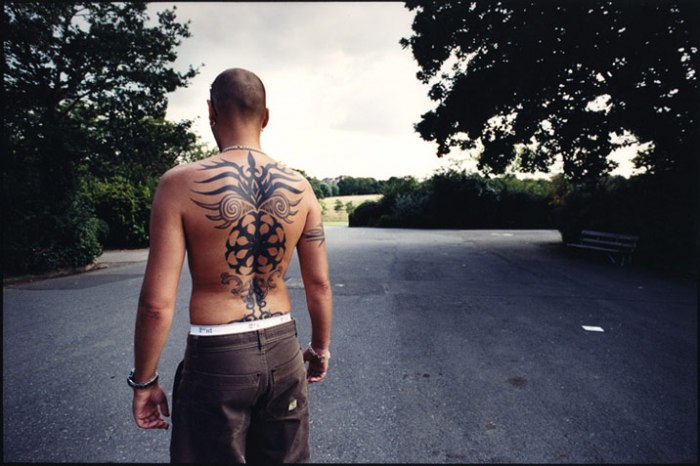
Brockwell Park. © David Secombe 2000.
From Pictures in the Human Skin by Gambier Bolton, Strand Magazine, 1897:
… in London at the present moment is produced the very finest tattooing the world has ever seen; for Mr. Sutherland Macdonald, whilst in the Royal Engineers, used often to watch the men working with their roughly made needles in the barrack-room, and having always had a taste for figure and landscape painting, he was at last induced to give his attention to tattooing, with the result that in a few years’ time he has not only equalled the work done by the Japanese, but has even excelled them. In Macdonald’s albums we find drawings and paintings gathered from all quarters of the globe, and of all and every kind, quaint, humorous, and pathetic, but each one specially selected for the purpose of being reproduced by the tattooing needles, and in more than one instance the copyright of some particularly striking picture has actually been purchased outright, so that no one but the wealthier patrons of [MacDonald’s] Jermyn Street studio shall have the use of them.
Turning over the leaves, we notice, amongst other quaint designs at this moment adorning the bodies of some of our best known society men, three five-pound notes, full size, on which, perhaps, the owner can “raise the wind,” if at any time short of a cab-fare, by placing himself in temporary pawn; a fox hunt in full cry, horses and their scarlet-coated riders, with a very level pack of hounds careering down the owners back in wild pursuit of a “little red rascal,” racing for his life; whilst on more than plucky individual, who rumour says has an extremely tender epidermis, not content with a handsome pair of dark blue socks with scarlet “clocks” on his feet, has lately been adorned with all manner of strange designs, from his neck down to the top of the socks, and this at quite a fabulous price, when we bear in mind the length of time it must have taken to carry out such a large order.
[Complete article here, courtesy of the Vanishing Tattoo Museum.]
The London Nobody Knows – revisited. Photos & text: David Secombe. (4/4)
Posted: June 22, 2012 Filed under: Pavements, Public Art | Tags: Charles Mayhew, Geoffrey Fletcher, London Labour and the London Poor, The London Nobody Knows Comments Off on The London Nobody Knows – revisited. Photos & text: David Secombe. (4/4)
London Bridge. Photo © David Secombe, 2002.
From The London Nobody Knows, Geoffrey Fletcher, 1962:
Begging, pure and simple, seems to have almost disappeared from the London streets, even the most impoverished making an attempt to offer some trifle in exchange for a coin. Mayhew’s book on the London poor is one of several books necessary for a study of the city’s pavement life, of which now only fragments remain. Victorian London was full of such harrowing sights as the man I saw years ago, legless and armless, selling ballads, or the festering bundel of rags covering the remains of a woman I saw more recently on the Embankment – a bundle of rags, however, that did not lack vocal abilities. On my starting to draw her, she cursed in language which would have given a bargee the shudders, and so I pushed off.
David Secombe:
The dolls in the photograph above were situated in the elevated walkway which links London Bridge with London Bridge Station, and formed part of an elaborate and idiosyncratic beggar’s pitch. The beggar in question had taped dolls holding lit joss sticks to three posts in the walkway, and as commuters hurried past him and his installation he performed a manic, shuffling dance, jerking back and forth violently, lunging at them with his cap. I asked him if he would mind having his photo taken and he declined, although he didn’t object to me picturing the dolls. He was clearly very proud of his pitch, which seemed more suited to White Cube or Flowers East than a begging bowl on London Bridge Station. There is probably some earlier precedent for his particular schtick, but I can find nothing like it in Mayhew, and he may have invented a new form: avant-garde panhandling.
Given time, certain members of London’s homeless communities become landmarks. In his ‘biography’ of London, Peter Ackroyd mentions the lady who appeared to live in a doorway near the shop Forbidden Planet on New Oxford Street for much of the 1990s: as Ackroyd noted, she had sat there day in, day out for so long that her outline was impressed upon the stone behind her. And there was the eccentrically dressed but actually quite beautiful woman who was a fixture in Lincoln’s Inn Fields for many years. I don’t know what became of the doll man, but I rather hope that his fate was less grim than the elderly oriental man who is a current fixture on Hungerford Bridge. He has a kind of toy guitar equipped with one string and a little hammer which he taps on it, feebly hitting the same note over and over again. He is worthy of Mayhew, and Fletcher, in authentic human misery.
… for The London Column.


 The London Column