A suburban ghost.
Posted: October 30, 2015 Filed under: Architectural, Gargoyles, Out Of Town, Parks, Tall Tales, Theatrical London, Vanishings | Tags: Halloween, theatrical digs, theatrical stories 4 Comments
Bridal wear display in a department store in Kingston, Surrey, 1982. © David Secombe.
Everyone has a ghost story. My brother told me of a menacing boarding house he once stayed at whilst playing repertory theatre in the early 1970s: anomalous knockings in the middle of the night, dried blood splashes on the wall behind the bed, a general air of foreboding. The place was such a forbidding environment that my sister, staying the night after going to see a Saturday evening show, fled at 3 a.m., unable to take the threatening atmosphere. As she put it: ‘Something terrible happened in that house’.
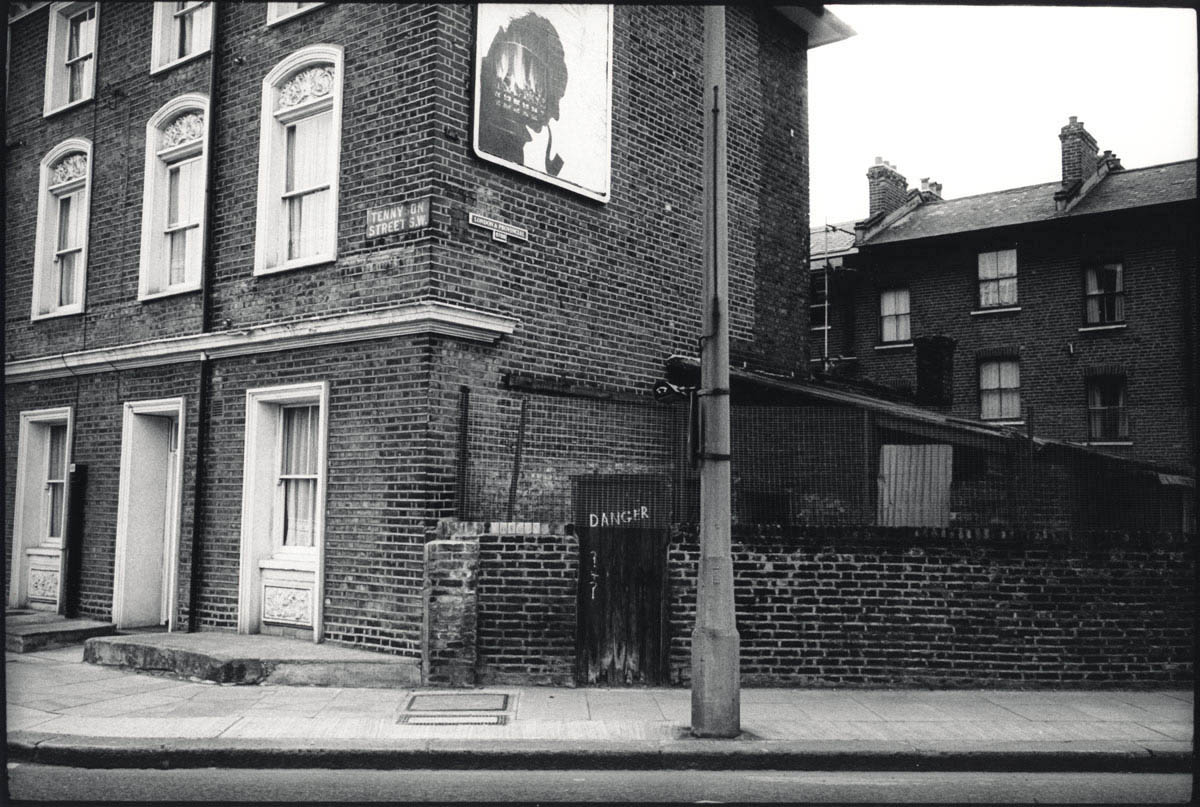
Street scene in pre-gentrification Battersea, 1982. © David Secombe.
For her part, my other sister has her own story about haunted theatrical digs. She was staying in the modern wing of an old house, and her room was at the end of a long corridor that seemed to take an age to walk down. As the week wore on she had a feeling something was coming … in bed one night she heard a child’s voice calling her name in her ear. She later discovered that this boarding house had once suffered a fire in which a child had died. After that experience, my sister was troubled to hear that a little girl had been seen by visitors staying in her own house.

Hoarding in front of a building site, Camden Town, 1987. © David Secombe.
Other family stories concern an old house my parents once owned, situated in a beautiful but secluded spot in the Surrey hills. On one occasion, my brother was staying there alone one night when he was awakened in the small hours by voices and laughter coming from downstairs. Following the sounds, he went and stood by the door to the drawing room; from beyond it he heard the unmistakable echo of a cocktail party in full swing. He opened the door, turned on the light and – of course – the room was empty.
My girlfriend has a story about something she saw in a house in Brockley. Staying over after a party, she was sleeping on a sofa in the kitchen extension – where the original scullery might have been – and awoke to see a green figure standing in the room making an energetic motion which suggested ironing – but the motion was angry, desperate. As she watched, the apparition grew larger and less defined until it dissolved in a jade haze.
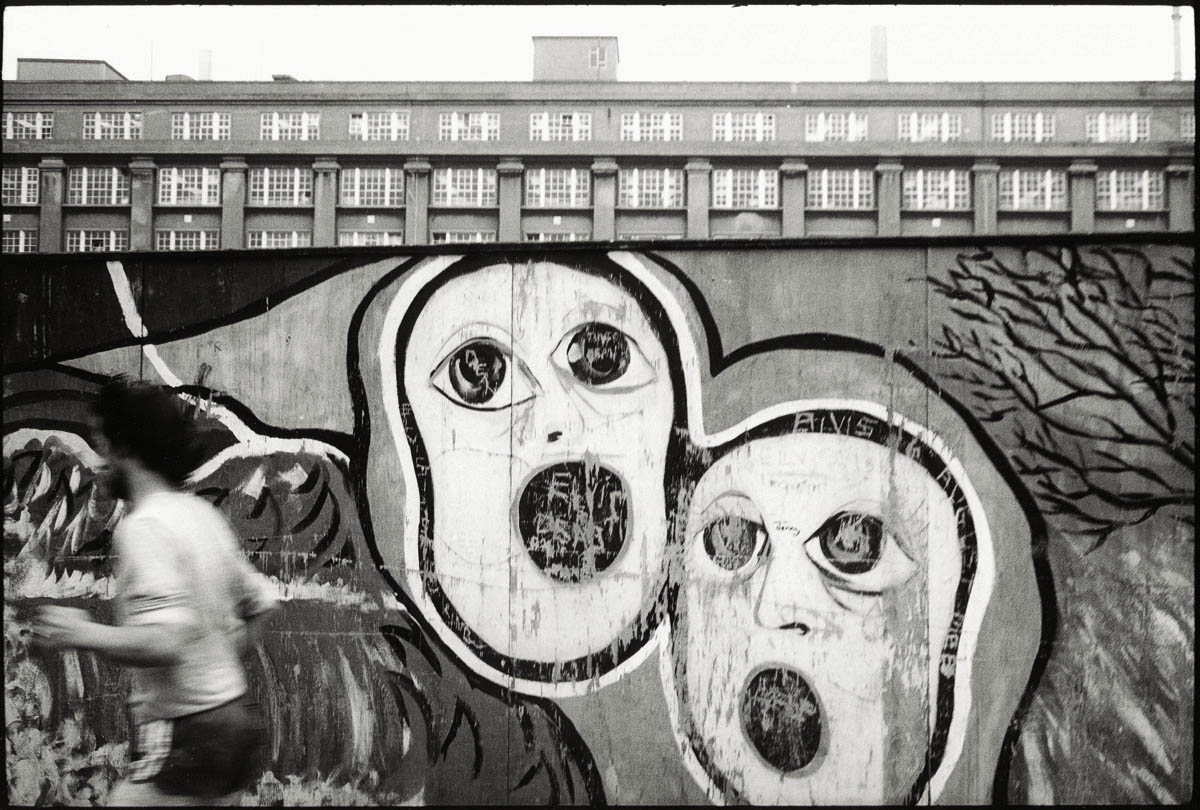
Public art on a hoarding opposite the National Theatre, South Bank, 1982. © David Secombe.
I first heard this story when said girlfriend told it to me in my own house in Brockley, just around the corner from where she had once spent a disturbed night. My place in SE4 was on a street which was struck by a V1 cruise missile in August 1944: according to ‘Flying Bombs and Rockets’, the rocket destroyed 6 houses and damaged a further 45 on Endwell Road, leaving my house as the end of a terrace. My girlfriend, my sister, my daughter and at least one other visitor independently identified a spot at the bottom of the staircase (a floor below street level) as, variously, ‘sad’, ‘eerie’, and ‘sinister’. In addition, they all reported the same sensation: as they headed up the stairs they felt that something was trying to catch hold of their foot. Nine people died in the V1 hit on Endwell Road; I never found out whether anyone was killed in my old house – but, for whatever it’s worth, my sister said that her impression of my basement was that there was someone trapped in it.
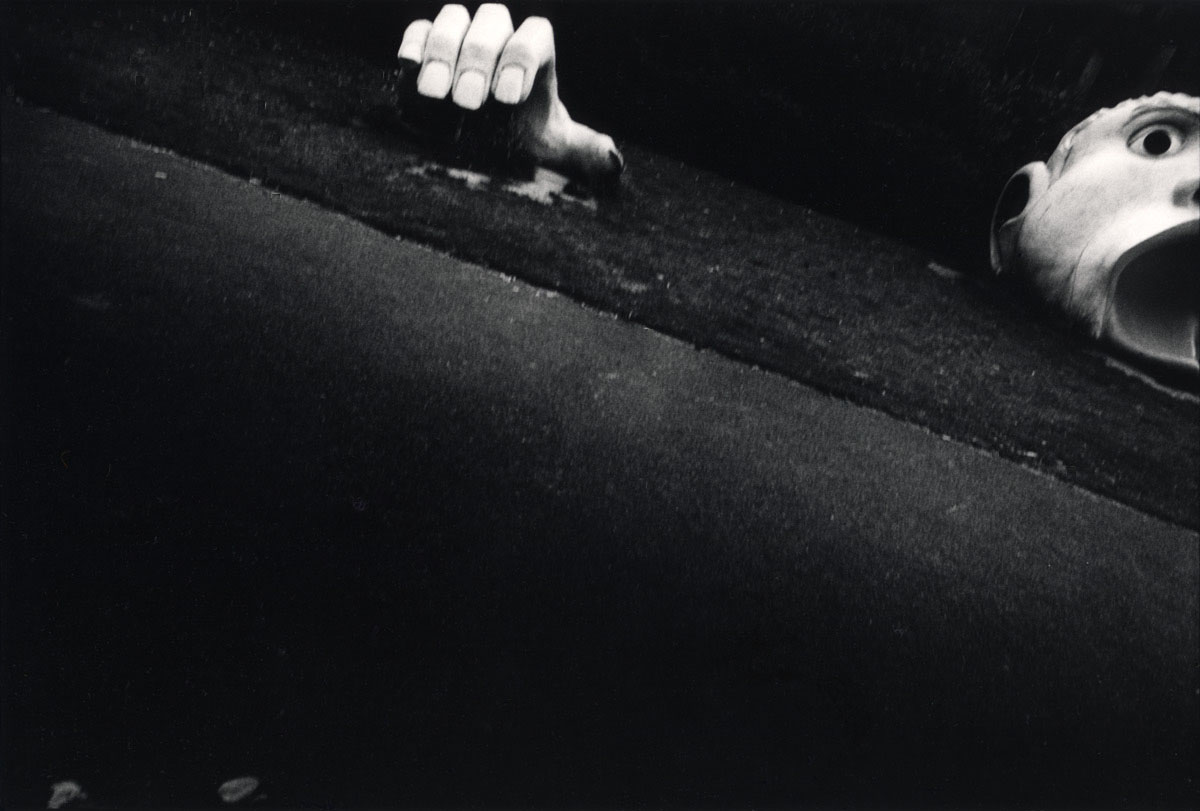
Slide, children’s playground, Rotherhithe, 1988. © David Secombe.
(But basements are always good copy: the best ghost story I ever heard relates to a club in Hoxton that had a persistent problem with its basement dance floor; but I told that story this time last year so I’m not going to tell it again.)

Suburban garden in November, Cheam, Surrey, 1979. © David Secombe.
Needless to say, I have never had any supernatural experiences of my own. None. My existence has been so relentlessly quotidian that I would welcome an encounter with the uncanny. I have stayed in many houses that were said to be haunted and never sensed the presence of ‘the further realm’. Stanley Kubrick observed, when discussing The Shining, that all ghost stories are ultimately optimistic as they suggest the survival of the human personality. So laughter in a distant room, a inexplicably rattling doorknob, a child’s ball that bounces on its own, a voice in your ear in an empty chamber, may all be seen as comforting: they reassure us that the day-to-day is not all there is.
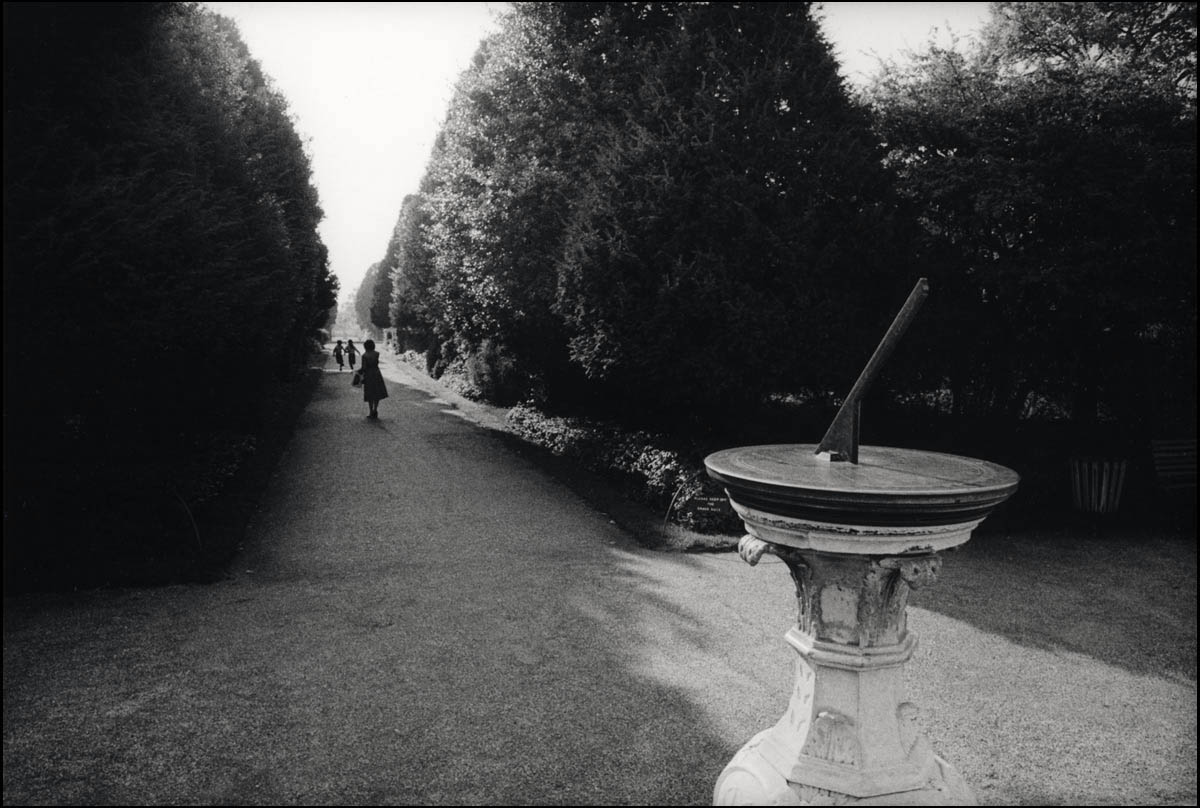
Sundial, Hampton Court Palace, 1979. © David Secombe.
I was trying to think what images I could use to illustrate this piece and ended up digging out a selection taken in various locations around London in the late 1970as or early ’80s. Photography is a form of magic that we somehow take for granted: it fixes time and can resurrect the dead. These pictures of mine also present me with my younger self: an under-employed 20-something loitering on suburban streets, Leica in hand, hoping to find something worth photographing. Sometimes I’d get lucky but more often than not, not.
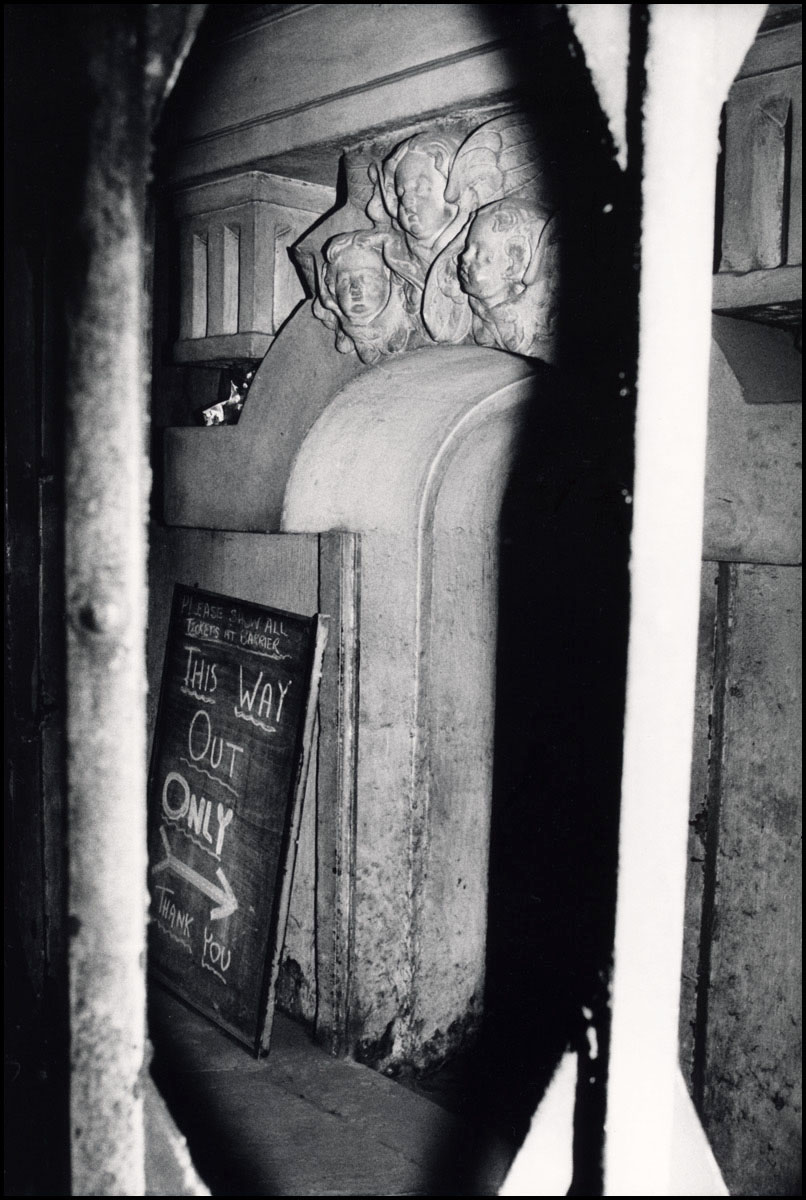
Entrance to Bank underground station showing an entrance to of the crypt of Hawksmoor’s St. Mary Woolnoth, 1989. © David Secombe.
If I am haunted by anything it’s by my own photographs. I’m not just talking about the good ones, or the ones where I was consciously trying to capture atmosphere; all of them are fragments of a past life, people and places lost to me. (For example, the misty garden in the picture above no longer exists; nor, to my dismay, does the fir planting seen in the Hampton Court photo.) Cartier-Bresson said that if he tried to calculate the time his shutter had clicked over the decades, all those 60ths and 500ths of a second, it would probably only add up to a few minutes. Photography can take over your life but what are you really left with? Just a few moments. The upside is that those moments give your life back to you, not always accurately, but in ways that allow us to recreate the past in a way that suits us. Photographs let us become our own ghosts. D.S.
This week, our friend and sometime contributor Andrew Martin is presenting a series of ghost-themed essays on Radio 3. They may be heard here.
Urban Myths no. 5: tales from a ghost club.
Posted: October 31, 2014 Filed under: Amusements, Fictional London, Hospitals, Tall Tales, Theatrical London | Tags: Andrew Martin, David Warner, Kieran Hill, London hauntings, Miles Richardson, Old Vic, Shoreditch clubs Comments Off on Urban Myths no. 5: tales from a ghost club. Props outside the Old Vic, Waterloo. © David Secombe 1989.
From Ghost Club by Andrew Martin and David Secombe:
Synopsis: The three members of the North Yorkshire Paranormal Investigation Society are engaged in a night-time vigil at a country house on the southern edge of the Yorkshire Moors.
Act Two, Scene 1:
It is now 11.30 pm. We find the three in the middle of their second ’session’. They occupy the three disparate seats, as before. Everyone looks jaded and more disheveled, but at least the electricity appears to have been restored – the lighting is from the Anglepoise lamps set up on the table. Quite atmospheric. As before, the aim is to maintain silence in hopes of contacting the beyond. PETE has commandeered a second seat, for the purpose of resting his legs and is reading a paperback – Elmore Leonard or similar.
IAN:
Pete … have you had any experiences that really gave you the, like, willies?
PETE:
How long have you got?
Pause; considering something.
Actually … No, forget it.
JOHN:
No, actually – what?
Pause. PETE looks at both his companions in turn. Puts his book down.
PETE:
I worked as a security guard once. In London. After I left college.
JOHN:
Yes, Classics is hardly the most useful degree –
PETE:
On my first day, they sent me to an abandoned maternity hospital in Finsbury Park that was waiting to be demolished. My job was to sit by the front door and patrol the place twice in an eight-hour hour shift. That’s all. I arrived at seven a.m. on a bright summer’s day, relieved the night shift – who I noticed was sitting outside – and sat down in the old reception booth and tried reading P.G. Wodehouse. But I couldn’t shake off a feeling of being watched. There was a telephone ringing somewhere in the building, but all the lines were supposed to be dead: I had to communicate with my manager via a callbox in the street. My first round was at ten. The place was an absolute shambles. God only knows what had gone on in there. It was a hot day but a storm was brewing. By the time I did my second round, at three, the sky was so dark it was difficult to see into the corners of the wards. Up on the second floor the heat from the day seemed to vanish and the air was very cold. That’s when I heard footsteps. First I thought they were my own echo: but they seemed to carry on after I’d stopped. They seemed to be getting closer each time, gaining on me.
IAN:
Then?
PETE:
I felt it was time to leave. I ran out of the building and used the call box to phone in my resignation. They were very apologetic: seems it was someone’s idea of a joke to send me there on my first day, as no-one liked working the place.
Pause – then PETE tells another one:
Later on, I was working at a club in Shoreditch. Used to be a pub, but it was all leather and sparkly lights when I knew it. The building was Georgian, but you’d hardly guess from the front. It had been bombed in the war and during rebuilding they came across medieval corpses. An unhappy spot. Didn’t stop them turning the basement into a dance floor. It was always cold; we’d try turning up the heating but the walls just ran with condensation. The landlord’s rottweiler refused to go down there. Once, I found some traumatised queen bleating that he’d followed someone into the toilet and seen them walk through the wall. Not quite the encounter he was expecting.
IAN:
Oh …
PETE:
I was cleaning up one morning-after-the-night- before, and I distinctly heard a voice close to my ear say “This one’s not afraid to be down here on his own”. … You’d have some nights down there and I used to wonder how many live bodies we had in and how many from the other side. You’d be hard pressed to tell them apart.
Silence. JOHN pours himself some more wine.
© Andrew Martin & David Secombe 2008-2013.
Ghost Club has yet to have a proper airing, although an earlier draft was presented as a rehearsed reading at the Jermyn Street Theatre in 2010, featuring David Warner as JOHN, Miles Richardson as PETE and Kieran Hill as IAN. We present this excerpt as our annual Halloween offering.
Urban Myths no. 4: Spring Heeled Jack.
Posted: July 16, 2014 Filed under: Amusements, Tall Tales, Transport, Vanishings | Tags: Hendon Way, London folklore, Spring Heeled Jack, Tim Turnbull, Urban Myths Comments Off on Urban Myths no. 4: Spring Heeled Jack.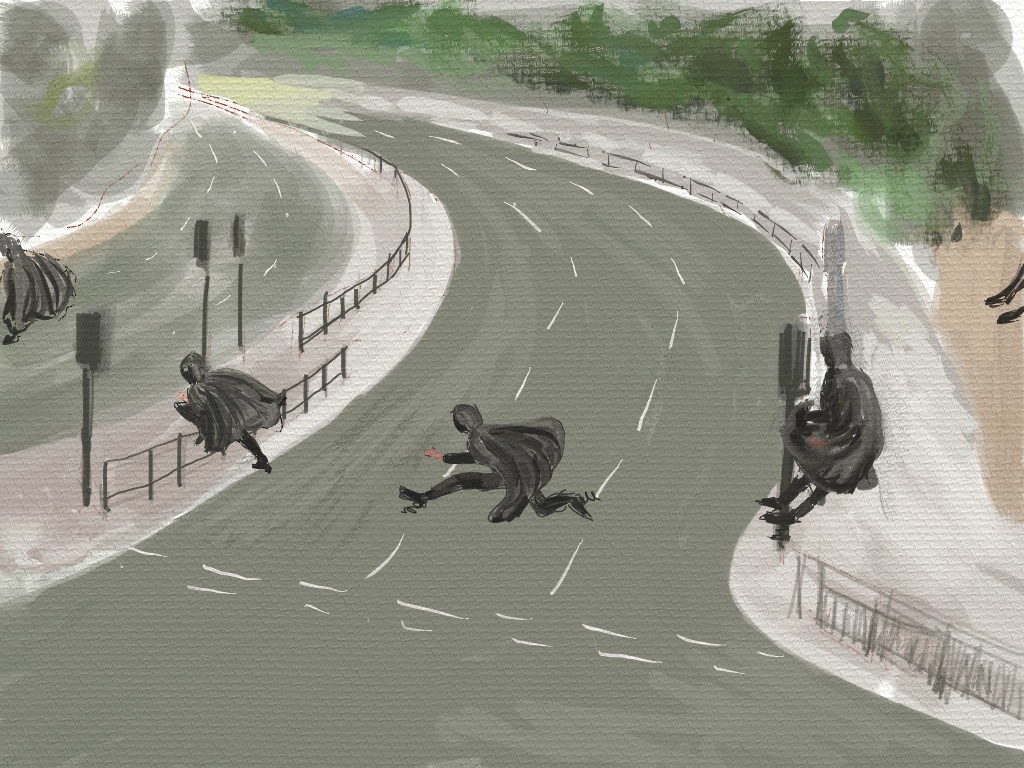 Spring Heeled Jack in Hendon. © Tim Turnbull 2014.
From the South Barnet Recorder*:
Dean and Jeanette Jackson were returning from a night out celebrating their son’s Ricky’s birthday party when they saw a mysterious figure darting across the A41 just north of Hendon.
Mr Jackson, forty, an office supplies salesman from Mill Hill, said: “I saw a man on the other side of the carriageway, a tall geezer wearing this big black cape and I reckoned he was going to a fancy dress do or something. I couldn’t see a car, but then he ran across two lanes, vaulted up the bank and vanished from sight – all in just a couple of seconds. He had no face as such, he was wearing a sort of mask that lit up like a toy robot. We were well baffled and voiced our startlement straight away. He was dead quick, and could jump like a Grand National champion.”
Mrs. Jackson, a beautician – thirty-seven – added: “Dean and I have slept with the light on for the past six nights. It is far and away the strangest thing to have happened to us since we moved to Mill Hill from Worcester Park. Every year something special happens on Ricky’s birthday. Last year it was the Pope, this year it’s Spring Heeled Jack.”
* Not real news item. However, Spring Heeled Jack was an urban myth of the Victorian era. A mysterious dark figure reported to be responsible for a string of attacks in the 1800s and known for his ability to leap great heights, was first sighted in Wandsworth in 1837 and given the SHJ sobriquet by the penny dreadfuls of his (or its) day. For further reading, see The Legend of Spring Heeled Jack.
See also: The Supermarket Spider, Airport Caterpillars, The Discarded Artist’s Statement.
Tim Turnbull’s poems have appeared in these pages before; this is the first time he has contributed as an illustrator. See: Clapham Common Clowns, Black Cab Blues, Frankie Howerd, Robert Graves, The Last Squat in Hackney.
A thought for the Undead.
Posted: October 31, 2013 Filed under: Catastrophes, Funereal, Parks, Tall Tales | Tags: adventure playground, buried alive, cholera, Halloween, Rotherhithe, The Not Really Dead, The Undead Comments Off on A thought for the Undead.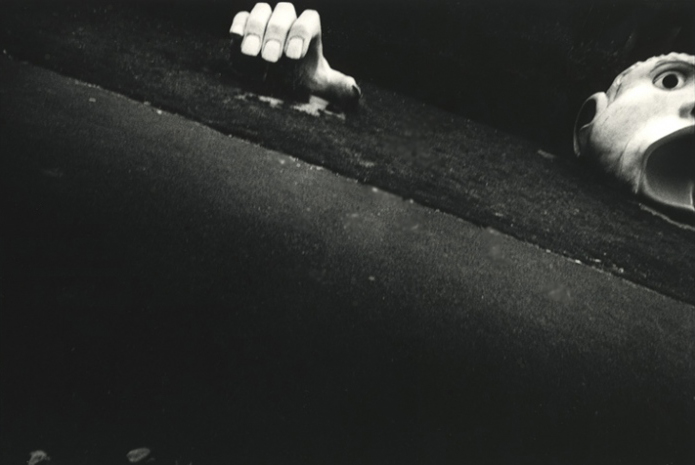
Playground, Rotherhithe. © David Secombe 1988.
From The Lancet, August 23, 1884:
Burying Cholera Patients Alive
It is not so much undue haste as inexcusable carelessness that must be blamed for the premature burying of persons who are not really dead. Such heedlessness as alone can lead to the commission of this crime is not a shade less black than manslaughter. We speak strongly, because this is a matter in regard to which measures ought to be at once taken to render the horrible act impossible, and to dismiss all fear from the public mind. If it be a fact, as would seem to be indisputable, that during the last few weeks there have been cases we will not attempt to say how many or how few of burying alive, a scandal and a horror, wholly unpardonable in the last quarter of the nineteenth century, have to be faced; and the sooner the full truth is known and rules of safety established the better.
Let it be once for all decided that measures shall be taken to ascertain the fact of death before burial. Why not revert to the old practice, and always open a vein in the arm after death, or pass a current of electricity through the body before the coffin is finally screwed down? It may be held that these unpleasant resorts are unnecessary. We do not think they are. In any case enough is known of the possibilities of ‘ suspended animation’ to render it unsafe to bury until the evidences of an actual extinction of life are unmistakable ; and, as it is impossible to wait until decomposition sets in in all cases of death from infectious diseases, it would be prudent to adopt what must certainly be the least of evils.
… our obligatory Halloween post. See also: London Gothic, Halloween, The Haunted House.


 The London Column