The Haunted House. Photo: David Secombe, text: Andrew Martin.
Posted: November 1, 2012 Filed under: Architectural, Funereal, Housing, Tall Tales | Tags: Alexander Woolcott, Andrew Martin, Bleak House, charles dickens, Edith Nesbitt, Haunted House, Inigo Jones, Lincolns inn Fields, Tulkinghorn Comments Off on The Haunted House. Photo: David Secombe, text: Andrew Martin.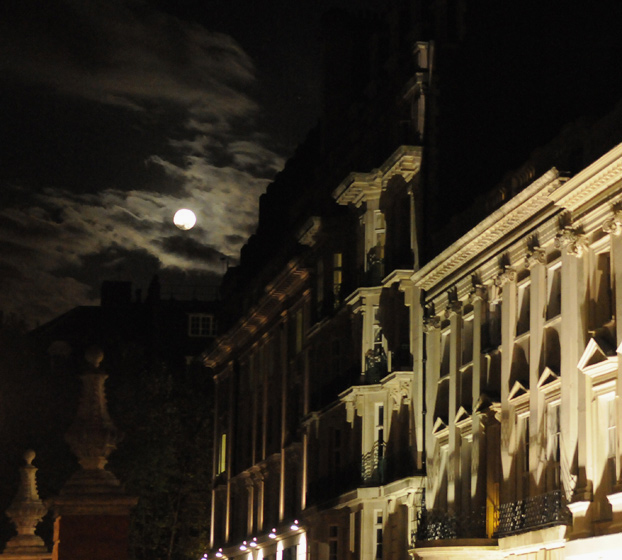
Lincoln’s Inn Fields, west side. Photo © David Secombe 2010.
The Haunted House
If ghost stories arise from the Gothic tradition, which was as much architectural as literary, it is also the case that persistent ghosts need a persistent location in which to manifest. So no wonder houses are haunted.
Haunted houses tend to be old and big. Such properties appeal to the romantic idea of faded grandeur, and also a baser snobbery. Every account of Borley Rectory, ‘the most haunted house in England’, describes it as hideous, but when I look at the pictures I wonder how much it would cost today if it were still standing, and whether the seller would take a low offer in view of its poltergeist infestation. Reading ghost stories we are torn: yes, a malevolent spirit stalks the east wing, but at least there’s am east wing for it to stalk. Ghost stories, both real and fictional, sometimes come with floor plans of the haunted area – literally, property particulars – and very mouth-watering they usually are.
Haunted houses also come with libraries, and with servants. The protagonist in a ghost story is quite alone in his huge house … except for his fifteen servants. The reader might not know about the servants until one of them hesitantly knocks and enters the master’s study on the final page and finds him slumped in his chair ‘With a look on his face, the like of which I’ve never seen …’
The author denigrates the house, but also slyly boosts it to engage our snobbery. In Walter de la Mare’s story, Out of the Deep (1923) the protagonist, Jimmie, inherits his uncle’s ‘horrible old London mansion’. But how horrible and old can a London mansion be? In Moonlight Sonata (1931) by Alexander Woolcott, one of the two principals inhabits ‘the collapsing family manor house to which he had indignantly fallen heir.’ The owner is down to his last gardener, who tends the ‘once sumptuous’ grounds, but the place doesn’t sound too bad to me. The Mystery of the Semi-Detached by Edith Nesbitt (1893) seems, from its title, to be bucking the trend, but the house is ‘commodious’, with several sitting rooms.
I myself grew up in a semi-detached of a more modest sort. We were its first occupants, and I was proud of inhabiting a new house. Those of my contemporaries who lived in old houses seemed to me to be taking a considerable risk. They were living in houses in which people had died, and people they didn’t know at that – people that nobody currently alive knew. It must be like living in a tomb. There would have to be certain echoes. In grappling with the subject, in his collection of sightings, Apparitions and Haunted Houses, Sir Ernest Bennett plaintively wonders, ‘Can it conceivably be the case that in some inscrutable fashion the woodwork and masonry of a house may exert some physical or mental influences which cause certain individuals to see the phantasmal figure of a former resident?’
… from Ghoul Britannia, published by Short Books. © Andrew Martin 2009.
David Secombe:
Elsewhere in his fine book (an overview of the British ghost story tradition), Andrew examines Charles Dickens’s fascination with ghosts and how they impacted on his fiction. The above photograph shows the Inigo Jones mansion – on the right – believed to have been the model for the chambers of Tulkinghorn, the sinister lawyer in Bleak House. Although Bleak House is not ostensibly a novel about ghosts, it deals with the dead hand of the past weighing upon the present; and Dickens’s treatment of Lincoln’s Inn is appropriately atmospheric, menacing and grotesque. Here is the opening of chapter 32:
‘It is night in Lincoln’s Inn — perplexed and troublous valley of the shadow of the law, where suitors generally find but little day — and fat candles are snuffed out in offices, and clerks have rattled down the crazy wooden stairs, and dispersed. The bell that rings at nine o’clock, has ceased its doleful clangour about nothing; the gates are shut; and the night-porter, a solemn warder with a mighty power of sleep, keeps guard in his lodge. [. . . ] It is a close night, though the damp cold is searching too; and there is a laggard mist a little way up in the air. It is a fine steaming night to turn the slaughter-houses, the unwholesome trades, the sewerage, bad water, and burial grounds to account, and give the Registrar of Deaths some extra business’.
See also: The Avoided House, Halloween.
Underground, Overground. Text: Andrew Martin, photo: Tim Marshall. (5/5)
Posted: June 1, 2012 Filed under: Tall Tales, Transport | Tags: Andrew Martin, ghosts on the tube, Pizza on the Park, Underground Overground Comments Off on Underground, Overground. Text: Andrew Martin, photo: Tim Marshall. (5/5)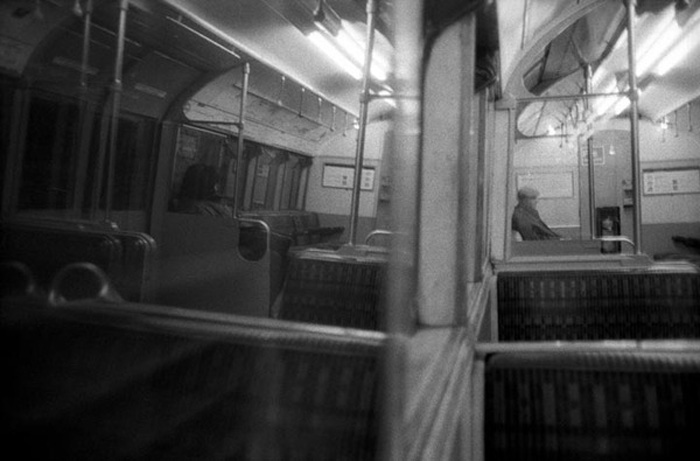
Bakerloo Line. © Tim Marshall 1992.
Andrew Martin writes:
There are the books full of Underground ghost stories. An invisible runner pounds along the platforms at Elephant & Castle; children scream in the basement of what used to be the surface building of Hyde Park Corner, and which became Pizza on the Park. (They continued to scream it was said, even while the Four Seasons and Margheritas were being rolled out.) William Terris, an actor murdered in 1897, manifests in Covent Garden station. The best one I know of was sent to me in a letter a few years ago. Late one night a Piccadilly Line driver was running his empty train into the depot at Northfields when he heard a knock on his cab’s connecting door into the carriage. He turned and opened the door, saw no one there but noticed that all the connecting doors of the carriage were open, as though someone had walked along the length of the train. The driver refused to continue, so another man was brought in to close the doors and take the train into the depot. Shortly after he started the train he heard a knock … and all the doors were open again.
The text is from Underground, Overground: a passenger’s history of the Tube, published by Profile Books (also available here). The photos are from Tim Marshall’s series When a Tube train stops.
Underground, Overground. Text: Andrew Martin, photo: Tim Marshall. (2/5)
Posted: May 29, 2012 Filed under: Sartorial, Tall Tales, Transport | Tags: Andrew Martin, Bella Freud, Underground Overground, Valentine's Day Comments Off on Underground, Overground. Text: Andrew Martin, photo: Tim Marshall. (2/5)
Piccadilly line. © Tim Marshall 1992.
Andrew Martin writes:
For Valentine’s Day, an editor once instructed me, ‘I want you to write about love on the Underground’, but I couldn’t dig up much. I read in Underground News that on 30 April 1986 at bank station a woman hit her eighty-year old husband with a handbag, which sent him tumbling down an escalator. Just before Christmas in 1989, an Underground labourer who had consumed ten pints of bitter had an unorthodox interaction with a cat on a Tube train. Then he fell into a stupor, and his first remark on being awakened by an appalled fellow passenger was, ‘What cat?’ He was later fined £500. For many years the dating agency Dateline placed posters throughout the Underground that showed a man and a woman crossing on adjoining escalators. ‘A hidden glance, a forgotten smile’ ran the copy. ‘Have you ever looked and wondered what might have been?’ That drove me mad, because if you’d forgotten the smile then you wouldn’t wonder what might have happened as a result of it. Even so, when the fashion designer Bella Freud (who launched one of her collections on a Tube train) said, ‘There’s a strange tension on the Tube, a moodiness, a sexiness’. I think she was right.
The text is from Underground, Overground: a passenger’s history of the Tube, published by Profile Books (also available here.) The photos are from Tim Marshall’s series When a Tube train stops.


 The London Column