Ridgers reminisces. Photo & text Derek Ridgers (5/5)
Posted: December 2, 2011 Filed under: Crime and Punishment, London Types | Tags: Freddie Foreman, Jack 'The Hat' McVitie, London underworld, Tony Lambrianou Comments Off on Ridgers reminisces. Photo & text Derek Ridgers (5/5)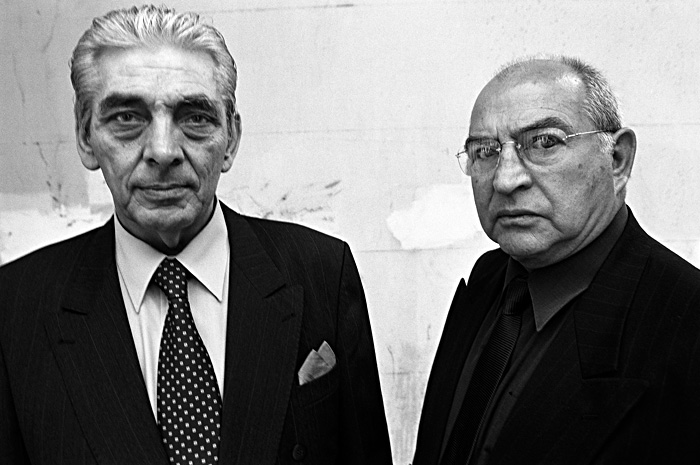
Tony and Freddie, Southwark, 2000. Photo © Derek Ridgers.
Derek Ridgers writes:
This is a portrait of Tony Lambrianou (RIP) and Freddie Foreman commissioned by Vox magazine. Freddie Foreman who is, incidentally, the father of the actor Jamie Foreman, was once known as ‘Brown Bread Fred.‘ If you don’t know your cockney rhyming slang, the significance of this nickname won’t be obvious but save to say they were both once rather dangerous men. They were both associates of the Kray firm and they both served serious prison time for their involvement in the murder of Jack ‘The Hat’ McVitie.
I photographed them around Freddie’s old manor, in the area south of Southwark Bridge in London. I went on a pub crawl with them afterwards and they were very amusing company, with endless stories of the old days and all their friends, euphemistically known as “the chaps.” They were nice but, even in their dotage, I’d be lying if I said that they were completely devoid of any hint of menace. If I’d have met them in their pomp, in the ‘60s, I’d have run a mile.
The thing is, back then, they might not have let me.
© Derek Ridgers. From The Ponytail Pontifications.
Ridgers reminisces. Photo & text: Derek Ridgers (4/5)
Posted: December 1, 2011 Filed under: Out Of Town, Transport | Tags: advertising photography, Mad Men Comments Off on Ridgers reminisces. Photo & text: Derek Ridgers (4/5)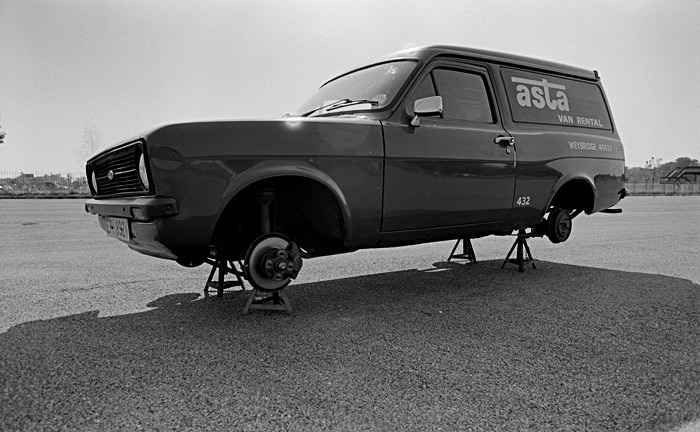
Van without wheels. Feltham, 1981. © Derek Ridgers.
Derek Ridgers writes:
This may look like a van with no wheels but to me it was an epiphany.
I was prostrate, stripped to a pair of shorts in a corner of the car park of Feltham Swimming Baths at the time, so it was an odd position to be seeing the light from. But it was at just about that moment, whilst I was taking that photograph, that I came to realise that I didn’t really want to be doing that sort of thing anymore. By “that sort of thing”, I mean advertising photography. At that moment, I realised that, other than financially, it was never going to amount to a particularly sensible career aspiration for me.
It was in August 1981 and it was only a few months after I’d left work at the London advertising agency Royds, where I’d spent the previous three years working as an art director. Though I say “left” that word isn’t exactly right. I was fired for reasons which, even now, I’m not completely sure about. But it wasn’t the first time I’d been fired from an advertising agency, far from it. In those days, employers never needed much of a reason. Especially in the rather cut-throat advertising business. Thinking back, it might have been because I’d elected not to work on the apartheid era South African Airways account. I don’t honestly know. I’d worked on quite a lot of successful accounts at Royds and I thought I’d done very well. But refusing to work on the South African Airways account may have upset the ultra-Conservative (with a cap C) chairman. I thought I had a choice but maybe I really didn’t. A few weeks later they just said “we’re going to have to let you go” and that was it.
I really enjoyed working as an ad agency art director. At times, it really was a bit like the TV show Mad Men. But with a lot more emphasis on the mad. In the context of 2011, some of the habits and working processes of ad men of the time would seem totally certifiable. Even then we realised much of what we were getting away with was a little excessive. Hugely enjoyable but certainly excessive. But, after ten years, a little voice in my head suggested that maybe I’d be better off out of the ad world. And besides, if you’re in the creative department and you’re not at, or near, the top by the time you’re 30, you’re rapidly reaching your sell-by date anyway.
But my sacking came at a perfect time in my fledgling photography career. I’d just had my second one man show (‘Skinheads’ in the Autumn of 1980) and I was getting my work into print fairly regularly. Plus many of my advertising friends said that they’d give me some photography work, if I decided to try to make a career out of it. And so, a few months after I left Royds, one of my old colleagues called me in and asked me to take a photo of a van with no wheels. They showed me a few layouts and said it could be any van, just as long as it had no wheels. They didn’t want anything much in the background either. That was all. It seemed simple enough.
So that’s how I came to be laying down, half naked, in the grit and grime of Feltham Swimming Baths car park. It was the only place I could find near where I lived that would allow me to take a photo of the van without too many buildings or trees in the background. It seemed like relatively easy money, so I hired a van and four car stands and set about the task. Anyone who’d been watching me that day whilst I did that shoot would have seen someone drive in and park a rental van in the emptiest corner of the car park. Then they’d have seen them jack up and remove all four wheels, remove most their clothes, (it was an extremely hot, humid day) and then go and lie down on the ground about 40 feet away take a few photographs of the wheelless van. Then then they’d have seen that person put the wheels back on, get dressed and drive off…. Anyone watching might have thought it seemed crazy.
As I was laying there sweating, with car park grit sticking to my chest, elbows and legs, it started to dawn on me that maybe I didn’t want to be an advertising photographer after all. I didn’t have an assistant in those days (it would be nearly a decade before I had one) and it simply didn’t occur to me how much stress and bother I would have saved if I’d simply hired an assistant for the day. That is what photographic assistants are for, after all, to do the hard stuff, so you don’t have to. But this was the moment I decided that that kind of photography work just wasn’t for me.
The guys at the agency seemed pleased and the ad itself turned out surprisingly well. But it wasn’t the kind of photograph anyone dreams of taking and if it wasn’t for this blog, this photograph would have been forgotten by all concerned three decades ago.
© Derek Ridgers. From The Ponytail Pontifications.
Ridgers reminisces. Photo & text: Derek Ridgers (3/5)
Posted: November 30, 2011 Filed under: Bohemian London, Clubs, London Types | Tags: Fetish, Skin Two, Torture Garden Comments Off on Ridgers reminisces. Photo & text: Derek Ridgers (3/5)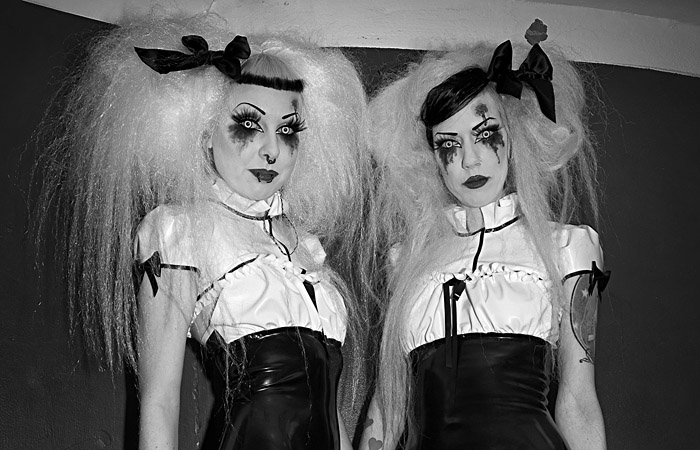
Ann-Sophie and Jenni, The Torture Garden, London, 2010. © Derek Ridgers.
Derek Ridgers writes:
I’ve been taking photographs in London fetish clubs since 1981. And the occasional fetishist in other clubs since about 1978.
To the best of my knowledge, the popularity of fetishism really started in the UK in 1976 with the emergence of punk rock and the appropriation of elements of bondage and fetish wear by many of the punk era designers. Prior to this time, people who wanted to dress in rubber and PVC had to do it behind closed doors, ordering their outfits by mail-order in brown paper parcels.
To begin with it was just a handful of people in a small dingy Soho club called Skin Two, which resided in what was, the rest of the week, a gay club called Stallions. Skin Two was started by an actor called David Claridge. He went on to become famous as the hand up the furry arse of TV star ‘Roland Rat’ and after his nocturnal predilections were exposed by the gutter press, he disappeared from the scene. The atmosphere in the Skin Two club was oppressive and sometimes menacing. Outsiders, especially ones with cameras, were certainly not made to feel welcome. But, pretty soon, big name photographers like Bob Carlos Clarke and several others brought fetish style images into view more and things got a lot more relaxed.
By the mid-’80s PVC and rubberwear was all over fashion magazines and pop videos. By the late ’80s/early ’90s some of the bigger fetish clubs like Submission and Torture Garden could easily attract 3000 people a night and people came from all over the world to get there. And then some of them went back home and started their own fetish clubs. Nowadays, Torture Garden has become very mainstream and it’s not completely unlike any other large club in any other major western city, except sometimes people are dressed very oddly.
In the early days, I got threatened with physical violence in Skin Two several times. One guy seized me by the neck and we nearly came to blows. A couple of women grabbed me one night and tried to drag me over to where one of the dominatrixes was waiting, whip in hand. I had to manhandle them off me and make my getaway. But I was clearly an outsider back then and I would never have even gotten into the early fetish clubs if I hadn’t become friendly with some of the people running them. I know for a fact that most of the old-time fetishists resented my presence. But it was obviously people like me that helped to publicise and promote the scene, so the people who ran the clubs have always been very welcoming. These days you can’t move for photographers in these kind of clubs.
I’m not really sure what it was about the fetish scene that appealed to me. I’m not a fetishist myself and don’t even really like wearing the leather trousers I’m obliged to wear in these clubs. To begin with I had a real compulsion to photograph the way people were dressing and the amount of humour and invention some people put into creating their own, largely home-made, outfits was certainly worth somebody recording. These days, most people in fetish clubs are wearing shop bought, off-the-peg outfits but there are still many remarkable individualists.
Nevertheless, some people say that there’s something badly wrong with any man over 30 who still wears leather trousers, whatever the excuse. In my case, they’re probably right. Exactly what that something “wrong” might be, I’ll leave you to draw you own conclusions.
Anyone who wants to know more about the fetish scene could do a lot worse than go here – http://www.thefetishistas.com/
© Derek Ridgers. From The Ponytail Pontifications.
Ridgers reminisces. Photo & text Derek Ridgers (2/5)
Posted: November 29, 2011 Filed under: Class | Tags: Enoch Powell, New Musical Express, Rivers of Blood, Stephen Wells Comments Off on Ridgers reminisces. Photo & text Derek Ridgers (2/5)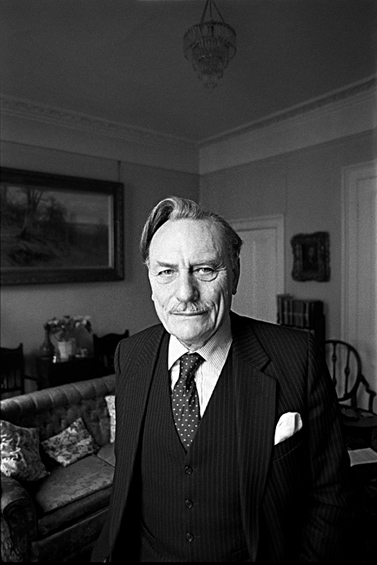
Enoch Powell, Eaton Square, 1984. Photo © Derek Ridgers.
Irrespective of his ridiculous views on race relations, Enoch Powell was certainly one of my strangest ever subjects.
I was commissioned to photograph him by the NME and, together with the writer Mat Snow, we turned up at his very grand flat in Eaton Square to meet a guy who seemed determined, for some reason, to try to make us laugh. For someone who achieved a starred double-first from Cambridge University, and who was often referred to as the greatest political mind of his generation, he struck me as a bit of a twit. To start with, he began by deriding my accent and the way I talk. He enquired as to whether I might be an Australian? I’m a Londoner, born and bred and though my accent isn’t of the typical gor-blimey cockney variety, it’s never (outside of the US) ever confused anyone before. Then he asked me about the origins of my name and started to try to find something funny about that. Next he spoke to a woman who had been detailed to bring us some tea and called her “dear” and invited us to speculate on what his precise relationship with her was (it was his wife). All the while he was grinning at us like Sid James in a Carry On film.
His desire to trivialise the situation must, I guess, have been some sort of bizarre tactic to make us forget to ask him anything remotely serious. It was a little patronising of him and it didn’t work. Mat Snow was far too canny an interviewer for that and he managed to ask him all the questions I’m sure he would rather have not been asked. Mat Snow writes “being interviewed as he was by New Musical Express, rather than await my questions he launched straight into an interminable monologue about Nietzsche and his philosophy of music, and seemed rather put out when I tried to get the interview back on track by asking him if perhaps his infamous ‘rivers of blood’ UK race war prediction of 1968 was perhaps a tad wide of the mark as things had panned out by then.”
Enoch Powell was a proud man but, in my judgement, by this stage of his political career, a little sad.
© Derek Ridgers. From The Ponytail Pontifications.


 The London Column