Spitalfields Revisited. Photo: Paul Barkshire, text David Secombe.
Posted: October 14, 2011 Filed under: Churches, Literary London, Markets | Tags: east end, Paul Barkshire, Silk merchants, Spitalfields Market, Vanished London Comments Off on Spitalfields Revisited. Photo: Paul Barkshire, text David Secombe.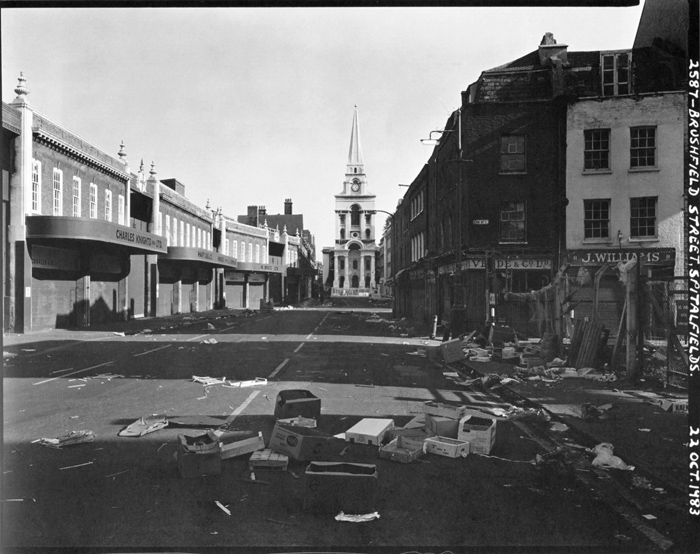
Spitalfields Market, 1983. Photo © Paul Barkshire.
Further to yesterday’s post on the vanishing East End, here is Paul Barkshire’s noble ’80s study of this now-transformed landscape. Despite the changes wrought since, Spitalfields remains one of the few areas left where one can get a sense of the London of popular imagination. Dickens knew these streets. London’s horror of its past (and Dickens would probably have been in favour of razing Spitalfields altogether) has been replaced by gentrification, which in the case of this quarter, marks the eventual success of the property speculators who built fine houses for prosperous silk weavers in the early 18th century.
We will be offering more of Paul Barkshire’s London shortly … D.S.
Spitalfields Market. Photo & text: David Secombe.
Posted: October 13, 2011 Filed under: Churches, Literary London, London Places | Tags: east end, Jack London, Thomas Cook Comments Off on Spitalfields Market. Photo & text: David Secombe.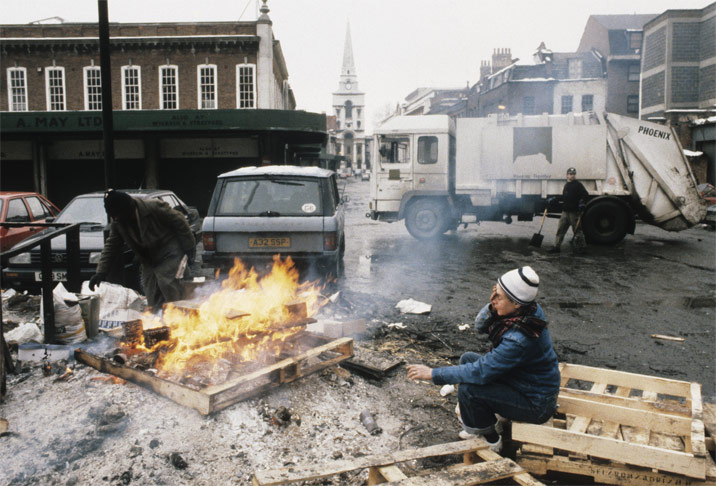
Photo © David Secombe 1990.
The opening of Chapter One of People of the Abyss by Jack London, 1902:
“But you can’t do it, you know,” friends said, to whom I applied for assistance in the matter of sinking myself down into the East End of London. […] “Why, it is said there are places where a man’s life isn’t worth tu’pence.” “The very places I wish to see,” I broke in.”But you can’t, you know,” was the unfailing rejoinder.
“Then I shall go to Cook’s,” I announced. “Oh yes,” they said, with relief. “Cook’s will be sure to know.”
“You can’t do it, you know,” said the human emporium of routes and fares at Cook’s Cheapside branch. “It is so – hem – so unusual. […] We are not accustomed to taking travellers to the East End; we receive no call to take them there, and we know nothing whatsoever about the place at all.” “Never mind that,” I interposed, to save myself from being swept out of the office by his flood of negations. “Here’s something you can do for me. I wish you to understand in advance what I intend doing, so that in case of trouble you may be able to identify me.” “Ah, I see! should you be murdered, we would be in position to identify the corpse.” He said it so cheerfully and cold-bloodedly that on the instant I saw my stark and mutilated cadaver stretched upon a slab where cool waters trickle ceaselessly, and him I saw bending over and sadly and patiently identifying it as the body of the insane American who would see the East End.
The photo above was taken twenty-one years ago, and shows homeless people lingering around a bonfire of pallets near the old Spitalfields vegetable market. Hawksmoor’s majestic Christ Church is seen in the distance. Spitalfields used to be cited by ‘psychogeographers’ as one of those London locales where the sad history of the city was engraved upon its streets and buildings: a place that was permanently wrong. The district’s association with poverty, with Jack the Ripper, the waves of the dispossessed that have settled over the centuries – this stuff was meat and drink to the likes of Iain Sinclair and Peter Ackroyd. For his part, Jack London’s attempt to discover the Edwardian East End bore fruit in a book which documented in depressing detail the squalor of Spitalfields, and included photos of down and outs sleeping against the walls of Christ Church. In the 1960s there were moves to demolish the entire area – including Hawksmoor’s church – and the time-locked deprivation of the Georgian district was eloquently pictured by the makers of the film based on Geoffrey Fletcher’s London gazetteer The London Nobody Knows, and by photographers Don McCullin, Paul Trevor and (later) Marketa Luscacova.
My picture dates from a moment just before the wealth and bombast of commercial London annexed the neglected East End. Spitalfields’ desirability as a property market perked up considerably around this time; long-term residents like Gilbert and George, Dan Cruikshank (who had been one of the original squatters who had helped save the area from destruction in the 1970s) and the American artist Dennis Severs, whose house is now a museum, acted as beacons of gentility amidst the inner-city gloom. And, as the 1990s rolled on, the East End went from being the Dark Heart of Old London to Shiny Retail Zone with bewildering speed. I remember laughing at my first sighting of Japanese tourists apparently lost in Shoreditch circa 1997 – but it was, I think, the same year that a Holiday Inn opened on Old Street. A visit to Spitalfields Market today is a trip to Covent Garden East: visitors are safe to purchase their branded goods and speciality coffees in a shopping environment free of disquiet. London Gothic has been displaced by Consumer Bland. It gives the lie to the theories of Ackroyd and Sinclair: with enough commercial pressure, any area, no matter how dark its history, can be transformed into a playground for contented shoppers. Cultural amnesia driven by money. However, given the recent unemployment figures, there may well be opportunities for a resurgence of old-fashioned Victorian deprivation in the East End, although this time it will be hustled to the margins of Whitechapel, Mile End, Barking, etc. D.S.
Jimmy, King of Clerkenwell. Photo & text John Londei.
Posted: October 5, 2011 Filed under: London Types | Tags: Dickensian, John Londei, King of Clerkenwell, Little Jimmy, London characters 1 Comment
Photo © John Londei 1983.
John Londei writes:
Some people might think little Jimmy Cleary eccentric, but to me he was a walking landmark: someone whose presence brings a touch of magic to an area. Whenever I saw Jimmy I knew I was in Clerkenwell.
Jimmy’s speciality was annoying motorists. He would not tolerate errant parking; his life seemed devoted to chasing drivers on from yellow lines. And woe betide anymore who ignored his orders! Bringing out a tattered notebook he took their number, and created such a commotion that the poor motorist found himself the centre of attention.
I’d always wanted to photograph Jimmy. He’s an elusive person and I knew it would be difficult to persuade him. I couldn’t believe my luck when he said yes. On shoot day we picked Jimmy up in a van – he enjoyed being in a vehicle – and took him to the location I’d chosen.
I was ready to take the shot, then a car decided to go up the road where Jimmy stood, only to meet by a car coming the other way. Each refused to move, it became a stand off and Jimmy was mesmerised watching the ensuing argument.
The standoff went on for twenty minutes, the weather deteriorated and the shoot was under threat. When they’d finally settled their argument I was at last able to take Jimmy’s picture.
It’s strange how serendipity can contribute to a shot Were it not for the delay I’d have missed that moment when, fleetingly, the sun broke through a cloud, hit a bronze tinted office window across the street, and bathed Jimmy in a pool of golden light.
© John Londei 2011.
Homer Sykes: Britain in the 1980s. Text by Charles Jennings. (5/5)
Posted: September 23, 2011 Filed under: Class, Sartorial Comments Off on Homer Sykes: Britain in the 1980s. Text by Charles Jennings. (5/5)
Jumble sale, Dulwich, circa 1980. Photo © Homer Sykes/Photoshelter.
Make Do and Mend
Between The Buttons: What Mothers Can Do To Save Buying New. (I got up so late I only had time to put on me flippin’ slacks )
A woman sat, in unwomanly rags (Our backs were covered up, more or less, but the other way round was a big success). But what went ye out for to see? A man clothed in soft raiment.
Recycled Clothing Sculpture Making Project: My shirts are made from Mum’s old drawers.
It depends how many boots he’s got to mend. I brought him home six and a half pairs today.
The handbags and the gladrags: These fragments I have shored against my ruins
(Taken from: Gert & Daisy; The Rag Trade; Make Do And Mend; Thomas Hood; Matthew, xi 7; The Goon Show; The Rolling Stones; Steptoe & Son; Rod Stewart; T. S. Eliot)


 The London Column