London Monumental. Photo & text: David Secombe (5/5)
Posted: September 10, 2011 Filed under: London Places, Public Art | Tags: Art Deco, Broadcasting House, Eric Gill, The Tempest Comments Off on London Monumental. Photo & text: David Secombe (5/5)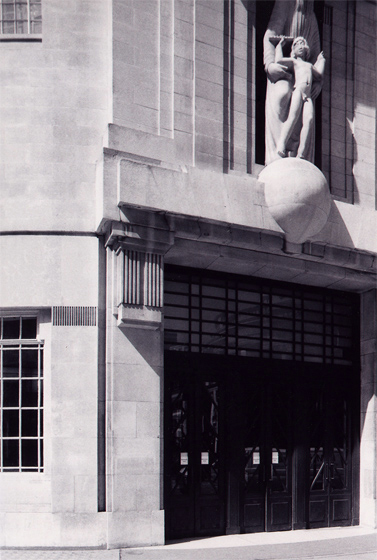
Gill’s Prospero and Ariel, Broadcasting House, 99 Portland Place, W1. Photo © David Secombe 2010.
The artistic legacy of Eric Gill (1882 – 1940) has been irretrievably sullied by the revelations made public in Fiona MacCarthy’s 1988 biography. MacCarthy quoted passages from Gill’s diaries in which he recorded a grotesque catalogue of perversions, including incest with his sister and daughters, as well as a passing liason with the family dog. Gill’s reputation was thus transformed from brilliant bohemian, who fused medieval craftsmanship with modernist practice, to that of a paedophile whose erotic carvings and prints are queasy evidence of a diseased mind.
Many of Gill’s admirers were appalled that MacCarthy had put this knowledge into her book, a sharp contrast to previous biographers who had resolutely ignored the evidence of the diaries. (That MacCarthy was blamed for her act of biographical integrity is appalling in itself.) At any rate, it is no longer possible to survey Gill’s huge output – his many religious carvings in cathedrals and churches, his monuments to the fallen carved in the wake of the First World War, his engravings, even his supremely elegant typefaces (Gill Sans, Perpetua, etc.) – without confronting the upsetting truth about their creator.
There are some fine examples of Gill’s public art in London: in Westminster Cathedral, on 55 Broadway, above St.James’ tube station, and his epic embellishments to the BBC’s flagship headquarters, Broadcasting House in Portland Place. B.H. features a cluster of works by Gill, most prominently his awe-inspiring Prospero and Ariel, two monumental carved stone figures which loom above the main entrance. There are many photographs of Gill working on the statues in situ: dressed in his customary monastic habit (affording passers-by glimpses of his genitals, as he considered underwear an ‘abomination’), Gill resembles a medieval stonemason carving for his God – or, perhaps, an extra who has wandered off the set of a period epic being filmed by Alexander Korda at Denham Studios. Broadcasting House is a sleek hymn to the Moderne set in Portland Stone, a Deco jewel keen to slip its moorings and set sail down Regent Street. And, for all Gill’s avowed medievalism, his sculptures are in keeping with the spirit of the times: Prospero and Ariel look fully at home at the prow of the BBC’s own dry-docked ocean liner.
… for The London Column. © David Secombe 2011.
London Monumental. Photo & text: David Secombe (4/5)
Posted: September 8, 2011 Filed under: Housing, Parks | Tags: John Nash, Regent's Park, Sir John Summerson Comments Off on London Monumental. Photo & text: David Secombe (4/5)
Cumberland Terrace, NW1. Photo © David Secombe, 1988.
From The Magus by John Fowles, 1966:
Beyond her stretched the grass, a quarter mile of turf to the edge of the park. Beyond that rose the Regency facade, bestatued, many and elegantly windowed, of Cumberland Terrace.
A wall of windows, a row of statues of classical gods. They surveyed the park as if from a dress circle.
[…] The afternoon sun made them [the houses of Cumberland Terrace] gleam with light, that Olympian elixir of serene, remote, benign light one sometimes sees in summer clouds.
Although John Fowles’ epic and impossibly romantic novel about the power of myth and storytelling is mostly set on an isolated Greek island, he chooses to end his story in NW1. In the final chapter of the novel, Fowles’ rattled ‘hero’ and his girlfriend have an angsty scene in Regent’s Park, where Nicholas wonders whether they are being spied upon from the windows of John Nash’s Cumberland Terrace. This is a brilliant example of a novelist employing a real location to enhance the themes of his narrative: Fowles exploits the theatricality of Nash’s park-side architecture to suggest that his punch-drunk protagonist continues to be an unwilling player in a drama staged for an unseen audience.
It is a fitting conceit, as the glimpses of Nash’s terraces from the park bely the (relatively) prosaic houses behind the grandeur of the facades. This louche and rather endearing architectural trick led Sir John Summerson, the celebrated eminence grise on all matters Georgian, to stick the boot in thus:
It is magnificent. And behind it all – behind it are rows and rows of identical houses, identical in their narrowness, their thin pretentiousness, their poverty of design. Where the eye apprehends a mansion of great distinction, supported by lesser mansions and service quarters, the mind must interpret it as a block of thin houses, with other blocks of thin houses carrying less ornament or none at all. The sham is flagrant and absurd. The terraces are architectural whims; and though Nash was serious enough in his intention, the effect is an odd combination of fantasy and bathos which only the retrospect of a century can forgive*.
Summerson’s aristocratic disdain is a bit hard to stomach here, and I think we are entitled to give Sir John the bird on this one. Fowles seems to have a better idea of what Nash was up to, and what he succeeded in doing. Nash’s terraces are there to enhance the public space, they exist to ennoble the walkers in the park, they lend drama to the business of taking the air. It is also at least possible, if not likely, that if they had been ‘dream palaces’ in a more concrete sense they would have gone the way of so many of the grand, inconvenient mansions of Piccadilly and Mayfair, swept away by ruthless economic imperatives well into the post-WW2 era. We can be grateful that the modest ambitions of the houses behind Nash’s palatial frontages have proved adaptable to changing circumstances, and so ensured their survival.
Unforgivably, Summerson also neglects to mention that Patrick Troughton’s Doctor Who had to contend with an invasion of Cybermen outside Cumberland Terrace in 1968: although one could say that it fell slightly outside his brief.
… for The London Column. © David Secombe 2011.
(*Georgian London, Sir John Summerson, 1945/1969.)
London Monumental. Photo & text: David Secombe (3/5)
Posted: September 7, 2011 Filed under: Bohemian London, Monumental | Tags: 55 Broadway, Jacob Epstein Comments Off on London Monumental. Photo & text: David Secombe (3/5)
Night by Jacob Epstein, 55 Broadway, Westminster. Photo © David Secombe 2011.
55 Broadway was built in the late 1920s to house the headquarters of the Underground Electric Railways of London, which later became London Underground. Fittingly, the edifice looms above St. James’s Park tube station, and the shopping mall at ticket hall level still contains much delightful Deco detailing. The building was designed by Charles Holden, who also designed the University of London’s Senate House in Bloomsbury. The building is further distinguished by the presence of sculptures and reliefs commissioned from some of Britain’s leading sculptors of the time, including the ‘big three’: Eric Gill, Henry Moore and Jacob Epstein.
Epstein carved his two contributions – Day and Night – directly into the Portland stone of no. 55. Predictably, Epstein’s brand of modernism went down badly and the male nudity of Day proved particularly controversial. There was a typically British outcry in the popular press, and Frank Pick, head of the Underground at the time, resigned over the affair. Epstein was eventually forced to shorten a penis on one of his figures by one and a half inches, but the furore impacted badly on his career, commissions being in short supply throughout the 1930s.
© David Secombe 2011.
London Monumental. Photos & text: David Secombe (2/5)
Posted: September 6, 2011 Filed under: Churches, Fictional London, Funereal | Tags: Bluegate Fields, Picture of Dorian Gray, St.George in the East Comments Off on London Monumental. Photos & text: David Secombe (2/5)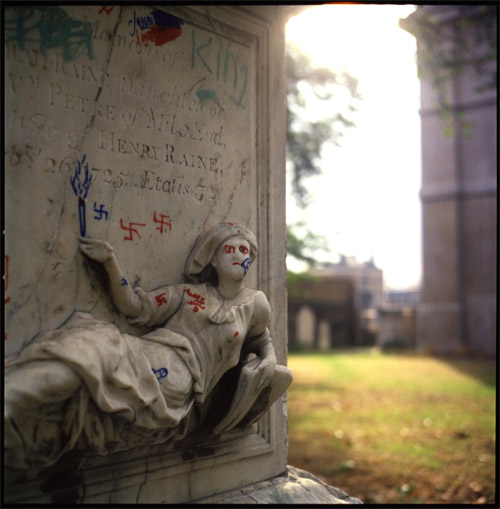
Raine Monument, churchyard of St. George in the East, Wapping. Photo © David Secombe, 1988.
From The Hole in the Wall, Arthur Morrison, 1888:
The Blue Gate is gone now – it went with many places of a history only less black when Ratcliff Highway was put to rout. As you left High Street, Shadwell, for the Highway – they made one thoroughfare – the Blue Gate was on your right, almost opposite an evil lane that led downhill to the New Dock. Blue Gate Fields, it was more fully called, though there was as little of a field or a gate, blue or other, about the place, which was a street, narrow, foul and forbidding, leading up to Back Lane. It was a bad and a dangerous place, the worst in all that neighbourhood. The sailor once brought to anchor in Blue Gate was lucky to get out with clothes to cover him – lucky if he saved no more than his life. Yet sailors were there in plenty, hilarious, shouting, drunk and drugged. Horrible draggled women pawed them over for whatever their pockets might yield, and murderous ruffians were ready at hand whenever a knock on the head could solve a difficulty.
Bluegate Fields, a.k.a. Blue Gate Fields, was a Victorian slum north of the Wapping docks. Two streets were once named Bluegate Fields, the ones now known as Dellow Street and Cable Street, streets which border St. George’s in the East churchyard on the east and northern sides respectively (St. George in the East is one of Nicholas Hawksmoor’s six great London churches). Bluegate Fields is name-checked in The Picture of Dorian Gray as the den of vice where Dorian goes to corrupt his soul. Unlike Arthur Morrison, however, Oscar Wilde never visited Bluegate Fields. The area features in Peter Ackroyd’s 1985 novel Hawksmoor which fictionalises the real Hawksmoor (in the novel he is called Dyer, whilst a 1980s detective is called Hawksmoor) as a shamanic figure and draws on the dark history of the East End, presenting the wilder side of the city as a place that is permanently wrong.
I took the above photograph in 1988, during a rather aimless wander across the East End with a newly-acquired Hasselblad. Last year I revisited the churchyard for the first time in twenty years and was dismayed by the state of the Raine monument. They have at least put iron railings around it now, but persistent vandalism and successively desperate attempts at cleaning have rendered it as white and featureless as a corpse pulled from the river. As I lamented the damage, youths who might well be the sons of the vandals responsible for the decoration seen above cheerfully urinated against the church wall. Peter Ackroyd’s theories of Psychogeography are much mocked, but I confess that on this visit I wondered whether he might be on to something. The persistence of sadness, decay and deprivation in this bleak spot are hard to ignore: the spirit of Bluegate Fields lingers on, albeit in a different register.
© David Secombe 2011.


 The London Column