London Monumental. Photos & text David Secombe (1/5)
Posted: September 5, 2011 Filed under: Catastrophes, Churches | Tags: caryatids, Elgin Marbles, Erectheum Comments Off on London Monumental. Photos & text David Secombe (1/5)
Caryatids, St. Pancras New Church, Euston. Photo © David Secombe, 2010.
From Georgian London, John Summerson, 1945/69:
St. Pancras is the queen of early nineteenth century churches; its architecture earns it the title, as much as its size and cost. Inwood’s flair for recapturing that nervous intensity of Greek architecture of the fifth century is very remarkable, and he seems to have had no difficulty in applying it to the commonplace objects of English practice.
The church stands on the corner of the Euston Road and Upper Woburn Place . It was consecrated in 1822, and was the most expensive church of its time – it was, in fact, the most expensive church in London since St. Paul’s. The father and son team of William and Henry Inwood won the competition to design the building and produced a church in the Greek revival manner, complete with a pair of pavilions modelled on the Acropolis’ Temple of the Erectheum. (Henry Inwood had travelled much in Greece and is generally considered to have been the dominant force in the design of the building.) The terracotta caryatids that guard the crypt are a clear echo of their ancient Greek forbears – one of which resides at the British Museum, part of that long-contested group known collectively as the Elgin Marbles. On July 7 2005, a suicide bomber detonated a bomb on board a number 30 bus which had just passed the church, proceeding down Upper Woburn Place before its destruction in Tavistock Square. The steps of St. Pancras were one of the sites for floral memorials to mark the tragedy.
© David Secombe 2011.
The Heath. Photo: Andy Sewell, text: Katy Evans-Bush (5/5)
Posted: August 27, 2011 Filed under: Parks | Tags: Andy Sewell, brutalist summer, hampstead heath, high noon, Katy Evans-Bush, september Comments Off on The Heath. Photo: Andy Sewell, text: Katy Evans-Bush (5/5)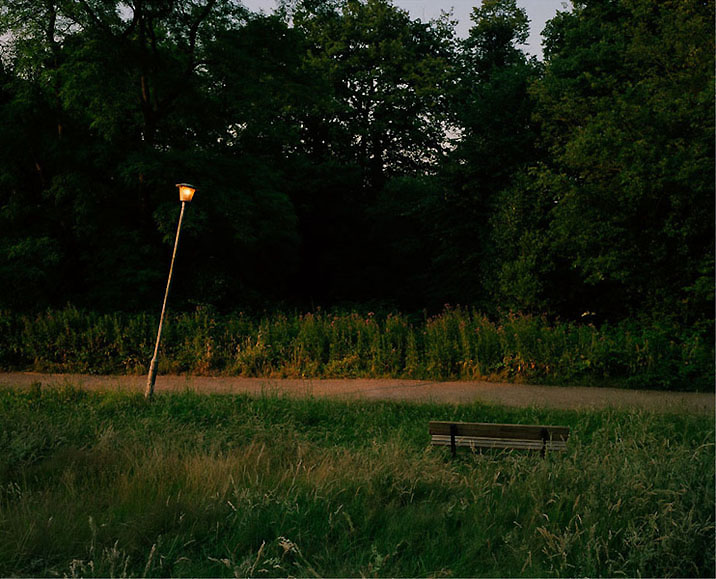 © Andy Sewell
And so the day ends. The summer is a particular kind of time, like high noon: a bit brutalist. It doesn’t allow many shadings: you’re either in it or you’re not. The Heath gives a respite, with its dark nooks and ancient crannies, and the thronging Bank Holiday weekend is the end of empiricist summer. September, as timeless in its way as summer is always trying to be the new thing, is a second chance to bathe in warmth and light, in the presence – but still beyond the reach – of gathering autumn. For those of us who can’t relax when the whole world is ordering us to, and those who can’t go away somewhere in the de rigeur month of August, September is a valediction.
So into the woods we go. Not a wolf in sight. KEB
… for The London Column © Katy Evans-Bush 2011
Katy Evans-Bush’s new book is Egg Printing Explained
buy The Heath, by Andy Sewell
The Heath. Photo: Andy Sewell, text: Katy Evans-Bush (4/5)
Posted: August 26, 2011 Filed under: Parks | Tags: Andy Sewell, hampstead heath, Katy Evans-Bush Comments Off on The Heath. Photo: Andy Sewell, text: Katy Evans-Bush (4/5) © Andy Sewell.
Things people do on Hampstead Heath:
Argue, bathe, be a human sculpture, break up, build a snowman, Capoeira, carve their initials, climb the hill, compose poetry in their head, cottage, daydream, do magic tricks, drink Ribena, eat crisps, examine the evidence, expose themselves, fall in love, fantasise about the past, forget the city, gaze at the city, get lost, get mugged, go fly a kite, go walking with granny, grope a stranger, hide from the mob, idealise the past, identify trees and insects out of a book, imagine the Heath full of wolves, jog, kiss, knit under a tree, laugh, lie in the grass, look at the sky, look for their lover’s lost wedding ring, look for their lover, make friends, meditate, mug someone, nobble an acquaintance by the bathing pond, open a packet of biscuits, play with the baby, pose, pull the dog on the lead, push-ups, quaff wine, question reality, read a book, read a Kindle, record a video, search for the change that fell from their pockets, shelter from the rain, sit on blankets, slip on the ice, splash, stare at the ground, strain their muscles, sunbathe, surreptitiously check their emails, Tai chi, tea and cakes at Kenwood, think about John Keats, think about what to have for dinner, tread carefully in the mud, unravel their picnic blanket, unravel the mysteries of the universe, visit Uncle Walter’s bench, walk off the tea and cakes, watercolours, weight training, whistle with a blade of grass, wish there weren’t so many people around, worry, write a book, yodel, zzzzz.
… for The London Column, © Katy Evans-Bush 2011
Andy Sewell’s book The Heath may be purchased here.
The Heath. Photo: Andy Sewell, text: Katy Evans-Bush (3/5)
Posted: August 25, 2011 Filed under: Literary London, Parks | Tags: Andy Sewell, hampstead heath, Katy Evans-Bush, London Eye, Me and the Dead, parliament hill, poems about london, Salt Publishing Comments Off on The Heath. Photo: Andy Sewell, text: Katy Evans-Bush (3/5) © Andy Sewell
The Bog of Despair
We’d lunched on Greek salad and coffee
In a place with white walls and a skylight,
And when the guy in the corner’s phone
Went off in a polyphonic can-can
We laughed without even trying to hide it.
We’d looked in a shop where a scarf
Of silk sat waiting for me to buy it,
And walked past a dog in a puddle
Of mud, who shook his coat,
But missed us – and we laughed.
The Heath was lovely that day –
The air was full of spring.
We’d walked up a foresty path,
Past a rubber hung like a thief on a tree,
Full of swag, and we’d laughed and laughed.
We’d walked past the swimming pond
And up the mound of Parliament Hill,
Talking about John Keats,
And other people we know, and the dog,
Looking for somewhere to sit, and laughing.
But every bench we came to
Was engraved in memory of someone
Loved and regretted, young, a child.
I imagined them sitting quiet
Along the hill, or invisibly playing.
The benches sat on a fat slope
Far from the blue chiffon horizon,
The blink of Canary Wharf,
The London Eye’s diamond necklace.
We read them, and flinched, and laughed.
We turned and started down:
You had to get your kids from school,
And I had a shiny scarf to get,
And the jeweller’s-window view
Of London had ceased to amuse us.
Your new shoes from Paris stuck
In the mud, and we laughed: the Bog
Of Despair! We laughed because
We could feel, behind us, up the hill,
The children watching us.
see Me and the Dead, by Katy Evans-Bush
see The Heath, by Andy Sewell


 The London Column