38 Special. Photo: Tim Marshall, text Travis Elborough (2/5)
Posted: July 12, 2011 Filed under: Transport | Tags: Routemaster, Tim Marshall, Travis Elborough Comments Off on 38 Special. Photo: Tim Marshall, text Travis Elborough (2/5)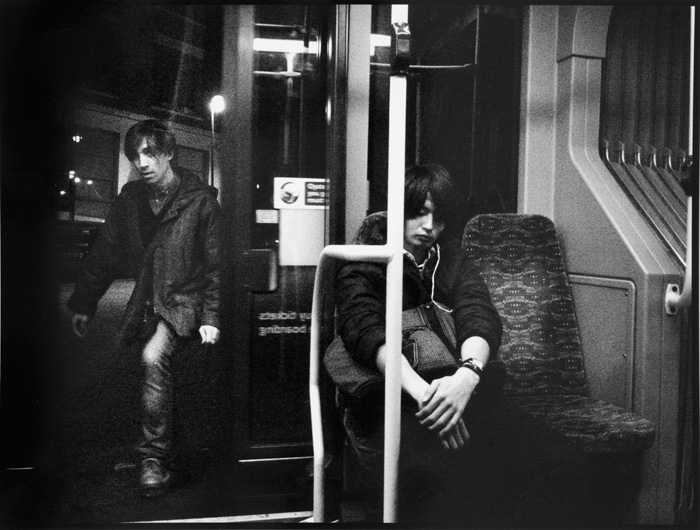
On a number 38 ‘Bendy’, Islington, 2006. Photo © Tim Marshall.
From The Bus We Loved; London’s affair with the Routemaster* by Travis Elborough:
The Routemaster was made to measure, Savile Row tailored for the city, ‘an attractive piece of street furniture’ specifically built for London. It exemplified the highest ideals of a public-spirited passenger transport service – physical evidence that London and ordinary Londoners should have the very best. ‘A handsome city deserves a handsome transport’ as All That Mighty Heart, the London Transport film, proclaimed in 1962. We loved it, not because it was old and quirky, but because it was bloody good. Well made. Importantly, it was greeted as an equal. It respected our custom. It was comfortable. Convenient. Efficient. We were free to get on and off, within reason, when we wanted to. ‘Passengers’ an old London transport motto maintained, ‘are our business not an interruption to our service.’ And on a Routemaster you could believe in that too.
Of course it grew out of and was born into another world. The society it was created to serve was more, or more visibly, stratified. It was a world with a certain intolerance of difference; you might see in its straight rows of seats a reflection of those times. A bus built for a city known for forming orderly queues rather than for wild alcoholic sprees; for a city of parsimonious coupon-snippers rather than designer-label consumers. It’s a bus that can exclude (the disabled, the pushchair), I concede. I prefer, however, to see a more egalitarian spirit at work. It was designed for (nearly) everyone, and everyone aboard is equal. By its careful, skilful design, it was intended in some small was to elevate an everyday experience.
By contrast, the metaphors many modern buses offer are slightly depressing. Their designs indicate troubled minds; seats on different levels, seats back to front, lurid playpen fabrics and colour schemes, straps at unusable heights, lava-lamp globules of extruded plastic at every turn and a soundtrack of bleeps and ticks, the Bendy’s have all the aesthetics of the inside of a Hoover attachment. New double deckers are huge, boxy, noisy and unwieldy. They look deformed, bulked out like Action Man after Hasbro pumped him full of steroids and turned him into some kind of inhuman gym-bunny cyberpunk in the 1990s. The average speed of a London bus continues to hover around 11 mph, and yet the engines on these vehicles seem tuned to accelerate with a speed and abruptness previously reserved for propelling dogs into space.
© Travis Elborough 2011
* Published by Granta Books.
38 Special. Photo & text: Tim Marshall (1/5)
Posted: July 11, 2011 Filed under: Transport | Tags: No. 38 bus, Tim Marshall Comments Off on 38 Special. Photo & text: Tim Marshall (1/5)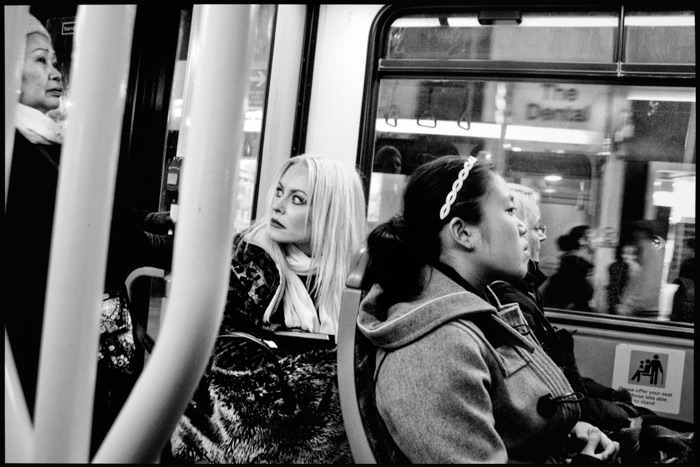
On board a no. 38, Shaftesbury Avenue, 2005. Photo © Tim Marshall.
Timothy Hadrian Marshall writes:
Everybody maps the city in his or her own unique way. My map of London started in 1980 when, as a student, I travelled from Battersea to Leicester Square on the old Number 19 Routemaster, as I made my way to the CSM Graphic Design building in Covent Garden. The characters I encountered on the journey intrigued me and I began making drawings of my fellow passengers. My location eventually changed and I went underground to become a Northern liner for two years, then in 1986 a Piccadilly Line man. The tube became another project, this time photographic, and I rarely travelled by bus anywhere during that time.
On moving to Islington in 2004, the estate agent said “ It’s a great location, only five minutes from Angel.” At the time good public transport connections all seemed terribly important. In my new locality I was pleasantly surprised to see the old Routemaster bus was still running, conjuring up every good thing about London, like a giant dinky toy from my childhood. Everyone appeared happy on the ‘Cliff Richard’ bus. You invariably knew the bus conductor, who would chat and make jokes, and you didn’t have to worry about bus stops, you could just jump off where and when you wanted to (all at your own risk, of course). Then one day, like Triffids in the night, the dreaded ‘Bendy Bus’ appeared.
© Tim Marshall 2011
Days and Nights in W12. Photographs and Text: Jack Robinson (4/4)
Posted: July 2, 2011 Filed under: Literary London, Vanishings | Tags: CB Editions, Crossing the Border, Days and Nights in W12 Comments Off on Days and Nights in W12. Photographs and Text: Jack Robinson (4/4)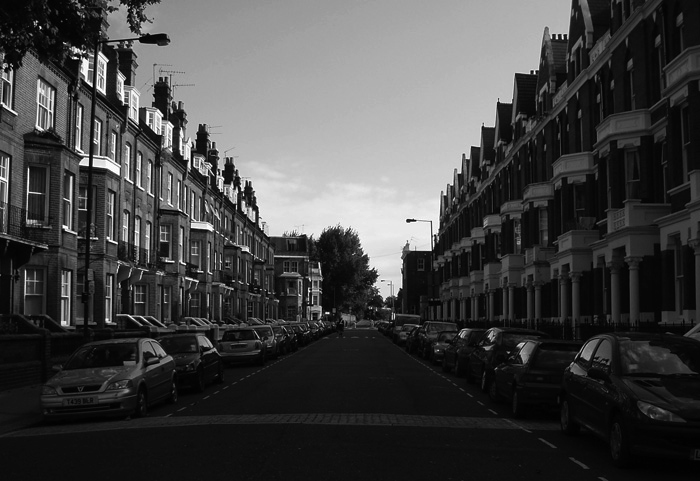
Photo: © Jack Robinson 2007.
From Days and Nights in w12* by Jack Robinson:
VANISHING POINT
Kieran, the youngest son of a wealthy Irish family – the one who never got punished, whose shoulders were never expected to bear burdens – lived in this street in the 1970s in a house that belonged to his parents. He rented out rooms to foreign students, and there were frequent parties, and always people coming and going. He told exaggerated stories about his work and love affairs, and every few months he went back to Ireland for the peace and quiet he needed to work on his novel – which was set at the time of the Great Famine in the 1840s; or was based, with her blessing, on the life of an American film actress. The first six chapters were with an agent; the entire first draft had been lost on a train. In the early 1980s, a few weeks after IRA bombs had exploded in Regent’s Park and Hyde Park, killing eight soldiers and seven horses, Kieran’s novel was published. Crossing the Border was a political thriller set in contemporary Northern Ireland. Kieran went over to Ireland to publicise the book at a literary festival. He was seen leaving his hotel and getting into a waiting taxi, but he never arrived at the festival venue. In London his house was broken into and his diaries and files stolen. The students who had lived in his house and who were traced by the police remembered him fondly: there was something both promising and insubstantial about Kieran, as if he was always about to depart.
© Jack Robinson.2011.
* CB Editions 2010.
Days and Nights in W12. Photographs and text: Jack Robinson (3/4)
Posted: July 1, 2011 Filed under: Artistic London, Bohemian London, Catastrophes, Transport | Tags: CB Editions, Days and Nights in W12, minicab, W.K. Teevald Comments Off on Days and Nights in W12. Photographs and text: Jack Robinson (3/4)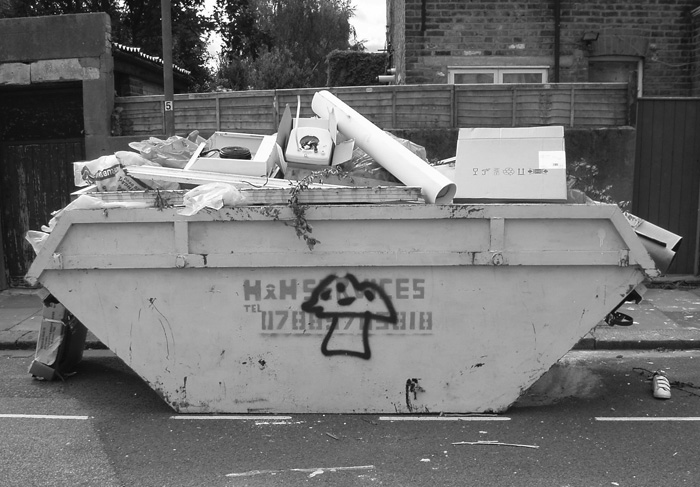
Batson Street, W12, 2007. Photo: © Jack Robinson.
From Days and Nights in w12* by Jack Robinson:
SKIP
The white roll in this skip is not posters for a film that’s no longer showing or rejected samples from an advertising agency but drawings of a Macedonian girl who speaks almost no English but has a body to die for. The drawings were made by the American artist W. K. Teevald; during his month-long stay in London, where he’d come to supervise the hanging of a retrospective exhibition of his work, he checked out of his hotel and moved in with this girl, and he considers the drawings to be the best work he’s done for years. On the day of his return flight to Los Angeles the taxi he’d ordered didn’t arrive, so he loaded his bags into the only car available from the nearest minicab office. The drawings were strapped onto the roofrack. ‘No problem, mister, the Lord is good, he will take best care,’ said the driver as he yanked on the rope and knotted it. He looked about twelve years old and was grinning; he could have been making a joke, except that the Virgin Mary was stickered all over the dashboard and a crucifix dangled from the rear-view mirror. When they arrived at the airport the roofrack was bare: not even a shred of rope was clinging to the metal frame. The driver demanded twice the fare that had been agreed before they’d set out and followed Teevald into the departures hall, pleading for justice and if not justice then charity, until he was turned away by security guards.
© Jack Robinson.2011.
* CB Editions 2010.


 The London Column