Licensed Victuallers’ Asylum. Photo & text: David Secombe.
Posted: December 7, 2012 Filed under: Architectural, Artistic London | Tags: Asylum, Old Kent Road, The New Hoxton, YBAs Comments Off on Licensed Victuallers’ Asylum. Photo & text: David Secombe.
Victuallers’ almshouses, Caroline Gardens, Peckham. Photo © David Secombe, 2002.
From Georgian London, John Summerson, 1945/1969:
There were plenty of other institutions, some educational, some charitable, some newly-born, some perhaps half a century old, which housed themselves with some grandeur. Almost all were Greek, with good, simple fenestration, and a portico – Doric or Ionic – to mark the status of the institution. Some of these buildings still stand. There is the pleasant, spacious courtyard and porticoed chapel of the Licensed Victuallers’ Asylum at Peckham, built about 1831. Others were damaged in the war and have disappeared since.
As Sir John pointed out, the Licensed Victuallers’ Asylum at Caroline Gardens – almshouses built for retirees from the brewing trade – is a rare survival in the unsentimental city. The Asylum is pretty enough to make one wonder at how it has managed to avoid the wrecking ball, as its very elegance must have been a goad to generations of developers and civic engineers. It is an oasis of Grecian calm just a few steps away from the bleak, business end of the Old Kent Road, and in its present context its charm seems positively defiant, even heroic: an assertion of a charitable ideal in architecture that is both grand and humane – and a welcome corrective to the lurid, day-glo Toys ‘R’ Us shed across the road.
The Old Kent Road remains one of the strangest of all London roads, as well as one of the oldest; it incorporates part of Watling Street, the Romans’ highway from Dover to London and far beyond, to the wild Welsh Marches. A walk along The Old Kent Road today – between New Cross and the Bricklayers’ Arms roundabout – is impressive by virtue of the vast contrasts in tone and scale. On the one hand you have the massive gas works, the acrid colours of the new retail sheds, the abandoned or decommissioned pubs, the unwelcoming wasteland of Burgess Park, the brutalist road scheme and the endless stream of traffic thereon … yet on the other you can see repurposed evangelical churches in former office units or light engineering premises, occasional glimpses of Georgiana subsumed into offices for tyre warehouses, and little runs of genteel villas and terraces which form tributaries off the churning thoroughfare. (The Victuallers’ Asylum is on Asylum Road, one of the most architecturally interesting streets in south London.) On a summer evening, the Old Kent Road has a strangely foreign quality; one could be in a dodgy suburb of Miami or Los Angeles. This may have something to do with its untended nature; even the Holloway Road doesn’t look this abandoned by civic authority. Perhaps any road in any city, left to its own devices, ends up looking slightly American.
With the repurposing come the artists, and it is no surprise that the ragged districts which line the Old Kent Road are increasingly hip areas for ambitious young artists to set out their wares. I have heard both Peckham and New Cross being described, with varying degrees of conviction, as ‘The New Hoxton’ – a statement which ignores the fact that Goldsmiths’ College has been churning out YBAs for decades, so one might say that New Cross was the ‘old Hoxton’. The Victuallers’ chapel was disused for many years but it has recently been adopted as an arts space by a group that calls itself ‘Asylum‘. Tomorrow, Saturday 8th December, it will be hosting a performance of ‘Christmas Mysteries’, a ‘musical adaptation of the nativity from the traditional Medieval Mystery Plays’. An atmospheric venue for it… photos of the interior of the chapel may be found here.
Incredible Londoners. Photo & text: David Secombe.
Posted: May 18, 2012 Filed under: Artistic London, London Music, Pubs, Vanishings | Tags: incredible Londoner, Jerusalem Tavern, Johno Driscoll, Thomas Britton 4 Comments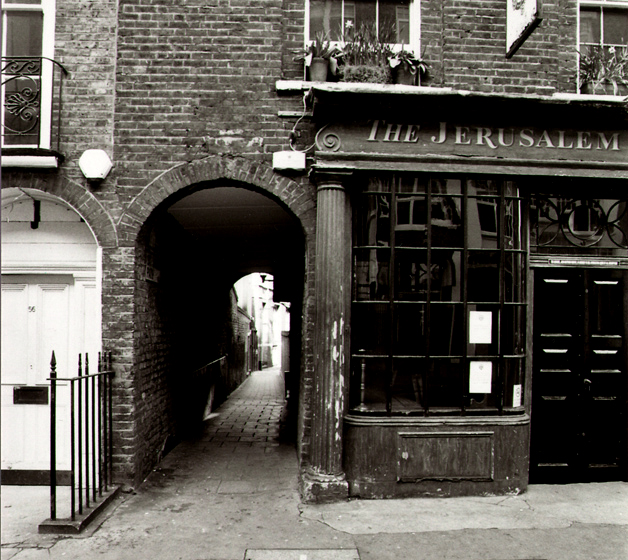
Jerusalem Tavern and Jerusalem Passage, Britton Street, Clerkenwell. Photo © David Secombe 2010.
This week’s sad news has prompted some of us to remember pub crawls with John on his patch, and the names of the hostelries we’d encounter on the way: The Horseshoe in Clerkenwell Close, The Crown on Clerkenwell Green, The Coach and Horses in Ray Street, The Marie Lloyd in Hoxton, The Eagle on Farringdon Road, the Sekforde Arms on Sekforde Street – and, now and again, The Jerusalem Tavern on Britton Street. As this week we have been remembering a great Londoner and champion of art, it seems oddly fitting to add this nugget about an artistic promoter who operated in the same area 300 years ago, and who is now buried in Clerkenwell churchyard. D.S.
From Without the City Wall, Hector Bolitho and Derek Peel, 1951:
Britton Street was named after an incredible Londoner of the late 17th century who walked the streets by day “in his blue frock coat and with his small coal-measure in his hand”, and who by night gave concerts in his humble abode next to Jerusalem Tavern, in what is still Jerusalem Passage. In The London Magazine we read: “On the ground floor was a repository for small coal; over that was a concert room, which was very long and narrow. … Notwithstanding all, this mansion attracted to it as polite an audience as ever the opera did.. … At these concerts Dr. Pepusch and frequently Mr.Handel played the harpsichord.” When passing along the streets with his sack of small-coal on his back, Thomas Britton “was frequently accosted with such expressions as these: ‘There goes the famous small-coal man, who is a lover of learning, a performer in music and a companion for gentleman.’”
Hockley Hole, AKA Central Saint Martins. Photo & text: David Secombe.
Posted: May 16, 2012 Filed under: Amusements, Artistic London, Bohemian London, Public Art, Vanishings | Tags: Back Hill, Central Saint Martins, Common People, Hockley in the Hole, John Driscoll, Johno's Darkroom 2 Comments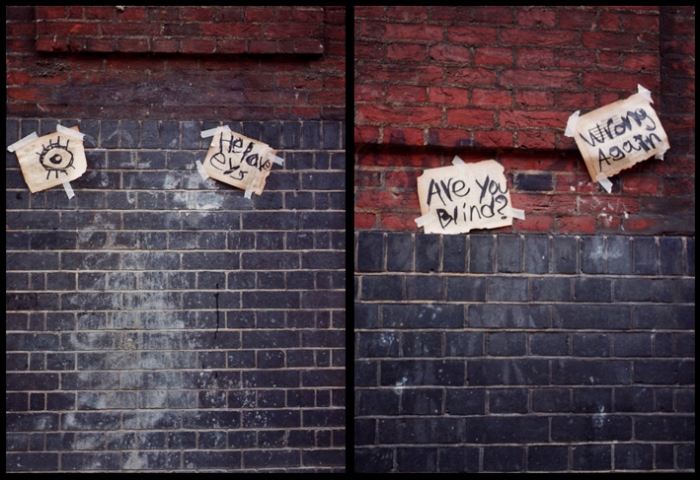
Back Hill, 2010. © David Secombe.
From The Fascination of London: Holborn and Bloomsbury, edited by Sir Walter Besant 1903:
The lower part of Saffron Hill was known at first as Field Lane, and is described by Strype as “narrow and mean, full of Butchers and Tripe Dressers, because the Ditch runs at the back of their Slaughter houses, and carries away the filth.” Just here, where Back Hill and Ray Street meet, was Hockley Hole, a famous place of entertainment for bull and bear baiting, and other cruel sports that delighted the brutal taste of the eighteenth century. One of the proprietors, named Christopher Preston, fell into his own bear-pit, and was devoured, a form of sport that doubtless did not appeal to him. Hockley in the Hole is referred to by Ben Jonson, Steele, Fielding, and others. It was abolished soon after 1728. All this district is strongly associated with the stories of Dickens. In later times Italian organ-grinders and ice-cream vendors had a special predilection for the place, and did not add to its reputation.
David Secombe writes:
One might add that in the 20th century, the area described above became associated with the photographic profession: at one time Clerkenwell was said to have more darkrooms and studios per square foot than anywhere else in the world. As a coda to yesterday’s post remembering the great Johno Driscoll, here’s a picture of ‘found art’ posted to the wall of John’s old premises, Holborn Studios, which is now a campus for Central Saint Martins art college. The building is situated within ‘the Hole’ – although the site of the bear-pit itself is now occupied by the pub opposite, The Coach and Horses. (Allegedly, the pub once afforded access to the Fleet river from its cellars, providing 18th Century fugitives with an escape route to the Thames.) Somehow, it seems right and proper that one of the most disreputable spots in 16th and 17th Century London should have gone on to be associated with photography, fashion, and art: the favoured trades of chancers, ne’er-do-wells and diamond geezers.
… for The London Column. See also: Little Jimmy, King of Clerkenwell.
Flotsam and jetsam. Photo & text David Secombe. (2/5)
Posted: April 17, 2012 Filed under: Amusements, Artistic London, The Thames, Transport | Tags: Britart, commercial Thames, corporate London, Damien Hirst, Spot paintings, Tate Boat, Tate Britain, Tate Modern, tate to tate 1 Comment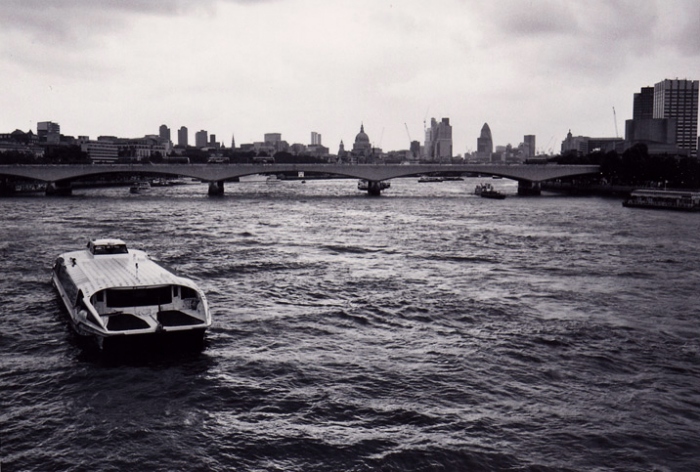
The Thames, looking east from Hungerford Bridge, 2010. Photo © David Secombe.
From Tate Online : 1 May 2003:
From 23 May Tate to Tate, a new boat service on the river Thames, will be available for gallery lovers. The service, which runs every forty minutes during gallery opening hours between Tate Modern and Tate Britain, will be launched on 22 May by The Mayor of London, Ken Livingstone. The boat also stops at the London Eye.
The Tate to Tate boat service, operated by Thames Clippers, is a state-of-the art 220 seat catamaran with specially commissioned exterior and interior designs by leading artist Damien Hirst. The boat is sponsored by St James Homes, a property developer.
David Secombe writes:
Now that Damien Hirst is the richest artist in the world (proof if any were needed of the global success of that strange London-based phenomenon known as ‘BritArt’), it seems entirely fitting that ‘the fastest’ commercial vessel on the Thames, ferrying passengers to and from the world’s most popular – some might say populist – art gallery, bears one of his patented designs. The Tate boat is decorated with Hirst’s bright, multi-coloured dots, and travels between those twin bastions of culture, Tate Modern and Tate Britain – the former fashioned from a derelict power station, the latter built on the site of a penitentiary.
For good or ill, Hirst seems to be the artist who best embodies his time; one can’t imagine a Bacon Barge or a Rothko Raft, whereas our Damien’s spotty pleasure cruiser – made possible by a property consortium – seems completely, depressingly, apt.
(The London Column has not yet felt the siren call of the current Hirst exhibition at the Tate, but you can read a response to the Sotheby’s extravaganza of 2008 on Baroque in Hackney. For another view of Hirst and his influences, see: http://www.stuckism.com/Hirst/StoleArt.html.)


 The London Column