The Riverine Strand.
Posted: May 12, 2014 Filed under: Architectural, Bohemian London, Churches, Housing, Literary London, Vanishings | Tags: Adelphi Terrace, Bob Dylan, Gordon's Wine Bar, John and Robert Adam, oscar wilde trial, Peter Ackroyd, Samuel Pepys, Savoy Chapel, Savoy Hotel, Subterranean Homesick Blues 2 Comments
 Royal Society of Arts, Robert St., Adelphi. © David Secombe 2010.
David Secombe: Thirty years ago, I accepted an assignment to illustrate a book of ‘London Walks’; I might have approached this task with more enthusiasm if I hadn’t known that I was offered the brief because the publisher didn’t have the money to pay the author’s preferred photographer. I lost my own copy of the finished item long ago, but recently came across one whilst helping my girlfriend clear an elderly aunt’s house. Looking at it now, it’s obvious that it was a formative experience for me, and that my photos were terrible. In an attempt to expiate former sins, this is the first of two posts revisiting the territory in a bid to see if a grizzled hack can improve upon a callow youth.
On a wet evening last week, I traced the steps of the ‘Riverine Strand’ walk in the company of TLC contributor and bad wine specialist CJ of the Sediment blog. We met outside Gordon’s Wine bar at the bottom of Villiers Street, both of us soaked through and longing for a glass of anything a notch above foul. Gordon’s advertises itself as ‘London’s oldest wine bar’, and it remains an atmospheric place to drink, although it has become more of a corporate playground in recent years. On this occasion our way to the bar was barred by thronging suits, which is why this piece lacks a picture of the vaulted cellar which is Gordon’s USP. We moved on …
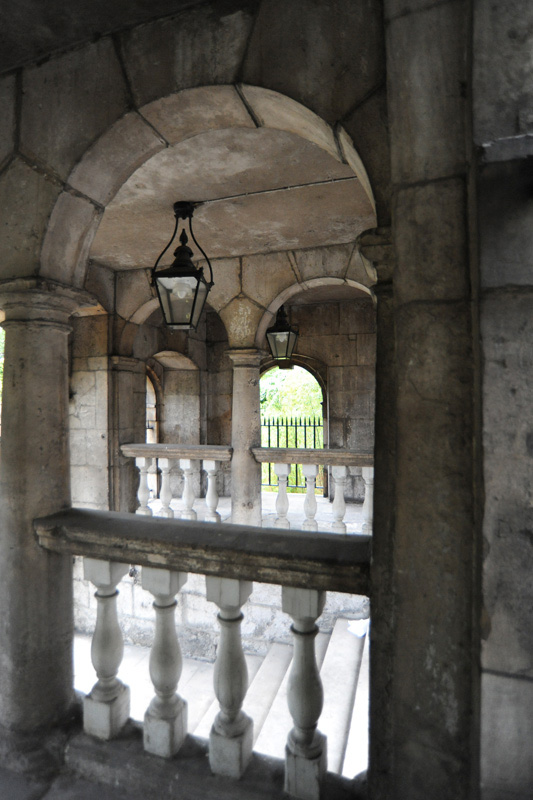
York Watergate. © David Secombe 2014
Opposite Gordon’s is a surviving fragment of the lost, pre-Embankment riverside landscape that once constituted this area: York Watergate, landing for York House, a palazzo which bordered the river for over 500 years. York House’s final, broke, owner, George Villiers, 2nd Duke of Buckingham, flogged it to developers for thirty grand. As Wikipedia gelidly states: ‘He made it a condition of the sale that his name and full title should be commemorated by George Street, Villiers Street, Duke Street, Of Alley, and Buckingham Street. Some of these streets are extant …’. For CJ’s benefit I pointed out that Samuel Pepys lived in a couple of houses on Buckingham Street, and that he also lived in the building where Gordon’s is now. CJ observed that it was still raining.
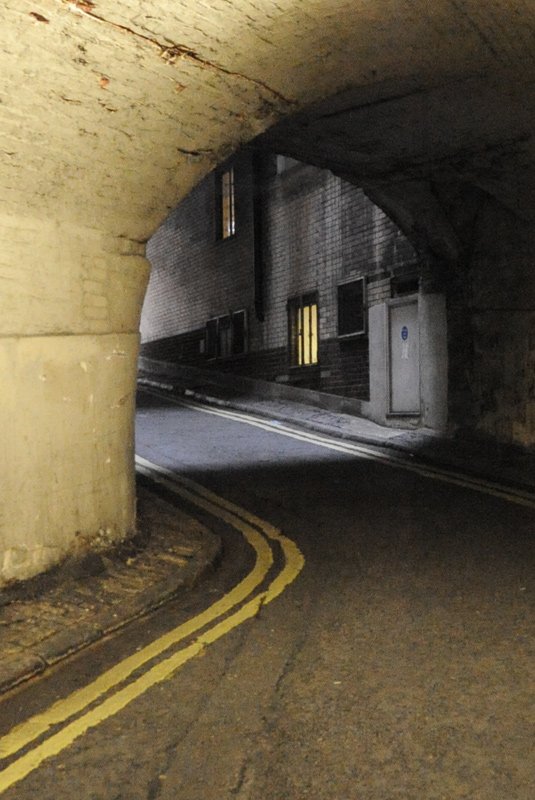
Lower Robert Street, Adelphi. © David Secombe 2014.
Lower Robert Street is an odd, subterranean thoroughfare that runs through what was once the undercroft of Adelphi Terrace, the centrepiece of the Adam Brothers’ Adelphi development. From The Encyclopedia of London:
In 1867 the Adelphi vaults were ‘in part occupied as wine cellars and coal wharves, their grim vastness, a reminder of the Etruscan Cloaca of old Rome’. Here, according to Tombs, ‘the most abandoned characters have often passed the night, nestling upon foul straw; and many a street thief escaped from his pursuers in these dismal haunts before the introduction of gaslight and a vigilant police’.
Dickens has David Copperfield wandering through this vanished maze, ‘a mysterious place with those dark arches’, which we can assume was an autobiographical reference. When I visited Lower Robert Street in the ’80s, for the purpose of illustrating the guidebook, it was still possible to see a dark courtyard beyond an iron gate: the basement of an Adam townhouse, seen from the POV of Victorian low-life … but that gate is bricked up now. (I dilated upon this factoid to an increasingly glazed CJ as drops of rainwater fell from his rimless spectacles.)
Above, the Adam houses reportedly were – as the houses that remain still are – a toy-town vision of elegance and grace. Of the Adelphi Terrace, E.V.Lucas wrote in 1916: ‘The Adelphi is still a favourite abode of men of letters, for it is central yet retired, and the brothers Adam planned rooms of peculiar comfort’. David Garrick, Richard D’Oyly Carte, Bernard Shaw, Thomas Hardy, all lived there, making it a sort of riverside version of The Albany.
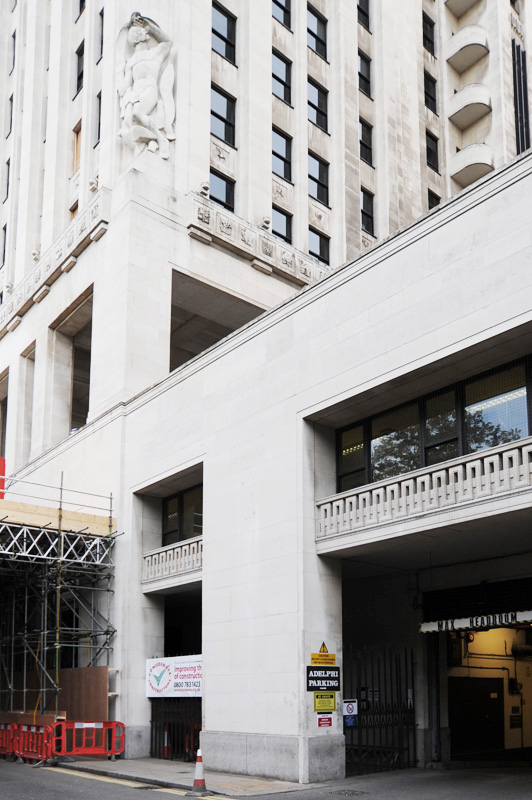 Collcutt & Hemp Adelphi, riverside frontage. © David Secombe 2014.
Adelphi Terrace was demolished by London County Council in 1936 and replaced by Collcutt and Hemp’s vast Deco block. The Adams’ Adelphi was the first neoclassical building in London, whereas Collcutt and Hemp’s edifice – grotesquely named ‘Adelphi’ – has been described by Ed Glinert (in The London Compendium) as ‘London’s most authentic example of totalitarian 1930s architecture’. Like Bush House at the other end of the Strand, it is a permanent reminder of loss, of a wrong inflicted upon the city. (NB: we are currently working on a survey of Boris Johnson’s skyscraper-nurturing programme.) In 1951, London County Council installed a plaque on one of the pillars of the ‘new’ Adelphi to commemorate the one they had connived to destroy. (The photo at the top of this post is of the Adam house which remains on Robert Street, facing Collcutt and Hemp, home to the Royal Society of Arts.)

Savoy Way. © David Secombe 2014
At this point, CJ wanly suggested going for a drink at the Savoy; but I reminded him that the last time we did that was five years ago, when both of us had money. Instead, we contented ourselves with a cursory inspection of the hotel’s rear quarters, a paragon of rationality, clad in the glazed tiles the Victorians reserved for only the filthiest urban environments.
At Oscar Wilde’s first trial, the following exchange took place between prosecution witness Charles Parker and prosecutor Charles Gill:
PARKER: Subsequently Wilde said to me. ‘This is the boy for me! Will you go to the Savoy Hotel with me?’ I consented, and Wilde drove me in a cab to the hotel. Only he and I went, leaving my brother and Taylor behind. At the Savoy we went first to Wilde’s sitting room on the second floor.
GILL: More drink was offered you there?
PARKER: Yes, we had liqueurs. Wilde then asked me to go into his bedroom with him.
(In an early draft of The Importance of Being Earnest, a solicitor arrives to remove Algernon to Holloway Prison for non-payment of restaurant bills at the Savoy, whereupon Algie retorts: ‘I am not going to be imprisoned in the suburbs for dining in the West End. It is ridiculous.’ Prior to his first trial, Wilde found himself held on remand at Holloway.)
It is tempting to imagine Oscar and Bosie hustling rent boys past the laundry bins and crates of vegetables on Savoy Way. CJ wondered whose laundry the gent in the photo might be carrying.
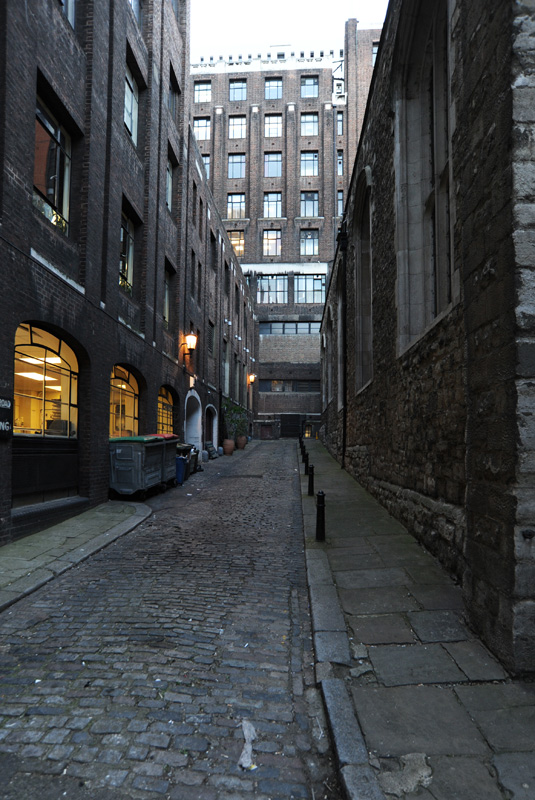
Savoy Chapel, Savoy Lane. © David Secombe 2014.
Adjacent to the Savoy stands one of those anomalous bits of medieval London marooned amongst anonymous offices. Savoy Palace, a vast 13th Century manor, once sprawled across the foreshore here; the Palace was entirely destroyed during the Peasants’ Revolt but the chapel was later rebuilt as part of Henry VII’s Savoy Hospital, of which it is now the only survivor. I don’t know whether Oscar and Bosie ever came here to ‘cool [their] hands in the grey twilight of Gothic things’, but this happens to be the spot where another Savoy resident, the newly-electric Bob Dylan, telegraphed Subterranean Homesick Blues for D.A. Pennebaker’s camera, as Allen Ginsberg and Tom Wilson loitered meaningfully in the background.
CJ and I emerged from Savoy Lane onto the Strand whereupon it started raining again, so we redoubled our efforts to find a sane place to drink. Dodging umbrellas and puddles by the corner of Waterloo Bridge, we chanced to see Peter Ackroyd alight elegantly from a cab and dive into a Tesco Express. We thought of waiting to see what the biographer of London would do when he emerged, entertaining the wistful hope that he might pop into Maplin’s for some fuses or a remote-controlled helicopter … but my boot was leaking, so we went to the Lamb and Flag, where we stood outside and drank our beers in the rain.
© David Secombe … for The London Column.
See also: A short walk down the Old Kent Road, Four streets off Hockley Hole.
Halloween. Photo: David Secombe, text: Andrew Martin.
Posted: October 31, 2012 Filed under: Anniversaries, Churches, Funereal, Gargoyles, Interiors, Monumental, Out Of Town, Public Art | Tags: Chaldon Church, demon, ladder of salvation, Purgatory and Hell, Trick or Treat 2 Comments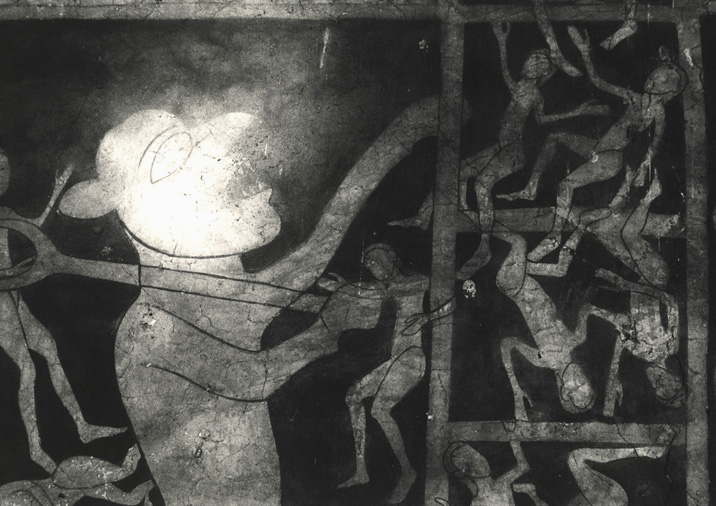
Mural, Chaldon Church, Surrey. Photo © David Secombe, 1989.
Halloween
When I was a boy, Halloween was a shadowy, elusive affair; the occasional carved pumpkin glowing in a window; the occasional fleeting glimpse of a reveller skipping away in a witch’s hat – usually some person you didn’t know and had never seen before. As a festival, it was upstaged by Bonfire Night, and I was frustrated by Halloween in those days. There was nothing you could buy, or be given in connection with it. Today, there is a great deal you can buy, as a result of the promotion of Trick or Treat, by which Halloween has eclipsed Bonfire Night and ghostliness has given way to mock horror. In the weeks before Halloween, Asda stores offer, amid a landslide of plastic tat; the Asda Squeezy Eyeball, the Asda Rat, the Asda Inflatable Coffin, the Child Grim Reaper Outfit (‘one size fits all’), the Adult Grim Reaper Outfit, the Inflatable Pumpkin Cooler (not for cooling pumpkins, you understand), the Skull Martini Shaker.
Asda is American-owned, and Trick or Treat came to us from America. The British folklorist Doc Rowe, believes that the Trick or Treat contagion began with a programme broadcast on BBC2 in the early ’70s as part of a documentary strand called Look Stranger. It depicted life on the American airbase in Woodbridge, Suffolk, and showed the children trick-or-treating. ‘Within two years,’ Doc Rowe told me, ‘all the tabloids were running features on how to dress up for the occasion.’ But his point is that this was merely the re-introduction into this country of a tradition rooted in psychology.
It helps to think of both Halloween and Bonfire Night as outgrowths of the Celtic celebration called Samhain, which marked the turning of their year and the beginning of winter. Samhain was associated with the lighting of fires to honour the dead, and defy malevolent spirits. The medieval church both denounced the festivals as diabolic and sought to appropriate aspects of them in the shape of All Saints Day on November 1st (on which the sanctified are honoured), and All Souls Day on November 2nd (a more democratic honouring of all Christian souls). According to Doc Rowe, ‘By tarring Halloween with an occult brush, by caricaturing it that way, the church made it an occult event.’ But while the original Halloween might not have been thoroughgoingly sinister, it did incorporate games and rituals of licensed naughtiness. All Souls Day, for example, was associated with Soul Caking, wherein poor Christians would say prayers for the departed relations of wealthier ones in return for food – and you can see how there might have been trouble if the rich didn’t play along.
It is likely that these traditions, these precursors of Trick or Treat, were taken to America by Scottish and Irish emigrants of the mid-nineteenth century … so the Asda Inflatable Coffin is actually our fault. But Doc Rowe believes these customs are ineradicable in any case. ‘The more you suppress these things, the greater they become.’ Apart from the Church, he identifies the main suppressors as ‘the health and safety camp’. I know what he means, and I wonder how long it will be before the words ‘high visibility vest’ come up in a ghost story.
… from Ghoul Britannia, published by Short Books. © Andrew Martin 2009.
David Secombe:
Chaldon Church is a tiny and ancient (11th Century) church tucked away in an unnervingly isolated hillside location about a mile north of the junction of the M23 and the ‘Magic Roundabout’ (a.k.a. the M25, London’s present-day Roman Wall). The church is famous for its terrifying medieval wall painting, described by Exploring Surrey’s Past thus: ‘The mural on the west wall of Chaldon church is one of the earliest known English wall paintings – it dates from about 1200 and is without equal in any other part of Europe. It is thought to have been painted by a travelling artist-monk. The picture depicts the ‘Ladder of Salvation of the Human Soul’ together with ‘Purgatory and Hell’. Wall paintings of this kind were intended as a visual aid to religious teaching. The whole picture is in the form of a cross, formed by the Ladder and the horizontal division between Heaven and Hell.’ No photo can adequately convey the power of this mural, or the sense of unease I experienced whilst photographing it on a bleak, windswept afternoon 20+ years ago.The medieval imagination retains its capacity to disturb; and the thrum of traffic from the nearby motorways seemed very distant indeed.
See also: The Avoided House.
The Rainbow. Photo & text: David Secombe.
Posted: October 18, 2012 Filed under: Churches, Crime and Punishment, London Music | Tags: Eric Clapton, Frank Zappa, Muddy Waters, Rainbow Theatre, Universal Church of the Kingdom of God, Victoria Climbie Comments Off on The Rainbow. Photo & text: David Secombe.
Universal Church of the Kingdom of God, formerly The Rainbow Theatre, Finsbury Park. Photo © David Secombe 2010.
The Rainbow Theatre, as the Art Deco Astoria cinema was renamed in 1971, played host to some of the most seminal moments in rock music history, from the first concerts held there in the 1960s until its closure as a music venue in 1981. It was here that Jimi Hendrix first burnt his guitar, where Eric Clapton had his all-star ‘comeback’ concert in 1973, where Pink Floyd tried out Dark Side of The Moon, where The Clash played host to their own riot in 1977 and where Frank Zappa was pushed from the stage into the pit by a disaffected audience member in 1972. My only personal experience of the Rainbow as a rock venue was seeing Muddy Waters play to a capacity crowd in (I think) 1979, cheerfully oblivious to the full-blooded fistfight raging in the stalls. Just as cherishable was my impression of the extraordinary interior, an Arabian Nights fantasy of palm grottoes under a nocturnal desert sky. This exquisite interior is surely the main reason for the building’s listed status; it would have been lovely to have secured a picture of its fabled decor …
Following the closure of the Rainbow in 1981 the building was largely disused until it was bought by the Universal Church of the Kingdom of God, a Brazilian Pentecostal Church, in 1995. The former Rainbow is now the Church’s UK headquarters. I knew nothing of the Church or its activities when I visited to photograph the exterior of the building, but I discovered that the Church is sensitive about its image: an agitated young man dashed out of the ‘Moorish’ foyer (can a church have a ‘foyer’? Discuss), ran across the street to where I was photographing and grilled me on my intentions. He deflated a little when I mentioned my interest in the building’s musical past, but insisted that I needed permission from the Church to take photos, at which point the conversation became rather less civil.
A cursory internet search helped explain my interlocutor’s jumpiness, as it appears that the UCKG has acquired a rather dubious international reputation; but more immediately sensitive to local sensibilities is the involvement of a former pastor of its Finsbury Park outpost in the Victoria Climbie case, adding yet another level of shame to that sordid and preventable tragedy. The Rainbow stood as something noble and glorious in its way; the headquarters of UKCG is something else, something monolithic and far less culturally benign.
The London Nobody Knows – revisited. Photos & text: David Secombe. (2/4)
Posted: June 20, 2012 Filed under: Architectural, Churches, Fictional London, Monumental | Tags: Alan Moore, Eye of Horus, Geoffrey Fletcher, Hawksmoor, Ian Sinclair, limehouse, Nicholas Hawksmoor, Peter Ackroyd, The London Nobody Knows Comments Off on The London Nobody Knows – revisited. Photos & text: David Secombe. (2/4)
St. Anne’s, Limehouse. Photo © David Secombe 2010.
From The London Nobody Knows, Geoffrey Fletcher, 1962:
St. Anne’s, Limehouse, was built by Hawksmoor, 1712-30, one of his three churches in the East End which alone make a worthwhile pilgrimage: the other two are St. George in the East and Christ Church, Spitalfields. All were begun within a few years of each other. As early as the 1730s, overcrowding had become a characteristic of the East End, a process accelerated in the early 19th century by the building of the docks between 1800 and 1830, the demand for unskilled labour, and the arrival of Jews and other refugees from Eastern Europe. These three churches were built as necessities, but there is nothing utilitarian about them. Their originality continues to surprise us. Hawksmoor’s architecture, imbued with Baroque rhythms, is massive yet solid, like Johnson’s prose. Characteristic of how little we really value them is the fact that, at time of writing, Christ Church, Spitalfields, is under threat of demolition, though thousands of pounds are uselessly thrown away in every conceivable direction.
David Secombe:
Christ Church, Spitalfields, was not demolished and has in recent years been the beneficiary of grants to restore the fabric of the building after decades of neglect. Hawksmoor’s six London churches have experienced a revival in general, and have become talismans for those who seek to pursue a hidden or mystical history of the city. Peter Ackroyd’s 1985 novel Hawksmoor elaborates upon ideas proposed by Ian Sinclair that Hawksmoor’s churches map an Eye of Horus upon the capital, whilst Alan Moore’s graphic novel From Hell links the Jack the Ripper murders to the looming presence of Christ Church over Whitechapel. Psychogeography aside, the massiveness and intensity of Hawksmoor’s designs have a slightly forbidding quality– and his monumental East End churches must have appeared anomalous and strange to those living in the surrounding Georgian and Victorian slums. In the 21st century, however, Christ Church looks anomalous for a different reason: the deadly corporatised make-over of Spitalfields market has transformed the area into Covent Garden East, and Hawksmoor’s magnificent creation now looms over a retail theme park safe for hipsters and their friends.
… for The London Column.


 The London Column
