Washday. Photo John Londei, text Joanna Blachnio.
Posted: November 4, 2011 Filed under: Fictional London, London Types | Tags: Joanna Blachnio, John Londei, Leather Lane Comments Off on Washday. Photo John Londei, text Joanna Blachnio.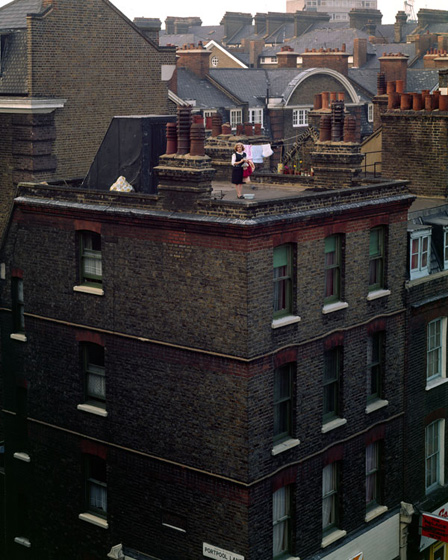
Portpool Lane & Leather Lane. © John Londei.
One – Two – Three by Joanna Blachnio:
One person can’t do it all, I said to my neighbour, Mrs Carlton, the other day. You mustn’t let them rely on you so much, I said, a husband and two grown boys can lend a hand around the house once in a while. My John, he doesn’t shy away from housework, only today he is still sleeping in after the pub.
I always wanted to have three kids. It was a trial when they were small – the whole lot born in less than five years. Mike drives the bus, Katie helps her husband in the shop, and Jenny, my youngest, is still at school. It’s her that comes up here most, even though she doesn’t do as much washing. She wants to be an astronomer. She took me with her one night and explained about the stars, but I couldn’t see half of them. I said to her, what’s the point of looking at them here in the city, with the streetlights and all? Anyway, I prefer it here by day. There’s always so much going on under those roofs across the road. They’re just roofs, like ours, but they look pretty today. You don’t get this kind of light at any other time of the year. You can tell autumn is coming – before long it’ll be too cold to put the washing outside.
Mrs Carlton lives across the road, just there. What would she do if I appeared now, out of the blue – out of the blue sky? It’s always ‘Mrs Carlton’: I’ve been here over twenty years, but close friends I haven’t made. It’s all fine, you talk and talk about the things you like, and suddenly the other person gives you this look. And there it stops, and never goes further. I do have the flowers, though. John says they’re just weeds, getting in the way of our veg, but I always look out for them. Last year the cold came early, and they didn’t appear at all – and now I’ve got three.
There’s Mrs Carlton bustling about the kitchen. I wonder what she’s thinking seeing me hang out my washing in that dress. There was only one like that in the shop, my size, and like tailor-made for me. I looked inside the purse: one – two – and that was all; so for a month I saved a bit of money, bought less food for myself, switched the lights off whenever I could – and when I came back to the shop, my dress was still there! I don’t know why I put it on this morning. It seemed different – everyone asleep or gone, and the house so quiet.
This air, you could swim in this air. I don’t really like washing. Cooking, cleaning, I don’t mind, but washing I’ve never cared for. Except we’ve got the new lines. I bought them only last week, and John put them up here. They’re so smooth, but solid, too. You could almost stand on them. Drop the bag of clips, leave the duvets – sitting in the basin for a little while longer won’t do them harm – prop yourself up, then stand. Now, first one foot, then the other. As long as you get through the first step, you can walk to the other end, and then – who knows?
I know it’s only a washing line. So what?
… for The London Column. © Joanna Blachnio 2011.
Drinker’s London. Photos Paul Barkshire, text David Secombe. (4/5)
Posted: October 22, 2011 Filed under: Eating places, Fictional London, Food, London on film, Pubs | Tags: El Vino's, Hugh Grant, Kate Winslet, Old Wine Shades, Richard Curtis Comments Off on Drinker’s London. Photos Paul Barkshire, text David Secombe. (4/5)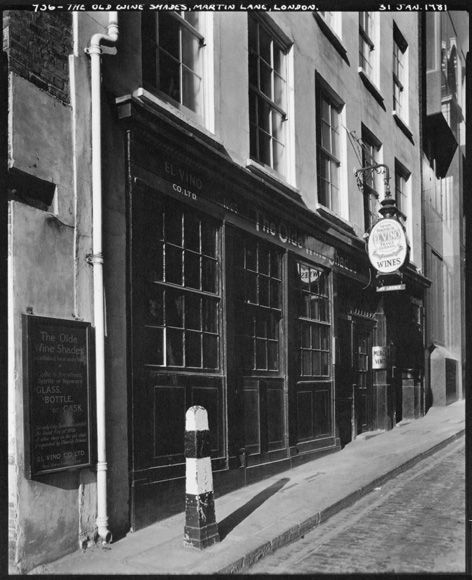
Old Wine Shades, Martin Lane. Photo © Paul Barkshire, 1981.
Old Wine Shades is part of the El Vino group, the venerable drinking chain that branches across the City of London. The one on Fleet Street was a legendary haunt of the local hacks in the days when ‘the Street of Shame’ was thronged with them, and El Vino’s continues to trade on its reputation as a City institution. However, an anonymous reviewer (‘A Customer’) on www.allinlondon.co.uk recently (August 2010) described Old Wine Shades thus:
A dreadful place. I work close by and El Vino’s is noted for rude staff and overpriced food and (especially) drink. On one of my few unavoidable visits (guest of others), my dining partner found a lady’s bracelet at the bottom of his coffee cup. A significantly chunky piece of jewellery. Not even an apology offered, much less anything off the bill. Basically, they trade on their historical connections and for that it’s worth a visit, but only on the way to somewhere better.
I have no idea if this is a fair assessment overall, but it poses several questions: what kind of bracelet was it? Did it have precious stones? What was it doing at the bottom of a coffee cup? Had its owner thrown it there as a protest? (surely you’d notice if your bracelet slipped from your wrist and into your cappuccino). Perhaps it was a prop left over from the filming of a romantic comedy, and the scene is easy to picture: a lunch date goes wrong in an historic London location, Kristin Scott-Thomas chucks her bracelet – a gift from Hugh Grant – in his coffee, leaving him embarrassed as she stalks off. We’d then have a quick bit of comic business with the waiter, a star cameo from Ricky Gervais. Hugh would probably pay another visit to Old Wine Shades at the end of the film, this time blissfully entwined with Kate Winslet or Kate Beckinsale, etc., who then finds the bracelet at the bottom of her coffee cup. I am sure I’ve seen this film. D.S.
London Monumental. Photos & text: David Secombe (2/5)
Posted: September 6, 2011 Filed under: Churches, Fictional London, Funereal | Tags: Bluegate Fields, Picture of Dorian Gray, St.George in the East Comments Off on London Monumental. Photos & text: David Secombe (2/5)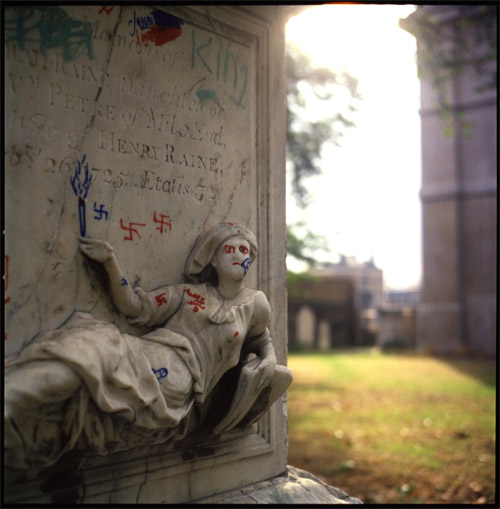
Raine Monument, churchyard of St. George in the East, Wapping. Photo © David Secombe, 1988.
From The Hole in the Wall, Arthur Morrison, 1888:
The Blue Gate is gone now – it went with many places of a history only less black when Ratcliff Highway was put to rout. As you left High Street, Shadwell, for the Highway – they made one thoroughfare – the Blue Gate was on your right, almost opposite an evil lane that led downhill to the New Dock. Blue Gate Fields, it was more fully called, though there was as little of a field or a gate, blue or other, about the place, which was a street, narrow, foul and forbidding, leading up to Back Lane. It was a bad and a dangerous place, the worst in all that neighbourhood. The sailor once brought to anchor in Blue Gate was lucky to get out with clothes to cover him – lucky if he saved no more than his life. Yet sailors were there in plenty, hilarious, shouting, drunk and drugged. Horrible draggled women pawed them over for whatever their pockets might yield, and murderous ruffians were ready at hand whenever a knock on the head could solve a difficulty.
Bluegate Fields, a.k.a. Blue Gate Fields, was a Victorian slum north of the Wapping docks. Two streets were once named Bluegate Fields, the ones now known as Dellow Street and Cable Street, streets which border St. George’s in the East churchyard on the east and northern sides respectively (St. George in the East is one of Nicholas Hawksmoor’s six great London churches). Bluegate Fields is name-checked in The Picture of Dorian Gray as the den of vice where Dorian goes to corrupt his soul. Unlike Arthur Morrison, however, Oscar Wilde never visited Bluegate Fields. The area features in Peter Ackroyd’s 1985 novel Hawksmoor which fictionalises the real Hawksmoor (in the novel he is called Dyer, whilst a 1980s detective is called Hawksmoor) as a shamanic figure and draws on the dark history of the East End, presenting the wilder side of the city as a place that is permanently wrong.
I took the above photograph in 1988, during a rather aimless wander across the East End with a newly-acquired Hasselblad. Last year I revisited the churchyard for the first time in twenty years and was dismayed by the state of the Raine monument. They have at least put iron railings around it now, but persistent vandalism and successively desperate attempts at cleaning have rendered it as white and featureless as a corpse pulled from the river. As I lamented the damage, youths who might well be the sons of the vandals responsible for the decoration seen above cheerfully urinated against the church wall. Peter Ackroyd’s theories of Psychogeography are much mocked, but I confess that on this visit I wondered whether he might be on to something. The persistence of sadness, decay and deprivation in this bleak spot are hard to ignore: the spirit of Bluegate Fields lingers on, albeit in a different register.
© David Secombe 2011.


 The London Column