Drinker’s London. Photos Paul Barkshire, text David Secombe. (2/5)
Posted: October 19, 2011 Filed under: Artistic London, Bohemian London, Literary London, Pubs | Tags: Ezra Pound, London bohemia, Sam Smiths pubs, The Princess Louise, The Rhymers Club, W.B. Yeats Comments Off on Drinker’s London. Photos Paul Barkshire, text David Secombe. (2/5)
Princess Louise, Holborn,1986. Photo © Paul Barkshire.
The Princess Louise is one of those carefully time-locked London pubs where one is invited to experience a idealised ‘heritage’ drinking experience: the Louise escaped post-war redevelopment and refurbishment and has survived into the 21st century as an authentically preserved/recreated Victorian boozer. At time of writing, the only beer on offer in the Louise is Sam Smiths, a rather dense, tawny ale brewed in Yorkshire; its main appeal is that it is remarkably cheap, but it is perhaps no coincidence that Sam Smiths currently lay claim to several other historic London pubs: these include the legendary Fitzrovia hangouts The Wheatsheaf and The Fitzroy Tavern, both much-frequented by the likes of Augustus John, Dylan Thomas, George Orwell, etc. – and also The Cheshire Cheese on Fleet Street, known to writers from Samuel Johnson (allegedly) and Charles Dickens up to Oscar Wilde, W.B. Yeats and Ezra Pound. (The Cheese was where Wilde came to hear John Gray, the model for Dorian Gray, read his poems, and where Pound demonstrated his impeccable Modernist credentials by eating two red tulips during a recital by Yeats.)
Since Paul Barkshire’s photo was taken in the 80s, the Princess Louise has had another make-over, reinstating ‘authentic’ Victorian mahogany & etched glass partitions, the original purpose of which was to divide up the patrons according to class and occupation. The end result is undoubtedly charming, and Sam Smiths should be congratulated for the sensitivity of their management of these historic pubs. The problem is that the loving restoration reinforces the sense of theme park, that creep of ‘Heritage’ (a tainted word if ever there was one) which imprisons London. The ghosts of the past are marooned amongst the tourists, and the centre of town is closed off to the truly louche and experimental. The Fitzroy Tavern and the Wheatsheaf can never be what they were in the 1920s and 40s; and where would The Rhymers’ Club, that austere flower of the Aesthetic movement which met at the Cheshire Cheese from the 1890s up to 1914, attracting Wilde, Yeats, Dowson, Pound, etc., meet today? A loft in Peckham or Dalston, probably. D.S.
… for The London Column.
Spitalfields Revisited. Photo: Paul Barkshire, text David Secombe.
Posted: October 14, 2011 Filed under: Churches, Literary London, Markets | Tags: east end, Paul Barkshire, Silk merchants, Spitalfields Market, Vanished London Comments Off on Spitalfields Revisited. Photo: Paul Barkshire, text David Secombe.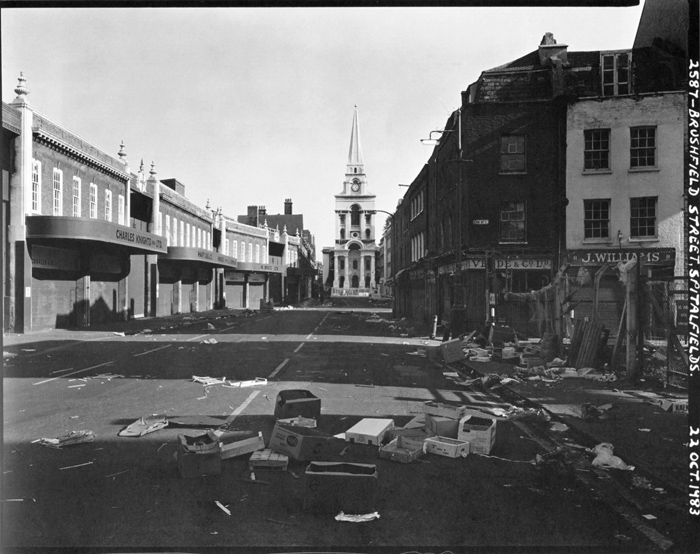
Spitalfields Market, 1983. Photo © Paul Barkshire.
Further to yesterday’s post on the vanishing East End, here is Paul Barkshire’s noble ’80s study of this now-transformed landscape. Despite the changes wrought since, Spitalfields remains one of the few areas left where one can get a sense of the London of popular imagination. Dickens knew these streets. London’s horror of its past (and Dickens would probably have been in favour of razing Spitalfields altogether) has been replaced by gentrification, which in the case of this quarter, marks the eventual success of the property speculators who built fine houses for prosperous silk weavers in the early 18th century.
We will be offering more of Paul Barkshire’s London shortly … D.S.
Spitalfields Market. Photo & text: David Secombe.
Posted: October 13, 2011 Filed under: Churches, Literary London, London Places | Tags: east end, Jack London, Thomas Cook Comments Off on Spitalfields Market. Photo & text: David Secombe.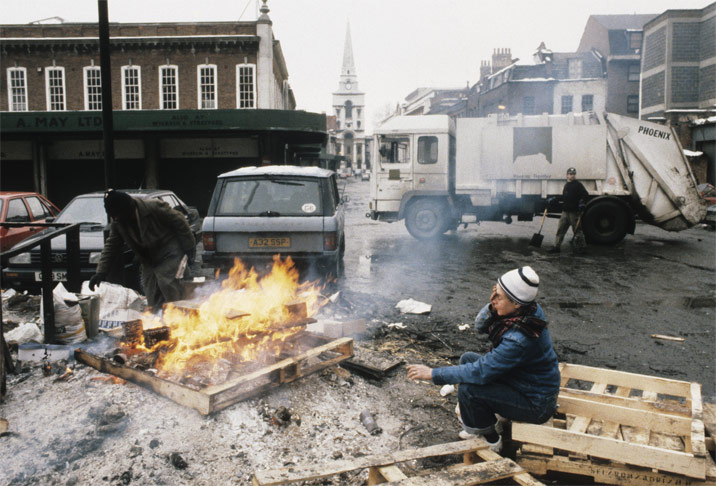
Photo © David Secombe 1990.
The opening of Chapter One of People of the Abyss by Jack London, 1902:
“But you can’t do it, you know,” friends said, to whom I applied for assistance in the matter of sinking myself down into the East End of London. […] “Why, it is said there are places where a man’s life isn’t worth tu’pence.” “The very places I wish to see,” I broke in.”But you can’t, you know,” was the unfailing rejoinder.
“Then I shall go to Cook’s,” I announced. “Oh yes,” they said, with relief. “Cook’s will be sure to know.”
“You can’t do it, you know,” said the human emporium of routes and fares at Cook’s Cheapside branch. “It is so – hem – so unusual. […] We are not accustomed to taking travellers to the East End; we receive no call to take them there, and we know nothing whatsoever about the place at all.” “Never mind that,” I interposed, to save myself from being swept out of the office by his flood of negations. “Here’s something you can do for me. I wish you to understand in advance what I intend doing, so that in case of trouble you may be able to identify me.” “Ah, I see! should you be murdered, we would be in position to identify the corpse.” He said it so cheerfully and cold-bloodedly that on the instant I saw my stark and mutilated cadaver stretched upon a slab where cool waters trickle ceaselessly, and him I saw bending over and sadly and patiently identifying it as the body of the insane American who would see the East End.
The photo above was taken twenty-one years ago, and shows homeless people lingering around a bonfire of pallets near the old Spitalfields vegetable market. Hawksmoor’s majestic Christ Church is seen in the distance. Spitalfields used to be cited by ‘psychogeographers’ as one of those London locales where the sad history of the city was engraved upon its streets and buildings: a place that was permanently wrong. The district’s association with poverty, with Jack the Ripper, the waves of the dispossessed that have settled over the centuries – this stuff was meat and drink to the likes of Iain Sinclair and Peter Ackroyd. For his part, Jack London’s attempt to discover the Edwardian East End bore fruit in a book which documented in depressing detail the squalor of Spitalfields, and included photos of down and outs sleeping against the walls of Christ Church. In the 1960s there were moves to demolish the entire area – including Hawksmoor’s church – and the time-locked deprivation of the Georgian district was eloquently pictured by the makers of the film based on Geoffrey Fletcher’s London gazetteer The London Nobody Knows, and by photographers Don McCullin, Paul Trevor and (later) Marketa Luscacova.
My picture dates from a moment just before the wealth and bombast of commercial London annexed the neglected East End. Spitalfields’ desirability as a property market perked up considerably around this time; long-term residents like Gilbert and George, Dan Cruikshank (who had been one of the original squatters who had helped save the area from destruction in the 1970s) and the American artist Dennis Severs, whose house is now a museum, acted as beacons of gentility amidst the inner-city gloom. And, as the 1990s rolled on, the East End went from being the Dark Heart of Old London to Shiny Retail Zone with bewildering speed. I remember laughing at my first sighting of Japanese tourists apparently lost in Shoreditch circa 1997 – but it was, I think, the same year that a Holiday Inn opened on Old Street. A visit to Spitalfields Market today is a trip to Covent Garden East: visitors are safe to purchase their branded goods and speciality coffees in a shopping environment free of disquiet. London Gothic has been displaced by Consumer Bland. It gives the lie to the theories of Ackroyd and Sinclair: with enough commercial pressure, any area, no matter how dark its history, can be transformed into a playground for contented shoppers. Cultural amnesia driven by money. However, given the recent unemployment figures, there may well be opportunities for a resurgence of old-fashioned Victorian deprivation in the East End, although this time it will be hustled to the margins of Whitechapel, Mile End, Barking, etc. D.S.
The Heath. Photo: Andy Sewell, text: Katy Evans-Bush (3/5)
Posted: August 25, 2011 Filed under: Literary London, Parks | Tags: Andy Sewell, hampstead heath, Katy Evans-Bush, London Eye, Me and the Dead, parliament hill, poems about london, Salt Publishing Comments Off on The Heath. Photo: Andy Sewell, text: Katy Evans-Bush (3/5) © Andy Sewell
The Bog of Despair
We’d lunched on Greek salad and coffee
In a place with white walls and a skylight,
And when the guy in the corner’s phone
Went off in a polyphonic can-can
We laughed without even trying to hide it.
We’d looked in a shop where a scarf
Of silk sat waiting for me to buy it,
And walked past a dog in a puddle
Of mud, who shook his coat,
But missed us – and we laughed.
The Heath was lovely that day –
The air was full of spring.
We’d walked up a foresty path,
Past a rubber hung like a thief on a tree,
Full of swag, and we’d laughed and laughed.
We’d walked past the swimming pond
And up the mound of Parliament Hill,
Talking about John Keats,
And other people we know, and the dog,
Looking for somewhere to sit, and laughing.
But every bench we came to
Was engraved in memory of someone
Loved and regretted, young, a child.
I imagined them sitting quiet
Along the hill, or invisibly playing.
The benches sat on a fat slope
Far from the blue chiffon horizon,
The blink of Canary Wharf,
The London Eye’s diamond necklace.
We read them, and flinched, and laughed.
We turned and started down:
You had to get your kids from school,
And I had a shiny scarf to get,
And the jeweller’s-window view
Of London had ceased to amuse us.
Your new shoes from Paris stuck
In the mud, and we laughed: the Bog
Of Despair! We laughed because
We could feel, behind us, up the hill,
The children watching us.
see Me and the Dead, by Katy Evans-Bush
see The Heath, by Andy Sewell


 The London Column