Old and New Soho. Photo & text by Eric Hands, Adam Macqueen (5/5)
Posted: May 27, 2011 Filed under: Literary London, Street of Shame | Tags: Auberon Waugh, Gannex Macs, Harold Wilson, Private Eye, Richard Ingrams Comments Off on Old and New Soho. Photo & text by Eric Hands, Adam Macqueen (5/5)
Christopher Booker, Richard Ingrams, Auberon Waugh and Barry Fantoni at the Private Eye office, Greek Street. Photo © Eric Hands
Eric Hands writes:
I arrived at Private Eye as a token working-class boxwallah – Ingrams’ term of endearment for non-editorial staff – following a mystical experience on Clapham Common (the drugs were better in those days) and a subsequent introduction to Barry Fantoni by the local vicar. My first job was to write up the ledgers for the advertising sales and, such was the shortage of space in the Greek Street premises, I shared a small smoke-shrouded cubicle with Auberon Waugh and Paul Foot. Bron had a habit of throwing his cigarette ends out of the window and on more than one occasion laid waste to a few fancy hats. I spent my first decent wage packet on a camera and the rest of my life trying to use one.
Regarding the above photo, Adam Macqueen – who is working on a definitive history of Private Eye – supplies the following which sounds about right. I’d date it circa 1974 as the poster was being used as a prop – rather than the photo being taken to celebrate the poster (if that makes sense). It was from a series of shots I took for a feature in the New York Times. Lighting by Anglepoise.
Adam Macqueen writes:
As far as I can tell, the poster must refer to Wilson’s legal action against the Eye for a joke about the trademark Gannex macs he always wore: they were manufactured by a company owned by his friend Joe Kagan, and the Eye wrote that Kagan had “employed Wilson as a commercial traveller and male model for the last seven years at an annual salary of £5-£10,000.” His solicitor Lord Goodman – himself a regular target and sworn enemy of the Eye – brokered an apology that was printed in February 1973: “This reference was not intended to be take literally, and we apologise to Mr Wilson for any suggestion that he was employed by or received payments of any kind from a commercial concern whilst he was a Minister of the Crown.”
Kagan, who did provide funding for Wilson’s private office, later got a peerage in his resignation honours list – the ‘Lavender List’ – and was imprisoned for theft and false accounting in 1980. And Wilson continued his feud after his resignation as prime minister in 1976, when he started touting what he called a “Private Eye address book” around friendly journalists. It was presumed to have been compiled from information private detectives working for his friend James Goldsmith had acquired from the magazine’s dustbins during his epic legal battle that year.
… for The London Column. © Eric Hands, Adam Macqueen 2011
Pepys Estate, Deptford. Photo Tony Ray-Jones, text Edward Mirzoeff, John Betjeman. (1/3)
Posted: May 17, 2011 Filed under: Architectural, Literary London, London on film, London Places | Tags: Edward Mirzoeff, John Betjeman, Pepys Estate, Tony Ray Jones Comments Off on Pepys Estate, Deptford. Photo Tony Ray-Jones, text Edward Mirzoeff, John Betjeman. (1/3)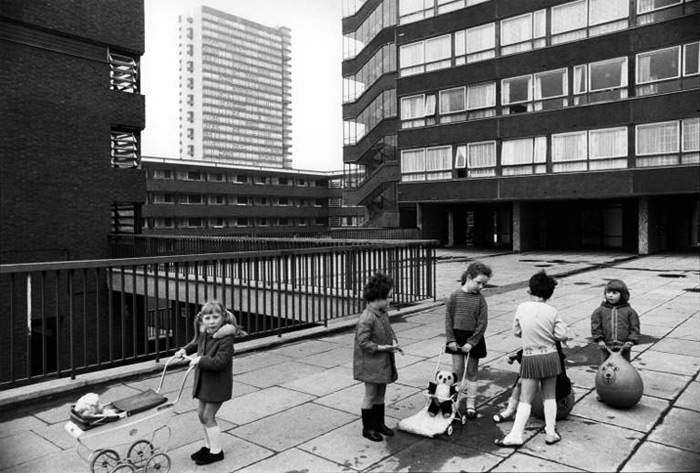
Pepys Estate, Deptford, 1970. Photo © Tony Ray-Jones/RIBA Library Photographs Collection.
Edward Mirzoeff writes:
Bird’s-Eye View was a pioneering series of 13 films shot entirely from a helicopter. For the first of these, The Englishman’s Home (BBC2 5 April 1969) John Betjeman wrote in the commentary about the new high-rise blocks. At the time his strongly-felt views were very much against progressive liberal thinking on the subject, and what he wrote was attacked and derided. By now most people have come round to his old-fashioned but humane way of thinking.
Betjeman refused to fly in the helicopter, but wrote his commentary, in verse, over weeks in the cutting room, once the picture-editing had been completed.
[Edward Mirzoeff was the producer of Bird’s Eye View.]
Pepys Estate, Deptford by John Betjeman:
Where can be the heart that sends a family to the 20th floor
In such a slab as this.
It can’t be right, however fine the view
Over to Greenwich, and the Isle of Dogs.
It can’t be right, caged halfway up the sky
Not knowing your neighbour, frightened of the lift,
And who’ll be in it, and who’s down below
And are the children safe?
What is housing if it’s not a home?”
[Tony Ray-Jones was one of Britain’s finest photographers, whose early death – at just 30 – in 1972 robbed us of an artist of acute insight and integrity. His book A Day Off is celebrated as one of the definitive post-war photographic studies of British life, and influenced a generation of native photographers, not least Martin Parr whose early work showed an obvious debt to Ray-Jones. Until I went searching for means of contacting the Ray-Jones estate, I was unaware of his work for Architectural Review in 1970: a total of 138 pictures that are now in the RIBA photographic library. These are images of the impact of modern housing, and he responded to the brief with characteristic power; he seems to have been especially engaged with the London subjects – Deptford, Thamesmead, the Old Kent Road, etc. – and some of these pictures are the equal of his better-known work. The London Column will be running a further two images from TRJ’s series on the Pepys Estate later this week. Special thanks to Robert Elwall at RIBA Library Photographs for allowing us to reproduce them here. D.S.]


 The London Column