A Psychogeographical Christmas. Photo & text: David Secombe.
Posted: December 20, 2012 Filed under: Architectural, Crime and Punishment, Food, Health and welfare, Hospitals, Housing, Literary London, London Labour, Monumental | Tags: Billy Butlins, BT Tower, charles dickens, Christmas Day in the Workhouse, Cleveland Street Workhouse, Cold War, Noel Edmonds, Post Office Tower, White Heat of Technology Comments Off on A Psychogeographical Christmas. Photo & text: David Secombe. The Cleveland Street Workhouse and the BT Tower. Photo © David Secombe 2011.
The Cleveland Street Workhouse was built in 1775 as a workhouse infirmary and ended up as part of the Middlesex Hospital until that institution closed in 2005. According to The Cleveland Street Workhouse it ‘has survived largely unchanged since the Georgian era. Its austere appearance is a rare testimony to the bleak and utilitarian institution it was designed to be. Its back yard was a graveyard for the poor, full of dead to a depth of at least 20 feet. Recent research has revealed that the building was the likely inspiration for Charles Dickens’ Oliver Twist, since the famous author lived a few doors away, on the same side of the road, for nearly five years of his young life, before he became famous as ‘Boz’’.
As it is Dickens’s bicentennial year, I offer here a glimpse of the grim edifice that loomed over the infant Dickens’s early years in the city. He was only two years old when his parents, fresh from Portsmouth, found lodgings in Norfolk Street – now Cleveland Street – in 1814. At that time the area still had a semi-rural character, with fields and farms lying just east of Tottenham Court Road – although the grand houses of Fitzroy Square were under construction and the churning awfulness of Oxford Street was only a few yards away. Dickens’s friend John Forster said that the novelist was able to recall vivid details of his early childhood, so it is an attractive proposition to believe that the workhouse in the picture above marked itself indelibly upon young Charles’s imagination during the three years (not five) in which he and his family lodged in the district. By 1817, Charles’s father had got a job in Chatham, and it was another five years before Dickens returned to the city, leaving his idyllic years in the Kent countryside for a more permanent engagement with ‘the great wilderness of London’.
The traditional Christmas is in many ways Dickens’s own creation, marked in particular by his characteristic juxtaposition of seasonal conviviality against the bleakness outside: ‘exaggerating the darkness beyond the small circle of light’ as Peter Ackroyd puts it. Dickens described composing A Christmas Carol whilst walking ‘the black streets of London, fifteen and twenty miles, many a night when all the sober folks had gone to bed’ and, for all its fairy-tale sentiment, it succeeded in rousing the conscience of his contemporary audience. The following year he produced The Chimes, another seasonal polemic. According to Ackroyd, The Chimes was partially inspired by a complacent review of A Christmas Carol and also by a story in The Times concerning a young woman, terrified of the workhouse, who had thrown herself and her baby into the Thames – the baby drowned, but the mother was rescued and condemned to death for murder of her child. The Cleveland Street Workhouse was Grade II listed in 2011 and, given Dickens’s agitating for reform of the Poor Law and his disdain for old buildings in general, he would probably have been appalled that this symbol of misery had been preserved for the nation – but there’s no question that the building retains its cruel power, an emblem of the darkness and suffering against which Dickens created some of his most brilliant effects..
Further north on Cleveland Street is the BT Tower, built as The Post Office Tower in 1961, the tallest building in London for nearly 300 years (it was taller than St Paul’s), its construction flattening a block of Workhouse-era buildings on the corner of Howland Street, including the one where Paul Verlaine and Arthur Rimbaud had lived during their stay in the city. The cylindrical form of the Tower was intended to lend stability in high winds – especially, it was darkly muttered, those from a nuclear blast. The Tower is also Grade II listed, and it too is an emblem of its time, redolent of the Cold War and the avowed technological modernity of the MacMillian/Wilson ‘White Heat of Technology’ era. When it opened in 1965, it boasted a revolving restaurant at its top, a concession operated by Billy Butlin; but if a nuclear exchange had taken place, the Tower would have been essential in maintaining contact between whatever was left of Britain and whatever was left of everywhere else. Today, advances in communication technology and the end of the Cold War have left the Tower almost as obsolete as its neighbour the Workhouse. The revolving restaurant was closed after an IRA bomb incident in 1971, and plans to re-open the venue for the 2012 Olympics were quietly shelved – which is a pity, as it would have made a suitably elevated position for the ego of some superchef or other. But, as this is a Christmas post, it is pleasing to report that on Christmas Day 1984, Noel Edmonds’s Live Live Christmas Breakfast Show was broadcast from the top of the Tower, an event described by its coiffed and beaming host as ‘one of the greatest communications projects ever put forward’. Noel went on to present several such Christmas Day TV events from the Tower throughout the 1980s, thus associating an icon of post-war modernity with the traditional late-20th Century Christmas: bored, over-fed and in front of the telly.
(NB: My friend and colleague Chris Brand has just pointed out that I have overlooked the Post Office Tower’s finest moment, in The Goodies’s Kitten Kong episode. Was this a Christmas special? Who cares.)
And on that tenuous and tortuously established link, we would like to wish all our readers a very Happy Christmas.
… for The London Column.
See also: The London Nobody Knows – revisited, Christmas on Greek Street
Up My Street. Photo: Dylan Collard (3/5)
Posted: September 26, 2012 Filed under: Class, Eating places, Food, Lettering, London Labour, Public Announcements | Tags: Dylan Collard, gentrification, Hipster hordes, Hipsterism, Holloway Road, The Archway Cafe Comments Off on Up My Street. Photo: Dylan Collard (3/5)
The Archway Cafe. © Dylan Collard.
David Secombe writes:
The genius of photography is the commemoration of the ephemeral; this is the reason why some of us are beady on the subject of digital photography, as it represents the commemoration of the ephemeral by means of the even-more-ephemeral. No such qualms arise from this week’s images by Dylan Collard, which were made using defiantly old-school methods. For his photos documenting the Holloway Road, Dylan lugged his massive Gandolfi ‘field’ camera (a device the size of a large hatbox, bolted to a hefty tripod) up and down that windswept, Stalinist boulevard to record scenes as quotidian as one could imagine.
In today’s photo, the proprietor (it can be no-one else) of the Archway Cafe poses for the camera in a way that we believe – we know – to be characteristic. Of course, he is having us on; he is playing the part of a surly cafe owner for our benefit, he knows that he is being memorialised for posterity – and Dylan’s limpid image preserves the shrewd glance of this short-order chef as if in amber.
Yet, if current trends continue, this commonplace scene is likely to disappear within a few years. The formica and the plastic condiment bottles already look like period pieces in this context, where they are employed as functional items rather than archly retro decor. This is not a cafe for budding screenwriters with their MacBook Pros, or middle-class mums with Range Rover-sized prams and Orla Kiely infants, but it can only be a matter of time. The hipster-friendly make-over of the Holloway Road is upon us with the inevitability of a melting ice shelf. And perhaps that is why our man in the Archway Cafe is so watchful, he might be keeping an eye out for the wrecking hordes: the girls with oversized glasses, cut-off shorts and day-glo leggings, the thin young men with buttoned-up plaid shirts, skinny jeans and implausibly bushy boybeards … an army of destruction as potent as any in history.
… for The London Column.
Up My Street is Dylan Collard‘s project documenting shops between Kentish Town and Archway. His exhibition The Twelfth Man is currently showing at Exposure Gallery, 22-23 Little Portland Street, London W1. Dylan is represented by the Vue agency.
Christmas on Greek Street.
Posted: December 22, 2011 Filed under: Literary London, London Labour, Theatrical London 2 Comments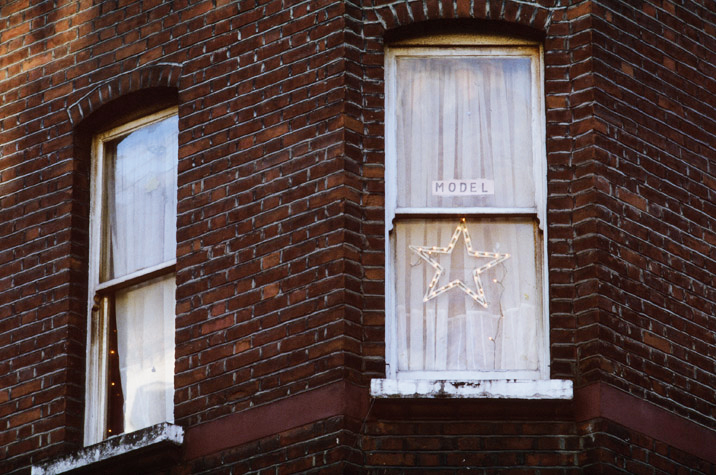
© David Secombe 2010.
From Act Two of The Homecoming, Harold Pinter, 1965:
LENNY: […] I’ve got a better idea. Why don’t I take her with me up to Greek Street?
Pause.
MAX: You mean put her on the game?
Pause.
We’ll put her on the game. That’s a stroke of genius, that’s a marvellous idea. You mean she can earn the money herself – on her back?
LENNY: Yes.
MAX: Wonderful. The only thing is, it’ll have to be short hours. We don’t want her out of the house all night.
LENNY: I can limit the hours.
MAX: How many?
LENNY: Four hours a night.
MAX: (dubiously) Is that enough?
LENNY: She’ll bring in a good sum for four hours a night.
MAX: Well, you should know. After all, it’s true, the last thing we want to do is to wear the girl out. She’s going to have her obligations this end as well. Where you going to put her in Greek Street?
LENNY: It doesn’t have to be right in Greek Street, Dad. I’ve got a number of flats all around that area.
MAX: You have? Well, what about me? Why don’t you give me one?
LENNY: You’re sexless.
… and a Merry Christmas to all our readers.
(see also: Old and New Soho no.5)
Dmitri Kasterine. Text: Joanna Blachnio. (5/5)
Posted: October 28, 2011 Filed under: London Labour, London Types, Markets, Street Portraits Comments Off on Dmitri Kasterine. Text: Joanna Blachnio. (5/5)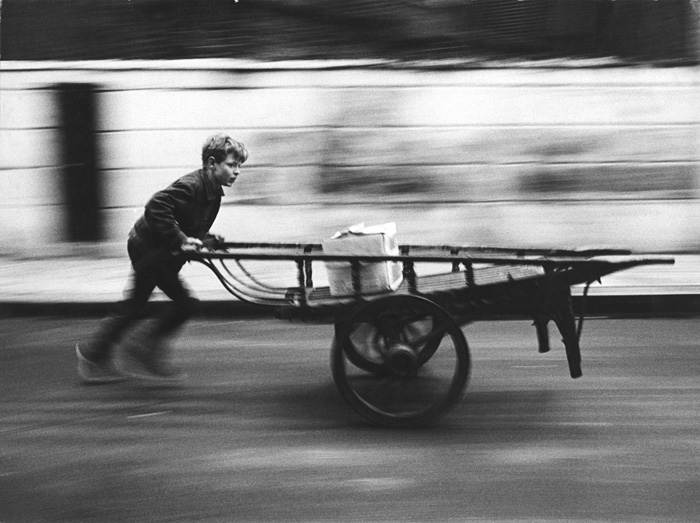
Barrow boy, World’s End, 1963. © Dmitri Kasterine.
Joanna Blachnio writes:
And then he forgets. Clearly. The formula for the circumference of the circle and the length of the arch. How to calculate mass, and how to express vacuum in numbers. He forgets the latchkey, warming slowly in his pocket, the water gathered by one of his wingless shoes. He forgets the order of notes on the musical scale. Even that game of marbles, shamefully lost to Jimmy Croghan. He forgets how mist comes into being – and it rises, contrary to experience, from the ground, spreading sideways. And envelops all except his face.
… for The London Column. © Joanna Blachnio 2011.


 The London Column