Nights at the Opera. Photo & text David Secombe (2/5)
Posted: August 2, 2011 Filed under: London Music, Theatrical London | Tags: Cherubin, Jane Mitchell, Massenet 3 Comments

Jane Mitchell, backstage, Royal Opera House, 1994. Photo © David Secombe.
Massenet’s Cherubin is a comic opera conceived as a sort of sequel to The Marriage of Figaro. It has received a few revivals in recent years, notably a splendid 1994 production at the Royal Opera House which featured Susan Graham, Angela Georghiou and some extremely arresting wigs. The photo above was taken on the first night of this production, and shows the soprano Jane Mitchell waiting in the wings for her final entry. In the backstage gloom, Jane’s marvellous profile was illuminated by just one, blue worklamp – and I had just enough time (about a minute) to set up my tripod and take a few frames before she left for the finale.
(You can hear Susan Graham and Angela Georghiou in this production here: a duet from the finale.)
I was working on a book project profiling a season of opera and ballet at the Royal Opera House, an offshoot of the famous BBC documentary series The House. The films painted a fascinating and not-entirely flattering portrait of life within the building, and several sackings and resignations ensued. As a stills photographer, I was less concerned with organisation’s internal politicking than I was with the sheer beauty of the working environment. However, complaints about the inadequacy of this environment and its antiquated facilities eventually led to the major redevelopment of the building, which was tied to a major re-landscaping of Covent Garden to monetize the scheme. The unfortunate consequence of this has been a further loss of character for the area: one entire Georgian terrace on the north side of Russell Street was demolished, creating more facilities for the ROH but also adding yet more chain outlets to a district choked by them.
(It may sound feeble, but I promised Jane a copy of this picture, a promise I never delivered; Jane, if you are reading this, drop me a line and I will make good on this. D.S.)
Nights at the Opera. Photo David Secombe, text Edward Mirzoeff (1/5)
Posted: August 1, 2011 Filed under: Interiors, London Music, London on film, Theatrical London | Tags: royal opera house, The House, wig Comments Off on Nights at the Opera. Photo David Secombe, text Edward Mirzoeff (1/5)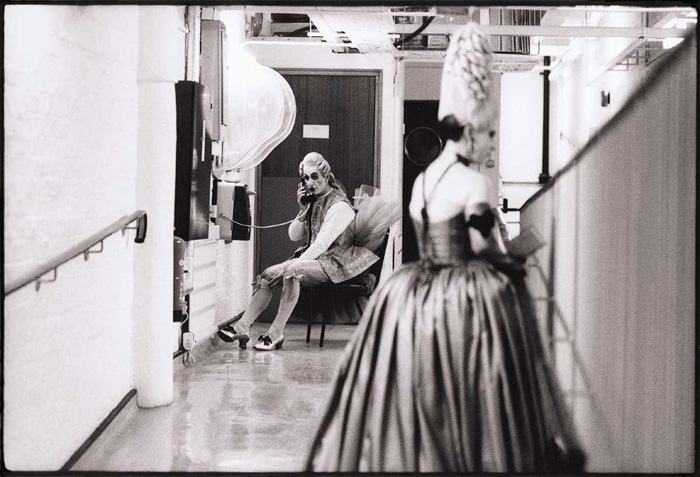
Backstage, Royal Opera House. Photo © David Secombe 1994.
Edward Mirzoeff writes:
The House was, in many ways, the definitive “fly-on the wall” television documentary series. The six episodes, shot in 1993 and 1994, went behind the scenes at the Royal Opera House, Covent Garden to reveal the astonishing dedication, talent and sheer hard work put in by singers, dancers, technicians and craftspeople in decaying and unhelpful surroundings. It also revealed the equally astonishing conflicts, confusions and ineptitudes of some members of the management and some grandees on the Boards.
The television audience, and newspapers all over the world, were gripped by the saga from week to week. Some people took it as an allegory of the state of the nation. And after it was over, the series went on to win all the prizes. BAFTA, Banff Festival, Broadcasting Press Guild, International Emmy, Royal Philharmonic Society – The House cleaned up all the statuettes.
Just one puzzle remained. Despite the many awards, despite the publicity and controversy, the series was never shown again. In a culture of endless repeats of mediocre television programmes, such restraint by BBC Controllers was curious.
[Edward Mirzoeff was executive producer of The House for BBC Television.]
Welcoming smiles … (3/3)
Posted: May 6, 2011 Filed under: London Music, London Places, London Types | Tags: Dave Hendley, Travellers, Westway Comments Off on Welcoming smiles … (3/3)
Travellers’ community, Westway. Photo © Dave Hendley 1972.
Dave Hendley writes:
The picture was made one Saturday in the late summer of 1972 at the other end of my working life and in a very different world. I was on a job for Time Out and the mission was to photograph a free music festival in what was then a grassed area under the Westway by Latimer Road. My brief was to photograph stock pictures of musicians for future inclusion in the magazine’s gig guides. The concert was a small and very comfy affair with an audience of around 150 – 200 people.
A short distance away, under what is now the West Cross interchange, there was a cluster of caravans and I spotted a group of traveller men-folk observing the event with curiosity and great amusement.
I wandered over and asked to take a photograph. These were times when being photographed was something of a compliment and the lads posed willingly. I suspect in today’s suspicious climate I would have met with a more hostile reaction. I took just two frames as was my normal procedure back then, film was a precious commodity and consequently I always shot very concisely. After all why would you want more than one or two shots of a particular subject?
Later in the afternoon the Time Out picture editor Rebecca John (the granddaughter of the painter Augustus John) came to say hello and I abandoned my duties for a visit to a nearby pub. Rebecca was a very lovely person and it is is one of my great regrets that we subsequently lost touch over the years.
I returned to photograph a few more bands, including a musician called Steve Hillage, a strange hippie type in a pixie hat. As I was shooting away a scruffy but very polite and gently spoken young man approached me and enquired if he could buy some pictures. He wrote his name, Richard, and contact details on the back of a crumpled flyer. On the following Monday I made my way to the Virgin shop in Notting Hill Gate where I sold Richard Branson a couple of frames for a tenner.
© Dave Hendley 2011


 The London Column