On the South Bank. (3)
Posted: August 8, 2013 Filed under: Amusements, London Places, Pavements | Tags: skateboarding poem, southbank skate park, Thomas Hogan artwork Comments Off on On the South Bank. (3)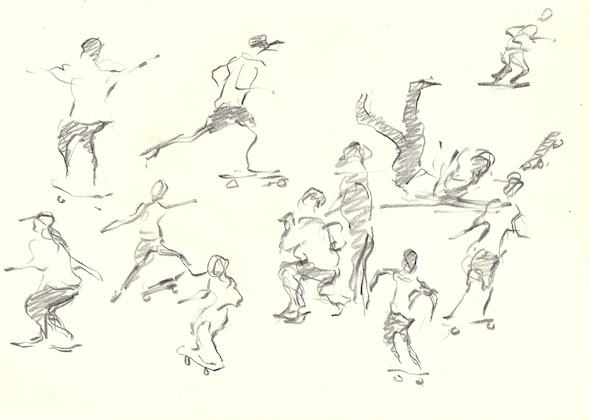
Sketchbook, Southbank, 2013 © Thomas Hogan
Lawrence Schimel, Skating Beauty
Like the uninvited
thirteenth fairy at the christening,
I am standing just outside
the place where they’re skating
and I want to curse them
for my not being a part
of such easy youthful
masculine fellowship.
Forget the prick of a finger
on a spinning wheel’s needle,
let them crush their hands
beneath the spinning wheels
of their skateboards!
But I want more than just
belonging; it is you I crave:
a beauty that could exist
only in fairy tale,
where magic or alchemy
transforms a catalogue of parts–
eyes, lips, lithe torso that twists
just so at the waist–into something
wondrous and unique, delicate and fierce,
hovering on that threshold
between boyhood and manhood.
Almost shy when on the ground,
unaware of your own desirability,
your board, tucked under your arm
like a shield, blocks the view of your
naked torso as you constantly shift
position, less nervousness than
restless excess of energy.
Then you mount your board.
Everything changes: you are
a modern-day centaur, board and boy
a single being whose grace
and almost preternatural calm
draws the attention of every eye.
Suddenly you launch into the air
legs bent at the knees. You soar,
your board flying up beneath you
and time stops
…………………………..for a hundred years
with you suspended in this moment
and only a kiss from me
could make it start again.
© Lawrence Schimel.
Lawrence Schimel was born in New York and lives in Madrid where he is a Spanish-English translator. His most recent poetry collection is DELETED NAMES (A Midsummer Night’s Press, 2013).
On the South Bank. (2)
Posted: August 7, 2013 Filed under: Amusements, London Places, Monumental | Tags: BMX Southbank, peadar o'donoghue, southbank poem, southbank skate park, Southbank Undercroft 4 Comments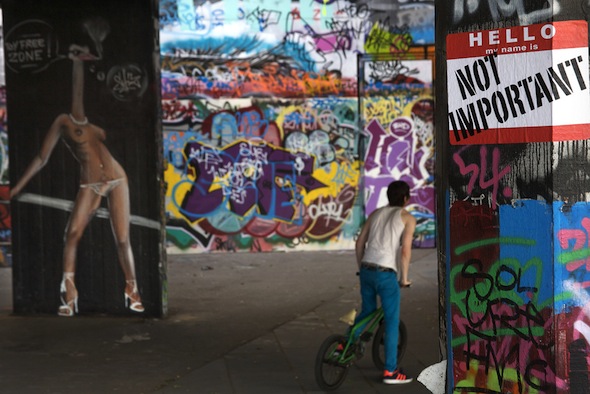
BMX Bike, Southbank Photo: © Mark Granier
Southbank
Everything is neither synonym nor like-
We bruise easy, for example;
Peach. Mottled. Punch.
A fib to say more Lyre than Lear,
The juice of the word ‘apophysis’
The bathos of bone, splintered,
Bowdlerized, a coda of this melancholy,
This street theatre, this effervescent
Promenade, this cultural quarter
This street-beat named desire,
This sliding scale on the spinning,
This leave us be moment,
This warmth from the city.
© Peadar O’Donoghue
Peadar O’Donoghue’s first collection, Jewel, is published by Salmon Poetry, and he edits The Poetry Bus magazine.
The discreet charm of the A102M. Photo & text: David Secombe.
Posted: September 13, 2012 Filed under: Literary London, London Places, Transport | Tags: blackwall tunnel, charles dickens, Special Patrol Group Comments Off on The discreet charm of the A102M. Photo & text: David Secombe. Blackwall Tunnel southern approach, SE10. Photo © David Secombe 1988.
From Night Walks by Charles Dickens, from The Uncommercial Traveller, 1861:
Some years ago, a temporary inability to sleep, referable to a distressing impression, caused me to walk about the streets all night, for a series of several nights. The disorder might have taken a long time to conquer, if it had been faintly experimented on in bed; but, it was soon defeated by the brisk treatment of getting up directly after lying down, and going out, and coming home tired at sunrise. In the course of those nights, I finished my education in a fair amateur experience of houselessness. My principal object being to get through the night, the pursuit of it brought me into sympathetic relations with people who have no other object every night in the year.
David Secombe writes:
The above photo was taken in just such a mood as Dickens described: unable to sleep, and with guests sleeping in the living room of my one-bedroom flat, I drove around south-east London looking for images. The sheer emptiness of the industrial hinterland of the Greenwich Peninsula was eerie and unsettling, although I took the photo above; a lambent nocturnal scene, seen from the vantage point of the ‘Tunnel Palladium‘. The stillness was unnerving and it wasn’t long before I moved on to Blackheath Village. There, whilst looking at the exhibits in a taxidermist’s window, I was interrogated by two officers from the Metropolitan Police’s Special Patrol Group. The conversation went as follows:
DS and two PLAIN CLOTHES OFFICERS in front of a taxidermist’s window. About 3 a.m.
PLAIN CLOTHES 1: Who are you then?
DS: (produces card) That’s me.
PLAIN CLOTHES 1: So what are you doing? We saw you walking out of that alley.
DS: I can’t sleep. I have people in my front room, so I thought I’d go for a drive and maybe take some pictures.
PLAIN CLOTHES 1: Bit dark isn’t it?
DS: Well …
PLAIN CLOTHES 1: You ever been arrested?
DS: No …
Pause.
PLAIN CLOTHES 1: Oh all right. (turns to face taxidermist’s window) What do you think of that kestrel? Clever isn’t it? Wouldn’t want it in my house though.
PLAIN CLOTHES 2: That’s not a kestrel. It’s a falcon.
PLAIN CLOTHES 1: What’s the difference?
PLAIN CLOTHES 2: Plumage. A falcon’s got different plumage. And a flatter head.
DS: I’m not very good with birds …
PLAIN CLOTHES 1: Don’t you start.
… for The London Column. © David Secombe.
London Gothic. Photo: David Secombe, text: Charles Jennings & David Secombe (5/5)
Posted: July 6, 2012 Filed under: Architectural, London on film, London Places, Monumental | Tags: Charlton House, Iain Sinclair, Ian Nairn, John Evelyn, walled-up corpse Comments Off on London Gothic. Photo: David Secombe, text: Charles Jennings & David Secombe (5/5)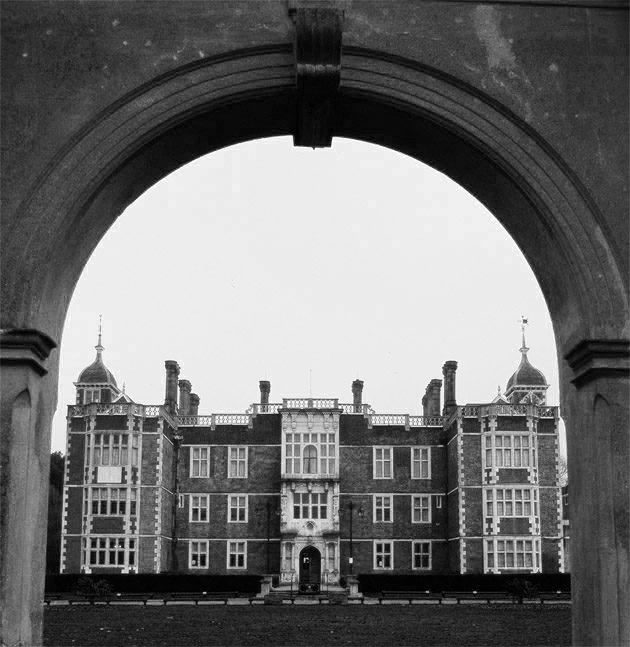
Charlton House. Photo © David Secombe 2010.
Charles Jennings writes:
Nowadays just another stop on the railway line, a part of the sprawl of outer London, Charlton has, to its great and inexplicable glory, one of the most stunning pieces of Jacobean architecture in the whole country. This is Charlton House, dating from 1607 and built for Adam Newton, tutor to Prince Henry, James I’s eldest son and heir to the throne. It is the most wonderful building, made all more wonderful by the drabness of its surroundings.
To get to it from Charlton railway station requires an uninspiring five-minute slog south on Charlton Church Lane before you reach the brow of the hill: a redbrick church – St. Luke’s – on the left, ranks of flats on the right and in the centre, hemmed in by a car park and a stretch of lawn, a fabulous dark red brick Jacobean mansion, decorated with white stone quoins and dressings, and with a great wedding cake frontispiece, involving a huge bay window and the main entrance porch. Sir Niklaus Pevsner claimed that Charlton House contained ‘the most exuberant and undisciplined ornament in all England’; while Ian Nairn drew a metaphor – aptly enough – from Jacobean melodrama, seeing the building as ‘Sinister poetry: the Duchess of Malfi in SE7′. John Evelyn, writing fifty years after the house was built, described the view from the house as ‘one of the most noble in the world, for city, river, ships, meadows, hill, woods and all other amenities’.
David Secombe:
At the end of Lights Out for the Territory, Iain Sinclair’s epic psychogeographical trek across London, the author visits Charlton House and ruminates upon its brooding presence and desirability as a residence for an aristocratic version of himself. Psychogeography is a much-derided concept, and it has been derided in these pages more than once (most recently by Andrew Martin earlier this week), but Charlton House is the kind of place which makes one wonder whether there might be something in it. It just seems monumentally wrong. In the midst of the anonymous south London sprawl it is spectacularly incongruous, but it isn’t just that (in fact, Charlton is the only London village where all the traditional elements remain visibly intact: the big house, the green, the church, the village). There is something else going on.
I once made a short film in which Charlton House featured as the main location. The film was a sort of parody of the English ghost story tradition, three men holding a night-time vigil in the Long Gallery of the House in the hope of seeing ‘something’. When being shown round the building during a recce, we ascended to the Long Gallery in a conspicuously modern elevator. I expressed my surprise at such an unexpected convenience, and was told that when the lift was being installed workmen discovered the body of an adolescent boy walled up behind one of the fireplaces. How long it had been there, no-one could say.


 The London Column