Royal Hospital, Chelsea. Photo & text: John Londei.
Posted: November 11, 2011 Filed under: Anniversaries, Hospitals, London Types, Wartime London | Tags: 11th hour of the 11th day of the 11th month, Armistice Day, Chelsea Pensioners, lest we forget Comments Off on Royal Hospital, Chelsea. Photo & text: John Londei.
© John Londei 1998.
John Londei writes:
This photograph features Chelsea Pensioners – or ‘Gentlemen’ to give them their correct title – and was taken in the Chapel of the Royal Hospital Chelsea in 1998 to mark the 80th anniversary of the Armistice that, on the “eleventh hour of the eleventh day of the eleventh month”, brought the First World War to an end.
Charles II founded the Royal Hospital in 1681. Sir Christopher Wren was commissioned to design and erect the building. The painting of the Resurrection on the domed ceiling of the Chapel, by the Italian artist Sebastiano Ricci, dates from 1714 and it’s believed to be a donation from Queen Anne. Back then compulsory services were held twice daily in the Chapel.
Seventeen of the Gentlemen in the shot were jokingly called ‘The Spice Boys’ because they always volunteered for such events. Nine days earlier they’d taken part in the Lord Mayor of London’s annual parade appearing on a float depicting The Royal Hospital’s history. But for me the real ‘star’ of this photo was Albert Alexandre, the last veteran of the First World War still resident at the Royal Hospital [the centre row of floor squares point directly to him sitting in the 1st row].
Albert was born in Jersey. Both his parents died when he was six, and he went to live in an orphanage. In 1917 Albert, who looked older than his years, lied about his age (he was 15) and enlisted in the Guernsey Light Infantry. He saw action at Passchendaele, outstanding among the battles of the war not only for its cost in life and limb (almost half a million allied casualties), but also for the weather. In the heaviest rain for 30 years, men, horses and pack mules drowned in the deep shell holes caused by constant bombardment. He witnessed men being blown to pieces all around him, and took part in hand-to-hand fighting. A phrase from one of Siegfried Sassoon’s poems sums it up: ”I died in hell – They called it Passchendaele”.
Albert was discharged in 1919, but re-enlisted into the Royal Garrison Artillery serving in India during World War Two. When Alfred’s wife died in 1992 he moved to the Royal Hospital where he remained until his death in January 2002 aged 100.
A large framed print of this sitting now hangs in the Gentlemen’s Ward at the Royal Hospital. With the passing of time that print, like those old soldiers therein, will just fade away…
© John Londei 2011.
Washday. Photo John Londei, text Joanna Blachnio.
Posted: November 4, 2011 Filed under: Fictional London, London Types | Tags: Joanna Blachnio, John Londei, Leather Lane Comments Off on Washday. Photo John Londei, text Joanna Blachnio.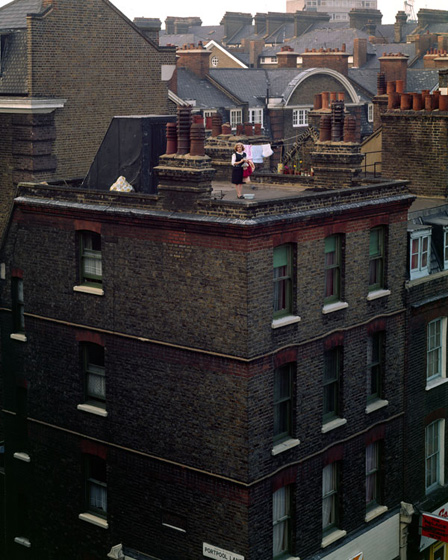
Portpool Lane & Leather Lane. © John Londei.
One – Two – Three by Joanna Blachnio:
One person can’t do it all, I said to my neighbour, Mrs Carlton, the other day. You mustn’t let them rely on you so much, I said, a husband and two grown boys can lend a hand around the house once in a while. My John, he doesn’t shy away from housework, only today he is still sleeping in after the pub.
I always wanted to have three kids. It was a trial when they were small – the whole lot born in less than five years. Mike drives the bus, Katie helps her husband in the shop, and Jenny, my youngest, is still at school. It’s her that comes up here most, even though she doesn’t do as much washing. She wants to be an astronomer. She took me with her one night and explained about the stars, but I couldn’t see half of them. I said to her, what’s the point of looking at them here in the city, with the streetlights and all? Anyway, I prefer it here by day. There’s always so much going on under those roofs across the road. They’re just roofs, like ours, but they look pretty today. You don’t get this kind of light at any other time of the year. You can tell autumn is coming – before long it’ll be too cold to put the washing outside.
Mrs Carlton lives across the road, just there. What would she do if I appeared now, out of the blue – out of the blue sky? It’s always ‘Mrs Carlton’: I’ve been here over twenty years, but close friends I haven’t made. It’s all fine, you talk and talk about the things you like, and suddenly the other person gives you this look. And there it stops, and never goes further. I do have the flowers, though. John says they’re just weeds, getting in the way of our veg, but I always look out for them. Last year the cold came early, and they didn’t appear at all – and now I’ve got three.
There’s Mrs Carlton bustling about the kitchen. I wonder what she’s thinking seeing me hang out my washing in that dress. There was only one like that in the shop, my size, and like tailor-made for me. I looked inside the purse: one – two – and that was all; so for a month I saved a bit of money, bought less food for myself, switched the lights off whenever I could – and when I came back to the shop, my dress was still there! I don’t know why I put it on this morning. It seemed different – everyone asleep or gone, and the house so quiet.
This air, you could swim in this air. I don’t really like washing. Cooking, cleaning, I don’t mind, but washing I’ve never cared for. Except we’ve got the new lines. I bought them only last week, and John put them up here. They’re so smooth, but solid, too. You could almost stand on them. Drop the bag of clips, leave the duvets – sitting in the basin for a little while longer won’t do them harm – prop yourself up, then stand. Now, first one foot, then the other. As long as you get through the first step, you can walk to the other end, and then – who knows?
I know it’s only a washing line. So what?
… for The London Column. © Joanna Blachnio 2011.
Dmitri Kasterine. Text: Joanna Blachnio. (5/5)
Posted: October 28, 2011 Filed under: London Labour, London Types, Markets, Street Portraits Comments Off on Dmitri Kasterine. Text: Joanna Blachnio. (5/5)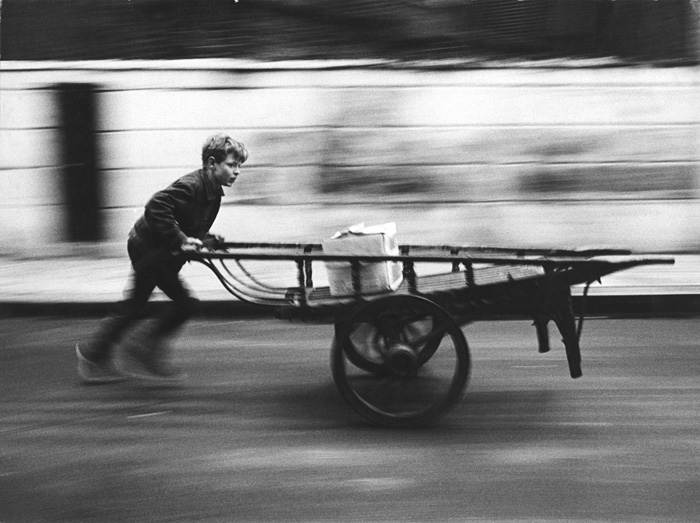
Barrow boy, World’s End, 1963. © Dmitri Kasterine.
Joanna Blachnio writes:
And then he forgets. Clearly. The formula for the circumference of the circle and the length of the arch. How to calculate mass, and how to express vacuum in numbers. He forgets the latchkey, warming slowly in his pocket, the water gathered by one of his wingless shoes. He forgets the order of notes on the musical scale. Even that game of marbles, shamefully lost to Jimmy Croghan. He forgets how mist comes into being – and it rises, contrary to experience, from the ground, spreading sideways. And envelops all except his face.
… for The London Column. © Joanna Blachnio 2011.
Dmitri Kasterine. Text: Tim Turnbull. (4/5)
Posted: October 27, 2011 Filed under: Literary London, London Types, Sartorial, Transport | Tags: London cabbies, The Knowledge, Tim Turnbull Comments Off on Dmitri Kasterine. Text: Tim Turnbull. (4/5)

Hailing a cab, Mayfair, 1965. © Dmitri Kasterine.
Black Cab Blues by Tim Turnbull:
All Hail! All Hail! the cabbies of London,
who are rammed to the gunwales with Knowledge;
so stuffed to the gills with it that it would turn
any lesser bloke’s brains into porridge.
Wave! Wave your brolly! and preen there bespokely,
the cut of your coat won’t persuade them to stop;
they do if they want, and for that reason only –
they’re nothing if not democratic, Old Cock.
Hark! O Hark! to their myriad opinions
but don’t venture yours, they’re never impressed –
you’re not in chambers, they’re not your minions
and so, for all your rhetorical prowess,
you’re bleeding mistaken if you think they might
go sarf uther river at this time o’night.
… for The London Column. © Tim Turnbull 2011.


 The London Column