London Perceived. Text: V.S. Pritchett, photos Evelyn Hofer (2/5)
Posted: July 26, 2011 Filed under: London Types, Pubs | Tags: Evelyn Hofer, London Perceived, The Salisbury, V.S. Pritchett Comments Off on London Perceived. Text: V.S. Pritchett, photos Evelyn Hofer (2/5)
The Salisbury, St. Martin’s Lane, 1962. © Estate of Evelyn Hofer.
V.S. Pritchett, writing in London Perceived*, 1962:
The square is our characteristic alternative to the grande place or the piazza. There are no central places, foreigners complain, where “Londoners meet” or stroll along together to pass the time of day. The answer to that is, first, that Lononders do not meet, do not gather, and reject the peculiar notion that people like “running across each other” in public places. They emphatically do not. We are full of clubs, pubs, cliques, coteries, sets, although the influence of mass life are changing us so that even the London public house is becoming public. But most pubs are still divided into bars, screened and provided with quiet mahogany corners where the like-minded can protect themselves against those of different mind. And – one must admit – with different purses.
Clearly, between the saloon bar and the public bar there is, or was, a class division; nowadays, the public bar is where men play darts. In the public bar, there being the thirsty tradition of manual work, you drink your beer by the pint; in the saloon, in the private, you drink it in half-pints; occasionally there is a ladies’ bar, and there ladies – always in need of fortifying, for they have been on their “poor feet” – commonly order stout or “take” a little gin in a refined medicinal way. The pubs catering for the Irish are rather different; the Irish like to swarm in public melancholy, their ideal being, I suppose, a tiled bar resembling a public lavatory a mile long, and with barmen who, as they draw your draught stout, keep an eye on you, show their muscles, and tacitly offer to throw you out by collar and shirt-tail. This is not the London English fashion, which is livelier, yet more judicious, sentimental and moralizing. The London publican cultivates a note of moneyed despondency and the art of avoiding “argument” by discussing the weather. One foggy, snowy morning in a pub in Lamb’s Conduit Street, near Gray’s Inn, I hear a customer mention the cold and the snow, and, in doing this, he was simply repeating what every customer had said as he came in.
“Couple of cases of sunstroke in the Feobal’s Road, I hear” said the poker-faced old Weller behind the bar – belonging to that generation of Cockneys who pronounced a “th” as an “f” and were averse to a final “d”. He spoke in the gravelly voice of one about to “cut his bloody froat”.
There are pubs where the same people always meet, where they tell the same stories, where they glance up at the changing London sky and sink into mournful happiness or fatten and redden with natural bawdy – I do not mean dirty – stories but with licence of their own invention. One is reminded that this is the city of the riper passages of Shakespeare and the sexy London papers. London is not puritan; it is respectable – quite another matter. Behind the respectability is the sentimental and fleshly riot. If they can be sure that they are among “a few pals, the male and female Londoners like to abandon themselves. The whited sepulchres turn rosy, the tongues wag, even raucously sing, and the ladies come out with quiet remarks that are surprising. There is a touch of “Knees up, Mother Brown” in all of them; in London, Eros is a shade hearty, and what is elsewhere called passion, in London is called being “friendly”. Friendliness is, of course, double-edged , for it suggests that some would-be friends must be kept out. A little scene I once observed at the bar of the Edinburgh Castle, in Camden Town – the Bob Cratchit country – goes to the heart of this aspect of London manners. A middle-aged couple were having a friendly talk, and an old man, suffering from city loneliness, occasionally “passed a remark” – always an offence – hoping to join in. The lady reached for her large handbag – an emblem of respectability – and took out a pound note – a sign of grandeur – put it on the counter and called to te old man in a “friendly” voice:
“Have a drink. Say ‘No thank you’; I always say ‘No, thank you’ when a stranger offers me a drink.”
And she put her pound note back in her bag, closed it with a slow snap, and, swollen with savoir-faire in the art of “friendliness” she resumed her private conversation. The Londoner know how to finish things without being, as the saying is, “nasty”. One had witnessed a death, of course.
* © 1962 and renewed 1990 by V.S. Pritchett. Used by permission of David R. Godine, Publisher, Inc.
[Special thanks in assembling this week’s feature are due to: Jim McKinniss; Mark Giorgione of the Rose Gallery in Santa Monica, California; Andreas Pauly at the Hofer Estate; and Carl Scarbrough at David Godine.D.S.]
London Perceived. Text V.S. Pritchett, photos Evelyn Hofer (1/5)
Posted: July 25, 2011 Filed under: Clubs, Eating places, Literary London, London Types | Tags: Evelyn Hofer, Garrick Club, London Perceived, V.S. Pritchett 1 Comment
Head waiter, Garrick Club, 1962. Photo © Estate of Evelyn Hofer
V.S. Pritchett writing in London Perceived*, 1962:
And what happens in square and pubs goes on in clubs, all the thousands of drinking clubs, the luncheon clubs, the dining clubs, the sporting clubs, the dance clubs, to the great clubs around Pall Mall and St. James’s. You are a Londoner, ergo you are a member. You are proposed and seconded; that done, you are among a few friends; you have your home from home. In none of these clubs is any utility of purpose frankly admitted. It is true that Bishops and Fellows of the Royal Society gather at the Atheneaeum; actors, publishers, and the law at the Garrick; the aristocracy and the top politicians at Boodle’s, White’s, or Brooks’s; that, following Stevenson and Kipling, a lot of bookish, professorial and civil wits are at the Savile, and professional eminences at the Reform, where Henry James had a bedroom with a spy hole cut in the door so that the servant could see whether the master was sleeping and refrain from disturbing him. (The hole is still there.)
Clubs change. London is made for males and its clubs for males who prefer armchairs to women. The great clubs are in difficulties. Their heyday was the Victorian age, when men did not go home early in the evenings; now at night they are empty of all but a few bachelors, sitting in the drying leather chairs. Some clubs have tried allowing ladies to dine in the evening, but the ladies, after the first riush of curiosity, in which they hoped to find out what happy vices their men were comfortably practising there, tend to be appalled by these mausoleums of inactive masculinity, even when they are elegant, and tend to be depressed by the gravy-coloured portraits on the walls. The architecture, gratifying to male self-esteem, does nothing for the sex, and the boredom that hangs like old cigar smoke in the air is a sad reminder of the most puzzling thing in the sex war: that men lie each other, rather as dogs like each other. The food is dull, but a point that the ladies overlook is that the wine is excellent and cheap.
How did this taste for clubs begin? Did it start with the witenagemot or the monasteries? Did it sprout from the guilds – for what are the Drapers’, the Fishmongers’, the Armourers’, the Watermens’, the Grocers’ companies, with their medieveal robes and seremonies, but medieval guilds turned into clubs for the Annual Dinner? The clubs start, as the whole of visible London does, except the Tower and Westminster Abbey, St. Bartholomew and the Elizabethan buildings in Staple Inn – the clubs start with the greatest of all london inventions: modern mercantile capitalism. They began with the coffee houses in the City. “We now use the word ‘club'”, Pepys wrote, “for a sodality in a tavern”. Lloyds was a coffee house, the place where one could read a paper and hear the news, and the more one sat about there, the more one heard. They were often started by servants – the most domineering of men – by the race of Jeeves, for the Woosters, the masters of the world; fashionable clubs like Boodle’s, Brooks’s, White’s take their names form the servants who founded them. The idea has the ease of Nature, and it is only in the nineteenth century, when industrial wealth came in, that clubs like the Public Schools, became outwardly pretentious and expensive.
* © 1962 and renewed 1990 by V.S. Pritchett. Used by permission of David R. Godine, Publisher, Inc.
[Special thanks in assembling this week’s feature are due to: Jim McKinniss; Mark Giorgione of the Rose Gallery in Santa Monica, California; Andreas Pauly at the Hofer Estate; and Carl Scarbrough at David Godine. D.S.]
Days and Nights in W12. Photographs and text: Jack Robinson (1/4)
Posted: June 29, 2011 Filed under: Amusements, Interiors, London Types | Tags: CB Editions, massage parlour, Shepherd's Bush, W12 Comments Off on Days and Nights in W12. Photographs and text: Jack Robinson (1/4)
Massage parlour: Askew Road, W12, 2010. Photo: © Jack Robinson.
From Days and Nights in W12* by Jack Robinson:
MASSAGE PARLOUR
Extras? You mean, as in ‘other services offered’? She runs through a menu of the day’s specials and when they say the prices seem a bit expensive she says so is philosophy, which is what she is studying, and it’s especially expensive for foreign students and why do they think she’s working here, for the fun of it? Some of them ask her what’s wrong with a bit of fun, missing the point completely. Some of them make a joke of it, asking how much for the meaning of life. (A lot, she says; more than you can afford, little man.) Some of them suggest she should be studying economics, or at least taking a joint degree, and point out that if she charged less she might get more takers. They have a point, she admits; but she is proud of her philosophy essays and her tutor says she has a natural gift and she knows what she’s worth.
© Jack Robinson 2011.
*CB Editions, 2010
Deep South London. Photos & text David Secombe (5/5)
Posted: June 18, 2011 Filed under: London Types | Tags: 20000 streets under the sky, London's Deep South, South London Comments Off on Deep South London. Photos & text David Secombe (5/5)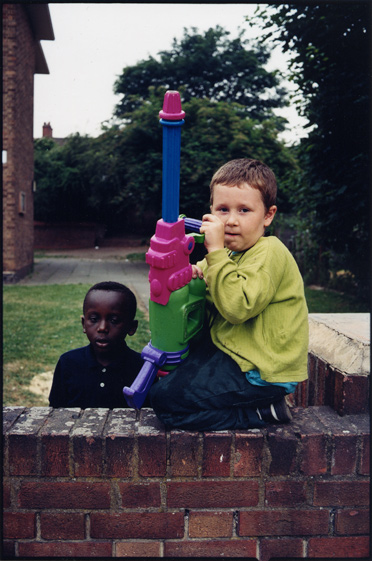
New Cross, SE14, 1999. Photo © David Secombe
In the South
Abandoned power stations, allotments, back gardens, badly painted public art, big sheds, Blow Up, bored au pairs, breakers’ yards, broken tumble dryer, cheap calls to Nigeria, dead riverside industry, evangelical church services, executive developments, failing schools, failing shopping precincts, forbidding pubs, half-decent football clubs, kebab shops, lock-up garages, mangy foxes, municipal parks, neglected cemeteries, prefabs, railway embankments, rats like cats, roadside shrines, second-hand shops, short-lived grand schemes, stranded Victorian villas, strangely-located nightclubs, tandoori restaurants, tattoo parlours, Turkish men’s clubs, tyre sitters, vandalised youth centres, wind off the Thames, 20,000 streets under the sky.
… for The London Column. © David Secombe 2011.


 The London Column