Dmitri Kasterine. Text: Joanna Blachnio. (5/5)
Posted: October 28, 2011 Filed under: London Labour, London Types, Markets, Street Portraits Comments Off on Dmitri Kasterine. Text: Joanna Blachnio. (5/5)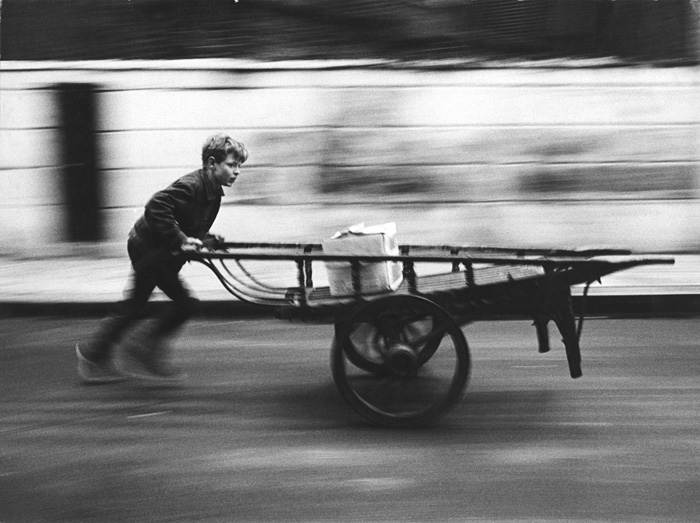
Barrow boy, World’s End, 1963. © Dmitri Kasterine.
Joanna Blachnio writes:
And then he forgets. Clearly. The formula for the circumference of the circle and the length of the arch. How to calculate mass, and how to express vacuum in numbers. He forgets the latchkey, warming slowly in his pocket, the water gathered by one of his wingless shoes. He forgets the order of notes on the musical scale. Even that game of marbles, shamefully lost to Jimmy Croghan. He forgets how mist comes into being – and it rises, contrary to experience, from the ground, spreading sideways. And envelops all except his face.
… for The London Column. © Joanna Blachnio 2011.
Drinker’s London. Photos Paul Barkshire, text David Secombe. (5/5)
Posted: October 23, 2011 Filed under: London on film, London Places, Markets, Pubs | Tags: 'Lovely! Lovely!', Barry Foster, covent garden, Frenzy, Hitchcock, Paul Barkshire, The Cross Keys 1 Comment Cross Keys, Endell Street, Holborn, 1980. Photo © Paul Barkshire.
According to Paul Barkshire’s caption, this much-loved pub is situated in Holborn; this might be technically true, but Endell Street is more commonly associated with Covent Garden, and the porters’ barrows outside the pub suggest the vegetable market which once dominated the whole area. The fruit and veg moved to Nine Elms in 1974, and in the year this picture was taken the retail fun park familiar to Londoners today opened on the site of the defunct market. Inigo Jones’ gracious 17th Century Piazza – threatened with wholesale redevelopment as recently as the early 1970s – was retained at the cost of its enshrinement as the heart of a remorselessly consumerist zone, much to the dismay of residents who had campaigned so hard for the area’s preservation.
We should be grateful that the area was not flattened, or London would now be saddled with something like ‘Forum des Halles’ in Paris, a deadening, subterranean 1970s shopping arcade where once flourished Les Halles, ‘the belly of Paris’, the city’s market since the middle ages. Les Halles was unceremoniously eviscerated in 1971, the same year Alfred Hitchcock filmed his lurid – and anachronistic – serial killer thriller Frenzy in Covent Garden. Looking at the film now, so much is wrong and fantastically dated, but the location shooting in the market was for real: despite its flaws, it manages to capture an environment that now seems as distant as the coaching inns of Dickens’ youth. Barry Foster may strangle Barbara Leigh-Hunt with an old school tie, (Foster’s unwanted catchphrase “Lovely! Lovely!” – was chanted at him ever after by drunks of all stripes) but the ambience of the market is as vivid as the muscat grapes he gives to Jon Finch.
The Cross Keys was slightly off my own map when I was a regular drinker in WC2 – the Opera Tavern on Catherine Street and the Coach and Horses on Wellington Street were more convenient. But those pubs have been made over into anonymous, tourist-service outlets that might be anywhere. Luckily, the Cross Keys is largely unchanged since Paul Barkshire photographed it thirty+ years ago (although the foliage is more exuberant these days) and remains a very charming spot to lose an afternoon. I am intrigued by the gent looking out of the window: is he waiting for a delivery? A visitor? Inspiration? And those barrows look a bit like props. Maybe he’s waiting for the shade of Hitchcock to shout ‘Action!’ D.S.
Spitalfields Revisited. Photo: Paul Barkshire, text David Secombe.
Posted: October 14, 2011 Filed under: Churches, Literary London, Markets | Tags: east end, Paul Barkshire, Silk merchants, Spitalfields Market, Vanished London Comments Off on Spitalfields Revisited. Photo: Paul Barkshire, text David Secombe.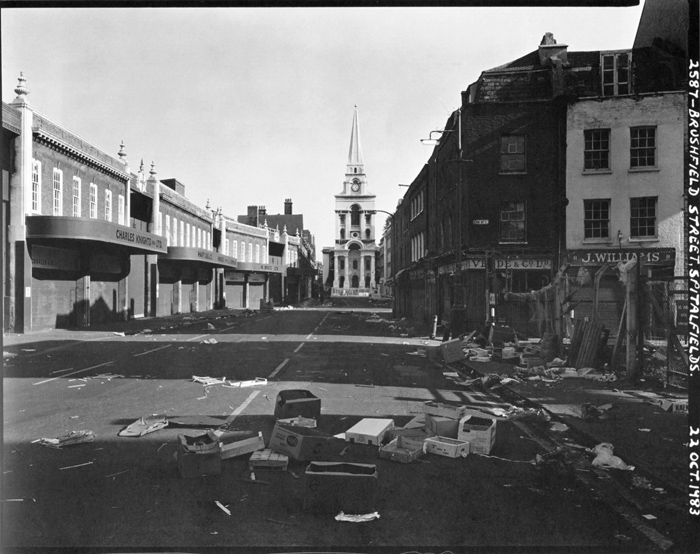
Spitalfields Market, 1983. Photo © Paul Barkshire.
Further to yesterday’s post on the vanishing East End, here is Paul Barkshire’s noble ’80s study of this now-transformed landscape. Despite the changes wrought since, Spitalfields remains one of the few areas left where one can get a sense of the London of popular imagination. Dickens knew these streets. London’s horror of its past (and Dickens would probably have been in favour of razing Spitalfields altogether) has been replaced by gentrification, which in the case of this quarter, marks the eventual success of the property speculators who built fine houses for prosperous silk weavers in the early 18th century.
We will be offering more of Paul Barkshire’s London shortly … D.S.


 The London Column