Halloween. Photo: David Secombe, text: Andrew Martin.
Posted: October 31, 2012 Filed under: Anniversaries, Churches, Funereal, Gargoyles, Interiors, Monumental, Out Of Town, Public Art | Tags: Chaldon Church, demon, ladder of salvation, Purgatory and Hell, Trick or Treat 2 Comments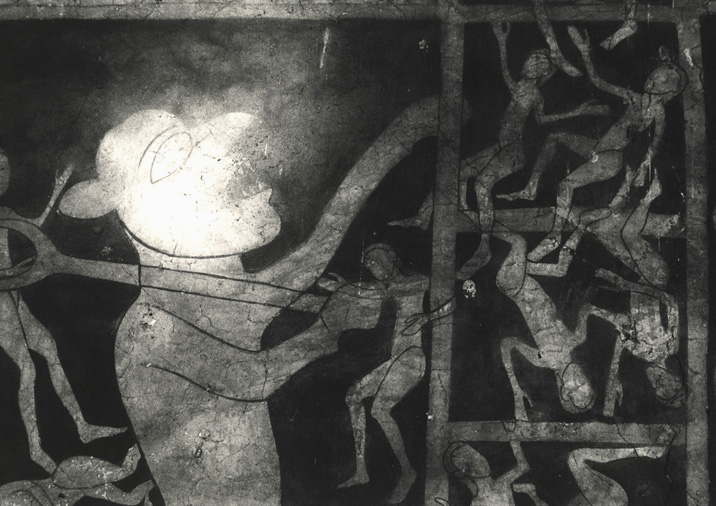
Mural, Chaldon Church, Surrey. Photo © David Secombe, 1989.
Halloween
When I was a boy, Halloween was a shadowy, elusive affair; the occasional carved pumpkin glowing in a window; the occasional fleeting glimpse of a reveller skipping away in a witch’s hat – usually some person you didn’t know and had never seen before. As a festival, it was upstaged by Bonfire Night, and I was frustrated by Halloween in those days. There was nothing you could buy, or be given in connection with it. Today, there is a great deal you can buy, as a result of the promotion of Trick or Treat, by which Halloween has eclipsed Bonfire Night and ghostliness has given way to mock horror. In the weeks before Halloween, Asda stores offer, amid a landslide of plastic tat; the Asda Squeezy Eyeball, the Asda Rat, the Asda Inflatable Coffin, the Child Grim Reaper Outfit (‘one size fits all’), the Adult Grim Reaper Outfit, the Inflatable Pumpkin Cooler (not for cooling pumpkins, you understand), the Skull Martini Shaker.
Asda is American-owned, and Trick or Treat came to us from America. The British folklorist Doc Rowe, believes that the Trick or Treat contagion began with a programme broadcast on BBC2 in the early ’70s as part of a documentary strand called Look Stranger. It depicted life on the American airbase in Woodbridge, Suffolk, and showed the children trick-or-treating. ‘Within two years,’ Doc Rowe told me, ‘all the tabloids were running features on how to dress up for the occasion.’ But his point is that this was merely the re-introduction into this country of a tradition rooted in psychology.
It helps to think of both Halloween and Bonfire Night as outgrowths of the Celtic celebration called Samhain, which marked the turning of their year and the beginning of winter. Samhain was associated with the lighting of fires to honour the dead, and defy malevolent spirits. The medieval church both denounced the festivals as diabolic and sought to appropriate aspects of them in the shape of All Saints Day on November 1st (on which the sanctified are honoured), and All Souls Day on November 2nd (a more democratic honouring of all Christian souls). According to Doc Rowe, ‘By tarring Halloween with an occult brush, by caricaturing it that way, the church made it an occult event.’ But while the original Halloween might not have been thoroughgoingly sinister, it did incorporate games and rituals of licensed naughtiness. All Souls Day, for example, was associated with Soul Caking, wherein poor Christians would say prayers for the departed relations of wealthier ones in return for food – and you can see how there might have been trouble if the rich didn’t play along.
It is likely that these traditions, these precursors of Trick or Treat, were taken to America by Scottish and Irish emigrants of the mid-nineteenth century … so the Asda Inflatable Coffin is actually our fault. But Doc Rowe believes these customs are ineradicable in any case. ‘The more you suppress these things, the greater they become.’ Apart from the Church, he identifies the main suppressors as ‘the health and safety camp’. I know what he means, and I wonder how long it will be before the words ‘high visibility vest’ come up in a ghost story.
… from Ghoul Britannia, published by Short Books. © Andrew Martin 2009.
David Secombe:
Chaldon Church is a tiny and ancient (11th Century) church tucked away in an unnervingly isolated hillside location about a mile north of the junction of the M23 and the ‘Magic Roundabout’ (a.k.a. the M25, London’s present-day Roman Wall). The church is famous for its terrifying medieval wall painting, described by Exploring Surrey’s Past thus: ‘The mural on the west wall of Chaldon church is one of the earliest known English wall paintings – it dates from about 1200 and is without equal in any other part of Europe. It is thought to have been painted by a travelling artist-monk. The picture depicts the ‘Ladder of Salvation of the Human Soul’ together with ‘Purgatory and Hell’. Wall paintings of this kind were intended as a visual aid to religious teaching. The whole picture is in the form of a cross, formed by the Ladder and the horizontal division between Heaven and Hell.’ No photo can adequately convey the power of this mural, or the sense of unease I experienced whilst photographing it on a bleak, windswept afternoon 20+ years ago.The medieval imagination retains its capacity to disturb; and the thrum of traffic from the nearby motorways seemed very distant indeed.
See also: The Avoided House.
London Gothic. Photo: David Secombe, text: Charles Jennings & David Secombe (5/5)
Posted: July 6, 2012 Filed under: Architectural, London on film, London Places, Monumental | Tags: Charlton House, Iain Sinclair, Ian Nairn, John Evelyn, walled-up corpse Comments Off on London Gothic. Photo: David Secombe, text: Charles Jennings & David Secombe (5/5)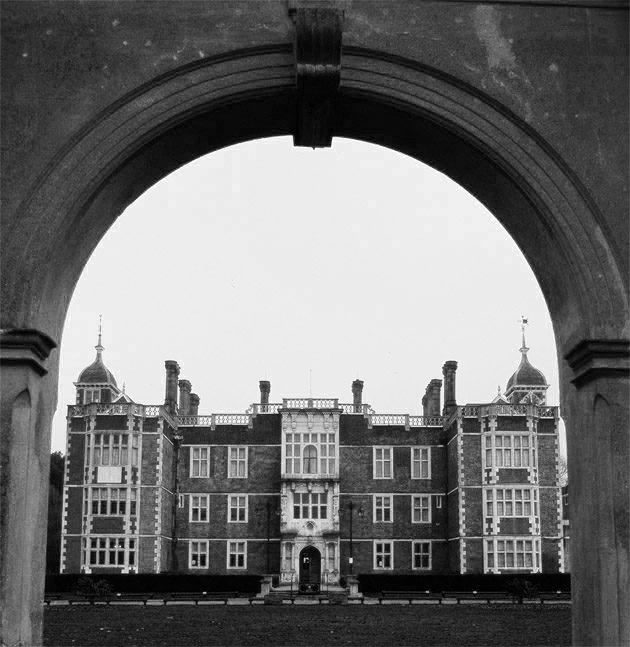
Charlton House. Photo © David Secombe 2010.
Charles Jennings writes:
Nowadays just another stop on the railway line, a part of the sprawl of outer London, Charlton has, to its great and inexplicable glory, one of the most stunning pieces of Jacobean architecture in the whole country. This is Charlton House, dating from 1607 and built for Adam Newton, tutor to Prince Henry, James I’s eldest son and heir to the throne. It is the most wonderful building, made all more wonderful by the drabness of its surroundings.
To get to it from Charlton railway station requires an uninspiring five-minute slog south on Charlton Church Lane before you reach the brow of the hill: a redbrick church – St. Luke’s – on the left, ranks of flats on the right and in the centre, hemmed in by a car park and a stretch of lawn, a fabulous dark red brick Jacobean mansion, decorated with white stone quoins and dressings, and with a great wedding cake frontispiece, involving a huge bay window and the main entrance porch. Sir Niklaus Pevsner claimed that Charlton House contained ‘the most exuberant and undisciplined ornament in all England’; while Ian Nairn drew a metaphor – aptly enough – from Jacobean melodrama, seeing the building as ‘Sinister poetry: the Duchess of Malfi in SE7′. John Evelyn, writing fifty years after the house was built, described the view from the house as ‘one of the most noble in the world, for city, river, ships, meadows, hill, woods and all other amenities’.
David Secombe:
At the end of Lights Out for the Territory, Iain Sinclair’s epic psychogeographical trek across London, the author visits Charlton House and ruminates upon its brooding presence and desirability as a residence for an aristocratic version of himself. Psychogeography is a much-derided concept, and it has been derided in these pages more than once (most recently by Andrew Martin earlier this week), but Charlton House is the kind of place which makes one wonder whether there might be something in it. It just seems monumentally wrong. In the midst of the anonymous south London sprawl it is spectacularly incongruous, but it isn’t just that (in fact, Charlton is the only London village where all the traditional elements remain visibly intact: the big house, the green, the church, the village). There is something else going on.
I once made a short film in which Charlton House featured as the main location. The film was a sort of parody of the English ghost story tradition, three men holding a night-time vigil in the Long Gallery of the House in the hope of seeing ‘something’. When being shown round the building during a recce, we ascended to the Long Gallery in a conspicuously modern elevator. I expressed my surprise at such an unexpected convenience, and was told that when the lift was being installed workmen discovered the body of an adolescent boy walled up behind one of the fireplaces. How long it had been there, no-one could say.
The London Nobody Knows – revisited. Photos & text: David Secombe. (2/4)
Posted: June 20, 2012 Filed under: Architectural, Churches, Fictional London, Monumental | Tags: Alan Moore, Eye of Horus, Geoffrey Fletcher, Hawksmoor, Ian Sinclair, limehouse, Nicholas Hawksmoor, Peter Ackroyd, The London Nobody Knows Comments Off on The London Nobody Knows – revisited. Photos & text: David Secombe. (2/4)
St. Anne’s, Limehouse. Photo © David Secombe 2010.
From The London Nobody Knows, Geoffrey Fletcher, 1962:
St. Anne’s, Limehouse, was built by Hawksmoor, 1712-30, one of his three churches in the East End which alone make a worthwhile pilgrimage: the other two are St. George in the East and Christ Church, Spitalfields. All were begun within a few years of each other. As early as the 1730s, overcrowding had become a characteristic of the East End, a process accelerated in the early 19th century by the building of the docks between 1800 and 1830, the demand for unskilled labour, and the arrival of Jews and other refugees from Eastern Europe. These three churches were built as necessities, but there is nothing utilitarian about them. Their originality continues to surprise us. Hawksmoor’s architecture, imbued with Baroque rhythms, is massive yet solid, like Johnson’s prose. Characteristic of how little we really value them is the fact that, at time of writing, Christ Church, Spitalfields, is under threat of demolition, though thousands of pounds are uselessly thrown away in every conceivable direction.
David Secombe:
Christ Church, Spitalfields, was not demolished and has in recent years been the beneficiary of grants to restore the fabric of the building after decades of neglect. Hawksmoor’s six London churches have experienced a revival in general, and have become talismans for those who seek to pursue a hidden or mystical history of the city. Peter Ackroyd’s 1985 novel Hawksmoor elaborates upon ideas proposed by Ian Sinclair that Hawksmoor’s churches map an Eye of Horus upon the capital, whilst Alan Moore’s graphic novel From Hell links the Jack the Ripper murders to the looming presence of Christ Church over Whitechapel. Psychogeography aside, the massiveness and intensity of Hawksmoor’s designs have a slightly forbidding quality– and his monumental East End churches must have appeared anomalous and strange to those living in the surrounding Georgian and Victorian slums. In the 21st century, however, Christ Church looks anomalous for a different reason: the deadly corporatised make-over of Spitalfields market has transformed the area into Covent Garden East, and Hawksmoor’s magnificent creation now looms over a retail theme park safe for hipsters and their friends.
… for The London Column.
London Monumental. Photo & text: David Secombe (3/5)
Posted: September 7, 2011 Filed under: Bohemian London, Monumental | Tags: 55 Broadway, Jacob Epstein Comments Off on London Monumental. Photo & text: David Secombe (3/5)
Night by Jacob Epstein, 55 Broadway, Westminster. Photo © David Secombe 2011.
55 Broadway was built in the late 1920s to house the headquarters of the Underground Electric Railways of London, which later became London Underground. Fittingly, the edifice looms above St. James’s Park tube station, and the shopping mall at ticket hall level still contains much delightful Deco detailing. The building was designed by Charles Holden, who also designed the University of London’s Senate House in Bloomsbury. The building is further distinguished by the presence of sculptures and reliefs commissioned from some of Britain’s leading sculptors of the time, including the ‘big three’: Eric Gill, Henry Moore and Jacob Epstein.
Epstein carved his two contributions – Day and Night – directly into the Portland stone of no. 55. Predictably, Epstein’s brand of modernism went down badly and the male nudity of Day proved particularly controversial. There was a typically British outcry in the popular press, and Frank Pick, head of the Underground at the time, resigned over the affair. Epstein was eventually forced to shorten a penis on one of his figures by one and a half inches, but the furore impacted badly on his career, commissions being in short supply throughout the 1930s.
© David Secombe 2011.


 The London Column