Tom Sharpe.
Posted: June 6, 2013 Filed under: Literary London, Out Of Town | Tags: Porterhouse Blue, Riotous Assembly, The Throwback, Tom Sharpe, Wilt Comments Off on Tom Sharpe.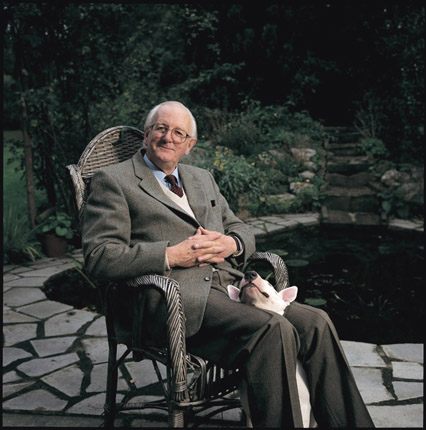
Tom Sharpe, Cambridge, 1992. Photo © David Secombe
Farewell Tom Sharpe … the author of Wilt, Porterhouse Blue, The Throwback, Riotous Assembly, etc. has died at the age of 85.
As an adolescent, I loved Tom Sharpe’s books. In his 1970s pomp, his fierce, majestic and paralysingly funny satires were a cause for great joy, and even made one proud to be British. But it can be a tricky thing to meet your heroes; and driving to Cambridge in the company of a nervous Spanish journalist (on his first ever visit to the UK) to interview the great man, I was fighting off my own attack of nerves. The interview started a bit awkwardly, as my colleague tried a line of questioning about the power of literature, during which he asserted: ‘Madame Bovary changed my life’ – to which Tom replied, ‘Well, you can’t have met that many doctors’ wives’. Things settled down after that, and we ended up going to a local pub – driven there at high speed along wild Fen roads by the author himself – where I finally got my chance to tell him that I thought Chapter 4 of The Throwback was the funniest thing I had ever read.
We discussed contemporary comedy and literature (he wasn’t much impressed), film version of his books (he hated the Smith/Jones version of Wilt but loved Channel 4’s Porterhouse Blue adaptation) and indeed photography, as he had once been a professional photographer and had pleasingly trenchant views on the subject. (When we came to do the photos, he insisted that I use his own tripod for the purpose of making the above picture, as he wasn’t convinced that mine was up to the task.)
The interview was for the Spanish edition of Elle magazine, as Tom had a strong following in Spain, and he eventually went to live there. He ascribed his popularity in Spain to the surrealism Spanish readers found in his books; but his own offering of an example of ‘typically English humour’, as requested on a Spanish TV interview, did not go down too well. He told the story of a troop of Tommies marching to the front line on the Western Front, and an exchange between a young soldier and a sergeant at a posting on the way. ”Ere, Sarge, when do we get to have a rest, been marching all day!’ ‘Don’t worry son, you’ll be dead in half an hour’.
My recollection of the day has a kind of glowing quality: it’s not often you an encounter someone whose work you love and in whom you discover someone who feels like a friend. He struck me much as he appears in the photo above: elegant, droll, mischievous, and as English as a Tudor manor house. We have lost another great one.
… for The London Column.
A Personal History of Indian Cuisine.
Posted: March 14, 2013 Filed under: Eating places, Food, Out Of Town, Tall Tales | Tags: Anglo-Indian cuisine, eating out in london, Indian restaurants in London, suburban dining in London Comments Off on A Personal History of Indian Cuisine.
Tandoori restaurant, Deptford. © David Secombe 2001.
David Secombe:
It is 1975, I am 13 and, like most white British people of my generation, my experience of Indian food is limited to a small, local curry house. Remote, distant Cheam in the remote, distant 1970s offered few opportunities for culinary experiment and a trip to an Indian offered the prospect of an exotic night out. Visits to The Partition of India – or whatever it was called – were made in the company of my two elder siblings; I was taken there with some ceremony by my sister and no ceremony at all by my brother. (I was never taken there by my parents, who were not attracted by its charms.)
The suburban Indian restaurant is one of the cultural phenomena of post-war British life, signifying social change, and a broadening of the scope of what is considered our national cuisine. But the 1970s offers very few excuses for Proustian reverie; even as a teenager I was aware that my local Indian didn’t cut it, as the food was barely adequate and served by staff who seemed either torpid or desperate. I also knew that part of its appeal was its very inability to deliver the experience you were looking for; it confirmed my adolescent conviction that the suburbs were a pale shadow of the real, yet-to-be-discovered world. (Incidentally, the restaurant in question appeared to be popular with adulterers. This was my brother’s theory, and we would giggle at furtive couples in corner booths, whispering as best they could over the sitar tape whilst poking at bits of Bombay Duck. Adulterous or not, these couples were also seeking a dining experience that was clearly not forthcoming.)
By the early 1980s I had arrived in the flesh pots of south London; just a few miles away from provincial Cheam, yet Wandsworth, Clapham and Tooting were home to tempting, ‘authentic’ Indian restaurants which delighted in their specific regionality – Nepalese, Goan, Bengali. Fabled establishments like The Concert for Bangladesh, Midnight’s Children, and Sherpa Tenzing offered dishes worlds away from the generic beige goo I knew from my sheltered youth. But you could still get caught out: during a meal at an unfamiliar establishment in Battersea, circa 1985, an ordinary-looking lamb passanda arrived at my table and, before anyone could say anything, the waiter produced a can of UHT whipped cream and sprayed foam all over it. It was a brilliant comic gesture, but it was supposed to be my dinner. Despite such misadventures, my local dining preference remained the curry house; I bypassed Nouvelle Cuisine and other foodie trends and stayed true to my suburban roots.
The ubiquity of Indian restaurants has generated an urban mythology particular to them. A sudden closure was darkly ascribed to the discovery of a skinned dog in the kitchen. Tales were told of a legendary establishment which offered a Chicken Bastard, a dish so hot that it was not intended to be eaten. ‘Witnesses’ spoke of an unwise party who took the challenge, goading the waiters who brought him his order, forcing it down with Carlsberg as kitchen staff emerged to watch, and of the ambulance that was summoned to take him to A&E. Such stories were clear evidence of cultural antagonism, but my own favourite tall tale is actually quite sweet, and is very possibly true. I knew a pair of Egyptian brothers who were my schoolmates at a boarding school on the outer fringes of London. It was said that at the end of term, they went into Leatherhead, ordered three dinners from the Siege of Delhi, packed them in their luggage (did they order poppadoms?), got a cab to Heathrow, flew to Cairo, and consumed the congealing banquet with their father as a festive, homecoming dinner: the ultimate Indian takeaway.
After decades of enjoying Indian food in almost every postcode within the M25, my love affair with it ended in a way my brother might have predicted. I became romantically involved with someone who remained very slightly married, and our lunchtime venue was a classy Indian in St James’s. The Cawnpore Massacre is one of London’s best restaurants, but its convenience for my beloved made it a kind of hell for me. As the months dragged on, I became all too familiar with the delicacies on offer, and the wonders of its kitchen paled against the looming inevitability of my defeat. To paraphrase Robert Shaw in Jaws, ‘I’ll never order Rhogan Josh again’.
© David Secombe 2013.
Halloween. Photo: David Secombe, text: Andrew Martin.
Posted: October 31, 2012 Filed under: Anniversaries, Churches, Funereal, Gargoyles, Interiors, Monumental, Out Of Town, Public Art | Tags: Chaldon Church, demon, ladder of salvation, Purgatory and Hell, Trick or Treat 2 Comments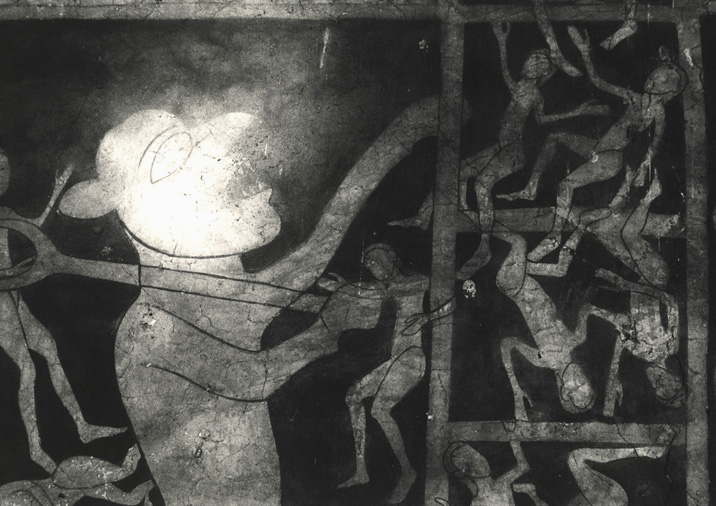
Mural, Chaldon Church, Surrey. Photo © David Secombe, 1989.
Halloween
When I was a boy, Halloween was a shadowy, elusive affair; the occasional carved pumpkin glowing in a window; the occasional fleeting glimpse of a reveller skipping away in a witch’s hat – usually some person you didn’t know and had never seen before. As a festival, it was upstaged by Bonfire Night, and I was frustrated by Halloween in those days. There was nothing you could buy, or be given in connection with it. Today, there is a great deal you can buy, as a result of the promotion of Trick or Treat, by which Halloween has eclipsed Bonfire Night and ghostliness has given way to mock horror. In the weeks before Halloween, Asda stores offer, amid a landslide of plastic tat; the Asda Squeezy Eyeball, the Asda Rat, the Asda Inflatable Coffin, the Child Grim Reaper Outfit (‘one size fits all’), the Adult Grim Reaper Outfit, the Inflatable Pumpkin Cooler (not for cooling pumpkins, you understand), the Skull Martini Shaker.
Asda is American-owned, and Trick or Treat came to us from America. The British folklorist Doc Rowe, believes that the Trick or Treat contagion began with a programme broadcast on BBC2 in the early ’70s as part of a documentary strand called Look Stranger. It depicted life on the American airbase in Woodbridge, Suffolk, and showed the children trick-or-treating. ‘Within two years,’ Doc Rowe told me, ‘all the tabloids were running features on how to dress up for the occasion.’ But his point is that this was merely the re-introduction into this country of a tradition rooted in psychology.
It helps to think of both Halloween and Bonfire Night as outgrowths of the Celtic celebration called Samhain, which marked the turning of their year and the beginning of winter. Samhain was associated with the lighting of fires to honour the dead, and defy malevolent spirits. The medieval church both denounced the festivals as diabolic and sought to appropriate aspects of them in the shape of All Saints Day on November 1st (on which the sanctified are honoured), and All Souls Day on November 2nd (a more democratic honouring of all Christian souls). According to Doc Rowe, ‘By tarring Halloween with an occult brush, by caricaturing it that way, the church made it an occult event.’ But while the original Halloween might not have been thoroughgoingly sinister, it did incorporate games and rituals of licensed naughtiness. All Souls Day, for example, was associated with Soul Caking, wherein poor Christians would say prayers for the departed relations of wealthier ones in return for food – and you can see how there might have been trouble if the rich didn’t play along.
It is likely that these traditions, these precursors of Trick or Treat, were taken to America by Scottish and Irish emigrants of the mid-nineteenth century … so the Asda Inflatable Coffin is actually our fault. But Doc Rowe believes these customs are ineradicable in any case. ‘The more you suppress these things, the greater they become.’ Apart from the Church, he identifies the main suppressors as ‘the health and safety camp’. I know what he means, and I wonder how long it will be before the words ‘high visibility vest’ come up in a ghost story.
… from Ghoul Britannia, published by Short Books. © Andrew Martin 2009.
David Secombe:
Chaldon Church is a tiny and ancient (11th Century) church tucked away in an unnervingly isolated hillside location about a mile north of the junction of the M23 and the ‘Magic Roundabout’ (a.k.a. the M25, London’s present-day Roman Wall). The church is famous for its terrifying medieval wall painting, described by Exploring Surrey’s Past thus: ‘The mural on the west wall of Chaldon church is one of the earliest known English wall paintings – it dates from about 1200 and is without equal in any other part of Europe. It is thought to have been painted by a travelling artist-monk. The picture depicts the ‘Ladder of Salvation of the Human Soul’ together with ‘Purgatory and Hell’. Wall paintings of this kind were intended as a visual aid to religious teaching. The whole picture is in the form of a cross, formed by the Ladder and the horizontal division between Heaven and Hell.’ No photo can adequately convey the power of this mural, or the sense of unease I experienced whilst photographing it on a bleak, windswept afternoon 20+ years ago.The medieval imagination retains its capacity to disturb; and the thrum of traffic from the nearby motorways seemed very distant indeed.
See also: The Avoided House.
Ridgers reminisces. Photo & text: Derek Ridgers (4/5)
Posted: December 1, 2011 Filed under: Out Of Town, Transport | Tags: advertising photography, Mad Men Comments Off on Ridgers reminisces. Photo & text: Derek Ridgers (4/5)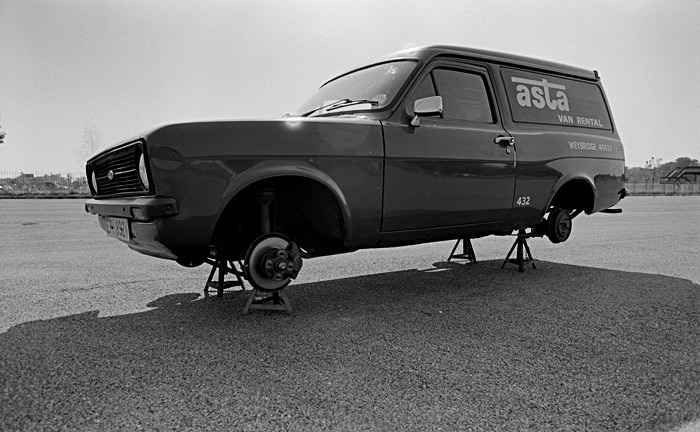
Van without wheels. Feltham, 1981. © Derek Ridgers.
Derek Ridgers writes:
This may look like a van with no wheels but to me it was an epiphany.
I was prostrate, stripped to a pair of shorts in a corner of the car park of Feltham Swimming Baths at the time, so it was an odd position to be seeing the light from. But it was at just about that moment, whilst I was taking that photograph, that I came to realise that I didn’t really want to be doing that sort of thing anymore. By “that sort of thing”, I mean advertising photography. At that moment, I realised that, other than financially, it was never going to amount to a particularly sensible career aspiration for me.
It was in August 1981 and it was only a few months after I’d left work at the London advertising agency Royds, where I’d spent the previous three years working as an art director. Though I say “left” that word isn’t exactly right. I was fired for reasons which, even now, I’m not completely sure about. But it wasn’t the first time I’d been fired from an advertising agency, far from it. In those days, employers never needed much of a reason. Especially in the rather cut-throat advertising business. Thinking back, it might have been because I’d elected not to work on the apartheid era South African Airways account. I don’t honestly know. I’d worked on quite a lot of successful accounts at Royds and I thought I’d done very well. But refusing to work on the South African Airways account may have upset the ultra-Conservative (with a cap C) chairman. I thought I had a choice but maybe I really didn’t. A few weeks later they just said “we’re going to have to let you go” and that was it.
I really enjoyed working as an ad agency art director. At times, it really was a bit like the TV show Mad Men. But with a lot more emphasis on the mad. In the context of 2011, some of the habits and working processes of ad men of the time would seem totally certifiable. Even then we realised much of what we were getting away with was a little excessive. Hugely enjoyable but certainly excessive. But, after ten years, a little voice in my head suggested that maybe I’d be better off out of the ad world. And besides, if you’re in the creative department and you’re not at, or near, the top by the time you’re 30, you’re rapidly reaching your sell-by date anyway.
But my sacking came at a perfect time in my fledgling photography career. I’d just had my second one man show (‘Skinheads’ in the Autumn of 1980) and I was getting my work into print fairly regularly. Plus many of my advertising friends said that they’d give me some photography work, if I decided to try to make a career out of it. And so, a few months after I left Royds, one of my old colleagues called me in and asked me to take a photo of a van with no wheels. They showed me a few layouts and said it could be any van, just as long as it had no wheels. They didn’t want anything much in the background either. That was all. It seemed simple enough.
So that’s how I came to be laying down, half naked, in the grit and grime of Feltham Swimming Baths car park. It was the only place I could find near where I lived that would allow me to take a photo of the van without too many buildings or trees in the background. It seemed like relatively easy money, so I hired a van and four car stands and set about the task. Anyone who’d been watching me that day whilst I did that shoot would have seen someone drive in and park a rental van in the emptiest corner of the car park. Then they’d have seen them jack up and remove all four wheels, remove most their clothes, (it was an extremely hot, humid day) and then go and lie down on the ground about 40 feet away take a few photographs of the wheelless van. Then then they’d have seen that person put the wheels back on, get dressed and drive off…. Anyone watching might have thought it seemed crazy.
As I was laying there sweating, with car park grit sticking to my chest, elbows and legs, it started to dawn on me that maybe I didn’t want to be an advertising photographer after all. I didn’t have an assistant in those days (it would be nearly a decade before I had one) and it simply didn’t occur to me how much stress and bother I would have saved if I’d simply hired an assistant for the day. That is what photographic assistants are for, after all, to do the hard stuff, so you don’t have to. But this was the moment I decided that that kind of photography work just wasn’t for me.
The guys at the agency seemed pleased and the ad itself turned out surprisingly well. But it wasn’t the kind of photograph anyone dreams of taking and if it wasn’t for this blog, this photograph would have been forgotten by all concerned three decades ago.
© Derek Ridgers. From The Ponytail Pontifications.


 The London Column