The London Nobody Knows – revisited. Photos & text: David Secombe (1/4)
Posted: June 19, 2012 Filed under: Dereliction, Literary London, Shops, Vanishings | Tags: Geoffrey Fletcher, limehouse, superior funerals, The London Nobody Knows, undertaker Comments Off on The London Nobody Knows – revisited. Photos & text: David Secombe (1/4)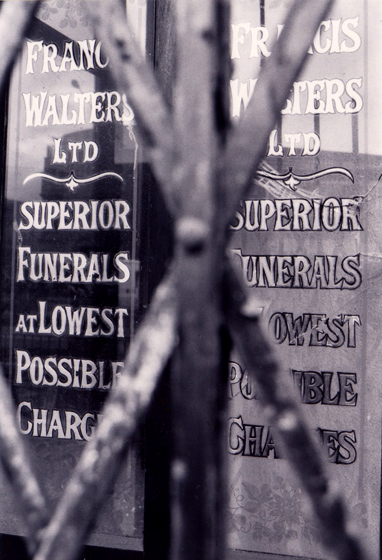
Limehouse. Photo © David Secombe 2010.
From The London Nobody Knows, Geoffrey Fletcher, 1962:
My chief pleasures in Limehouse are confined to a small area, centering on the church of St. Anne. The undertaker’s opposite the church is a rare example of popular art. Even today, East End funerals are often florid affairs – it is only a few years since I saw a horse-drawn one – but such undertaker’s as [the one in the above photo] must be becoming rare, so it is worth study. It is hall-marked Victorian. The shop front is highly ornate and painted black, gold and purple. Two classical statues hold torches, and there achievements of arms in the window and also inside the parlour. The door announces ‘Superior funerals at lowest possible charges’. On one side of the window is a mirror on which is painted the most depressing subject possible – a female figure in white holding on (surely not like grim death?) to a stone cross and below her are the waves of a tempestuous sea. Inside the shop are strip lights – the only innovation to break up the harmony of this splendid period piece – a selection of coffin handles and other ironmongery and a photograph of Limehouse church. As I looked, a workman, with a mouthful of nails, was hammering at a coffin. An unpleasant Teutonic thought occurred to me that, at this very moment, the future occupant of the coffin might well be at home enjoying his jellied eels . . . Undertaker’s parlours of such Victorian quality must be enjoyed before it is too late. This one mentioned is, I believe, the best in London. People stare through the windows of undertakers – at what? Unless they are connoisseurs of Victoriana there seems to me little beyond the elaboration of terror and a frowsy dread that has no name.
David Secombe:
The shop Geoffrey Fletcher rhapsodised over fifty years ago remains in situ opposite St. Anne’s, but is now derelict. When I took this photo a couple of years ago, it was possible to see the remnants of the shopfront, but a matter of days later the entrance was boarded up and the last remnant of the Victorian throwback that Fletcher described with such relish disappeared from view. This week we are running a small selection of excerpts from Fletcher’s classic, alongside contemporary views of the sights he delineated so lovingly. Fletcher’s book is a kind of requiem for an older, more private city – and although his fears about the fate of many individual buildings proved to be unfounded, Londoners are faced with a new wave of monolithic redevelopment. In our current era of corporate-sponsored ‘regeneration’, the final words of the book seem truer than ever: ‘Off-beat London is hopelessly out of date, and it simply does not pay. I hope, therefore, that this book will be a stimulus to explore the under-valued parts of London before it is too late, before it vanishes as if it had never been. The old London was essentially a domestic city, never a grandiose or bombastic one. Its architecture was therefore scaled to human proportions. Of the new London, the London of take-over bids and soul-destroying office blocks, the less said, the better’.
… for The London Column.
London Facades. Photos: Mike Seaborne, text: Charles Jennings.
Posted: March 16, 2012 Filed under: Dereliction, Shops, Vanishings | Tags: abandoned shops, Charles Jennings, Mike Seaborne, pre-corporate London Comments Off on London Facades. Photos: Mike Seaborne, text: Charles Jennings.
Clockwise from top left: Englefield Road, Bethnal Green Road, Willesden High Road, Whitecross Street.
© Mike Seaborne 2005, 2006.
Fag End London by Charles Jennings:
Two geezers in overalls flicking litter into a truck (‘Could’ve bleeding stayed in bed, didn’t know it was only this one’).
Keeping their ends up against the taggers and bomb artists on the main road. ‘That shouldn’t be allowed ’cause they laid out a lot of money’.
You’ve got your haggard local shops, giving out, giving in, ‘Houses & Flats Cleared, Apply Within’, a stupidly optimistic fingerpost.
The coughing of the birds, the single, muted noise of a car driving along in first a block away.
‘Big Reductions on Room Size’, with a tiny old lady picking at some cream-vinyl dining chairs stuck out on the pavement as if they were posionous, a dysfunctional boy pulling at the hair of a girl in a newsagent’s doorway, the sullen rumble of a train. Who’s going to be passing through?
Dead cars, living cars, stuff you do to your car, garages.
Those jaded avenues of small houses, the litter, the small shops, nervy pre-dereliction, the effort to keep up.
The midget shops, the kebabs, the roaming crazies (woman in a tank top scouring the bins: ‘Fucking said to him, “Fucking listen”‘).
This tomb of obscurity.
The dead concrete around the tube station, ruined retail outlets.
Drowning in toxins, grimed-up, catching screams from the estate on the west side, the traffic barrelling to hell on the roundabout.
Sort myself out a nice K-reg Astra.
It’s shy of life, but only because it’s keeling over.
… for The London Column. © Charles Jennings 2012.
Mike Seaborne:
London Facades is a series of photographs about the disappearing face of pre-corporate London. The project is London-wide and embraces a range of different facades, including shops, industrial and commercial buildings and housing.
The pictures are mostly taken in areas of the inner city undergoing regeneration – and in many cases gentrification – and the most suitable subjects are often found on the periphery of such redevelopment schemes where the blight seems more evident than the intentions to renovate or rebuild.
Dmitri Kasterine. Text: Tim Wells. (3/5)
Posted: October 26, 2011 Filed under: London Types, Sartorial, Shops | Tags: Bespoke tailoring, Dmitri Kasterine, Tim Wells Comments Off on Dmitri Kasterine. Text: Tim Wells. (3/5)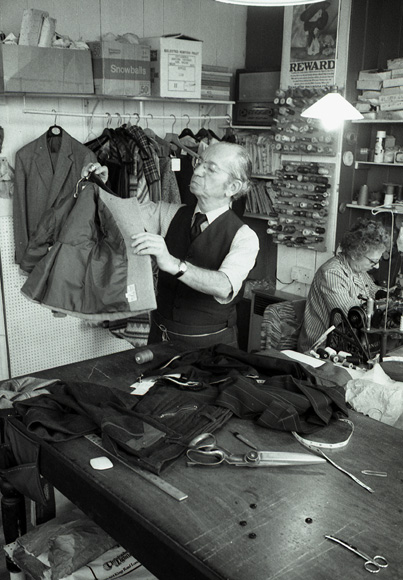
Tailor, Putney. Photo © Dmitri Kasterine.
Dead Man’s Pockets by Tim Wells:
Things found in the pockets of Tim Wells, Saturday Night, 28.02.09
Right coat pocket – mobile phone (Liquidator as ringtone), spectacles.
Ticket pocket – a dozen of his own business cards, business cards for Niall O’Sullivan, Alice Gee and S. Reiss Menswear, return train ticket to Epsom.
Left coat pocket – keys – England fob, poem entitled ‘Self-Portrait as a P G Tips Chimp’, flyer for 14 Hour 14th march show with Karen Hayley, Ashna Sarkar, Amy Blakemore and others.
Inside coat pocket – an Elvis pen.
Right trouser pocket – £8.56 in assorted change.
Left trouser pocket – empty
Hip pocket – Oyster card and wallet
Wallet (black leather) – £160 in twenty pound notes, dry cleaning ticket, Leyton Orient FC membership card from 87/88 season, visa and cash card, picture of Joan Collins in window nook, horoscope stating ‘The first thing you have to ask yourself is what has to go; the second is what is going to take its place; and the third is where will I go to celebrate. Day done.’
© Tim Wells 2009.
Londei’s London Shops. Photo & text: John Londei (3/3)
Posted: June 9, 2011 Filed under: Interiors, Shops | Tags: John Londei, Shutting Up Shop, Small shops, tobacconist's Comments Off on Londei’s London Shops. Photo & text: John Londei (3/3)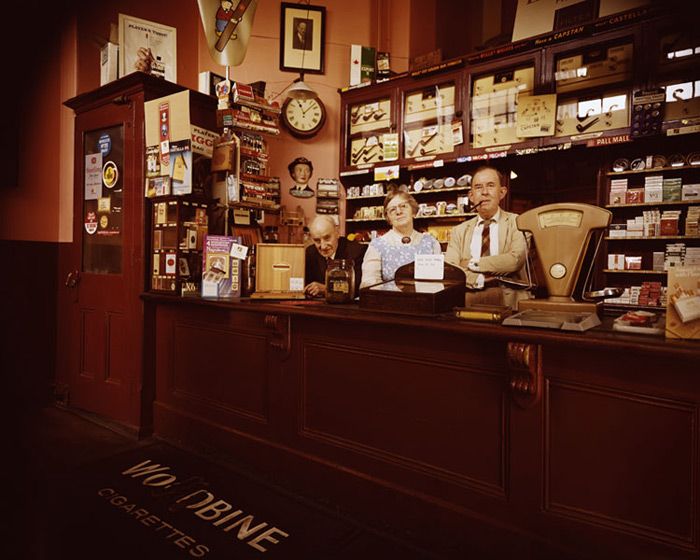
Tom Cornish, Tobacconist, 87 Clerkenwell Road, EC1. Photo © John Londei
John Londei writes:
This was the second photograph I took for my book Shutting Up Shop. The tobacconist sat across the road to my studio, two doors along from ‘Morrison’s’ the chemist, the shop that started the ball rolling.
In 1956 William Hadly was de-mobbed from National Service. “A friend got me a job here telling me: ‘You’ll only be number two’. In 1959, I ended up buying the business.”
Tom Cornish opened the shop over one hundred years ago. “I never met him. He went out of business in 1911. But I still keep the picture of him – our ‘founder’ – above the clock. It shows the business has some standing.”
The shop had remained unchanged since William took over, the corner wooden phone kiosk an echo of the days when most people didn’t own a telephone. “You’d be surprised how many people comment on it. Only tobacco, I sell only tobacco, nothing else! Not even chewing gum. Every morning I’m up at 5.20, and open the shop at 7 o’clock. I shut at five in the evening. We always make sure we are in bed by 9.30. The biggest change for me was when VAT started in 1973. Most nights I do the books. The VAT has given me so much extra work.”
George Fieldwich, who had worked at a local pub, joined the shop at the age of seventy-one. William’s wife, Erna, was Austrian, and used to be a language teacher. “I enjoy the foreigners’ surprise when I speak to them in their own tongue. I am a non-smoker. I would have preferred to run a bookshop.”
William always seemed to have his pipe permanently clenched between his teeth; in fact I can’t remember ever seeing him without it. “I go all round the jars and try them all out. People come from miles around for this stuff. Once you’ve got a customer, you’ve got them forever. That’s why we don’t change the name of the shop, because it was famous.”
Erna also saw no reason to change things. “See that ‘Senior Service’ lady on the wall… We could have sold her a hundred times over. We have had many offers for her. But we always refuse.”
© John Londei 2011
John Londei’s book Shutting Up Shop: the decline of the traditional small shop is published by Dewi Lewis.


 The London Column