A Short Walk Down The Old Kent Road.
Posted: October 14, 2013 Filed under: Class, Public Art, Pubs, Tall Tales | Tags: Andrew Martin, Dun Cow, gentrification, Old Kent Road, only fools and horses, Pink Tank, Thomas A Becket 5 Comments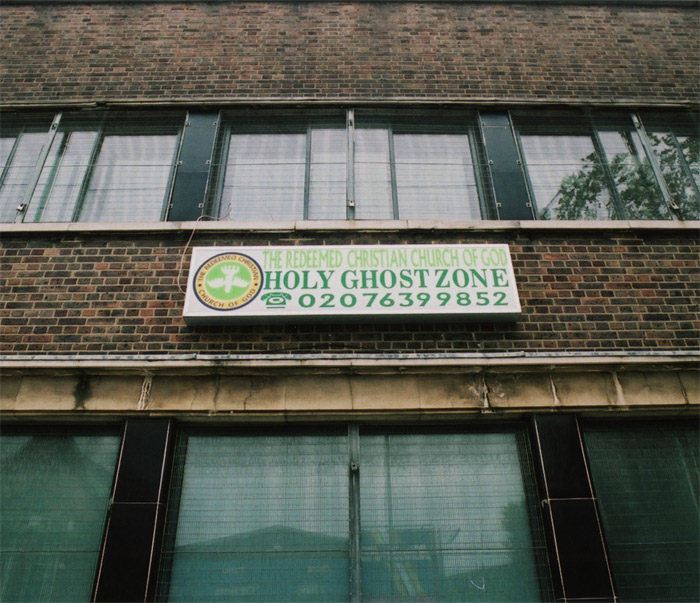
Holy Ghost Zone, Old Kent Road. © David Secombe 2008.
Andrew Martin:
When playing Monopoly my father was always determined to acquire Old Kent Road and Whitechapel, and to build on them as soon as possible. It’s the most modest portfolio on the board, with houses on Old Kent Road, as I remember, costing little more than a hotel on Mayfair. ‘You might laugh,’ my father would tell us in baleful tones, ‘but everybody always lands on Old Kent Road.’
I’m interested in the Old Kent Road as a sort of social counterweight to Hampstead, but my friend David, a South London partisan, is a genuinely keen on it, and gave me a guided tour this week.

Tesco, Old Kent Road. © David Secombe 2004.
‘When the evening sun’s like this,’ he said cheerfully, as we skirted a sofa that had been thoughtfully set out on the pavement, ‘it’s got a sort of I’m-in-a-scary-part-of-LA charm.’ We were walking past the Old Kent Road’s array of cosmopolitan food shops, beauty parlours, international cash transfer places, evangelical ministries, van washing businesses. As the cars screamed by, David would stop every now and again to photograph the lowering clouds over some light industrial unit or brutalist block of flats. He seemed particularly taken with the visual possibilities of the flyover at the southern end of the Road. ‘A friend of mine owns a flat that looks right on to that,’ he said enviously.
 .
.
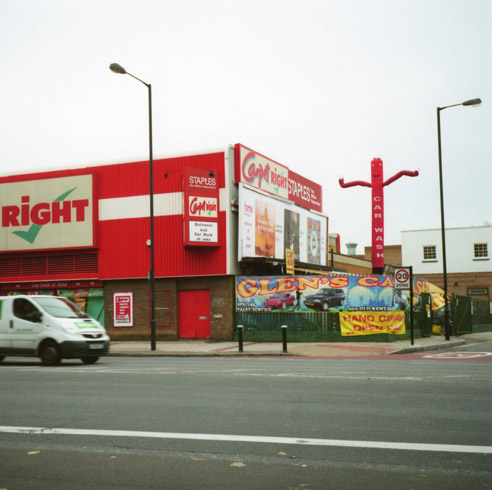
Carpet Right, Old Kent Road. © David Secombe 2008.
I looked at a price list outside one of the Road’s pubs: it advertised a cocktail called a Slippery Nipple, consisting of Sambuca, Bailey’s and Grenadine. You could have a jug of Slippery Nipple for £12.50. Another sign forbade anybody wearing a hat to enter the pub. You knew there was some insight into human behaviour behind this, and that it had been won the hard way.
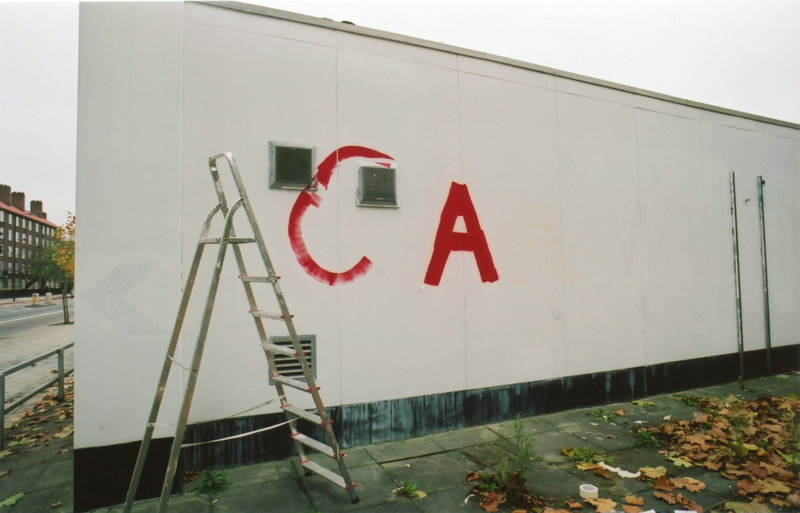
Re-branding exercise, Old Kent Road. © David Secombe 2008.
‘If Dickens were alive today he’d be down here all the time,’ said David as car came crawling noisily down the Road with only two of its tyres inflated. David then attempted, with windmilling arms, to direct the dazed-looking driver to a nearby sprawling depot called Madhouse Tyres.
As he did so, I reflected that the Old Kent Road does have the look of suburban LA or Chicago – that rangy wildness – and it occurred to me that this is what happens to British streetscapes when middle class vigilance is reduced and planning controls relaxed: they begin to look American.
………….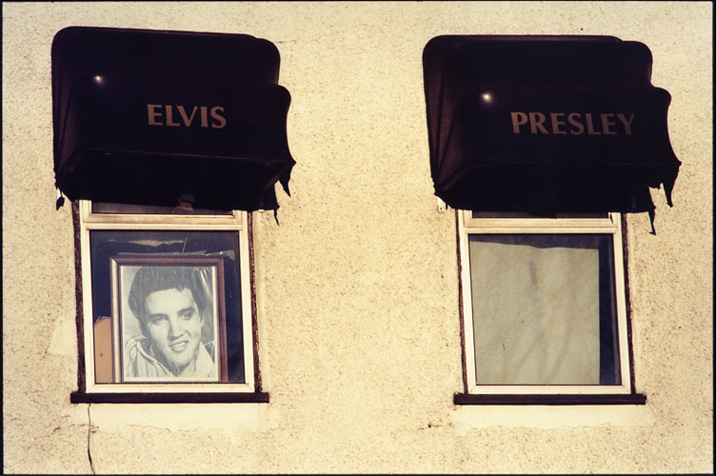
Chinese Elvis restaurant, Old Kent Road. © David Secombe 2002.
David pointed out East Street, which goes off the Old Kent Road. Its market features in the opening credits of ‘Only Fools and Horses’, in which Rodney and Del Boy inhabit a tower block inevitably called Nelson Mandela House. David took me to Mandela Way, which intersects with Old Kent Road, and where there is a small patch of green space occupied by a tank that has been painted pink and decorated repeatedly with the stencilled word ‘Scab’. ‘If this was North London,’ I marvelled, ‘there would be letters in the Hampstead and Highgate Express every week until it was taken away.’ ‘Really?’ said David, snapping away, ‘it’s been here for years.’*

Tank, Mandela Way. © David Secombe 2004.
In the streets off Old Kent Road, you never know what you’ll find: a battered looking Georgian house with an ice cream van parked in the front drive and a lone security camera staring at it; a tiny house with a sign saying ‘This property is protected by guard dogs’ – that’s dogs, plural; sudden bombsites with rampant buddleia, the scars of the Second World War still seemingly fresh. There are also surprising runs of pristine Georgian and Victorian houses with obviously middle class occupants.
……..
Almshouses, Asylum Road, SE15. © David Secombe 2008.
You could argue that Old Kent Road is going upmarket. The famous old Dun Cow pub is now the Dun Cow Surgery, and the Thomas A Becket, the even more famous boxing pub, built on one of the many sites where the Canterbury pilgrims took liquid refreshment, is now an estate agency, a sign of the times to an extent almost ridiculous. ‘You’d think there’d be a plaque acknowledging what it used to be,’ I said to David. But he frowned and shook his head, ‘That’s one of the great things about the Old Kent Road,’ he said, as we trudged on, ‘a profound lack of sentimentality.’
.. .
.
Andrew Martin outside the Asylum Tavern, Asylum Road, off the Old Kent Road, at the end of the trip described in the foregoing article. © David Secombe 2004.
© Andrew Martin. This article originally appeared in Andrew’s Class Conscious column for The New Statesman in 2004.
(*The tank is a Soviet T-34 placed on Mandela Way as a protest by a disgruntled property developer following the rejection of a planning application.)
Urban Myths no.2: Airport Caterpillars.
Posted: October 4, 2013 Filed under: Amusements, Tall Tales, Transport, Wildlife Comments Off on Urban Myths no.2: Airport Caterpillars.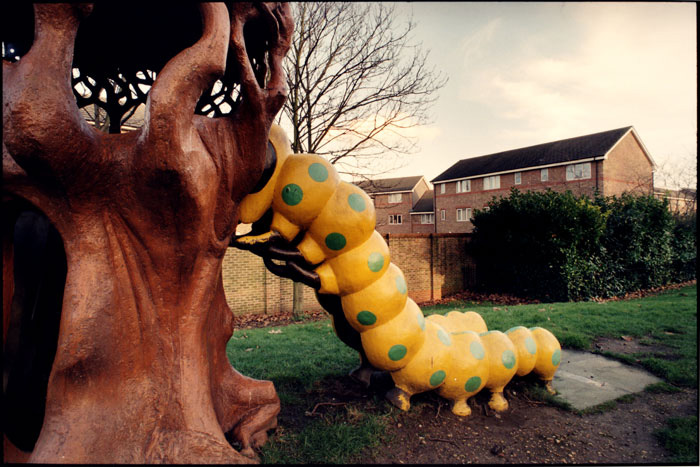
Playground, Rotherhithe. © David Secombe 2003.
Giant Edible Caterpillars Seized at Gatwick*
Customs officers at Gatwick Airport got more than they bargained for when they searched the luggage of a passenger arriving from Nigeria: inside his suitcase they found more than ninety kilograms of giant caterpillars swarming inside a bubble wrap cocoon.
The man told the customs officials that they were for his personal consumption during his stay in Britain. However, the caterpillars are a popular delicacy across Africa and, as such, represent a valuable trading commodity. Customs official Bridget Fumes commented: ‘We get a lot of people trying to smuggle animals into the country – last month we had someone wearing a lizard as a hat and a man with a pair of monkeys down his trousers, but to my knowledge this is the first time we have had giant caterpillars.’
Stavros Wilt, an insect expert at the Natural History Museum, commented: ‘These are likely to be mopane worms, the larvae of emperor moths, which are commonly eaten in Africa. A favoured method of consumption is to pinch the caterpillar at the tail to rupture its innards, followed by a sharp flick to liberate the guts via the burst carapace. The resulting matter may be fried until crisp with onion, tomatoes and chillis. Alternatively, they may be dried and eaten raw as a crunchy snack.’
‘This was an unusual seizure but the vigilance of our officers prevented this consignment of rogue insects from entering the UK, and possibly posing a risk to the health and wellbeing of the populace,’ proclaimed Ms Fumes. ‘I would warn travellers not to attempt to bring any products of animal origin into the UK without a permit, as they may not have been inspected to appropriate standards and may contain diseases. These caterpillars are not something I expect to see in the Gatwick staff canteen any time soon!’
An increasing number of British outlets offer mopane worms for ‘own consumption only’. The online retailer Planet Nosh sells 40g bags for £16.99, saying that the insects are a tasty and nutritious alternative to traditional meat products, and describes them as ‘the ultimate barbecue novelty’. Experts estimate that the caterpillars seized at Gatwick had a street value of £40,000.
The caterpillars are being cared for at an animal rescue shelter in Kent.
* NB: A mostly, if not entirely, genuine news item: a mash-up of reports from International Business Times, The Independent, lepidoptera.pro, etc. The second in an occasional series. See also: The Supermarket Spider (http://wp.me/p1twhU-33W)
A Personal History of Indian Cuisine.
Posted: March 14, 2013 Filed under: Eating places, Food, Out Of Town, Tall Tales | Tags: Anglo-Indian cuisine, eating out in london, Indian restaurants in London, suburban dining in London Comments Off on A Personal History of Indian Cuisine.
Tandoori restaurant, Deptford. © David Secombe 2001.
David Secombe:
It is 1975, I am 13 and, like most white British people of my generation, my experience of Indian food is limited to a small, local curry house. Remote, distant Cheam in the remote, distant 1970s offered few opportunities for culinary experiment and a trip to an Indian offered the prospect of an exotic night out. Visits to The Partition of India – or whatever it was called – were made in the company of my two elder siblings; I was taken there with some ceremony by my sister and no ceremony at all by my brother. (I was never taken there by my parents, who were not attracted by its charms.)
The suburban Indian restaurant is one of the cultural phenomena of post-war British life, signifying social change, and a broadening of the scope of what is considered our national cuisine. But the 1970s offers very few excuses for Proustian reverie; even as a teenager I was aware that my local Indian didn’t cut it, as the food was barely adequate and served by staff who seemed either torpid or desperate. I also knew that part of its appeal was its very inability to deliver the experience you were looking for; it confirmed my adolescent conviction that the suburbs were a pale shadow of the real, yet-to-be-discovered world. (Incidentally, the restaurant in question appeared to be popular with adulterers. This was my brother’s theory, and we would giggle at furtive couples in corner booths, whispering as best they could over the sitar tape whilst poking at bits of Bombay Duck. Adulterous or not, these couples were also seeking a dining experience that was clearly not forthcoming.)
By the early 1980s I had arrived in the flesh pots of south London; just a few miles away from provincial Cheam, yet Wandsworth, Clapham and Tooting were home to tempting, ‘authentic’ Indian restaurants which delighted in their specific regionality – Nepalese, Goan, Bengali. Fabled establishments like The Concert for Bangladesh, Midnight’s Children, and Sherpa Tenzing offered dishes worlds away from the generic beige goo I knew from my sheltered youth. But you could still get caught out: during a meal at an unfamiliar establishment in Battersea, circa 1985, an ordinary-looking lamb passanda arrived at my table and, before anyone could say anything, the waiter produced a can of UHT whipped cream and sprayed foam all over it. It was a brilliant comic gesture, but it was supposed to be my dinner. Despite such misadventures, my local dining preference remained the curry house; I bypassed Nouvelle Cuisine and other foodie trends and stayed true to my suburban roots.
The ubiquity of Indian restaurants has generated an urban mythology particular to them. A sudden closure was darkly ascribed to the discovery of a skinned dog in the kitchen. Tales were told of a legendary establishment which offered a Chicken Bastard, a dish so hot that it was not intended to be eaten. ‘Witnesses’ spoke of an unwise party who took the challenge, goading the waiters who brought him his order, forcing it down with Carlsberg as kitchen staff emerged to watch, and of the ambulance that was summoned to take him to A&E. Such stories were clear evidence of cultural antagonism, but my own favourite tall tale is actually quite sweet, and is very possibly true. I knew a pair of Egyptian brothers who were my schoolmates at a boarding school on the outer fringes of London. It was said that at the end of term, they went into Leatherhead, ordered three dinners from the Siege of Delhi, packed them in their luggage (did they order poppadoms?), got a cab to Heathrow, flew to Cairo, and consumed the congealing banquet with their father as a festive, homecoming dinner: the ultimate Indian takeaway.
After decades of enjoying Indian food in almost every postcode within the M25, my love affair with it ended in a way my brother might have predicted. I became romantically involved with someone who remained very slightly married, and our lunchtime venue was a classy Indian in St James’s. The Cawnpore Massacre is one of London’s best restaurants, but its convenience for my beloved made it a kind of hell for me. As the months dragged on, I became all too familiar with the delicacies on offer, and the wonders of its kitchen paled against the looming inevitability of my defeat. To paraphrase Robert Shaw in Jaws, ‘I’ll never order Rhogan Josh again’.
© David Secombe 2013.
A Haunted Bus. Photo: David Secombe, text: Andrew Martin.
Posted: November 2, 2012 Filed under: Amusements, Literary London, Tall Tales, Transport | Tags: haunted bus, L.P. Hartley, Walter de la Mare Comments Off on A Haunted Bus. Photo: David Secombe, text: Andrew Martin.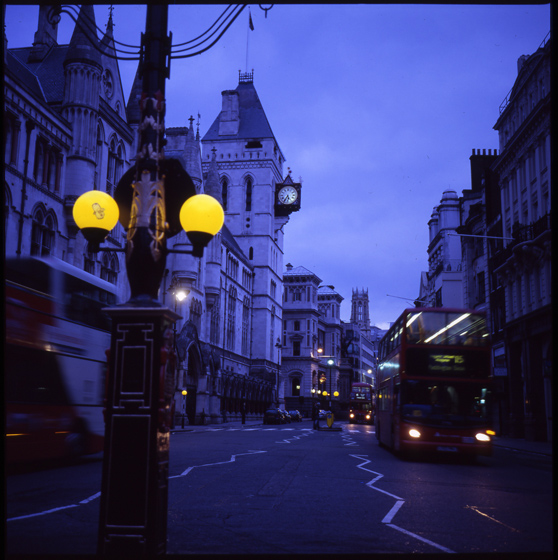
Strand, looking towards Temple Bar. © David Secombe 2010.
An attempt at Putting on a Brave Face
In A Visitor from Down Under by L.P. Hartley, which was published in a collection called The Ghost Book, edited by Walter de la Mare in 1932, we are on the top decl of an open-topped bus ‘making its last journey through the heart of London before turning in for the night’. The loquacious bus conductor encounters a silent, pale passenger with hat pulled down and collar up. ‘Jolly evening,’ says the conductor. (He is being ironic; it is wet and foggy.) There is no reply from the passenger, who holds up his fare between the fingers of stiff, apparently immobile fingers. The conductor takes the money and goes back downstairs. Later, the mysterious passenger is not there. The conductor never saw him come down the stairs, but he rationalises the situation with a very good example of sceptical wishful thinking: ‘He must have got off with that cup-tie crowd’.
From Ghoul Britannia by Andrew Martin, published by Short Books. © Andrew Martin 2009.


 The London Column